
Translated material
The House of Commons ordered Johnson to delay Brexit, after which he suggested holding early elections
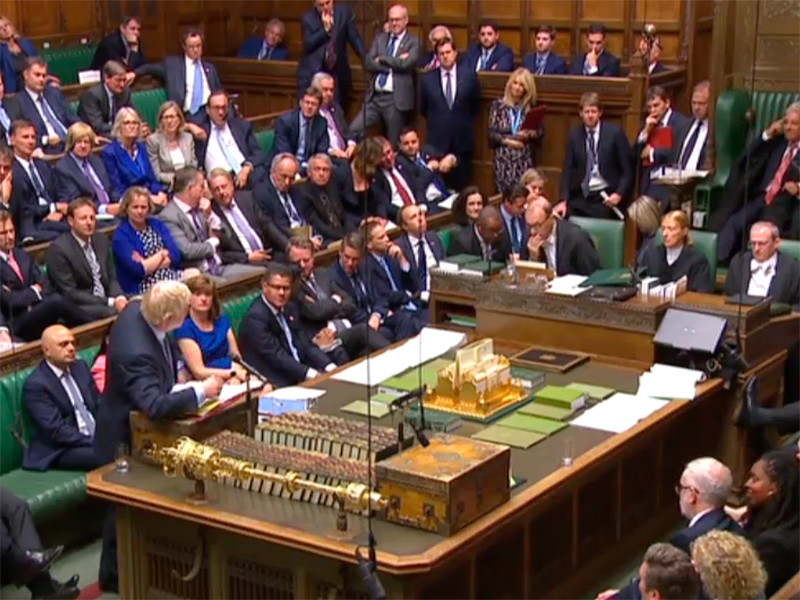
The House of Commons of the British Parliament in the third reading adopted a bill obliging the government of Prime Minister Boris Johnson to postpone the country's exit from the European Union for three months - until January 31, 2020, TASS reports.
The bill, in which one amendment was introduced, was supported by 327 legislators. 299 parliamentarians opposed, the microblog of the House of Commons on Twitter said. Before entering into force, the bill should also be approved by the members of the House of Lords of the British Parliament. It is expected that this can happen on Thursday evening, however, parliamentary procedures can allow a few lords playing for the “hard” Brexit to significantly tighten this process.
Voting in parliament was a defeat for Prime Minister Boris Johnson. It is all the more crushing that 21 member of the conservative party, whose leader is Johnson, opposed the position of the head of government during the vote.
For his part, British Prime Minister Boris Johnson submitted a proposal to the parliament on the early elections on October 15. The head of the government stated this, speaking on Wednesday in the House of Commons, the lower house of the British legislative body.
“This country does not need elections, but the House of Commons did not leave any other way out, except to allow the people to decide who he wants to see the Prime Minister, and I am introducing this proposal to the parliament,” Johnson said. His performance was a reaction to this voting before, during which the deputies voted for a new delay in Brexit.
Deputies must discuss Johnson's proposal at the coming hour and a half, after which they will vote. To conduct extraordinary elections, two -thirds of the legislators should be performed for this. The chances that the people's deputies will support the proposal were greatly decreased after the leader of the opposition Labor Party Jeremy Korbin said that he did not intend to give approval to early elections until the Brexit bill will gain the status of the law.
The new head of the British government, who took office on July 23, intends to withdraw the UK from the European Union no later than October 31 - with a transaction on the conditions of "divorce" with Brussels or without such (the so -called "hard Brectes"). If the bill passes the last stages of approval in parliament and receives the power of the law, Johnson will be obliged to ask the EU to postpone Brexit if he cannot reach a new agreement with Brussels or to obtain permission from parliament on Brexit without a transaction, which is extremely unlikely. In Brussels, for his part, they have already expressed his readiness to give London a few more months to find a way out of the impasse in which the “divorce” process from the EU turned out to be.
The United Kingdom was supposed to leave the EU on March 29, 2019, that is, two years after filing a written notice of withdrawal from the community. However, deputies of the House of Commons three times rejected the draft agreement on the terms of Brexit, reached between Brussels and the Government of Teresa May, the predecessor of Johnson at the premiere post. As a result, the EU agreed to transfer Brexit first to April or May, then on October 31, and May was forced to resign, not being able to get the situation out of the impasse. After her departure, the British Prime Minister was occupied by Johnson, who promised that he would not allow a new delay in Brexit, and that the country would leave the EU without a deal with Brussels if he did not agree with the demand of London.