
Translated material
“Brexit” is tired of everyone, but about what is happening right now, a powerful political thriller will someday. Here are some of the plot lines
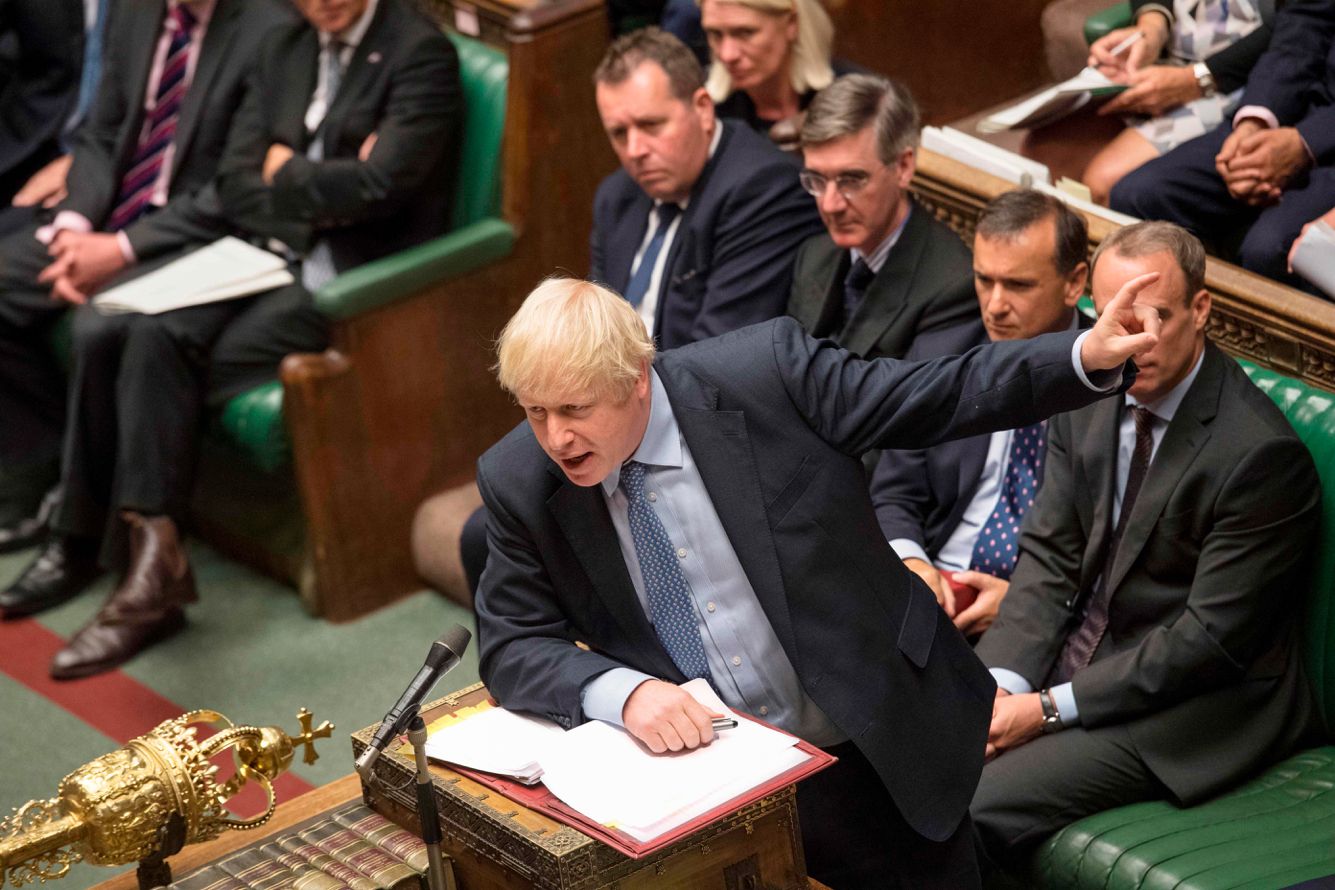
For the sake of Brexit, Prime Minister Boris Johnson went to a constitutional coup (at least his opponents think)
Boris Johnson became Prime Minister at the end of July, promising at all costs to withdraw the UK from the European Union on October 31, 2019 (initially it was planned to do this in March). To do this, he either needs to agree on a new agreement with the EU on the conditions of the release (and achieve his approval by the British parliament, which three times rejected the previous version of the former Prime Minister Teresa May, which is why Brexit and delayed), or abandon any agreements in general. Johnson himself claims that until the last to achieve a more profitable agreement.
But he also stated that he was not afraid of the exit without a transaction, against which many members of the parliament are categorically oppose. At the same time, European leaders made it clear that they did not intend to revise the main points of the previous agreement.
What is the dispute about?
The most acute discussions go around the borders between the Republic of Ireland, part of the EU and Northern Ireland, which is part of the UK. The economy of Northern Ireland is closely connected with the Irish: in order to avoid collapse, May and European leaders agreed not to return a full -fledged border between the two parts of the island until the settlement of the issue. However, supporters of Brexit believe that because of this, the whole UK will actually remain in the Customs Union with the EU, and without the opportunity to influence it, since its representatives will come out of European management structures. Moreover, to decide how much this situation will last in Europe. Another option is to introduce customs control between Northern Ireland and the rest of Great Britain, but this threatens the rejection of the territory from the country.
A month passed, and Johnson began to act. On August 28, he asked Queen Elizabeth II to appoint a break in the work of the country's parliament, which should begin between September 9 and 12 and end on October 14. In this procedure (it is called “prophetic”) there is nothing atypical; British governments used to use it quite often, when they did not have enough time to finalize the laws that they planned to be entered in parliament. The time for the break is atypical: five weeks, the longest since 1945. Because of this, Johnson’s opponents even spoke about the constitutional coup, since the prime minister was believed to deprive the parliamentarians of the time in order to withstand the exit without an agreement; He himself denied it.
This is a difficult accusation, especially considering one of the main arguments of Brexit's supporters at the 2016 referendum, which insisted that European structures take powers from the British parliament - a symbol of democracy in this country. It turns out that now this is what the fighters themselves do for Brexit.
His own party rebelled against the prime minister (including Churchill's grandson)
Johnson’s calculation could be built on the fact that his opponents in parliament are too divided: some want a new government, others - early elections, and others - the second referendum. However, after he asked to delay the meetings of the parliament, they all united and at the beginning of last week voted for the law obliging Johnson to ask the European Union for another three -month delay (the third in the year!) - if by October 19 he could not reach a new agreement with Europe.
The law could not be held if he had not been supported by 21 parliamentarians from the Conservative Party - thereby they actually opposed their leader Johnson. Among the "rebels" are the grandson of Winston Churchill, 71-year-old Nicholas Soms, former Minister of Foreign Affairs and Defense Philip Hammond, member of the House of Commons since 1970, Kenneth Clark, the rising party of the party 46-year-old Rory Stuart.
In this situation, Johnson asked the parliament to appoint early elections on October 15 - so that the decision on Brexita would make a new parliament. To do this, he needed the support of two -thirds of the House of Commons, which he did not predictly received. In principle, the opposition does not object to the elections, but only if Brexit will not take place without a transaction.
All the “rebels” of the conservatives were actually excluded from the party, forbidding them to run from it in the next elections. A few days after that , the Minister of Labor and Pensions, Embber Radd, who called the exclusion of his colleagues, “act of political vandalism” and accused Johnson that his real goal was not a new agreement, but the exit without a deal. Many are waiting for the Radd's resignation will not be the last, and this will further undermine the position of the prime minister.
The brother refused to support Johnson (and the sister has long been against)
Not the most significant, but, of course, the brightest detail of the political crisis in the UK is the decision to leave the parliament, made by Prime Minister Joe Johnson. In a farewell tweet, he wrote that “the last weeks was breaking between the loyalty to the family and national interests,” clearly made it clear that he was opposed to the policy of his brother, leading to “Brexit” without a transaction.
Opponents of the prime minister said this is the extra evidence of the failure of his course. One of the “rebellious” conservatives Nick Boles, in particular, said that Johnson was ready to “put anyone and anything on the altar of his ego and ambitions.”
The conflict because of the Brexit in the Johnson family did not begin yesterday. In the elections to the European Parliament in May 2019, the younger sister of the current Prime Minister Rachel ran for the challenge to cancel the exit from the European Union. The New York Times Nevertheless claims that this does not spoil personal relationships within the family.
No one knows what will happen next (but Johnson still has trump cards)
“Rather, I will be dead in the ditch, than I will ask for another delay,” Johnson said at the end of the last days. But here and now it seems to many that he has almost no chance of getting his own, that is, to withdraw the UK from the European Union on October 31 - without violating the law.
Here's what he can do:
- Ignore the decision of the parliament and not ask for the European Union about the delay . But this threatens Great Britain with a constitutional crisis, and Johnson personally - by a court and even a prison (which British lawyers have already warned).
- Agree with the EU about the new contract. Another unlikely option, given how hard the European Union holds on the current agreement. The radical option is to establish customs control between Northern Ireland and the rest of Great Britain, against which the EU did not initially object. But this can lead to unpredictable consequences in the country itself.
- Take a vote of no confidence to their government for voting. This does not need two -thirds of the vote, enough simple majority. Then, if the new office is not formed within two weeks (and this is unlikely), the new elections will take place in October, as Johnson wanted. But before the government had never offered parliamentarians, and mainly from their own party, to vote against themselves - and, according to experts, it is unlikely that voters will like this.
- Write two letters to the European Union. The law adopted by the parliament requires Johnson to ask for a delay - Okay, he will do it. But the law does not forbid him to write a second letter with an explanation that the government does not intend to go to any concessions in the future. In this case, the EU himself can refuse a delay. Moreover, such decisions are made unanimously, so it is enough that only one country is opposed to the delay - they call , say, Poland.
- Resign. In this case, the Provisional Government will be formed, and it will already ask for delay. But he will not have a majority, so you still have to hold early elections.
If Johnson really leaves, this will once again prove that his real goal is not Brexit at all on October 31. The teacher of the latest history of Europe University in the Belfast Alexander Titov in an article for Medusa explained: it is much more important for Johnson to hold elections and get a stable majority in parliament. Therefore, even if he remains at the post, he will most likely ask for delay (as the law proposed now requires), will avoid the release without a transaction and the associated chaos (which they are waiting for even in his own government), will appoint new elections (which oppositionists do not mind, provided that “Brexit” will be postponed), he will show himself the most fundamental politician of Great Britain.
Dmitry Kartsev