
Translated material
New "folk" article. How much does a government representative cost in Moscow?
In the first week of September, Moscow courts issued the first sentences in the “Moscow case” : Danila the fugitive , Ivan Podkopaev , Kirill Zhukov and Yevgeny Kovalenko , who were accused of applying violence against police and Russian heads, sentenced to real terms in a general regime colony.
Part 1 of Article 318 of the Criminal Code, the maximum punishment is 200 thousand rubles of a fine, six months of arrest or five years of compulsory work or imprisonment, while there is no minimum threshold. Thus, the use of violence against a representative of the authorities, which is not dangerous for life and health, is qualified. In case of such a danger, the maximum punishment increases to ten years in prison.
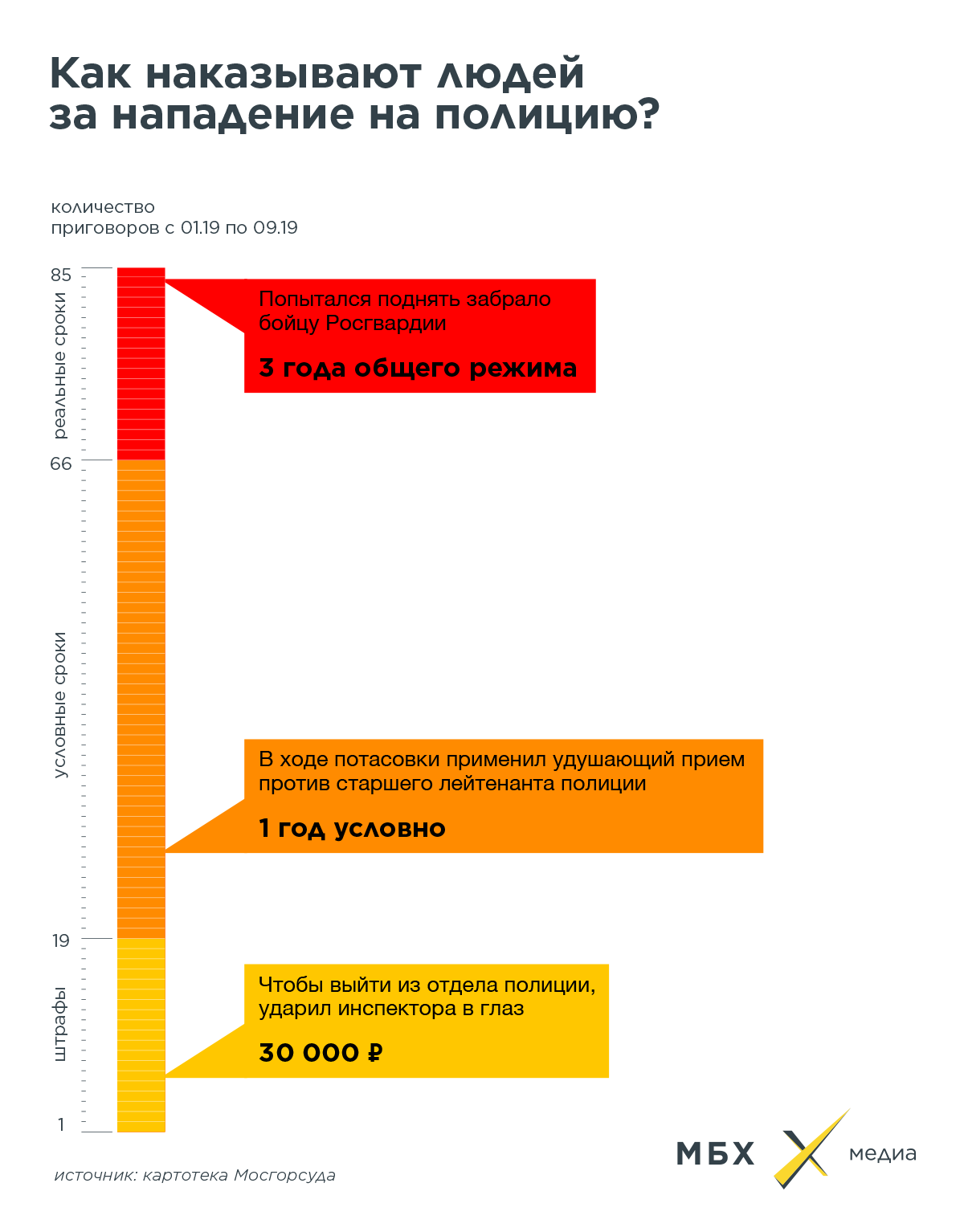
“MBH Media” analyzed all sentences published from January 1 under the article 318 of the Criminal Code that were issued by Moscow courts. During this time, the courts of general jurisdiction ended 170 processes, but in general access can only be found 109 sentences. At the same time, some documents are depersonalized so that it is impossible to find out the term of punishment or the amount of the fine. It turned out that, for domestic cases, the main punishment is a fine or a conditional period. But the most severe punishment is applied to the detainees at rallies - real imprisonment.

 Penalty for torn shoulder straps
Since the beginning of the year, not a single court has issued a decision on the termination of the case under the article of the Criminal Code. Almost all the defendants pleaded guilty and asked to consider their affairs in a special order. For this, they were sentenced to a fine of up to 30 thousand rubles - more often than others, such decisions were made by the judges of the Lublin and Tushino courts.
It was not important for the judges who people used violence: for example, the Tushino court fined a man for 30 thousand rubles, who “ deliberately struck at least one hit with his right foot to the area of the left knee joint ” of the junior police sergeant, and a man who inflicted 9 beats to the police lieutenant awarded less - 20 thousand rubles. And the largest punishment in the form of a fine - 150 thousand rubles - gave the girl in the Lefortovo court for violence against the traffic police inspector: without rights and in a state of intoxication, she hit him several times in the face, after which she damaged the police radio and struck her legs twice. She was given such a great fine according to the totality of crimes.
Oddly enough, the judges also applied a fine for the use of violence, associated with corruption of a police form. Dorogomilovsky court appointed a fine to the collector, who, when detained, grabbed the inspector’s left hand by the neck, and struck one blow with his right hand. At the same time, he tore the shoulder strap from the policeman. And in the Lublin court for the attack on the police major, associated with the corruption of the pocket of the police uniform, a man was appointed 15 thousand rubles of a fine - they are also punished for their usual participation in rallies.
A conditional term for hitting a district police officer and strangulation during a search
The most common sanction under this article is conditional imprisonment. Basically, the defendants give a year of conditional punishment with the same trial period - this is a median indicator.
More often than others are conditionally punished in the Ostankino court. The plots of the prosecution there look most interestingly: the year of the conditional term was given a drunken guest of the hostel from Ukraine Kostuu, who "was able to intoxication of his left hand with a fist of his left hand, inflicted one blow to the body of the police captain, caused him physical pain and moral suffering, and also violated the normal activities of the authorities and undermined their authority." The executive director of the unnamed firm Martanov, who during the search in the case of tax evasion, destroyed the hard drive, and then tried to strangle the operative, senior police lieutenant, was also punished .
As in the case of business that ended in fines, almost all the defendants took a special order with guilty. In the general order, we considered only three things. But in the Shcherbinsky court, thanks to this, the defendant managed to relieve himself of an insult of a policeman.
Real imprisonment: knife to the controller
Despite the four sentences with real deprivation of liberty in the “Moscow case”, in Moscow they are very rarely sent for an attack on employees to the colony. Moscow judges consider the isolation necessary only if the defendant has an outstanding criminal record or if an attack on a policeman is only one of the crimes.
But non -citizens of Russia are also strictly punished. Thus, a citizen of the Central Asian Republic, F. Rakhmanov, who was detained for driving in a state of intoxication, tried to tie the traffic police inspector, the senior lieutenant of the police, but nothing came of him. He damaged the policeman’s signal vest and “caused him physical suffering.” For this, Rakhmanov was given a year of a general regime colony.
Over the year, the most strict punishment for the non -hazardous for the representative of the authorities was issued by the Kuzminsky court - 2 years 2 months of a colony of general regime. Earlier, the convicted K. Ismagilov repeatedly insulted the controller on the bus, then took out a knife from the portfolio and headed with him in the direction of the victim, "which is why she took a threat to her address." Oddly enough, for the threat of violence against the controller, they are punished stricter than for the blows to the police.
Violence is more strict for the danger to the representative of the authorities: the most strict sentence is 3.5 years of general regime. So the Tver court was punished by a citizen of Ismagilov, who at the KFC restaurant hit the patrol, "humiliating the authority of the representative of the authorities to others."
The most "terrible" crimes
Such sentences are weakly correlated with the decisions in the “Moscow case”, where the minimum sentence is 2 years of the colony for the resistance of the detention. In conditions in which judges usually give a fine or a suspended sentence, in the Tver and Meshchansk courts they do not find conditions, thanks to which it is possible not to resort to “isolation from society”.
The convicted persons involved in the “Moscow case” were judged by all severity even despite the current practice. Danila the fugitive was sentenced to two years in the colony for pushing the security forces. Kirill Zhukov, who tried to raise the Rosgvardisian, was sentenced to three years in prison - Ivan Podkopaev was sentenced to the same time , who allegedly sprayed the pepper can towards the police. Three and a half years gave Evgeny Kovalenko, who threw the urn towards OMON fighters.
The investigation in the “Moscow case” has not yet been completed: Pavel Ustinov’s affairs are going to court, who allegedly dislocated his hand to the Rosgvardez during the detention, and Aydar Gubaidulin, who was accused of throwing a plastic bottle. The investigation in the case of Samariddin Rajabov continues - he is also accused of throwing a bottle. Gubaidulin and Rajabov face up to 5 years in prison, Ustinov - up to 10.