
Translated material
Kill "Seagull"
Will a new life come in the new theater season
The beginning of the season is always the illusion of a new life. One theaters manage, others build decoration. But in any case, the artists will again paint their faces and repeat the roles, the directors will wake up at night in the hustle of staging thoughts, scenographs - to make fragments, and workshops - solve problems. And where the theater will breathe, and where is a dull crane is still unknown.
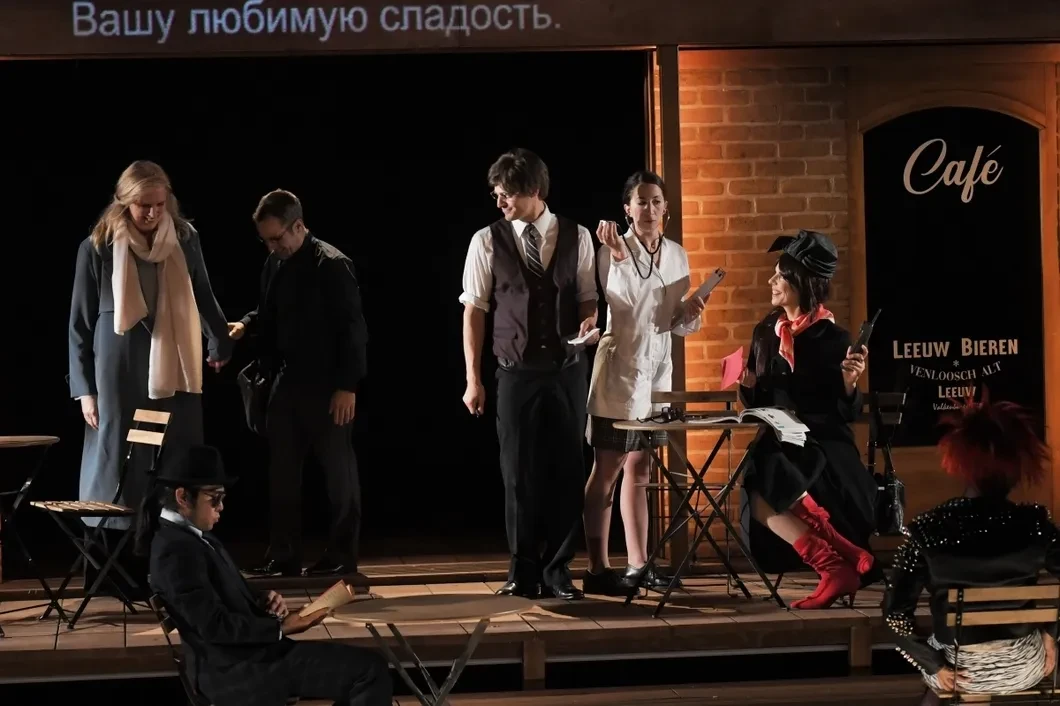
The event of the season happened on his eve, in the summer. The performance of Robert Lepage “Seven Floods of the Ota River”, brought to Moscow by the Chekhov festival, is an infrequent example of how incredibly significant the theater can be in the first quarter of the 21st century, which seemed to have already produced all the ways of art. Lepage connected the plots, situations, characters, fate and history of the Japanese, Jews, Canadians, French, Germans and Americans into a single, with laughter and horror, the canvas of life, steadily, through circumstances, time, space, breaking through to the ridge and nerve of existence. Lepage takes into account in the rhythm of the performance not only the Drive of the Cinema, but also the magic of the iPad, whose screen spreads to the scale of the world with one movement of the fingers. But before us, it is the theater, its ancient power, his magic “box”, in which feelings and images will swirl.
Seven hours of stage text are the thoughtfulness of every detail, virtuoso possession of the “silence technique”, the grandiose symphonism of the created on the stage.
And - thought. Truly large, not only the directorial - humanitarian. On the connectedness of all on Earth, about the confused breathing of periating humanity, about the fire of the Hiroshima that arises throughout the globe.
From Kamerger to Tversky has never been so far. The first scene of Russia, the Moscow Art Theater named after Chekhov opened 122th season. Its attendance (the main criterion of the Ministry of Culture) is close to 99%, and the “running” - the premiere of Zhenovach on a large stage with a stellar composition - is growing up and collects a full house.
The Moscow Art Theater is becoming more and more “Shekhtel’s house”: the windows glued with color pictures disappeared, by which it was impossible to understand whether the theater was behind them or another high -profit institution. Now in the windows - the sipia of portraits of the founders, and in the interiors - the deliberate severity of the modernity. The course of non -combination, calm artistic construction and life inside: the Moscow Art Theater is no longer a factory of disposable productions, they try to work and live differently here. A lot of creative blood needs to disperse it through the veins of such a large organism, to take the troupe as much as possible. Zhenovach’s plans are purely “Male History” - a performance on the legendary prose of Viktor Nekrasov “In the trenches of Stalingrad”. Oscaras Korshunovas will put a “seagull” on the big stage. For Malaya, Egor Peregudov chose "a month in the village." And Ulanbek Bayaliev is the story of Sergey Klychkov “Sugar German”.
Between the leaders of the two Moscow Artists, it is not just a huge distance - species discord. But to entertain and attract the viewer, in addition to the scene, they gather the same way: lectures, poetic performances, reading, laboratories. Boyakov here is a pro, and the editor of O'Kay Vadim Vernik was invited to the chamberlain for this; The plans include a special media center. “I will live up to all your expectations,” he assured the troupe at the opening of the season.
Well, the season overshadowed by the new management, the season again began with a scandal. The artists who dared to participate in the discussion of the conflict situation inside the theater (organized the Moscow Komsomolets), found that they were ordered not to let them down: Boyakov personally ordered them. Meanwhile, MK brought the protocols of general meetings explaining the departure of Doronin and the causes of her deaf silence. Minister Medinsky scared the troupe with a confluence - either with the theater of nations, or with the Moscow Art Theater Blood. It was declared: the Moscow Art Theater will save
“Fidelity to patriotism, classical art and Orthodoxy, financial assistance from the state will increase, and changes in leadership are the only opportunity to save the theater.”
And they save. 20 premieres were announced on three scenes, but most importantly, the direction is proclaimed: “For seeking meanings, images and moral guidelines.” In the upcoming season, the “landmarks” are sparkled with new faces: the theater, the writer, the commissar Prilepin, told the television journalist Pivovarov that his unit killed people in the Donbass much more than others: “Rarely, anyone could compare with my battalion ...” To be proud of the murder - this has not yet happened in Russian culture. And now these correctly oriented will outline the right paths and sculpt theatrical models. Who is in Moscow, some in Yaroslavl.
So the season is marked with fresh paint, which was previously mixed, but now he boasts: life strategies of a number of characters are not building public opinion, not the opinion of criticism, but only the arrangement of the authorities of those who are in charge.
Malaya Bronnaya received a new leader (not at the risk of writing “artistic”: this is not quite a position, rather a gift). The day before yesterday, the member of Bolotnaya today persistently does not recommend going to protest promotions, and no longer Navalny, but exclusively Sobyanin gives him reasons for rapture. The ability of proper adoration is rewarded. Konstantin Bogomolov this season confidently goes out in three new roles: the head of the theater, a fan of the authorities and husband Ksenia Sobchak. Roles are fresh, doomed to good luck.
But Dmitry Krymov this season is homeless. Although Boris Godunov rehearses and not only, but outside the troupe and theater house, as a nomad. It would seem that by right of talent he is the first contender for the artistic leadership. But no one has yet been offering Krymov.
Lemon is forever . A characteristic symptom - in the theater "The Commonwealth of the Actors of Taganka" rewritten Chipollino. There is no more revolution in the final of the musical fairy tale. Instead of it, fruits - ladies serve the petition of the prince Lemon. And since the ruler is vastly wise, he cancels his unfair decrees and remains to rule - apparently, forever.
The fear of the revolution and the horror of the authors before unwanted analogies directly intervened in the children's performance. And the children who have already read the Rodari in the original will understand what censorship is.
But not in all theaters they die of fear.
The theater art studio from this season has become the official branch of the Chekhov Moscow Art Theater. Here, a parade of all performances in 15 years will be held, they will put a new version of Leskovsky’s “shitty family”, and Zhenovach will begin work on the “Babi Yar” based on the novel Anatoly Kuznetsov.
In Ramt Peregudov puts “Romeo and Juliet”, Yuri Butusov is considering the choice, Borodin begins to rehearse “Woe from Wit”, and then the play “My Soul Pavel” according to the novel by Alexei Varlamov. In the future - a new play by Tom Stoppard Leopoldstadt. Here, Alain Maratra puts Maruvo, Alexander Koruchekov - “Treasure Island”, Pushkin and Chekhov are rehearsed by young directors.
Life in Vakhtangovsky is in full swing: the season is open in the updated, with a needle, the Premiere of Yuri Butusov “Per Gunt”. Rimas Tuminas begins work on the “war and the world”, Ivan Popovski is going to put “dead souls”. The theater plans - Kafka, Pushkin, Platonov.
Mindaugas Karbauskis in Mayakovka will work on Folkner (“Yoknapatof”) and on Bernhard (“Not a single soul knows what we are doing what we think”), Anatoly Shuliev will put the Vampilov’s “eldest son”, and Yuri Iooffe will “Dikarka” by Ostrovsky.
Everyone is going to work hard, but reality in front of our eyes exacerbates the main question: for what?
PS
I dream of a pipe: so that in the heads the directors of the next reigned his own, purely intimate, but sensitive to the challenges of the Glavrepertkom era: the need for new texts, new heroes, and new conflicts. Isn't it time to get out of the circle of all the same words, take into account the wear of the texts, not relying only on the uniqueness of your own interpretation? Isn't it time to hear the call of the squares, stuffy buildings of the court, camp torture? Stop ignoring the rhythms, challenges and dramas of today? The time before our eyes is oversaturated with injustice, state cruelty, police arbitrariness, in this low -acid atmosphere it is difficult, almost like in the play of Lepage, to breathe spectators. Not to those who come to the hall to “relax, relax”, but to those who are looking for answers to the main questions.