Translated material
Urnotherapy
Having received psychological trauma a year ago, the authorities began to cut off negative scenarios on distant approaches to the sites. What came of it
The unified voting day in early autumn was originally conceived by the Russian authorities as the most comfortable way to hold elections - citizens relaxed over the summer, from the political struggle distract leaves, school chores and gardens, you can safely deploy an administrative resource and get the desired result. However, on September 9, 2018, an unpleasant surprise brought the elections to the elections: four candidates from the authorities for governor's posts could not win in the first round.
In the second rounds, the current governors lost - and as a result, representatives of the LDPR (Vladimir Region and the Khabarovsk Territory) and the Communist Party (Khakassia) became the heads of regions, who initially intended the role of statists in the elected performance. In fact, the second round in the Primorsky Territory was canceled on artificial occasion, and the new election in December, the new candidate from the authorities eventually won the new election.
Under the impression of last year’s injury to the current one day of voting, to which 16 elections of the heads of regions and 13 elections were scheduled for legislative assemblies of the constituent entities of the Federation, the authorities began to prepare in advance. The governors who went to the re -election selected the most weak rivals: in particular, the System Opposition parties (the Communist Party, LDPR and SR) did not put up their candidates in the regions traditionally favorable for themselves (for example, the LDPR in the Trans -Baikal Territory, just Russia - in the Astrakhan region, the Communist Party in the Kursk region); In St. Petersburg, at the last moment, a candidate from the Communist Party Vladimir Bortko withdrew from the election.
Other unwanted candidates were cut off with the help of a “municipal filter”, which in most of the regions without the help of deputies from “United Russia” is technically impossible to pass.
Finally, since the brand of United Russia became a shameful stigma in the eyes of voters, many regions urgently adopted laws that allow self -nominated governors (in the Trans -Baikal Territory they were in such a hurry that they forgot to make appropriate changes to the charter of the region, which made the elections dubious from a legal point of view).
Among the 16 governor’s elections, the most undoubtedly elections were the election of the head of St. Petersburg. In parallel with them, a municipal campaign took place, and the situation in the city developed extremely nervous. The municipal election commission refused the deputies in registration, hid their location, violated the deadlines, etc. The governor's campaign against this background also passed nervously: judging by the surveys, even after the removal of the communist Bortko from the acting Governor Alexander Beglov was non -zero chances not to gain 50 percent of the votes in the first round and lose in the second according to the scheme of 2018 - the Lysoma line.
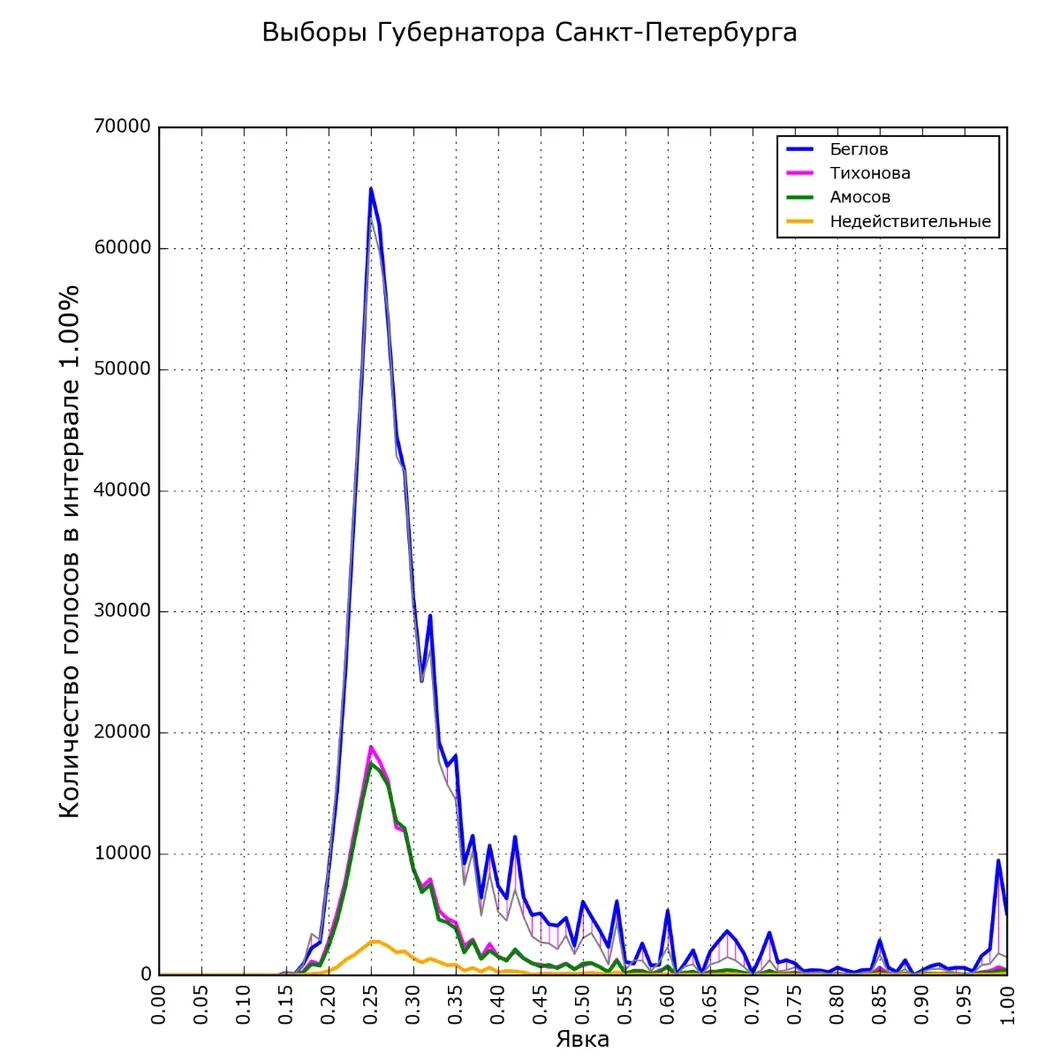
Shortly before the voting day on social networks, audio recordings of “briefings” appeared, at which members of election commissions were taught to fake voting results for the governor, counting him by other people's ballots. This is a more subtle and more difficult technology for falsification of results than a banal stuffing of ballots or a volume post that was used in the elections of George Poltavchenko in 2014, when a real manipulation of almost 40% increased by 25%.
This time, as the analysis shows, there were much less stuffing - the distribution of votes for candidates in the turnout is a narrow, almost symmetrical bell. The number of votes added for Beglov (corresponds to a shaved area in the illustration) can be estimated at about 86 thousand (from a total number of 735 thousand), which corresponds to a real result of about 61.5% with an official 64.5%. Once again, we note that this value does not include the possible contribution of the transfer of votes from other candidates. To assess this effect, analysis of other sources, for example, observers' evidence, is required. In addition, falsifications were distributed unevenly across the city and in some territorial election commissions were much more significant in relative expression.
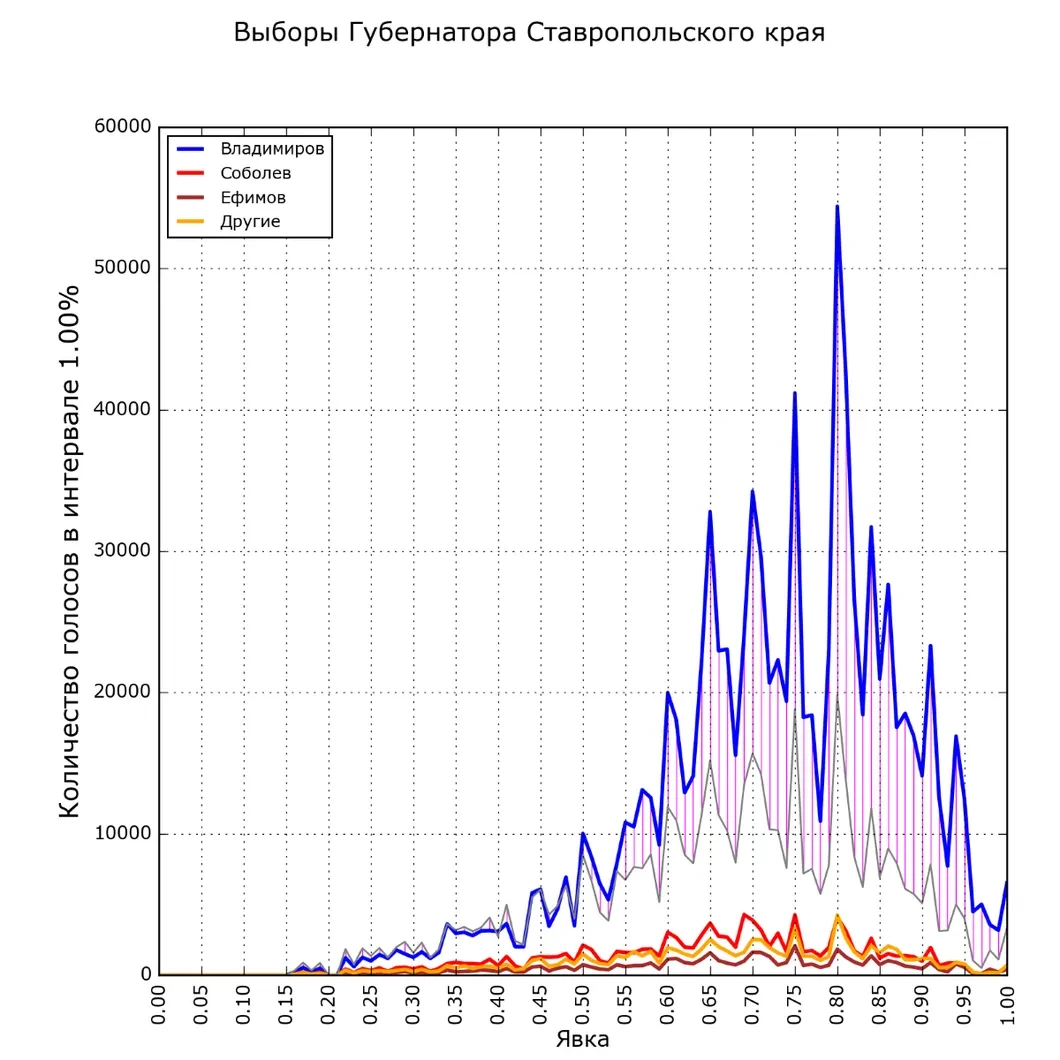
With all this, the elections of the governor of St. Petersburg were one of the most “clean” in this cycle. The smaller level of falsification was observed only in the elections of the governor of the Murmansk region. At the opposite end of the spectrum - the election of the Governor of the Stavropol Territory, where, with an official explicit of 67% and the result of the current governor, 80% real turnout and the result (as far as they can be estimated with a very small number of sections with nephealized data) amounted to approximately 20–25% and 55%, respectively. It is impossible not to note the love of precinct election commissions of the Stavropol Territory for round yaques - 60%, 65%, 70%, 75%and especially 80% - it is immediately clear that people honestly performed the assigned task.
The main sensation in the elections of regional legislative assemblies is local “overturning elections” in the legislative Duma of the Khabarovsk Territory, where last year he became the governor, defeating the current head of the region in the second round, representative of the LDPR Sergey Furgal. The United Russia party has not just lost the majority in the Legislative Assembly -
She received only two places in it, taking the third place after the LDPR and the Communist Party and losing all single -mandate districts.
EP partially prepared the ground for this defeat itself, less than a year ago, having advanced the bill on an increase in the number of single -mandate and a decrease in the number of deputies elected on party lists. At the same time, the distribution of votes for the party by turnout with a proportional vote does not show any action of the administrative resource in favor of the LDPR. On the contrary, the Governor’s party on high turnouts loses a small share of votes in favor of United Russia.
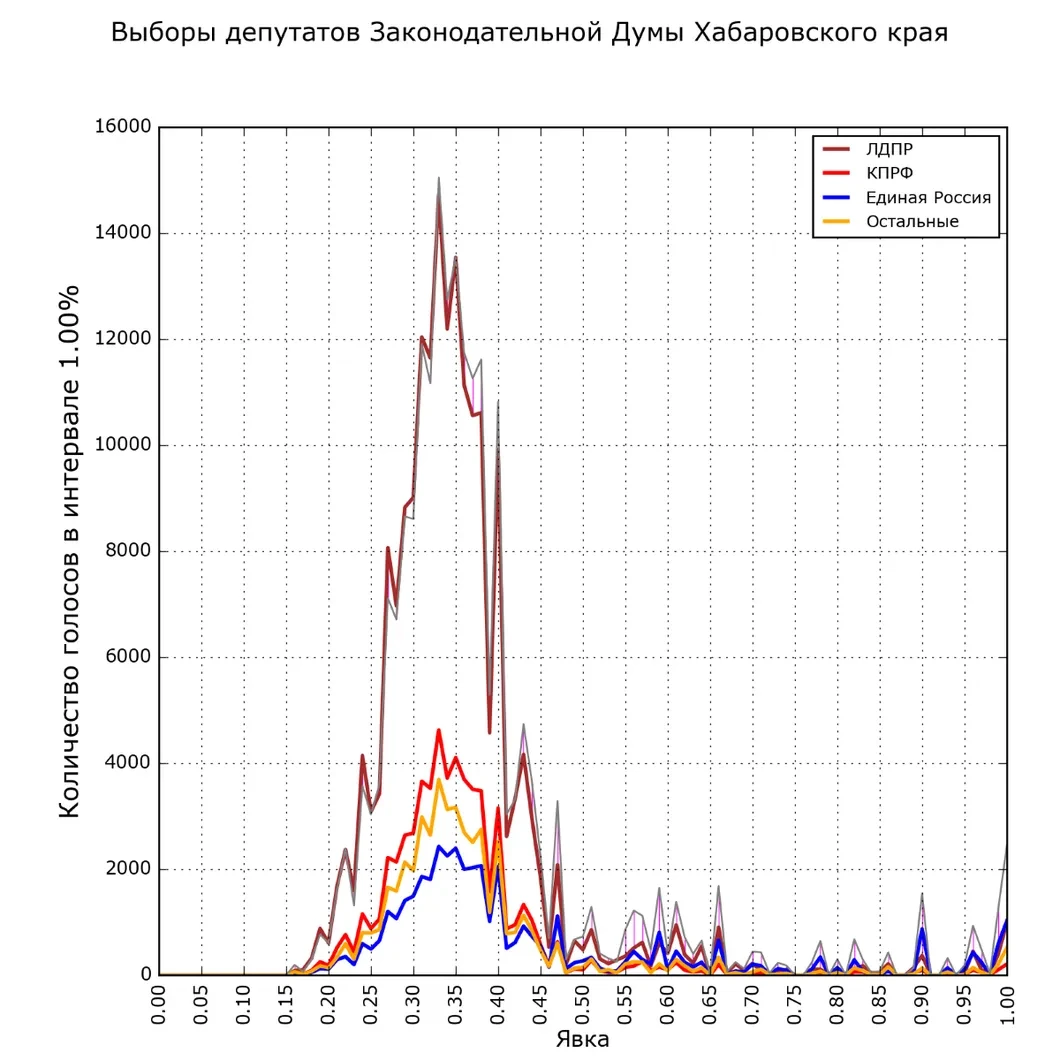
However, such nephalus elections to the regional legislative assembly in this electoral cycle were a rarity; In 10 of 13 regions (except for the mentioned Khabarovsk Territory, Sevastopol and Moscow) there were noticeable or strong falsifications in favor of United Russia. However, this did not help:
According to political scientist Grigory Golosov, compared with previous elections, the result of United Russia decreased by an average of 16 percentage points.
Separately, it is worth mentioning the elections of deputies of the Moscow City Duma. The law adopted for the past elections of the MGD on the need to collect signatures for candidates not coming from preferential parties, combined with the desire to move away from the United Russia brand, led to the fact that the applicants for 45 seats in the Moscow City Duma had to massively collect voter signatures for their nomination on the dragon Moscow conditions (about 5,000 signatures depending on the size of the district).
As a result, candidates from the party of the authorities, disguised as self -nominated (“conscientons”), as well as the masses put to help, registered by very dubious signatures, and the many honestly and publicly collected signatures of independent deputies refused to register. The result was mass demonstrations in the center of Moscow, accompanied by beatings and arrests of participants - and traditionally invisible elections to the Moscow City Duma suddenly found themselves at the center of public attention.
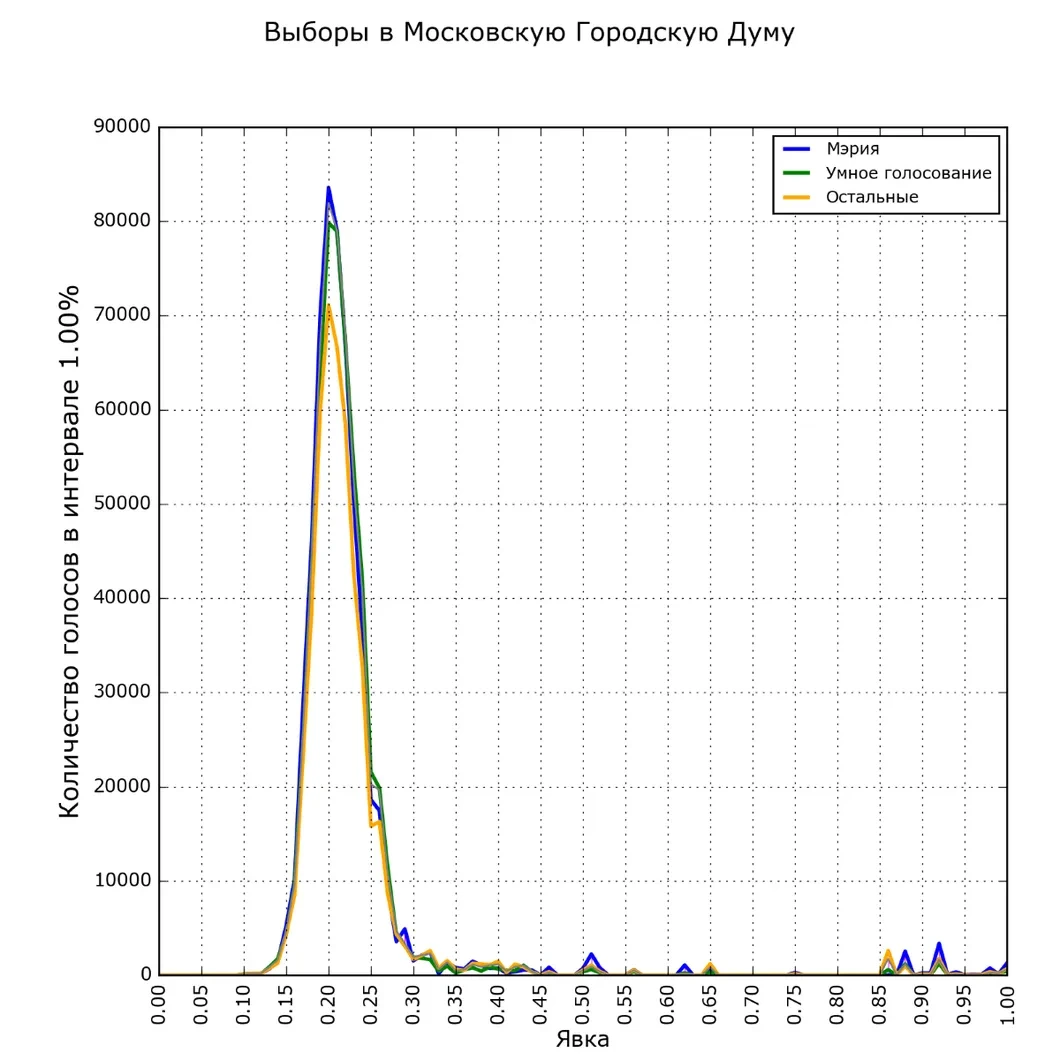
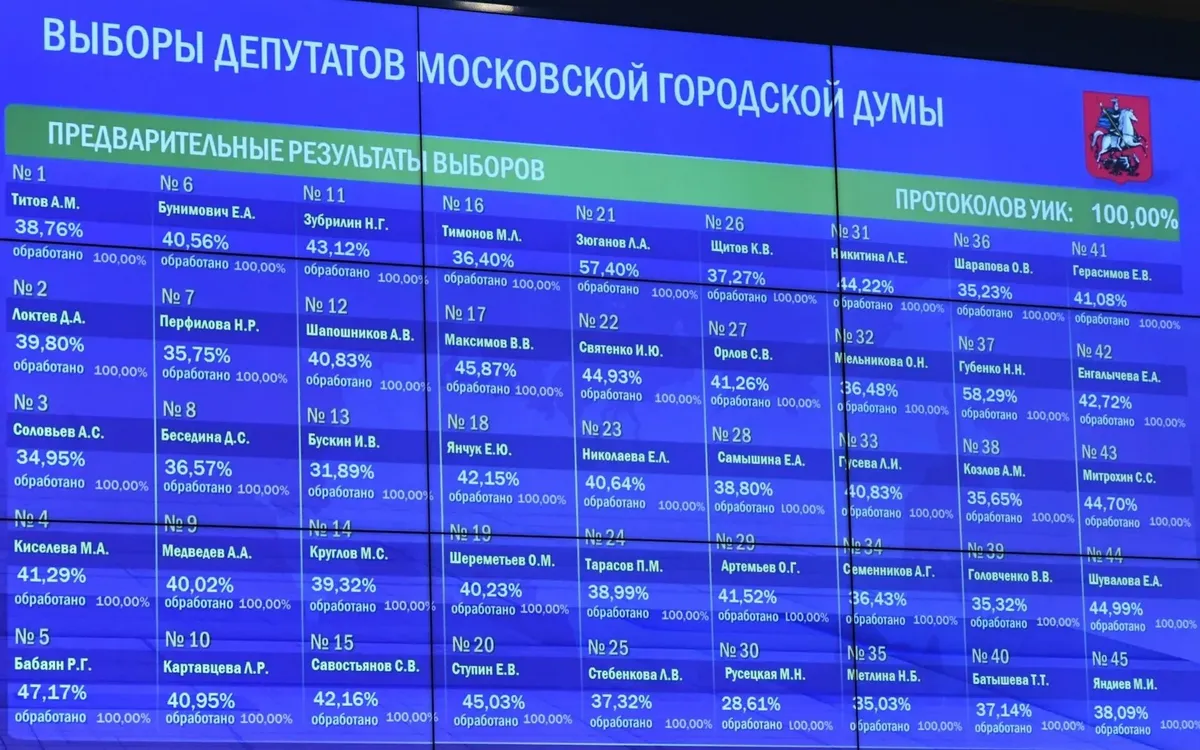
This created a favorable ground for the Smart Voting project, Alexei Navalny, who proposed to vote coordinatedly for his list of candidates alternative to candidates from the city hall. Although the project of “smart voting” was not limited to Moscow, it was in the capital that he turned out to be the most successful. According to the results of the vote, the participants of the “Navalny List” received 20 seats in the MGD, and “candidates from the city hall” - 25. The capital's power has never suffered such a defeat in the Moscow City Duma elections in history. Proof of the effectiveness of the “smart vote” “from the contrary” was the fate of the active municipal deputy of Roman Uneman, whom the Navalny team did not include in the list of “smart voting”, preferring him a candidate from the Communist Party of the Communist Party Vladislav Zhukovsky. As a result, Juneman was only 84 votes from the City Hall, and Zhukovsky took third place.
Traditionally, for recent years in Moscow, densely covered by independent observers, there were no significant falsifications on the voting day, although there is a suspicion that the candidates of the “Navalny List” could win several more districts where the lag from the candidate of the city hall made up a few tens of votes.
The additional factor in favor of the authorities of the candidates became three experimental sites for “electronic voting”, where the results were much more proceeded than in Moscow as a whole. In particular, one of these sites played a decisive role in the loss of Juneman’s novel in the 30th constituency. At the same time, according to the total number of votes received by the “List of Navalny” (excluding “coordinated communists” Nikolai Gubenko and Leonid Zyuganov), only a little behind the “City Hall list” (including Gubenko and Zyuganov) - 548 thousand votes against 562 thousand.