
Translated material
Minefield
Another battle between myths and the truth of a long -ended war is unfolding at the site of the battle under Prokhorovka.
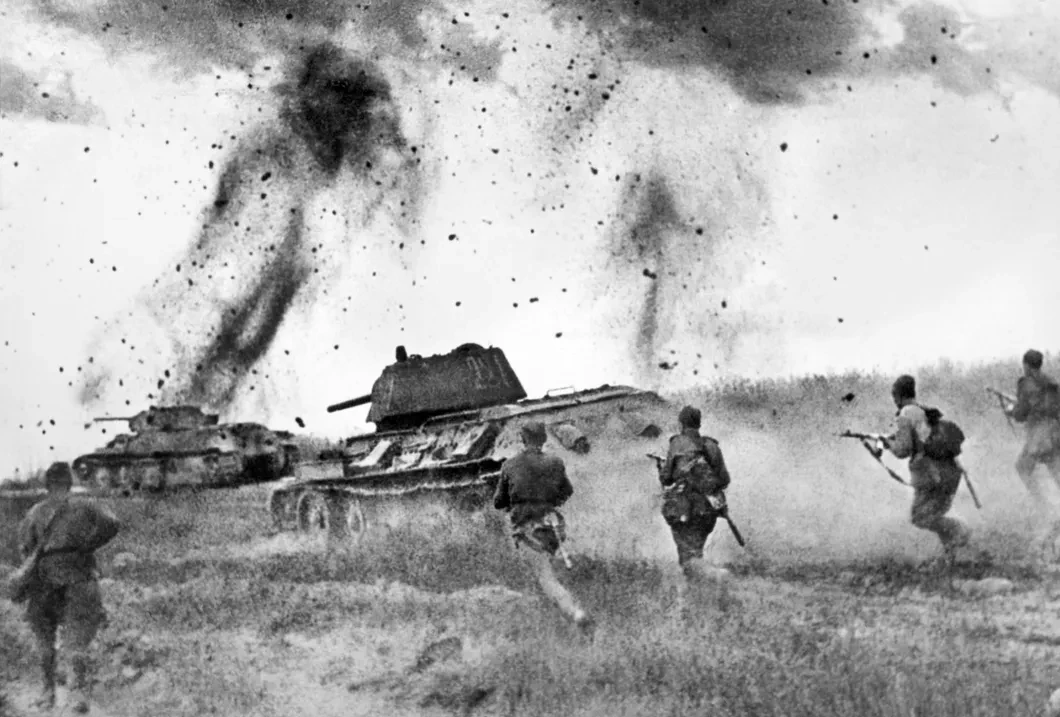
This huge arc on the map has become a place of one of the main battles of the Great Patriotic War. It was here that the German command made the last attempt to turn the course of the war: the Operation Citadel was supposed to “compensate for the defeat near Stalingrad. Here, the Germans were able to concentrate an unprecedented amount of forces and means, including the latest Tiger tanks for the first time as part of the 2nd SS tank corps. But the yard was no longer 1941, the Soviet command prepared for the defense, which was held by three fronts, the breakthrough failed, the offensive potential of the German armies was exhausted; In addition, the allied landing in Italy began ...
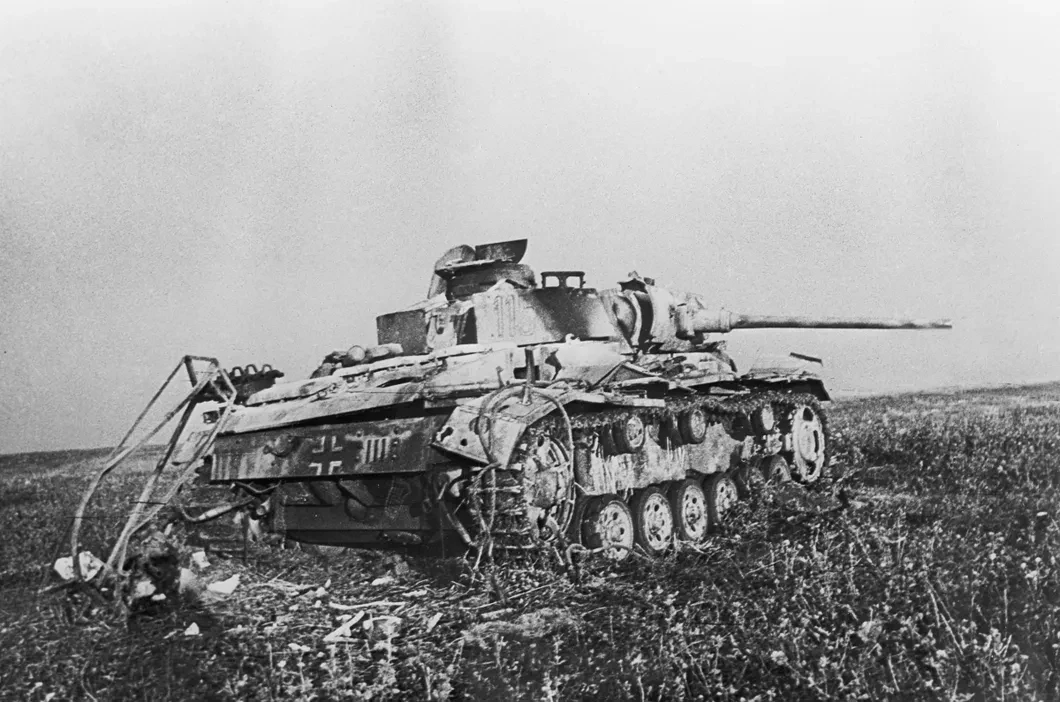
And already on July 13, Hitler gave an order to turn the “citadel”, the withdrawal of troops began - and, accordingly, the offensive of the Red Army. The Prokhorovka, as it was believed in Soviet historiography, the decisive battle of the battle: the famous counterclaim of the SS men with the guards of the Rotmistrov, the largest tank battle in history (as it was written in our school textbooks: 1,500 - then 1200 - tanks from both sides!), During which the attacked corps of the SS was defeated and retreated. In fact, the corps, in accordance with the order, retreated in perfect order and during its retreat participated surrounded by four Soviet divisions ...
This summer, the question of the ratio of truth and myth in the history of the Great War was again raised. The German newspaper Di Velt published an article by its scientific observer about the Battle of Kursk, in which the author proved that the battle under Prokhorovka by the Red Army was lost. Losses were given: on July 12, 1943, after his counterattack, the 5th Guards Tank Army of General Rotmistrov practically ceased to exist.
The losses of the Germans, according to the observer, amounted to ... five cars. There was no oncoming battle at all: the Germans standing on the defense simply shot the tanks attacking them, as in a dash.
The special indignation of our “patriots” caused the German sarcastic remark that the monument in honor of the victory on the Prokhorovsky field should be dismantled. “Komsomolskaya Pravda” brought the free translation of this, as she wrote, “Requirements” and devoted to him a series of publications, in which she reminded how that war ended at all, but the newspaper did not concern specific numbers. Indeed, to whom there are any monuments to put, we must figure it out ourselves; I would not name this passage as a sample of tact.
The need to repulse the impudent statement of a German journalist became the basis for a benefit on the pages of the federal press of the Prokhorov historian, a leading researcher at the South-Western University (in Kursk) Valeria Zlutin, the most authoritative specialist in the history of the Battle of Kursk. But his books describe a completely different battle. And why did not colleagues write on his behalf!
I called him in Prokhorovka, Zamulin sighed, said that he was amazed at the illiteracy of the questions of journalists and the quality of the recorded answers. And we agreed that in early September I would come to him, talk in more detail.
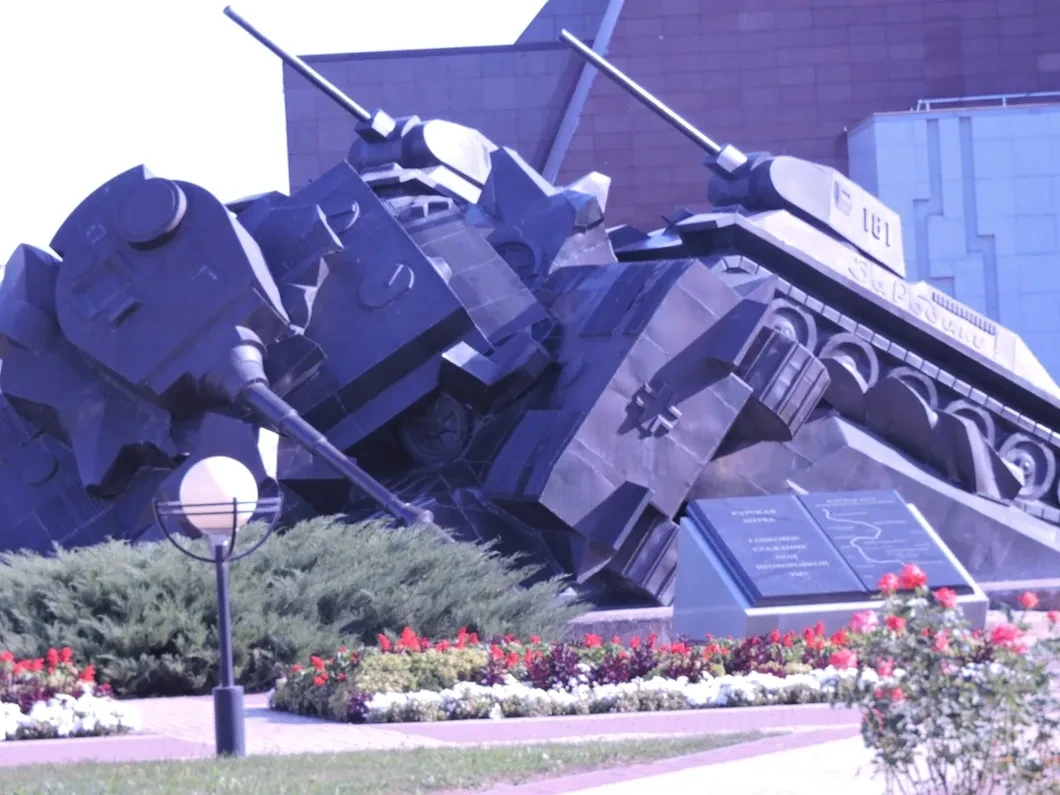
... Prokhorovka is striking in the number of monuments in the village itself and its neighboring environs; It is inaccessible to the richest imagination.
Suffice it to say that
At once, on two monuments, the authors depicted the defeated Reichstag, and the tanks (on the armor of which the slogans “for the homeland!” And “for Stalin!” Was carefully bred to form, if not a tank army, then the corps - for sure.
At the Museum “Prokhorovskoye Field - the Third Torn Field of Russia”, next to the monument “Tank Taran”, sitting Nikolai Ivanovich Ryzhkov (God forbid him health) and Pushkin (on the monument a plate, from which I learned that among the three authors of the project is the deceased chairman of the Russian Writers Valery Ganichev writers).
In general, the inscriptions on the local monuments are a separate song.
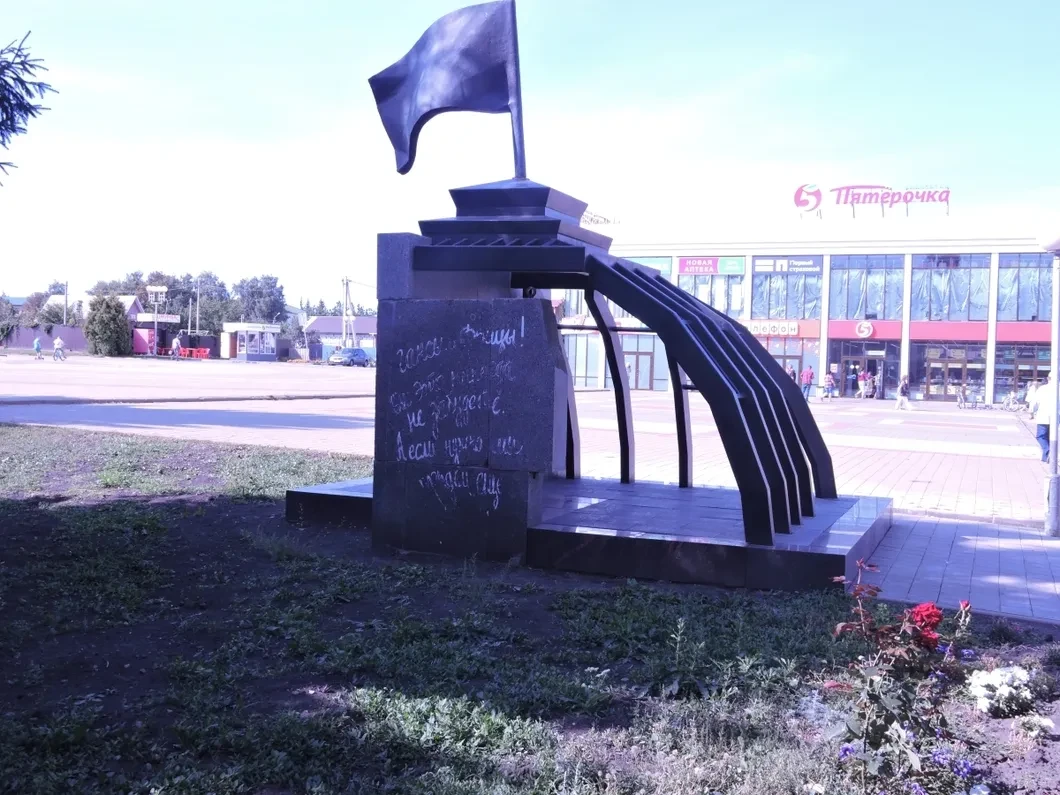
- On the back of the memorial on the station at the station, I in amazement read the inscription made with oil paint: “Hans and Fritz! You will never forget it. And if necessary, we will come again. ” Does it not seem to you that this is the result, including the rampant boast on the occasion of the Great Victory, won here, thousands of kilometers from the Reichstag?
- The first is funny. The second is disgusting. Third - nothing good from this will not work anyway.
- By the way, how do your books meet here?
- I released my first essay on the history of Prokhorovsky battle in 2000. The museum-reserve published this book as part of the Book of Memory. I was then his first director, then left the first deputy. Then it went quietly. Then I made the following on its basis - "Prokhorovka: the unknown battle of the Great War." And for this book I was fired from the museum.
It was already November 2008, by that time I just planned to defend the candidate, published several books ... In general, I was offered to become a dressing room or service worker. This is officially.
And they unofficially said that I would denigrate the great feat of the Soviet soldier and therefore I can’t work in the museum.
Three months later, I defended the thesis on the history of hostilities in the south of the Kursk arc and began working at the Kursk State University, where my qualifications arranged, stayed here, then moved to the southwestern university, where he defended himself.
- In general, there is a lot of lies?
- Here it must be borne in mind that everyone lied. Mistaken - all. During the fighting, especially with the concentration of forces and means that was on the Kursk arc, there was hell here, to understand what happened, people could not and did not understand ... The headquarters should know everything, put everything on a piece of paper. And then I collect these pieces of paper and as a historian I study. Therefore, the analysis of two bases, two sources, is required. It gives a voluminous look and complements one another.
The approach of the Wehrmacht officers and ours was absolutely different. Our lies had more, even in operational documents. But we have more details in the presentation of the situation. And an understanding of where the person is lying, where - no, comes with experience.
The Germans have the main principle of lies - silence. Actually there are almost no lies. Because their documents were strictly divided into propaganda and for internal use, that is, for combat work. And if you write a document for propaganda, you can turn on the fantasy in full, how much you have put, you will only applaud you. But if in operational documents you were mistakenly or deliberately distorted the information and this information, God forbid, formed the basis of some major solution, you, be sure, will get out of the ground, shake out ... Maybe they had a short, compressed, only basic information. Without smearing.
- Is a lot of Kursk a lot now?
- You know, when I started working, they told me: your main task is to find the daddy in which everything lies. Then I realized: there is no such daddy ...
The first who began to engage in the Battle of Kursk was Georgy Koltunov-our fellow countryman, from Rylsk, a participant in the Battle of Kursk, commanded the battalion of communication in the 3rd Army of General Gorbatov, by the end of the war he became the chief of staff of the communications regiment. In the 46th, we formed first a group, then the faculty, and he was among the officers who were prepared as military historians, prepared for four years. This was the first release of military historians in the Soviet Union.
In the 70s, Koltunov and Soloviev wrote a book about the Battle of Kursk. The only book was the only one, overloaded, of course, by heroic, all sorts of part Popolitrabot, the chapter about it was a whole ... chatter, in a word. But the second part of the book, which, in fact, Koltunov wrote, became the first and only in the USSR, from which one could understand who wanted, where he came and what came of it.
I repeat: this was the first and long years the only book in the Soviet Union. Since then, she has never been reprinted.
- I will return to the question. Is it still a lot of classes?
- As for the Battle of Kursk, there is nothing secret for me. To finally understand what happened here, in fact, I lack only two documents.
The first document is the records of negotiations between the Supreme Commander -in -Chief with the commander of the Voronezh Front and the chief of the General Staff. Specifically-July 11, somewhere from ten-half of the eleventh in the evening to an hour-half of the second night of the 12th. It was at this time that Stalin talked with Vatutin and Vasilevsky. I know what I was talking about for sure, about what - I know approximately. Because I saw the memoirs of the head of the Voronezh Front, which provided the connection. They talked about the counterattack - to conduct, not to conduct ...
The situation was difficult, the conversation was on the nerves. On the eve of the Germans, the army of Rotmistrov was thrown from the line, by this time Vatutin knew that the Germans had broken through the third defense lane, which was occupied by the 69th Army, and jumped 18 kilometers from Prokhorovka. What forces jumped out is unknown. Then it became clear how many tanks there were. And on July 11 they did not know this. So the reserves pulled up? There was a danger of ticks.
The 69th Army of Kruchenkin was frankly weak, there the drap began. That is, the situation has changed dramatically. It was about entering both reserve armies - Rotmistrov and Zadov. And Vasilevsky asked: Comrade Stalin, what will we do?
Then Vatutin was called back: in the south, near the division broke down ... there really were 112 tanks ... nonsense that is.
The second thing that is very important to me is Malenkov’s report. They tell me that there is no such document that this is a fiction and so on. But I saw the page of this document with my own eyes. And Pavel Alekseevich Rotmistrov in a published conversation said that the commission was, that he was almost removed from his post, almost did not give him to court ...
Why do I need these two documents - Stalin's telephone conversations and the report of the Malenkov commission? If you adhere to the rules described in operational art, it is not clear what the Soviet command held on July 12. They say that a front -line counterattack was applied ...
Firstly, this is a counterattack, for the first time in the leading documents of the headquarters of the Voronezh Front, it was mentioned on July 15. In other guidelines of the front command, which conceived this operation, the concept of “counterattack” is not found. Why? The front headquarters plans, letting in the army, the army is developing ...
But in the headquarters of those armies that participated in the counterattack, the documents should be. And they are not! You see, six armies participated in a counterattack, but nothing! Nothing!
Further. If an operational directive comes, the army commander meets it and develops his plan of action - on the basis of an order of a higher organization. I found such an order in the 5th Guards Tank Army. Rotmistrov writes: the army on July 12 goes on the offensive. For a military man, a counterattack and an offensive in the context of conducting a defensive operation are different things. On July 12, the Kursk defensive operation continued, the Germans have not yet lost their offensive potential, the command of the defending side could only be carried out by a counterattack - the form of a defensive battle. And the offensive - it hit, broke through, introduced armored units into a breakthrough, captured the city, territory ... This is a completely different operation.
They may say that at the headquarters of the Rotmistrov, by and large, people were poorly educated. Higher education was the chief of staff and chief of the operational department. And what, in essence, is the difference? Still, do they come? Although the Rotmistrov himself already had the degree of candidate of military sciences and he still understood the difference between terms. He writes: the army is ready for the offensive.
OK. We go down below. The corps commander (each building!) Also must draw up his own document. I dug up thousands of documents and found only one corps of the Rotmistrov army-18th. And then the corps commander, Bakharov, writes on the basis of the army order: on the morning of July 12, the corps brigade ... and then - the most interesting! - Go into a breakthrough . This formulation is already not suitable for the definition of counterattacks.
The Rotmistrov army should not have left for any breakthrough, it had to hit to stop the Germans. They pass into a breakthrough when there is an offensive. At first, the artillery irons everything, then the infantry breaks through, then tanks enter the gap ... Based on this, what follows? If there is no directive for a counterattack, if the army command writes that this is an offensive if the corps commander writes that he goes into a breakthrough, what was it?
Recall. On July 15, the Western Front of Baghramyan proceeds to the implementation of the Kutuz plan, on the same day, goes to the implementation of the Rokossovsky Central Front Plan for the Eagle ... But Vatutin is fighting here ... And who is the representative of the bet here? Head of the General Staff. They are already coming there, but here ...
So, I have an assumption that these two documents can confirm - Stalin’s telephone conversation with Vatutin and the report of the Malenkov commission. My hypothesis: it was an attempt by the command of the Voronezh Front, with the consent of the rate and chief of the General Staff, sharply, without any pause-daytime, weekly-to move from defense to the offensive. It was a powerful group: the army of the Rotmistrov-41 thousand personnel, the army of Zhadov is 65 thousand, in total already one hundred, beyond the troops of the 69th Army, the Chistyakov army-80 ... 850 tanks ...
So, Vatutin and Vasilevsky decided to strike at the SS corps, cut it ... The density was planned to be fantastic - 62 tanks per kilometer ... So if the Soviet command was able to form this armored wedge - to form, the Germans themselves admit that whatever the SS corps would have rolled out, even with that misera of the artillery, the Rotmistrov’s misera ... but the terrain intervened. The Germans even earlier captured the bridgehead on which the tanks could turn around, even a brigade. And there was a thin stream.
As a result, the meaningless death of hundreds of our tanks and thousands of people.
-On the website of your museum, I read a completely different, much more peppy interpretation. “On July 12, after a 15-minute artillery preparation, the counterattack was applied, after which the tank formations moved towards each other ... The armor of the Soviet tanks was not as powerful as the German ones, but they wedged into the battle formations of the German troops, gaining an advantage due to speed and maneuverability, shot The enemy from close range into the side armor.
A short -distance battle deprived the Germans of the opportunity to use the advantage of powerful guns. As a result, tank duels mixed and started up and ensued ... The result of a tank battle under Prokhorovka was the German plan on the Kursk arc “Citadel” and significant losses of the tank forces of the German army. The tank battle near Prokhorovka was a prologue for the defeat of the Nazi troops in the Battle of Kursk (July 5-August 23, 1943), which became a turning point in the entire World War II ... ”What do your former colleagues do?
-Of course, it was not the way they describe it ... But what to wonder if you open their site and immediately see the listing of the main events: “rite of clamping” ... “Protecting the newlyweds of bread-salt” ... I understand that this is “clamping”-related. If we have so many monographs from afar. They held so many scientific conferences for which they collected the best minds of Russia on this profile ... And if they conducted a “rite of clamping”, they handed over his fourteen-year-old passports, the father consecrated the recruits, and that’s all ...
What are you talking about? What their text is crooked? I know who works there, who makes these texts, is not surprising.
Well, so we live.