
Translated material
Bryullov’s journey from Vyborg to Strasbourg. The ECHR will consider the case of the picture, which has been under arrest in the storerooms of the Russian Museum for 16 years
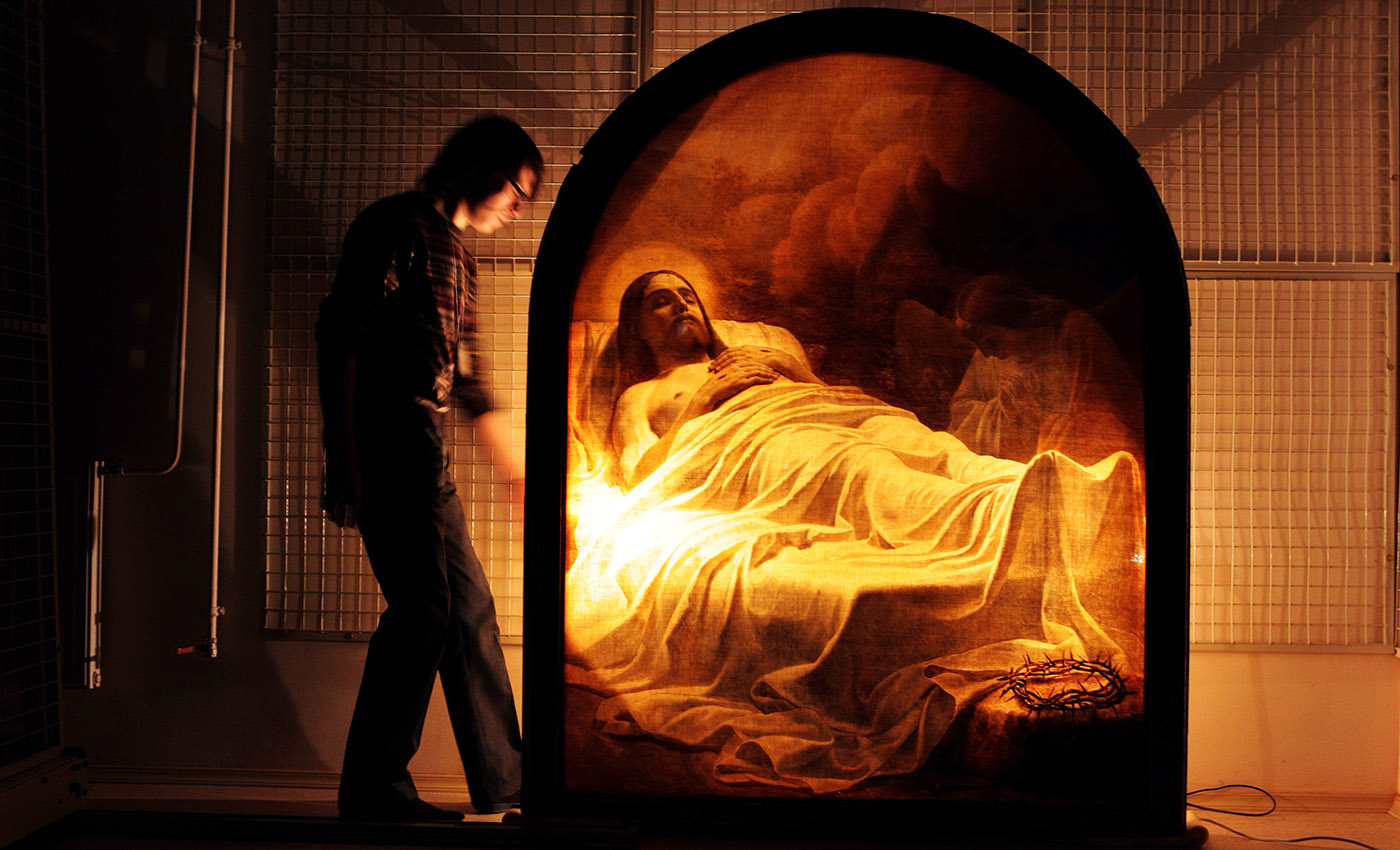
Demonstration of the picture of Karl Bryullov “Christ in the Tomb” in the Russian Museum in 2010. Photo: Alexey Danichev / RIA "Novosti"
The European Court of Human Rights (ECHR) Comminized the complaint of German citizens Irina and Alexander Pevzner to the Russian authorities refusal to return to them the picture of Karl Bryullov “Christ in the coffin”, seized by the FSB in 2003 in connection with the case of smuggling, which was later terminated. The constitutional and supreme courts recognized the confiscation of the canvas illegal-despite this, it is still hidden from the owners in the reserves of the Russian Museum.
The ECHR sent the Russian government questions about the fate of the picture of Karl Bryullov “Christ in the Sepulcher”, which collectors Irina and Alexander Pevzner in 2003 passed for examination to the State Russian Museum (timing) and since then cannot get back. Their complaint states that the Russian authorities first confiscated the picture with a violation of the European Convention on Human Rights, and then did not fulfill the final decision of the Presidium of the Supreme Court on the return of the picture. The applicants are asked to recognize the violation by Russia of the Convention - Article 1 of Protocol 1 on Property Protection and Article 6 guaranteeing a fair trial, including the execution of court decisions. By the end of 2019, the Russian government should answer the issues of the ECHR: are the applicants “victims of the violation of the Convention”, whether the authorities are guessed to fulfill the decision of the National Court on the return of the picture by socially significant goals, whether the principle of the presumption of innocence and legal certainty guaranteed by the Convention has been observed in the case.
As an unknown canvas of Bryullov returned to Russia
The painting by Karl Bryullov “Christ in the Tomb” was written in the 1840s by order of Count Nikolai Adlerberg, the future Governor General of Finland. Among the art historians there is no consensus on how the canvas was in Europe - perhaps Bryullov worked on the picture intended for the house church, in the estate of the customer near Munich, or it was taken out by the count when, after the attempt on Alexander II, he left Russia forever. One way or another, in the 1930s, the picture without the signature of the author and reliable information about its origin entered the Russian Orthodox Church of the Resurrection of Christ in Brussels. In 2002, the Pevzner's couple acquired it from the parish community for 100 thousand euros. The new owners found that the picture was painted in the rare technique of "Transparent" - it should be considered to be a lumen as a slide.
“The canvas was placed between two glasses in a frame screwed to the wall of the church hall with metal bolts, and made an impression of blackened Vetoshi,” says Irina Pevzner. - It was possible to see the painting only after the picture was removed from the wall at our request and lit from the back. There are units of such works in the world. ”
This discovery became a historical and cultural sensation: in the Russian Museum they knew about Bryullov’s work on “Transparet”, but its location and technique were not known to the museum workers. The collectors agreed with the community of the temple that if an examination of the timing does not confirm the authorship of Bryullov, the deal will be terminated.
“Based on the interests of the Motherland”: the FSB investigator changes the picture to close the case
The owners of the Brussels find were born in Leningrad, but live in Germany: Alexander Pevzner, a relative of famous avant-garde artists of the early twentieth century Naum Gabo and his brother Antoine Pevzner-physicist, his wife Irina-doctor of philological sciences. In the spring of 2003, they brought a picture to St. Petersburg, where the timing experts confirmed the authorship of Bryullov. The museum did not hide interest in buying a canvas, but had no funds for it. Soon after, the St. Petersburg FSB opened a criminal case under part 2 of Article 188 of the Criminal Code (smuggling of cultural value).
The FSB officers arrested the picture as material evidence and left in the museum to “responsible storage” - without the right to exhibit and restoration, in which Bryullov’s work was already in need. A forensic examination conducted by order of the investigation estimated it in the amount of at least $ 300 thousand.
During the search, the owners seized the customs declaration of temporary importing the picture to Russia and allowed them to return to Germany. Only after their departure, the Federal Penitentiary Service of the FSB in absentia brought to Alexander Pevzner an accusation of smuggling of cultural value, and then suspended the investigation due to the lack of the accused in Russia. In 2005, the main keeper of the timing Ivan Karlov in the status of acting The director of the museum told the FSB that “storage of a unique artistic monument without regular preventive restoration measures could lead to irreparable losses of copyright painting”, asking for “accelerating the investigation time”.
“We confirm that they are interested in the receipt of the picture in the timing funds for permanent storage,” the museum worker in the FSB said in a letter.
For many years, the investigation in negotiations with the defense of Pevzner and with him himself invited the accused to abandon the rights to the picture. His lawyer Semyon Haifets said that the true goal of the “artificially fabricated business” is “holding the picture” in Russia, and this is “almost a raider seizure”. The lawyer Anna Stavitskaya shall have the same opinion. Alexander Pevzner himself, in evidence of his words, gives a notarized and deciphered jury in Germany an audio recording of a telephone conversation, which, according to the collector, took place in him in 2008 with the FSB investigator Vladimir Kraevsky. The fact of the connection by the number of the investigator’s official phone and the conversation, which coincides by the duration with audio recording, is confirmed by billing data. According to the transcript (is at the disposal of “Mediazons”), the contestant, who introduced himself to Kraevsky, invited the singer “based on the interests of the Motherland to leave the picture in Russia and transfer it to the Russian museum” in exchange for the termination of the case. The investigator explained that the "great cultural value of the object" has repeatedly paid attention to "museum staff and our other comrades and leaders." “The power is on your side, and the law on mine,” reacted to the proposal of Kraevsky Pevzner, warning that the picture in Brussels was “flooded with water” and “there was a disaster with mold.”
The picture becomes the "instrument of the crime"
However, the security forces failed to bring the case of Bryullov’s picture to the conviction. Initially, the smuggling was seen by the investigation in the “inaccurate” customs declaration: according to the FSB version, the owner issued a temporary import of the picture (not providing for the payment of the fee), “having intent” to sell it to the Russian museum and not indicating the authorship of Bryullov (at that time not yet established). But the courts of St. Petersburg in 2010-2011 twice recognized that the refusal of the special services to return the picture and stop the criminal prosecution of the singer is unreasonable. After that, the investigation adjusted the prosecution: according to the new version, the collector entered the picture to Russia in general “without declaration and customs control”. The proof was the turnout from the guilty of two employees of the Vyborg customs - Blavatsky M.V. and Kotlyara D.V. According to their testimony, eight years ago, without an inspection, they issued a fictitious declaration of temporary import of cultural value in exchange for the promised monetary reward. This, according to the report of the investigator Kraevsky, agreed with the customs officers “an“ man named Sergey ”unknown to the investigation.” Blavatsky and Kotlyar to criminal liability neither for complicity in smuggling, nor for a bribe or attempt on it was not attracted to it.
But the Pevzner case transferred to the court did not come to consideration either-the 10-year statute of limitations expired. In 2013, the judge of the Vyborg City Court Yevgeny Trichleb decided to stop the criminal prosecution of the collector and confiscate the picture from him as a “instrument of crime”. In 2014, the Leningrad Regional Court abolished the decision on confiscation and demanded that the Pevzner spouses return the picture.
In 2015, the Presidium of the Lenobll Court rejected the cassation representation of the deputy prosecutor general Sabia Kekhlerov, who demanded to revise the decision to return the canvas to the owners.
In 2016, the Prosecutor General’s Office appealed to the Judicial Collegium for Criminal Cases of the Supreme Court and still achieved confiscation of the picture. The defense objected that the annual period established by Article 401.6 of the Code of Criminal Procedure for review in the cassation of court decisions “on the grounds entailing the deterioration of the position of the person in respect of which the criminal case was terminated” has already expired. However, the Armed Forces found that confiscation did not worsen the position of the owner of the picture, since it is only about the fate of material evidence, and Article 401.6 does not apply to the collector. The decision said that “as a result of the illegal actions of Pevzner A.E. The Russian Federation was caused by damage ”, he deduced the punishment for a criminal act, and therefore confiscation is a fair“ criminal law measure of influence ”, although the case of Alexander Pevzner was not even considered in court essentially. “If the Supreme Court has decided to confiscate, I have no reason to doubt its legal impeccability. A masterpiece of this level of rarity and uniqueness should belong to the state, and the museum in 2003 sought to acquire it, but, unfortunately, it fell into private hands, ” said Grigory Goldovsky, a factory department of Russian-XII-XIX centuries.
After the decision on confiscation, the management of the Ministry of Culture ordered the director of thermal commissar Vladimir Gusev to organize the ceremony of the transfer of the picture converted to the state property to the museum "involving the Federal Security Service of St. Petersburg and Lenblast and the relevant coverage of the results of the investigation of the criminal case." However, these plans were hindered by the intervention of the Constitutional Court, which in 2017 recognized the confiscation of the picture outside the annual period established by the Code of Criminal Procedure and sent the case to revise. The exhibition planned by the museum was canceled, a book published by the timing of Bryullov’s masterpiece - removed from public access.
"Contradicts the main provisions of law and the laws of the Russian language"
Member of the Presidential Council of Human Rights (HRC), lawyer Yuri Kostanov, in the conclusion in the case of Pevzner, wrote that the confiscation of the picture of Karl Bryullov is illegal and violates not only national legislation, but also the norms of international law, including the European Convention on Human Rights. He noted that the picture in this matter could only appear as a item of smuggling, and the fact that it was recognized as an instrument of crime "contradicts the main provisions of criminal law and the laws of the Russian language."
On June 14, 2017, the Presidium of the Supreme Court, on the direction of the Constitutional Court, revised the Pevzner case, canceled the decision to confiscate the picture and decided to return it to the collectors. “We fought for this work, it received the seized by law enforcement agencies. But if the issue is resolved, we do not need a stranger, ”the Director of the Director of the State House Vladimir Gusev commented on this decision. However, literally on the eve of the revision of the Ministry of Culture, it managed to register a confiscated picture in the Goskatalog of the Museum Fund, which actually blocked the execution of court decisions on its return to the owners.
Since then, Irina Pevzner, who has not even appeared in the criminal case of her husband, has been excluding the canvas from the museum fund.
In 2018, the Prosecutor General’s Office in a certificate for the report of the Prosecutor General Yuri Chaika in the Federation Council stated: “Personal criminal proceedings were completed. Those court decisions are addressed to execution, according to which the picture placed in the timing is subject to return to the owner. The courts of the court are not executed. ” This is also stated in the decision of the ECHR on the communication of the case "Pevzner against Russia." “In accordance with the answers of the Ministry of Culture of Russia to applicants, one of the reasons for the failure to fulfill is the belonging of the picture to the Museum Fund,” the Strasbourg court notes .
Continuing to hold Bryullov’s canvas in state property, the Ministry of Culture refers to the fact that there is no direct indication of its exclusion from the museum fund in the decision of the Armed Forces. At the same time, information about the picture on the public portal of the Goskatalog of the Museum Fund, according to the documents of the department, is “temporarily closed” by the Ministry of Culture on the recommendation of the FSB.
According to the rules of enforcement proceedings, the first instance is responsible for the execution of the decision on the return of the picture in the judicial system - that is, the Vyborg City Court. It is he who must oblige the Ministry of Culture to exclude the picture from the museum fund. At the end of 2018, the defense of Irina Pevzner appealed to the Vyborg court with a request to make such a decision and take measures to “suppress the intervention of the FSB” in the procedure for its execution. The court has not yet considered this appeal, the next meeting was scheduled for September 18, 2019.
"Trying to run the time machine"
In July of this year, after the communication of the complaints of the Pevzners of the ECHR, the deputy prosecutor of the Leningrad region Mikhail Ustinovsky submitted a cassation submission to the Leningrad Regional Court, demanding to cancel the decision to terminate the criminal case, which was made six years ago by the Vyborg court and confirmed by the Presidium of the Armed Forces. At the same time, the prosecutor for the first time in the entire 16-year history of the dispute around Bryullov’s painting claimed that its legal owners were not established. Lenoblsud refused to consider the presentation, but appealing this decision may delay the consideration of the issue of excluding the picture from the museum fund in the Vyborg court.
“The idea of the Ustinovsky prosecutor is like an attempt to launch a time machine - to repeat the performance of the deputy prospector Kekhlerov, on the initiative of which in 2016 the Supreme Court revised acts of St. Petersburg ships and decided to confiscate the picture of Bryullov after a year from the date of their entry into force. Only since then did the Constitutional Court directly banned such a revision, after which the Presidium of the Armed Forces and the Vyborg Court, and even the Ministry of Culture admitted that the picture should be returned to singers. In June 2017, the deputy prosecutor general Leonid Korzhinek asked the owners to return the picture in June 2017, ”says Grigory Vipan, head of the judicial practice of the Institute of Law and Public Policy. He notes that the ECHR, in the communication of the complaints of singers in May 2019, also proceeded from the fact that the picture should be returned to him: the Russian authorities were asked questions about why this has not yet happened.
In early September, Irina Pevzner turned to the chairman of the Vyborg City Court Arthur Gavrilenko with a request to speed up the decision to exclude the picture from the museum fund. Her statement (there is at the disposal of “Mediazons”) states that the red tape lasts for nine months-at first due to the fault of the judge Viktor Solyanik, whose refusal to consider the case was canceled in the appeal, and then due to “unreasonable deposits of meetings” by judge Christina Petrova. Pevzner emphasizes that the ECHR has already raised the question of Russia “On Violation of Reasonable Formations” of the return of the picture.
The lawyer of collectors Maxim Krupsky calls the situation unprecedented. “The confiscation of the picture, according to the law, is no longer possible. At the same time, for two years of the decision of the highest courts of Russia, in accordance with which the picture should be returned to the Pevzner spouses, which is not executed, which is being trampled by the fundamental legal principle of binding court decisions and the strictness of their execution throughout Russia, ”the lawyer states.
The head of the international practice of the Agora human rights group, Kirill Korotheev, calls the refusal of the Russian authorities to give a picture to the owners, despite all the final court decisions, “open arbitrariness”.
Editor: Dmitry Tkachev