Translated material
Chekists against spirits
How the KGB imitated violent activity. Says historian Eduard Andryushchenko, working in the archives declassified by Kyiv
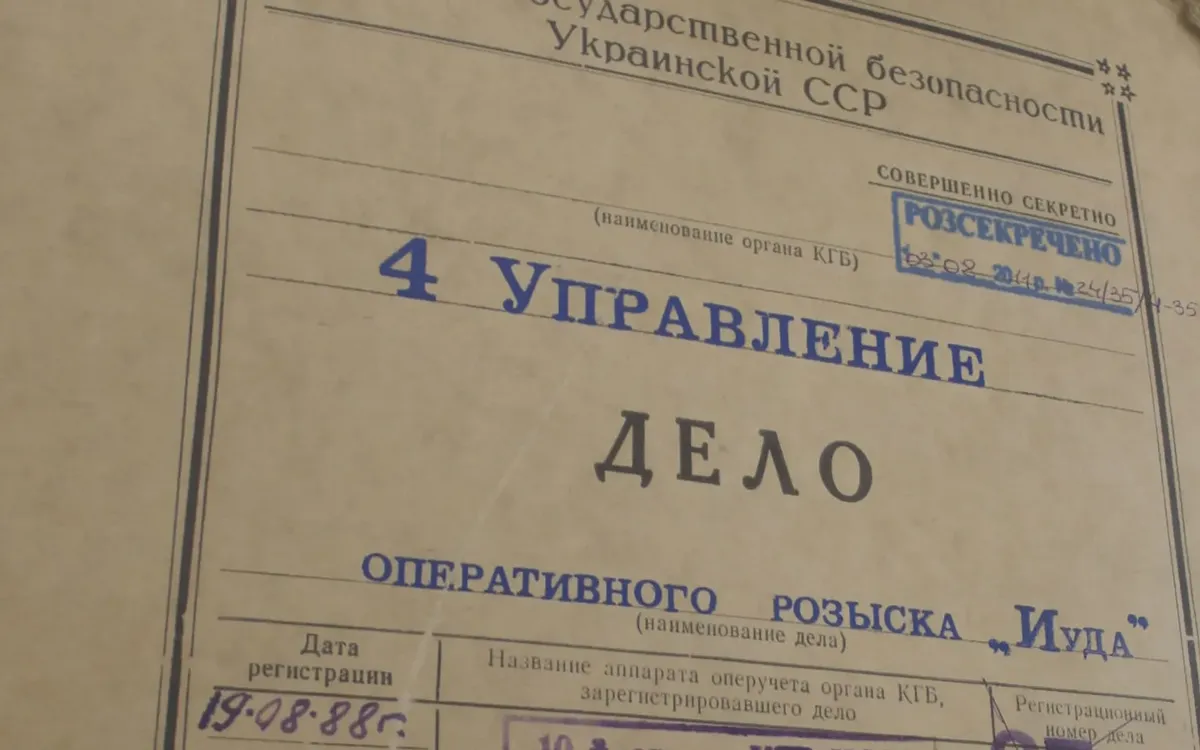
After the Maidan, the KGB archives in Ukraine were disclosed almost completely, and not only citizens of the country, but also foreigners can work with them. If you study these documents, you can see that the omnipotence of special services, the faith in which is carefully protected in Russia, including thanks to the regime of secrecy, is largely myth. The system of ideological control over citizens from repressive at some point turns into an absurd and even parody itself. Which is also scary, but at the same time terribly funny.
One of the popularizers of research of the Chekist archives is the Kiev journalist and historian Eduard Andryushchenko, who prepares articles based on documents and leads his telegram channel “KGB Files”. In an interview with the Novosti, the Novaya Andryushchenko spoke about the most amazing finds.
"It was important not to do, but to report"
- How would you describe the KGB officers of the Soviet period after reading the declassified archives? These are fanatics, cynics, fools, maybe?
- Rather, we need to talk about what stereotypes about the KGB workers are destroyed. There was an image of a kagbeshnik, which has been cultivated for many years: this is such a super -mosquito knight without fear and reproach, who knows everything and fanatically devoted to his work. And even if this is a villain, then a very attractive, infinitely professional villain, from whom no details can be hidden. After reading the documents, it seems to me that this is not entirely true. We can say that fanatics were more until the end of the 30s, to a large wave of purges inside the special services. With each new cleaning of fanatics, cynics and pragmatists were increasingly replaced. And by the end of the 80s, when the service in the KGB meant, among other things, also a comfortable existence, the number of fanatics at the expense of people seeking prestigious work was reduced to a minimum.
Infusal, misunderstanding by the Chekists themselves, often what the KGB officers should do.
Ochkatiga was common: it was important not to do, but to report. In fact, we must show that we work efficiently, but at the same time we are indispensable, since there are still a lot of enemies, so we need to maintain our privileges, financing and everything in the same spirit. Often this led to cases when from some group of teenagers who played “fascists” under the influence of Soviet films and painted leaflets with swastika, the KGB could create an anti-Soviet underground organization and report that it was neutralized.
-It is very familiar: in Russia, the work of “new greatness” was straight as if according to some patterns of the past.
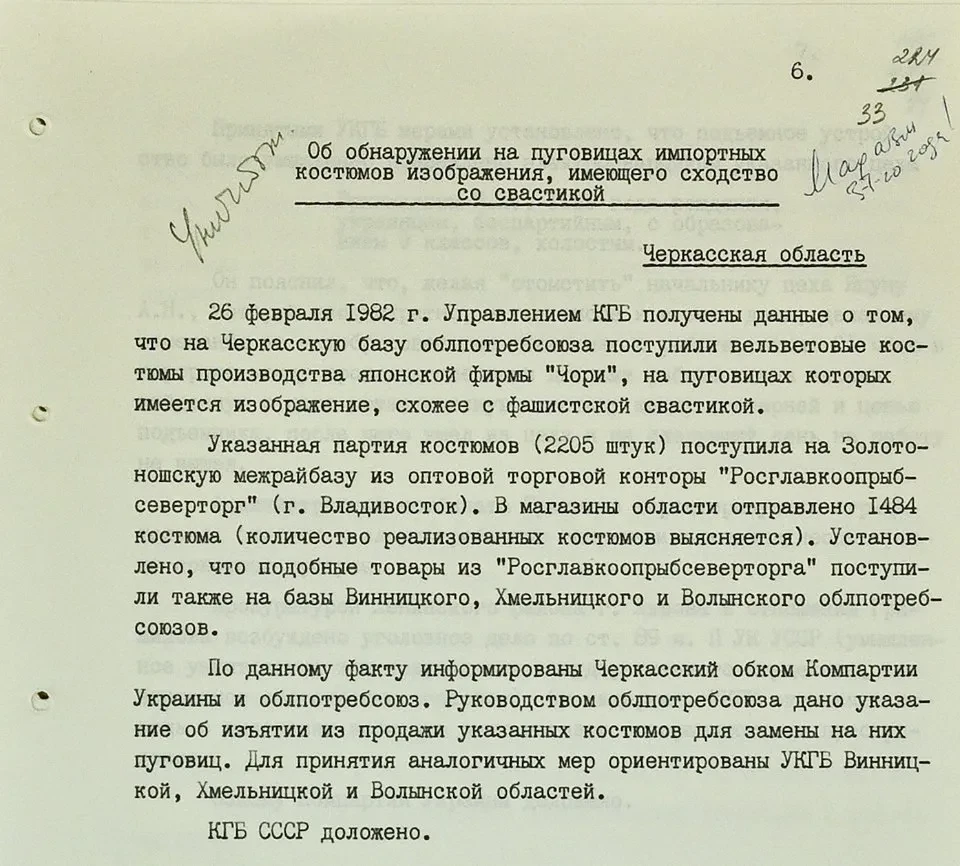
-Yes, and earlier, for example, it seemed to me that in Soviet times (with the exception of the 30s) this was not. But it was. They imitated violent activity very actively, especially in late Brezhnev times, when the Chekists fought at all with some windmills. There is a story about the fact that Japanese buttons were detained on the border, the pattern on which the swastika resembled, and on the document on this subject, someone from the Central Committee could not stand it with his hand and wrote that this was the “insanity of 1937”.
Or another example found by my colleagues, who shows what incompetent and disabilities were often employees of special services. In the late 80s, they began to destroy cases, which, as they said, have no operational value. And the senior officer of the 2nd department of the 5th department of the KGB of the Ukrainian SSR Major Polyansky wanted to destroy the case of Alexander Dovzhenko, the famous writer and director. For him, it was just some incomprehensible Dovzhenko: how many of them, these intellectuals, were, well, let's destroy the matter, why does it need it at all? Here, even his own at the level of the authorities began to troll until correction to the "senior project" in the resolution. Of course, some had an idea of whom they work in the midst of dissidents and intelligentsia, but some of the employees turned out to be so incompetent.
- One of the stories that personally struck me: the persecution of people who caused the Spirit of Lenin in a spiritual session to ask about Stalin. It is clear that it is simply not serious. Why did you need such attention from the KGB? Is it ignorance on their part or an attempt to control everything where is the name of Stalin, Lenin?
- I would not say that this is ignorance. The post -war repressions were, of course, not of the same level as in 1937, but the vector was approximately the same. There were cases of condemnation for jokes, for some kind of joke-this is from that opera. Just the reason was non -standard. This also once again illustrates how they could from some group of people who, out of boredom, was doing in the evenings, to make an underground organization. It has always been an indicator of some success and efficiency of work, and, probably, to someone such “exposures” brought stars to shoulder straps.
"Each story is the answer to the question why the union collapsed"
- From the documents that you already managed to see, the feeling is created that every sneeze was controlled. Or did the remoteness from Moscow provide an opportunity for some relief?
-I always heard that in general in Moscow it was even somehow freely breathing. As they told me, the Chekists were more executive in the field, they tried to get in more before the center.
- How in total control can only be blamed for specialists? After all, people themselves with masochistic pleasure conveyed to each other.
- The system is more to blame. If such an atmosphere had not been created from above in the country, then people would not have to do any particular interest. Great propaganda of informing played a role: even in the stagnant years, no one canceled lectures on increasing political vigilance. They collected in the working groups of people to whom the lecturer from the KGB told how a vigilant citizen laid his neighbor, and he ended up with a spy. The base feelings that sit in people at any era, in such conditions, usually come to the surface.
In general, if we talk about the informers who were recruited in order to convey to their neighbors or colleagues, only part was guided by their own initiative and perverted zeal. There are thousands of cases when people were forced to deal with the devil under pressure. In the notes of the KGB officers themselves, it is clear that such people often tried to shield their comrades, to convince the curators that nothing terrible was happening, and generally conveyed extremely reluctantly. It is clear that it is easy to put a stigma on them, but even in such circumstances, many of these people tried to behave with dignity, there was no bloodthirstiness in them.
- You can imagine that if you read documents about executions, then all this is very difficult to accept. And when you read about some absurd things in the KGB system, how do you perceive them?
-Very often it is really funny, as if you read some kind of tragicomic story. But each such story is in itself the answer to the question why the Soviet Union collapsed.
In the documents, it is noticeable that at different levels of power the party degenerated, no longer believed in its slogans. Everyone understood the KGB perfectly, but could not stop playing this imitation.
- What documents amaze you the most?
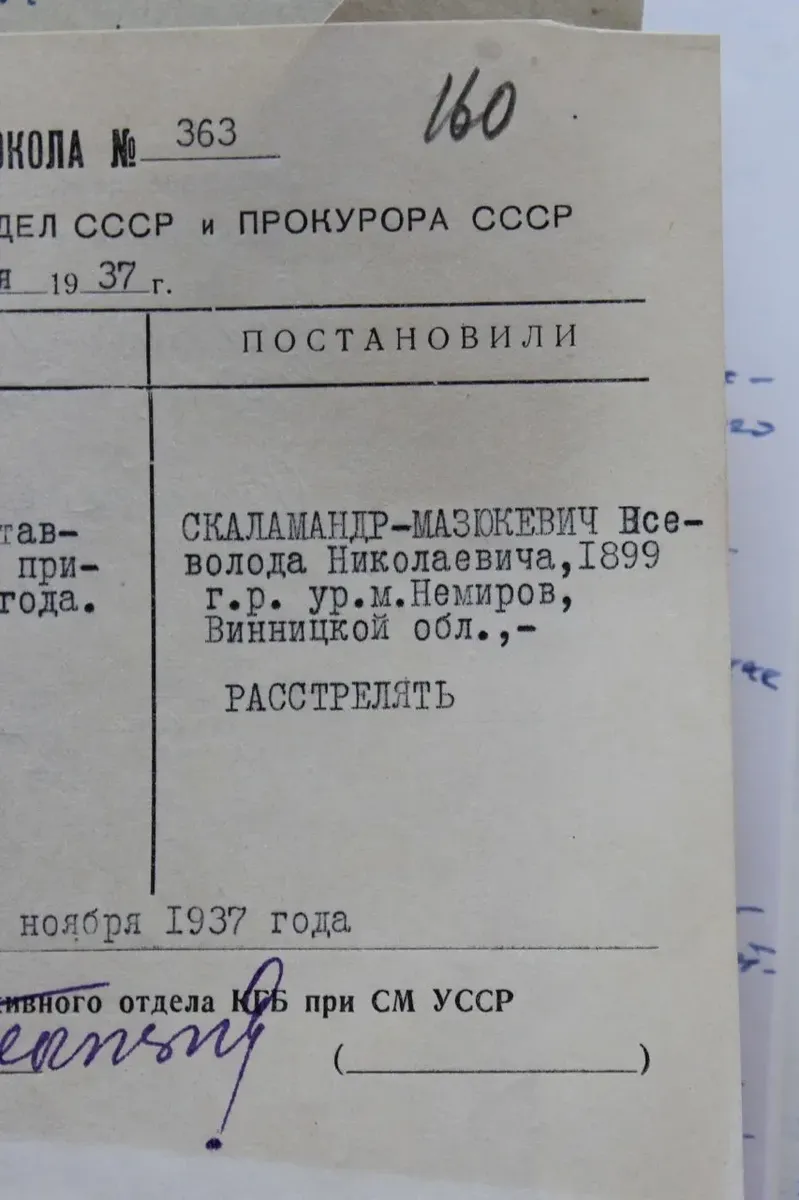
- In 1937, a young Kyiv photographer named Scamandra was sentenced to death. He was accused of espionage in favor of the Poles and Czechs. It is clear that the case went very quickly - it was generally the era of the conveyor instead of the trial. But in the text of the verdict, his surname was written with a mistake: instead of “scamandra” - “Scalamandra”. This is very significant: the regime was so much the same as it doesn’t matter what last name, it is important to condemn and shoot.
After reading such documents, a feeling arises: it is good that this whole system has collapsed, there is some kind of justice of the universe in this. Although I still consider it unfair that people from the system have not suffered any punishment - with the exception of those who, in the end, became the victim of their former colleagues, falling under cleaning. The communist system deserved the second Nuremberg. But unfortunately, this did not happen.
"Members of the Central Committee were unhappy that the Chekists were taking away time from them"
- Now it is customary to talk about the confrontation of power structures. On the example of Russia: the Ministry of Internal Affairs is fighting with the prosecutor’s office, the prosecutor's office with the Investigative Committee, and all of them together - against the FSB. In the old days was there something similar to hardware wars?
- I can recall only one document. This is a report of the beginning of the 80s about “negative manifestations in the field of catering” (specifically it was about the restaurants of large cities of Ukraine)-from the Jewish songs performed by the musicians, before the invasion of speculators and prostitutes. The document separately emphasized that this is all “roofing” the police. The report also contained information about theft directors of restaurants, and it was also a stone in the police garden. I talked with a man who was close to this area in the past. He stated that restaurants for the elect, where a simple person could not go and where the most wild things took place from the point of view of Soviet legislation, were not indicated in this report, because the Chekists themselves “roofed”.
In the archives, you can mainly find information about the war of the KGB and the Ministry of Internal Affairs, but about how a new wave of Chekists devours its previous generation (I mean cleaning the 30s and 1953). You can read how people interrogate their colleagues, colleagues and bosses yesterday.
- Returning to that story about an appointment on a document about swastikas on buttons. It turns out that there were some kind of sound forces inside the system itself, which understood: what it does is at least overkill?
- Undoubtedly. You can also imagine how much this sounded orally. This is, in fact, some daily reports about the state of affairs in the country. And this despite the fact that at that moment the Brezhnev Politburo stood at that moment, and the leadership of the republics was all old, ossified people incapable of changes and often for some adequate assessment of reality. But even they understood that, speaking in simple language, they are plucked by some kind of bullshit.
But what is important to understand: this is not about this postscript about the termination of repression - all the more so in this story no repression was initially not supposed. Members of the Central Committee were simply unhappy that they were trying to take away their “valuable time” from scratch. This irritation is characteristic of party members in the early 80s, and especially in 1982, when the concentration of insanity in the last year of Brezhnev’s reign became prohibitive-from attempts to prohibit the bard song to the fight against aromatic sticks, as they are used by Krishnaites.
"The secrecy of the archives in Russia is an indestructible symbol"
- How is access to archives from a technical point of view? In Ukraine, in general, anyone can come and see these documents?
- Yes, according to the package of laws on decommunization (there are four of them, and one of them is devoted to access to the documents of Soviet repressive bodies), all citizens of Ukraine, foreigners and stateless persons have the right to study the documents. The principle of "everything is open to all." Prior to this, such legislative norms were adopted in the Czech Republic back in the 90s, and it was precisely the Czech model who were guided by those who drawn up this bill in Ukraine. In fact, you woke up one day and think: why don't I see the documents in the archive? And you have the right to this. The only thing you can’t go on the same day, you need to agree in advance to find what you need, and then order a pass. For foreigners, including Russians, access is possible after an additional check by the SBU: they just need to understand what kind of person you are, why are you interested in archives.
-Are there any documents that are still hidden?
- Those documents that are in the industry state archive of the SBU and are related to the Soviet period, absolutely everything must be declassified by law. There is another problem: not all of these documents are described and cataloged. Often, even the archives themselves may not know exactly if they have any business. The array of documents is such that the years will go to this to describe all this.
- Why did they manage to open archives in Ukraine, but in Russia they could not?
- Probably because, as our second president said, Ukraine is not Russia. Firstly,
The fact that the Chekists are not in power plays their role. Although in Ukraine the process of opening archives was generally also long, painful and difficult.
Under Yanukovych, at some point, all the progress on this issue was very quickly curled up. And only after 2014 did the political will be enough in power to finish it all.
In general, the struggle for opening access to archives began about 15 years ago. Then the current head of the Institute of National Memory Vladimir Vyatrovich came to the SBU archive as a simple historian and tried to get some documents, based on the laws existing then. In the SBU they told him: Sorry, your laws are not particularly interesting for us, we always worked like that [in secrecy] and are not going to change anything. Vyatrovich was indignant, wrote a series of articles and gave several interviews on the topic that the SBU archive remains almost unchanged. After some time, the SBU invited him to head this very archive. Vyatrovich as a result was the first to start the declassification process.
But after a couple of years, Yanukovych was chosen by the president, and after that Vyatrovich was immediately removed. A press conference of the new head of the SBU immediately passed, who said that everything would be enough: what we wanted to declassify was declared, we do not need it anymore. Soon in Kyiv they detained and taken for the interrogation of the historian Ruslan Chopped, who worked with archival documents. All digital media and laptop were seized from him, a criminal case was opened on the fact of preparation for the disclosure of information that contains a state secret. However, the campaign began in support of the clogged, there were pickets near the SBU building, and in the end the historian was left alone.
It seems to me that for the special services the inviolability of the archives, and for all the time from the day of the founding of the Cheka, is generally some kind of standard that should never be violated. Of course, I hope that once the archives in Russia will be open and they will be able to use them, among other things, Ukrainians who will come without fear of their safety. I would personally also like to come and get to the Lubyanka, as this would restore the missing details of the puzzle in some stories that I collect. When the union collapsed and it was not clear who could come to power in the field, the Chekists decided to clean their archives in advance, and what was destroyed in Ukraine remained only in Moscow. Plus, there is an officially unconfirmed version that the last chairman of the KGB of Ukraine Golushko was transported to Lubyanka. It is ridiculous, by the way, that now the SBU, when it does not find information about the business you are interested in, writes at the end the list of places where you can still contact your search - including the FSB.
- What is so terrible in declassifying archives?
- Since your special services not only retain, but are also proud of their continuity from the KGB, I am afraid that they do not have a rational approach in this matter, and no one sets such thoughts at all. You can’t - and that’s it. If the archives were declassified in Russia until the 91st year-even without taking into account information about those agents who are still alive-it does not seem to me that this would have some serious consequences for the authorities. But the secrecy of the archives is an indestructible symbol, about the same order that Lenin, who should always lie in the mausoleum.
"Chekists contributed to animal husbandry"
- Which special services are worse - current or Soviet?
- I cannot fully compare the Soviet and current intelligence services, because I did not read about modern employees and did not intersect with them personally. But now the era of total access to information, it will not work out to work “in advance”, this is understandable. Although some principles of work were still preserved and were inherited-in the same Russia it is visible.
-They try no less than in the conditional 30s.
-Still, if a person has been tortured, he can say about it, they will write about it, they will hear about it, and he will have to, well, if he does not make excuses if he does not react, but at least somehow look back at it. In the 30s, no one had to look back at anyone.
-Based on those documents that you saw, was there something good in the KGB?
- In general, often the KGB is not only about repressions and the persecution of dissenters, but, for example, about the real struggle against terrorism. There is a story that the KGB caught a terrorist who planned to blow up the plane in Kyiv. Here the Chekists seem to be such quite positive heroes. In different departments, people worked differently, and it is clear that there were probably good things there.
-Honestly, I thought that you would say that the KGB as an institution is some kind of absolute evil.
- I would not really demonize the special services. Не могу с уверенностью судить, была ли какая-то человечность в КГБ в 30-х, допустим, годах: то, что я изучал, — это как раз вот именно людоедство, кровь и треш. А в 70–80-х далеко не все решалось через репрессии.
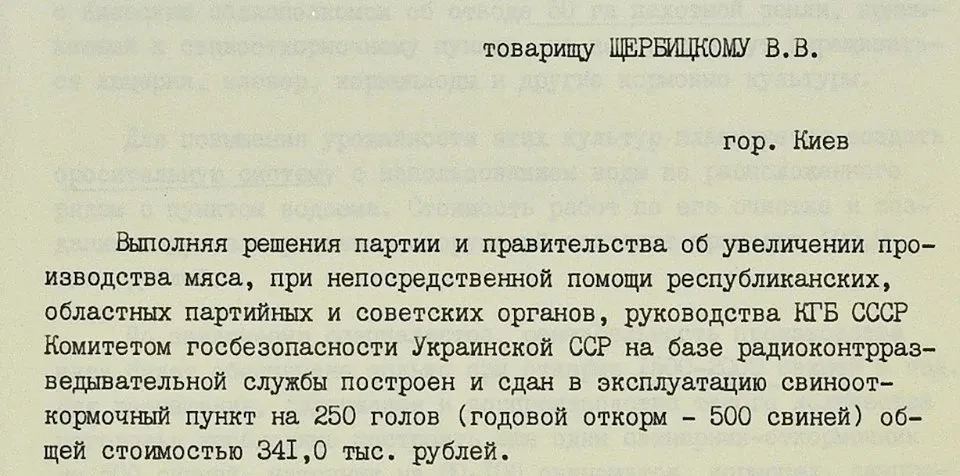
И кстати: пусть это прозвучит несерьезно, но КГБ Украины в 80-х годах, например, построил собственный свинооткормочный комплекс, о чем КГБ докладывал первому лицу республики. Чекисты внесли свой вклад в животноводство и обеспечение людей мясом. Очень полезное дело, между прочим.