
Translated material
Red in black
How Sergey Loznitsa Stalin buried
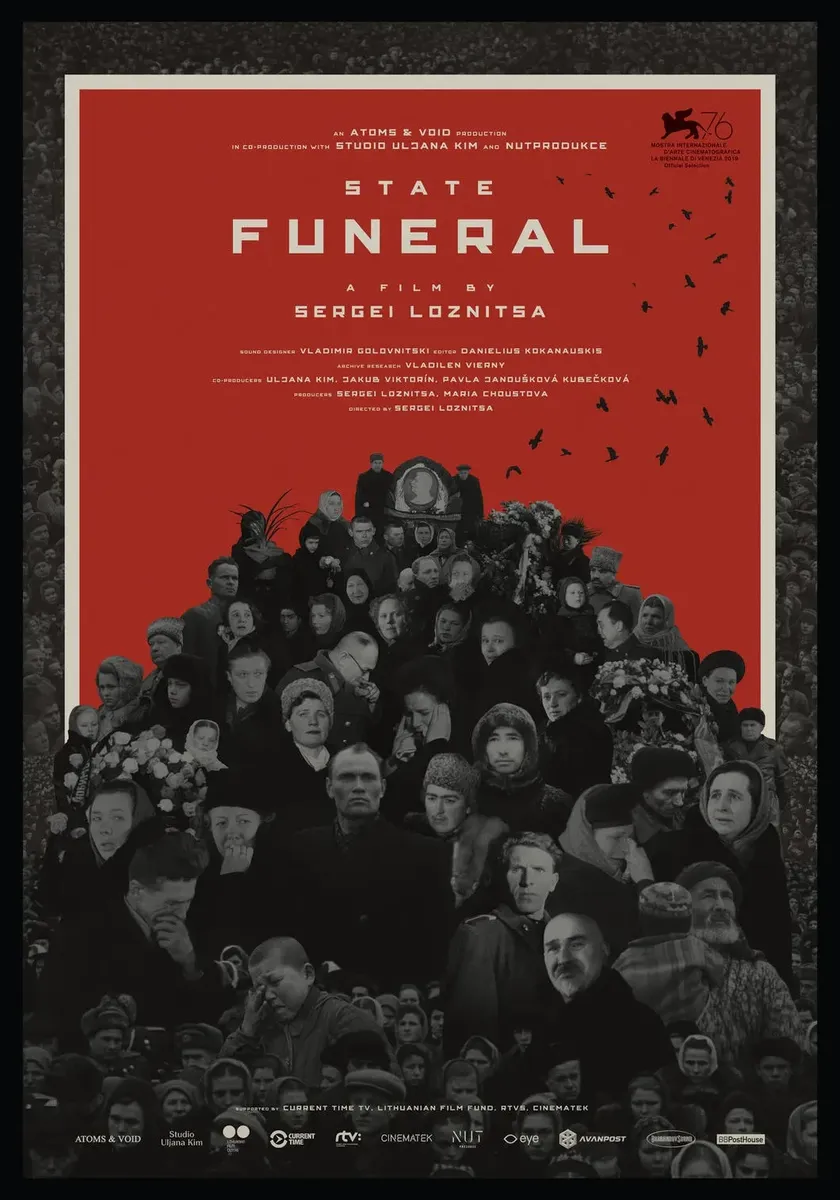
The world premiere of the film "State funeral" took place in Venice. But Russian spectators will see the film, “Artdokfest” included it in the competition.
The red title "State funeral" is on a black background. The picture is based on a unique archive video of the funeral of the Generalissimo. A giant installation that has gripped an immense country. Millions of grieving, frozen, lost, perplexed. The father of the peoples died? But the gods do not die - like demons.
Loznitsa and his group spent a lot of time on the restoration of film and audio recordings. Color and black and white shots interspersed with a terrible impression-as if they were removed not almost 70 years ago. And yesterday, today. It seems that in this line there are our friends, neighbors, fellow students, colleagues and their children. Extend your hand - touch their hands. The feeling of momentary creates and, as always for the director, carefully recreated sound accompaniment: the sound of factory whistles, saluts of guns, a collective rustle of steps and a knock of heels, a rustling of paper on the rostrum of the mausoleum.
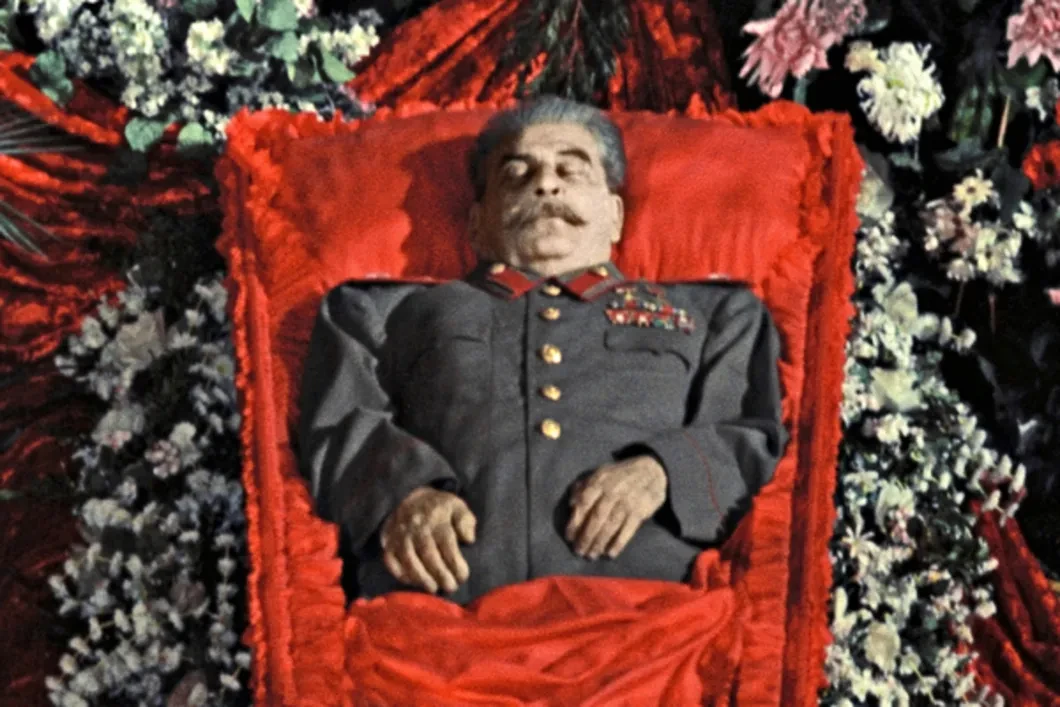
After all, in this line, they still stand at his grave on March 5 in order to bow to an eternally living corpse, with excitement to lay out flowers, drive away the blasphemy-antistalers. The dragon does not die, even if it is broken by paralysis. The puny body solemnly lies on a giant grief of flowers. The body is carried in a special coffin with a transparent window so that the body can look at heaven. They carry, like an Egyptian pharaoh, the main servants-disputes.
For Loznitsa, the rituality of a cosmically large -scale event is not just an integral part and the basis of a “strict regime”, but also the magnificent climax of the personality cult.
The film is divided into conditional chapters.
Chapter one - "bad news"
The tragic news was filed with pompusively in the voice of Levitan, like an announcement of the capture and surrender of the city. This is on the one hand, on the other - surrealist. Well, why should the posters know the details of the epicrisis: “On the basis of atherosclerosis ... hemorrhage in the brain, in its left hemisphere ... Along with the right -sided paralysis of the limbs and loss of consciousness ... damage to the stem part of the brain with the disorder of the most important functions - breathing and blood circulation.”
A large country is immersed in dark wilds of sorrow. Cities, auls, mountains, Siberian villages, miners of Donbass, Baku oil industry workers, collective farmers of Tajikistan, residents of Alma-Ata, Stalingrad, Yerevan. At numerous rallies and meetings, workers with wet eyes take an oath to complete the great work of the construction of communism, bequeathed by Comrade Stalin.
Chapter two - collection
At the airfield, members of the Central Committee busily meet government delegations of the fraternal republics, the Communist Parties of foreign powers. The plane behind the aircraft, handshakes, representative cars, aircraft ... The repeatability includes an association with the conveyor. The machine for receiving guests and organizing the funeral is already debugged. The machinery, the harsh clarity in the execution of the order, as you know, is an integral part of totalitarianism - Lee Hitler, Stalin.
The radio does not fall silent, it is the main source of cosmic grief. “There is no death here, there is an eternal life! Immorter in the communism, to which we are going. "
Amaze details. For example, wreaths: from sandy acacia, tulips, magnolias, heavy ears of wheat, stainless steel, brass and mighty bronze of oak leaves and acorns. Wreaths go, fly, float from all over the country. After the funeral, they do not have enough space on Red Square.
Chapter three - queue
She crawls from the Kursk station along Sadovaya, turns to Tverskaya. Tverskaya from the Belorussky station to Pushkinskaya Square is filled with people. Trucks and dense rows of the military compress it, tamped, directed. She is still swaying to Pushkinskaya. Walks like a sea.
There are no episodes with a crush in the film, either destroyed, or hidden in special -hazards. Experts believe that from the entire giant corps of the filmed material - dozens of operators throughout the country worked - sixty percent. I think that they got into the frame and “slow -minded”, perhaps even those six students who carried the crowd of a coffin with the body of an outstanding composer Prokofiev. But where to look for these shots?
Chapter Four. Column hall
People climb the stairs with rolled silk railing and mourning flowers. They are trying to make out a god of flowers, drowning in them, drowning in them. Near the coffin there is a crushed, frightened Vasily Stalin, hand in hand with him - Svetlana Alliluyeva with a impenetrable expression on his face. The servants of the authorities vigilantly guard the coffin, not letting the “strangers”: the newly -made Prime Minister Malenkov, Beria, Molotov, Bulganin, Kaganovich in the prestigious first row. Beria suspiciously worsens with glasses.
“We swear,” tears the soul of the radio, “that all our thoughts belong to our Communist Party.” The miners of Donbas believe that it was Stalin who lit the stars. Pioneers are honored at the coffin. Hierarchs bring a wreath from the Orthodox Church, which Stalin destroyed. A rally begins at the Kirov plant.
An endless crowd flows past the coffin.
The most valuable, attractive in the film Loznitsa is faces. Simple and intelligent, young and dotted with wrinkles.
Alarmed and calm. Tears on the cheeks of women and men, generals, workers, artists. One with a theater binoculars. To look out. Remember. It looks like communion. Or on a grandiose, thoroughly staged performance, which the Pravda newspaper will call “great farewell”. The 1953 documentary Khronika documentary was also called, which became the basis of the picture of the Loznitsa.
Humor occurs in the most unexpected moments. For example, the portraits of Stalin in different republics are different. Unexpected in Belarus, here the leader is the snub -nosed Belarusian. But the concentrated creators at the coffin: artists inspiredly draw portraits of a dead man, sculptors sculpt him as a living. The first poets of the rampant compose and read on the radio passionate poetic viras for the glory of the leader. Fascinated - fascinating the masses ... until today. “We, the last groan of cherishing, did not cease to feel alive” (Vera Inber). “Your life, any of your words is a guide to action for us” (Sergey Smirnov). “May your era are tormenting, stretching from century to century” (Olga Bergholz). “There are no words to tell them how we grieve for you, Comrade Stalin” (Konstantin Simonov).
Fifth. Red Square
Mausoleum with two names: Lenin, Stalin.
Tribune with honorary guests: diplomats, honored and folk. At the Mausoleum, members of the Politburo in pies, papakha, Beria in a black hat, half a step ahead of Khrushchev. All roles are painted here. The manager Khrushchev opens a short rally. The first word is Malenkov. Beria's main words are a call for vigilance, repuls the enemies. "The party will move the ranks even more ..."
And again the portraits of listeners. Thousands of portraits. They buzz through the country, steamboats, factories, and trains are howl. The howl breaks off a minute of silence. Crowds of people froze, as if scratched, either from grief, or from the March cold. Excavators, tractors, machines, timber trucks and lumberjacks with saws stood up. A strict portrait of the leader flies on them on the stele of the crane: are everyone grieving? Are there any evading?
It is curious that in many speeches the word "family", "native government" is increasingly sounding. In this multimillion -dollar family, a mother is a party, father is Stalin, who "in every crumb, every sigh." So the people remained an orphan: "Who are you leaving us for?"
The genre of the film is very unexpected. Lullaby. To the music of the Blanger and the poems of the Isakovsky, the country is beating its sleeping people and his Father Tiran: “He will give you strength, the road will indicate the road / Stalin with his hand. Sleep, my sparrow, sleep, my son, / Sleep, my native call. "
Cinema Loznitsa - about the dream of reason. About the death of an era that does not die. About the mourning line, which is crossed by millions, enchanted and pumped up by propaganda, peering into the future and again crossing the line ... back.
“State funeral” is a study of the phenomenon of the relationship of terror and illusion, incomprehensible, frenzied attachment to tyrant, mechanism and magnetics of myth -making. The readiness of the collective subconscious subconscious mind is emotionally in an ideological order.
Three days and three nights were farewell. The magical kingdom, which lost the lover of the dragon, was raging inconsolably, although it is no longer necessary to send sons and daughters to the block.