Date
Author
Владимир Севриновский

Preserved copy
Translated material
First blood: how Chukchi whales live
In the summer, journalist Vladimir Sevrinovsky went to Chukotka to make a photo project about the community of local whales, who do not forget traditional fishing and hunt the sea beast by the same methods as their ancestors. Samizdat publishes a report on a large hunt in the world of Arctic post -apocalypse, where people in houses on piles count the wanders of relatives, kill whales with their hands, and then drink tea with them.
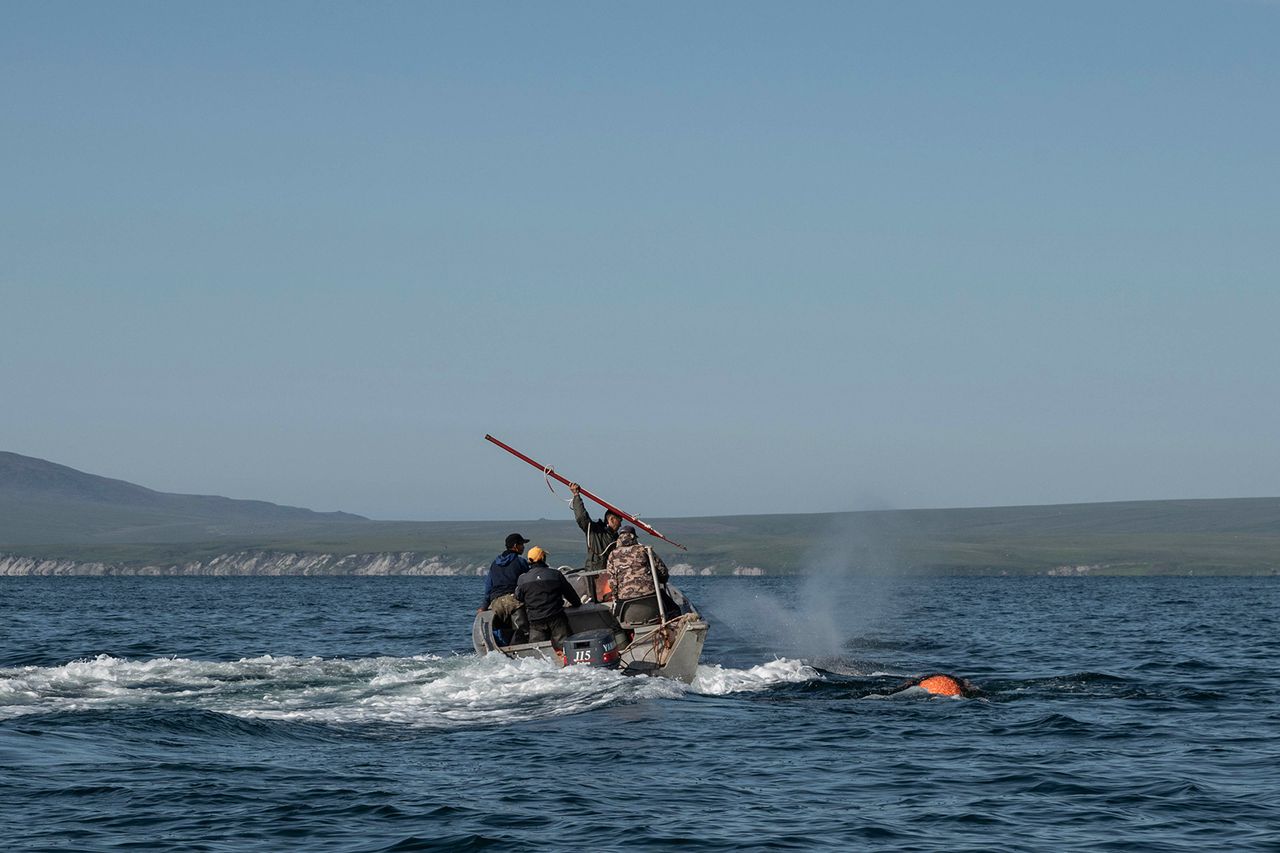
The head of the Kitoboev community Vladimir Eneuchewwun draws the air with his nose: “Do you smell the smell? This is an exhalation of a whale. He is nearby. " A fountain takes off a half -kilometer above the water - and the boats rush in pursuit.
The St. John's wort is nervous. The first whale broke. Harpoon stuck in his side, the animal dived, and a bright red buoy, tied to a metal tip, disappeared under water. But after a few seconds, he surfaced and swayed on the waves: the tip of the harpoon did not turn in the body, jumped out, and the whale left. Now Vladimir has noticed not far away the second - and three light boats with hinged “pits” rushed after him.
At the first, experienced Kitoba already got up to his full height and a harpoon brought in a picture, not paying attention to the pitching. On the second - the team - the boat we are flying with the head of the community: he gives instructions on the walkie -talkie, twists the steering wheel and grimaces in pain - last night he damaged his hand. In the third, the boy Rustam floats with his father. He is concentrated and gloomy - today his first hunt.
“Gorbach,” the walkie -talkie brings out in disappointment. On hunchbacked whales, hunting is prohibited: both the law will be violated and compensation will not be paid.
For another twenty minutes of screening through the bay of Lavrenty, dissecting the eastern end of Russia on the border of the polar circle, and now is a new goal. Black shadow rises from the water, and the boats rush across, preventing the whale from catching their breath. The first harpoon flies. Bui dives - and this time rises soon.
“That's it, they put the mark,” Vladimir whispers.
A huge fin takes off next to Boin from the sea. The nearest boat sharply turns to the side. Kita does not cost anything to turn him over and kill the hunters. At one of the past exits to the sea, the tail shot over the boat broke his comrade's neck. But next to the first buoy, the second is, followed by the third. They pull upstairs, and the whale is increasingly difficult to dive. A huge animal beats on the surface. Three meters from the boat with Rustam rises a dark head in shells - and with a splash falls back. Father is preparing to lay a turn, Rustam will stand up and brings a harpoon.
On land
“The sea beast is not prey for us. We meet each whale as a dear guest. Like you, ”Vladimir grinned into a short graying beard, waved a slice of black tongue into soy sauce, chewed with appetite and said blissfully:“ Young whale, gentle. ” Just came from California. "
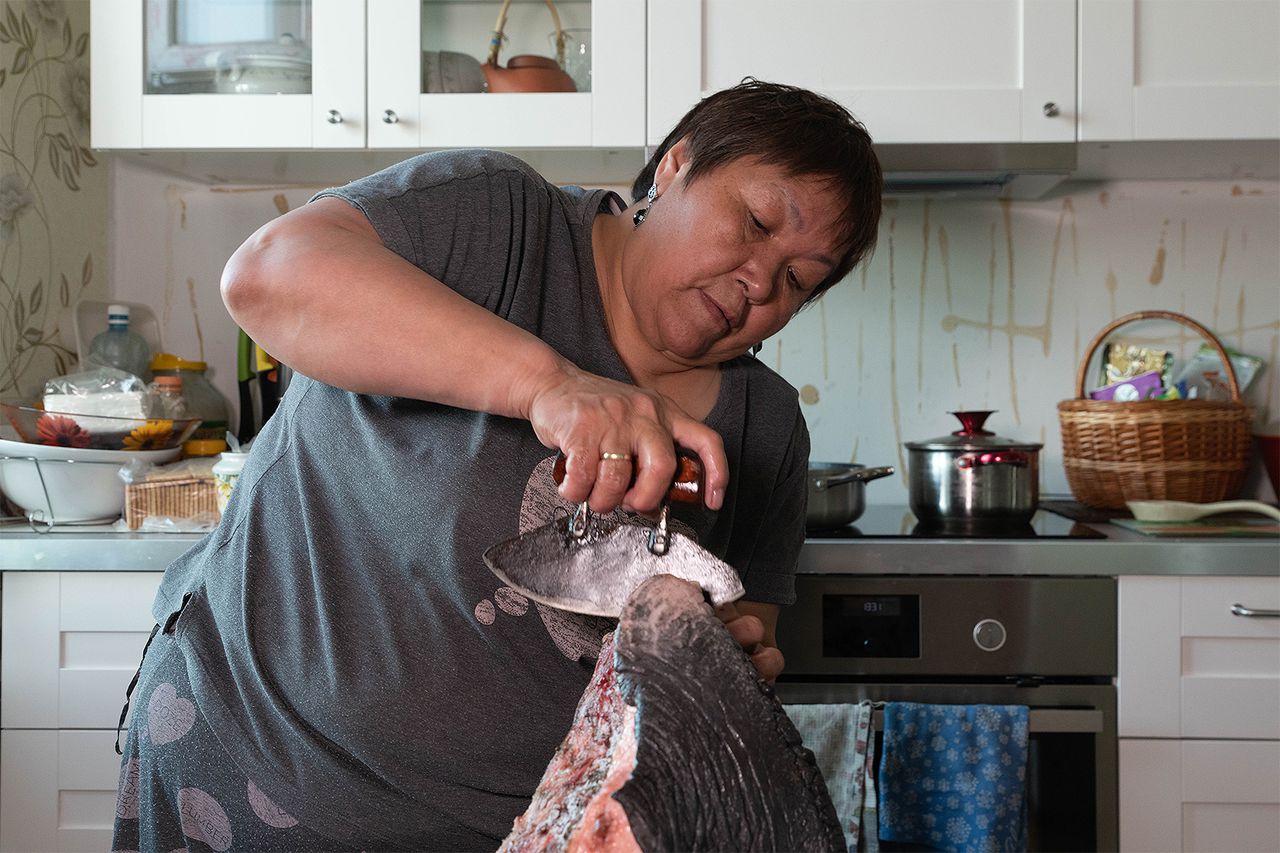
Ten days before the first hunting of Rustam, I am sitting in the kitchen at the head of the Kitoboev community. Typical furniture, wallpaper with leaflets, a photo of a son is a familiar environment that you meet everywhere in Russia. The wife of Vladimir Anna cuts a whale tongue with a female knife-pekul, similar to a semicircular tesak and braid at the same time.
Vladimir has a round bronze face with mobile black eyes. In a smile, failures are blackened, there is not enough index finger on his left hand - infection began from the wolf bite, and the hunter, not particularly thinking, was cut off with an ax: “This is still! A friend on fishing fell into the nose of the hook. They thought to gently bite off with ticks, and he opposed. He asked to cut with a piece of nose and began to catch on it further. There was no spare hook, but the fish pecked, entered the excitement. ”
Outside the window, the seagulls cry, the hills descend to the shore of the pale blue Bay of Lavrenty. The landscape crosses a series of rickety electrical pillars. Vladimir and Anna live in a multi -storey building on piles driven into permafrost on the outskirts of the village of Lavrenty, the capital of the Chukotsky district. In the seventies, the government decided to “compact” the region, built here a school, a hospital, a recreation center and several Khrushchev, in which the Chukchi and Eskimos from the villages, scattered along the coast of the Bering Strait, were brought.
We listen and understand the songs of whales and dolphins in the release of the podcast "Sounds of science"
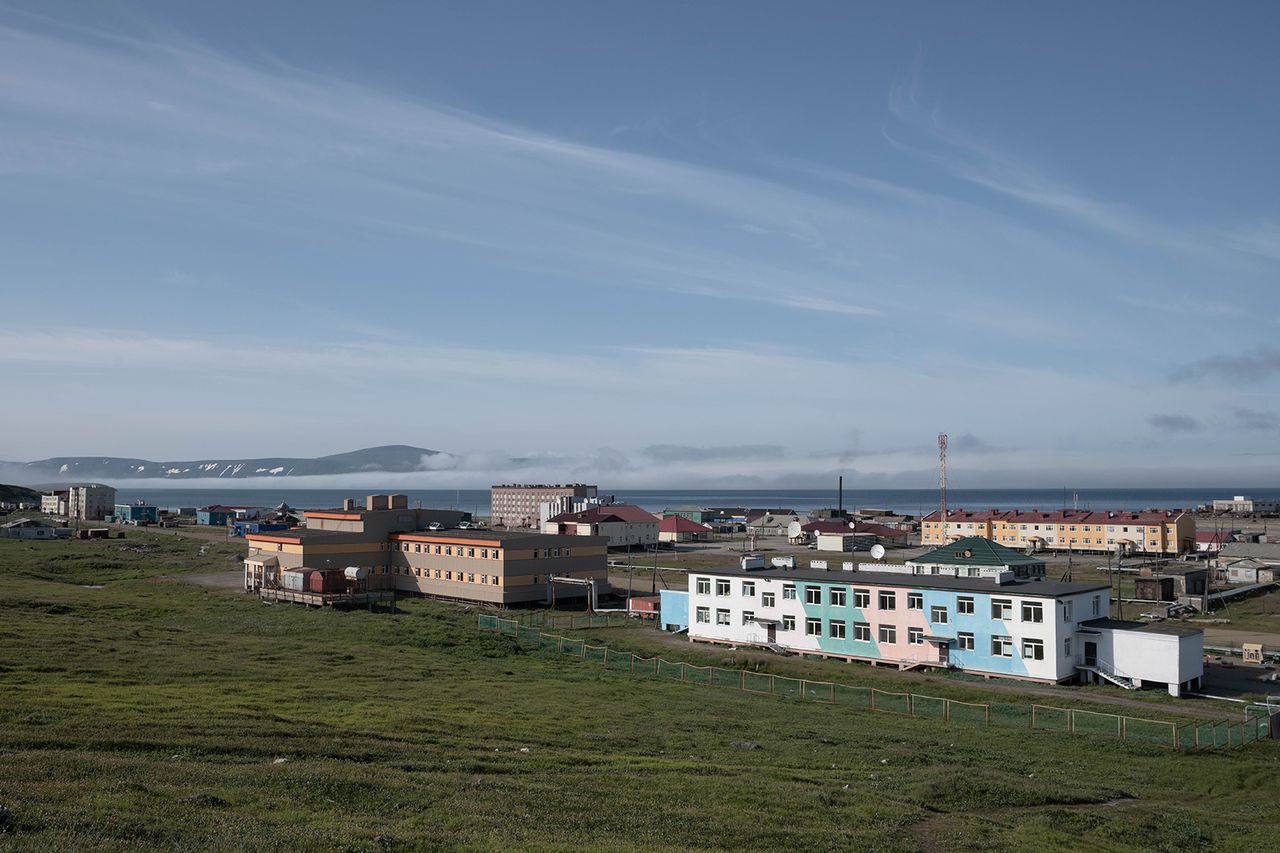
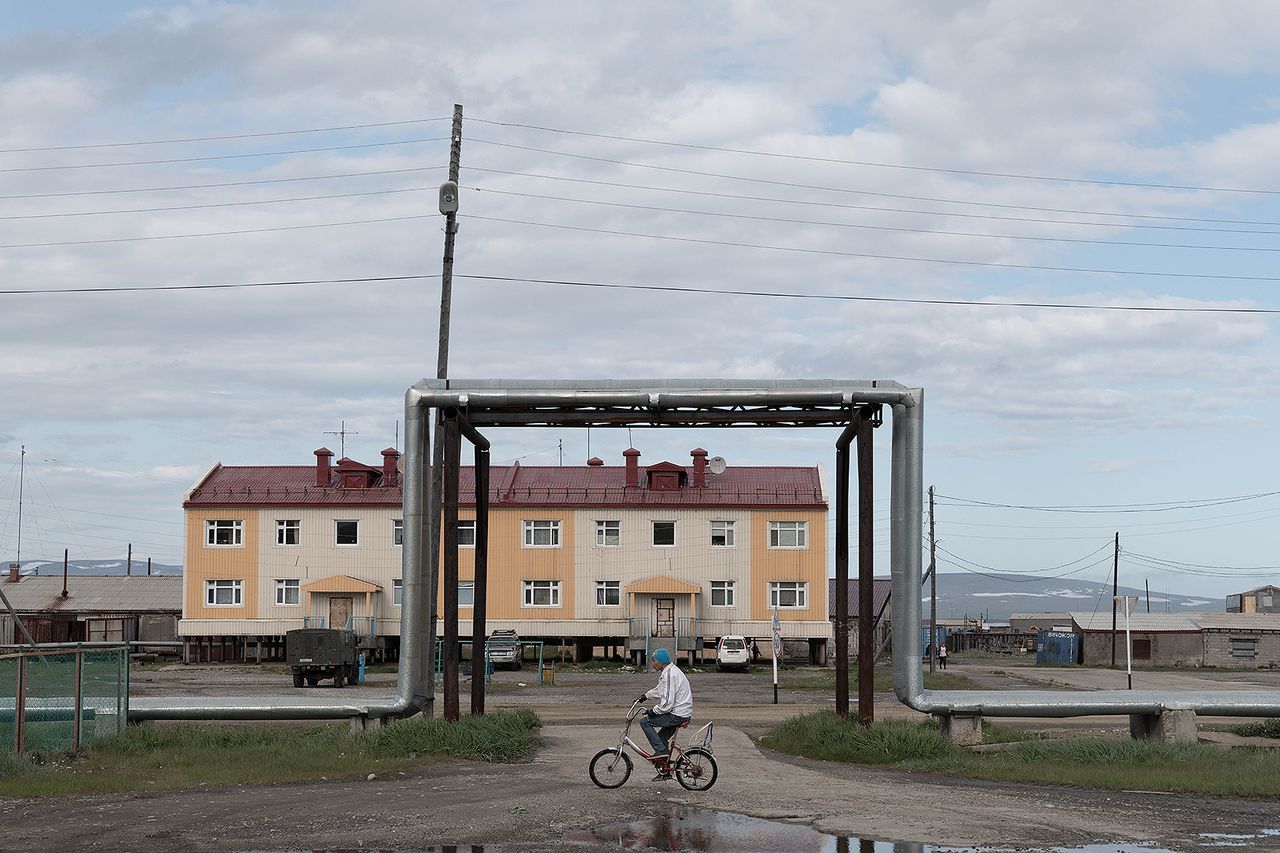
The take-off and landing strip cuts the village with a population of a thousand two hundred people exactly in the middle. The road here is only to the neighboring village of Lorino, therefore, minus, the Captain Sotnikov, the airfield coming several times during the summer of the old ship, is the only means of message with the world. During the rains, the clouds are not allowed to sit down, and a wet soil take -off - to rise, and the village is completely cut off from the continent for a couple of weeks.
Dogs of various kinds roam the streets, but all with clear blue eyes.
“This is in the genus and a Sharpey and the shepherd,” Vladimir nods at a strange dog with thoughtful folds on his forehead. - Just like ours. There are almost no pure Chukchi left here. ” Vladimir’s grandfather is a Cossack, his closest assistant’s father is an Ingush. Both consider themselves Chukchi, and not without reason: the language of the community knows the language better than most neighbors.
Finally, the UAZ slows down near the large hangar on the shore of the bay. It belongs to the community of marine St. John's wort Daurkin, named after the first Chukotka cartographer. In 1747, in the midst of the Russian-Chukutsk wars, his family was captured by the Russians. Father fled; Mother, a relative of one of the Chukchi leaders, was burned alive, and the boy was sent to Anadyr. There Daurkin was baptized by the name of Nikolai, they gave him an education, and until the end of his life he faithfully served the Russian state as a pioneer and geographer.
In 1742, the Senate issued a decree "The Non -Minar Chyukch is altogether"The war in which the family of Nikolai Durkin died lasted several decades. The Chukchi greeted the Russian pioneers with such fierce resistance that in 1742 the Senate issued a decree "of the non -named chyukch to eradicate at all." According to various calculations, in the process of executing the decree, Russian troops destroyed up to a third of the indigenous population of the peninsula, but they still lost the war. In the decisive battle of the Chukchi, the head of the punitive expedition, Major Pavlutsky, was killed, seized the regimental banner and went on the offensive. The empire had to agree.
In exchange for peace and the cessation of attacks on the prison of colonists, Chukotka leaders were offered the nobility and almost complete self -government - the Chukchi empire was nominally, without paying Yasak. Where rifles and artillery were powerless, alcohol first played a fatal role, and in Soviet times, boarding schools, where the children of the small peoples of the North were forcibly taken away.
In the perestroika, the whalers actually saved the melting population of the peninsula. Then the shops were empty throughout the country, but here it resulted in a real humanitarian catastrophe and full -scale hunger. Without subsidies, without modern weapons and high -speed boats, the whales pricked the sea beast with peaks from old boats and fed people. Vladimir speaks of difficult times simply: "When Kita needs to breathe in the winter, he breaks the ice."
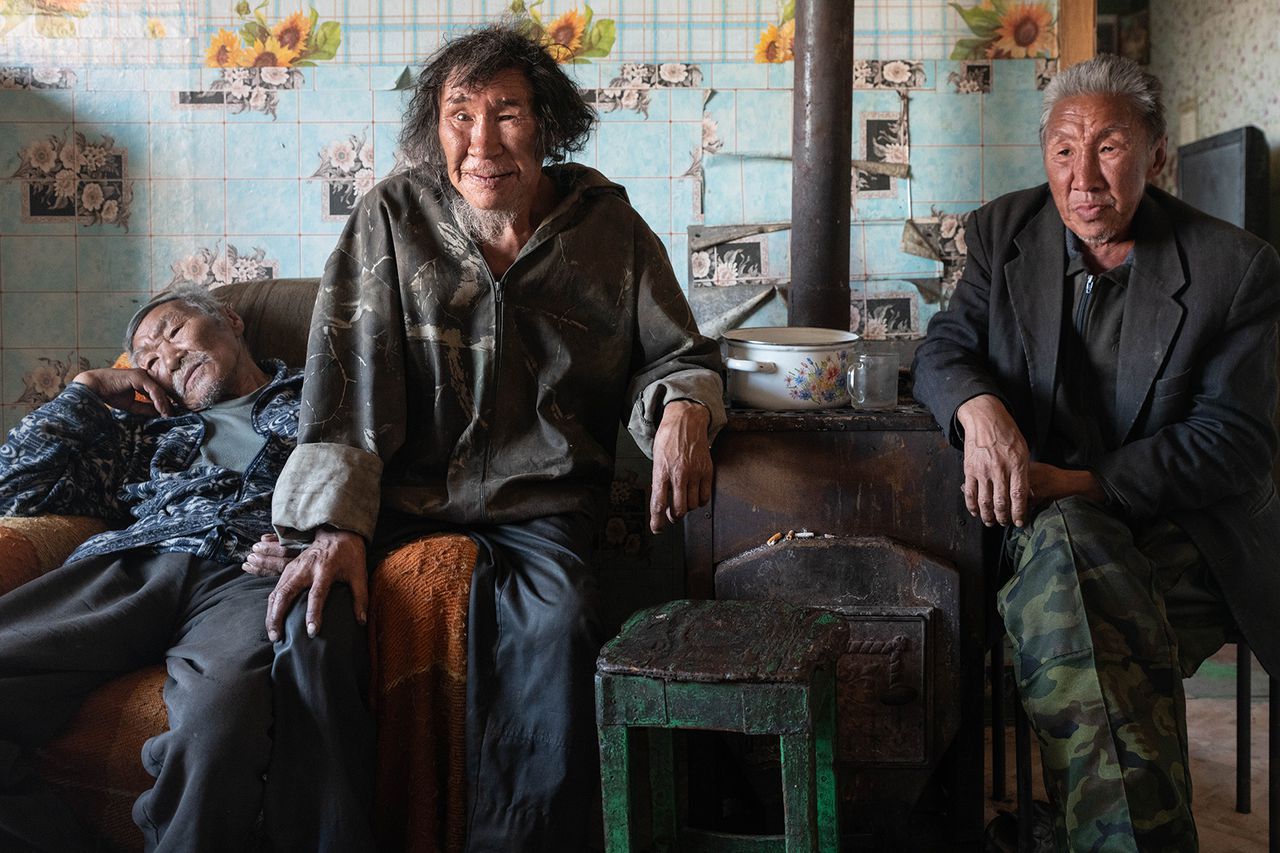
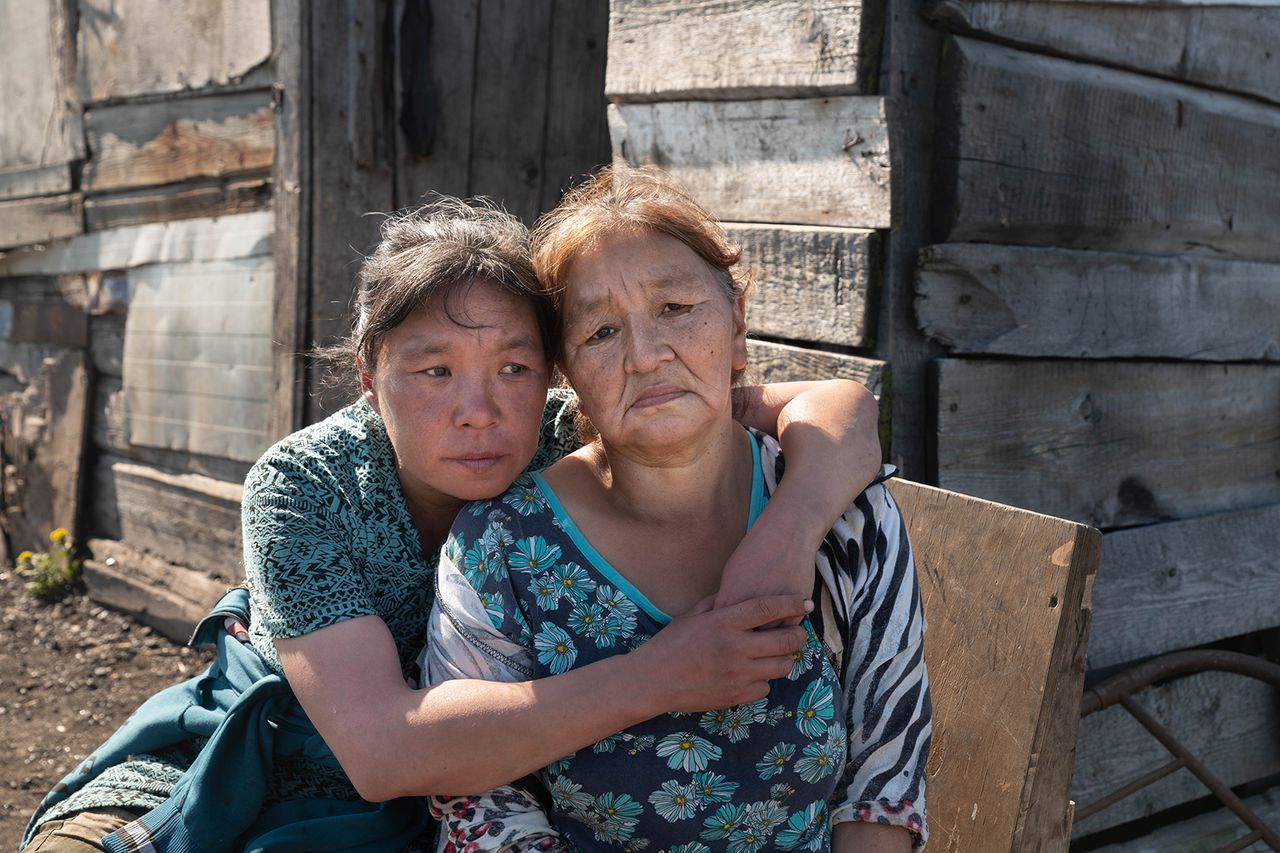
But the extinction of Chukotka, which began in Soviet times, continues. Today, the Chukchi remains about 16 thousand, of which less than a third of them are owned by their native language - mostly old people. It's not about assimilation, since the indigenous people of the Arctic are not Russian. Having lost the language and culture, the Chukchi in the villages get drunk and die, especially if they are not busy with reindeer husbandry and do not follow the sea beast.
The hangar of Kitoboev from Durkina has heavy iron gates on both sides: some are turned to the village, others open to the sea. At the entrance there is a dark room where they drink tea, a little further - a common workshop where whalers sharpen harpoons and repair equipment. A large photograph of the Ossetian mountains hangs above Vladimir - a reminder of the Caucasian roots. Behind the workshop - a bobin with a rusty chain and a hook on which the boats are lowered into the sea and pulled back. In the corner, hunters throw severed heads of seals - come in handy for a report.
The naval peoples of Chukotka get the naval beast in special government quotas. It is forbidden to sell extracted meat - only there is and share with the fellow villagers. Information about the sealing seals, walruses and whales is entered into a special document, according to which the state then pays compensation for the work of the hunter. Most of the government quotas fall on the seal.
“The most delicious in the seal is the eye. Unless it’s hard to chew the pupil, ”says Vladimir. - Recently, one kid, very tiny, put him entirely in his mouth. Trying to figure out - does not come out. I don’t want to spit out. And let's make signs to his father to cut his eyes right in his mouth. ”
Brush whale meat hangs under the tributary of the hangar. The members of the community are dipping him in sour fat, seize with lard - that’s the whole dinner. A woman of an indefinite age looks and with embarrassed overwhelming beg a piece of whale skin. Hunters dismiss like a fly. She takes a couple of steps back, but does not leave, spins nearby.
I am interested in when the closest hunt for a whale, but Vladimir only grins:
“They don’t plan so here. It's too late today, and tomorrow will be tomorrow. Grandfather said: “Let's go ashore - we will see there”. ”In the sea
In the hangar, brand new boats are prepared for the first descent. They have to be delivered to the branches of the community in other villages scattered along the coast of the Chukchi peninsula. Vladimir shouts to workers to move, and calls them lazy. Only Rustam, the son of an engineer in terms of fishing, do not need to adjust. His swarthy, ever-concentrated face leaves no doubt: like Vladimir, some of the boy’s ancestors came here from somewhere in the southwest. He answers the questions monosyllabic and revives only at the sight of hunting or fishing equipment.
Rustam is thirteen, but he communicates little with his peers from the village. He works with St. John's wort and at the first call rushes to help everyone who asks. In his free time, the boy puts the harpoon in order: heals the shaft and sharpens the metal tip that stuck in the body of the whale.
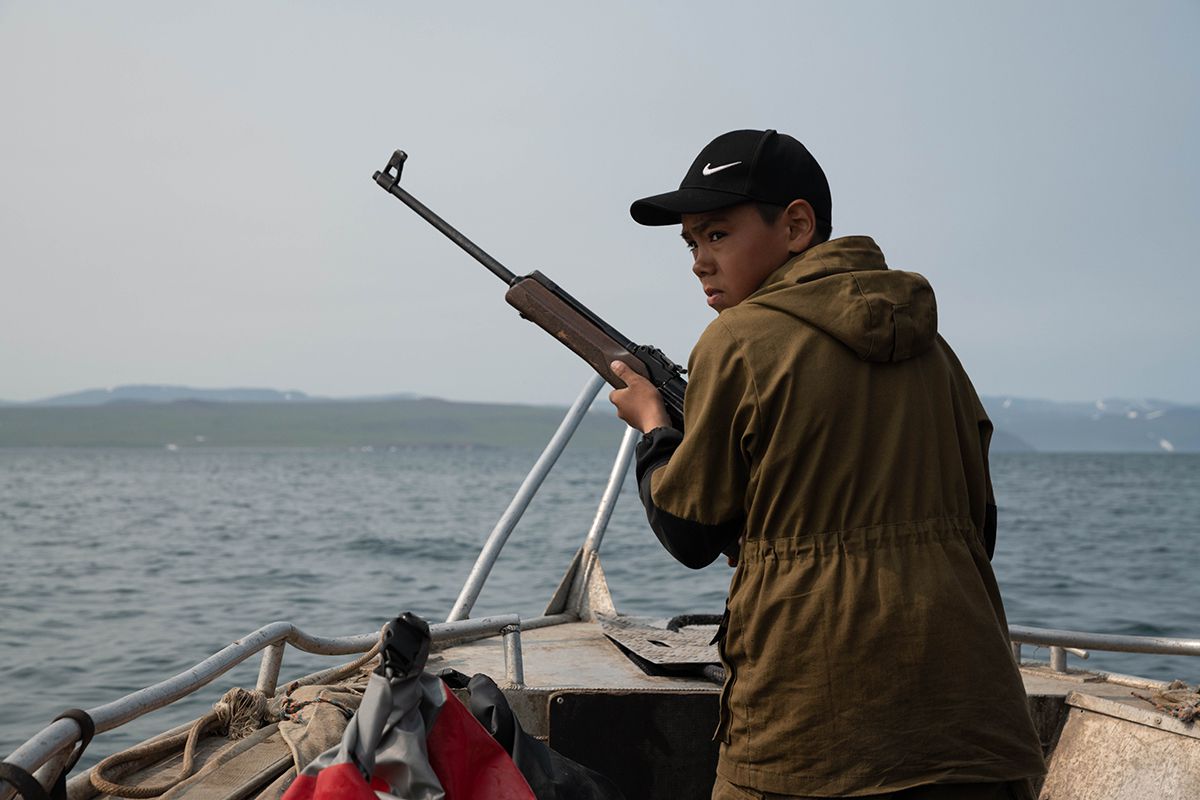
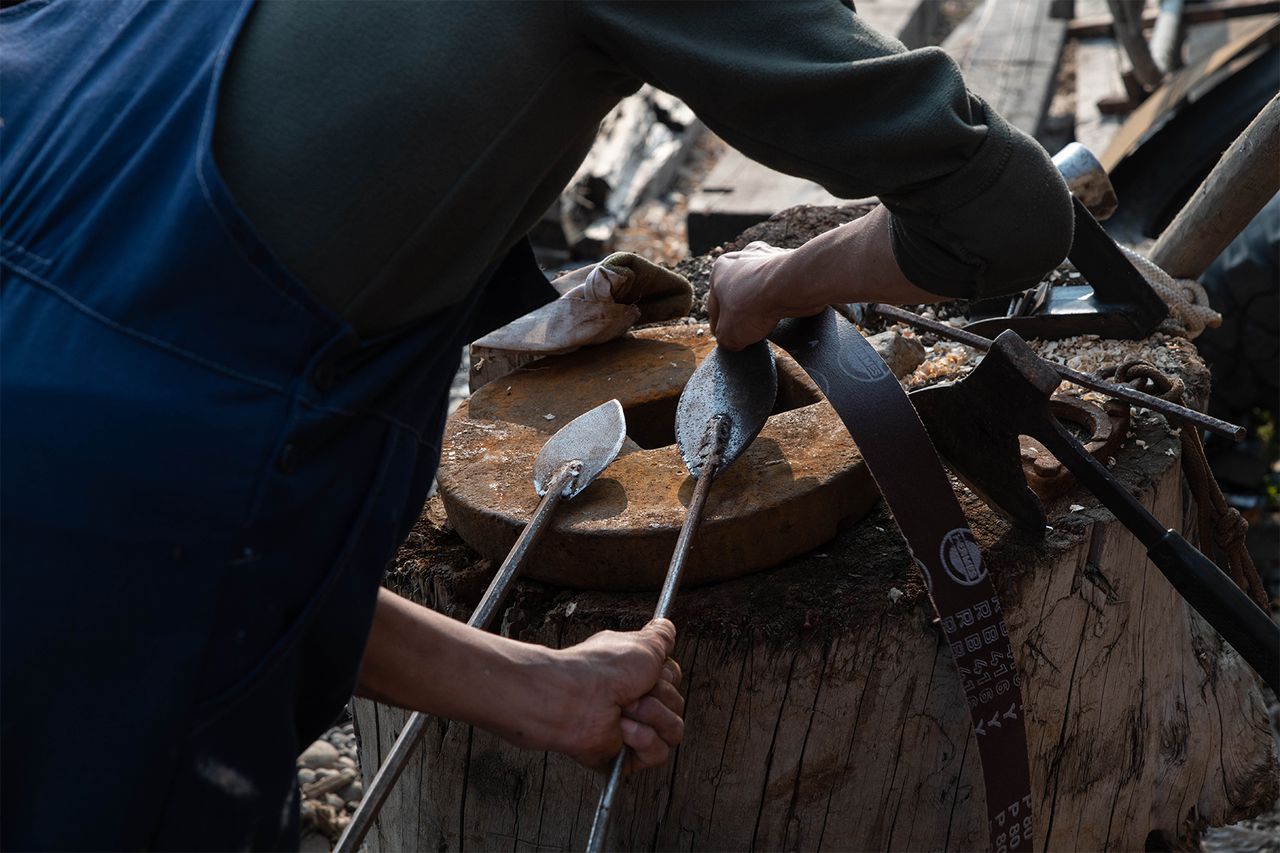
According to the principle of action, he differs little from the bone ancestor, to which the Chukchi, according to archaeologists, used at least the last two thousand years. A rope with a buoy is attached to the tip. When the harpoon gets into the whale, he dives, the rope pulls and turns the tip 90 degrees. He firmly stuck in the flesh of the animal, and buoy pulls him upstairs and does not allow to swim. When the whale is exhausted, it is finished off from carbines.
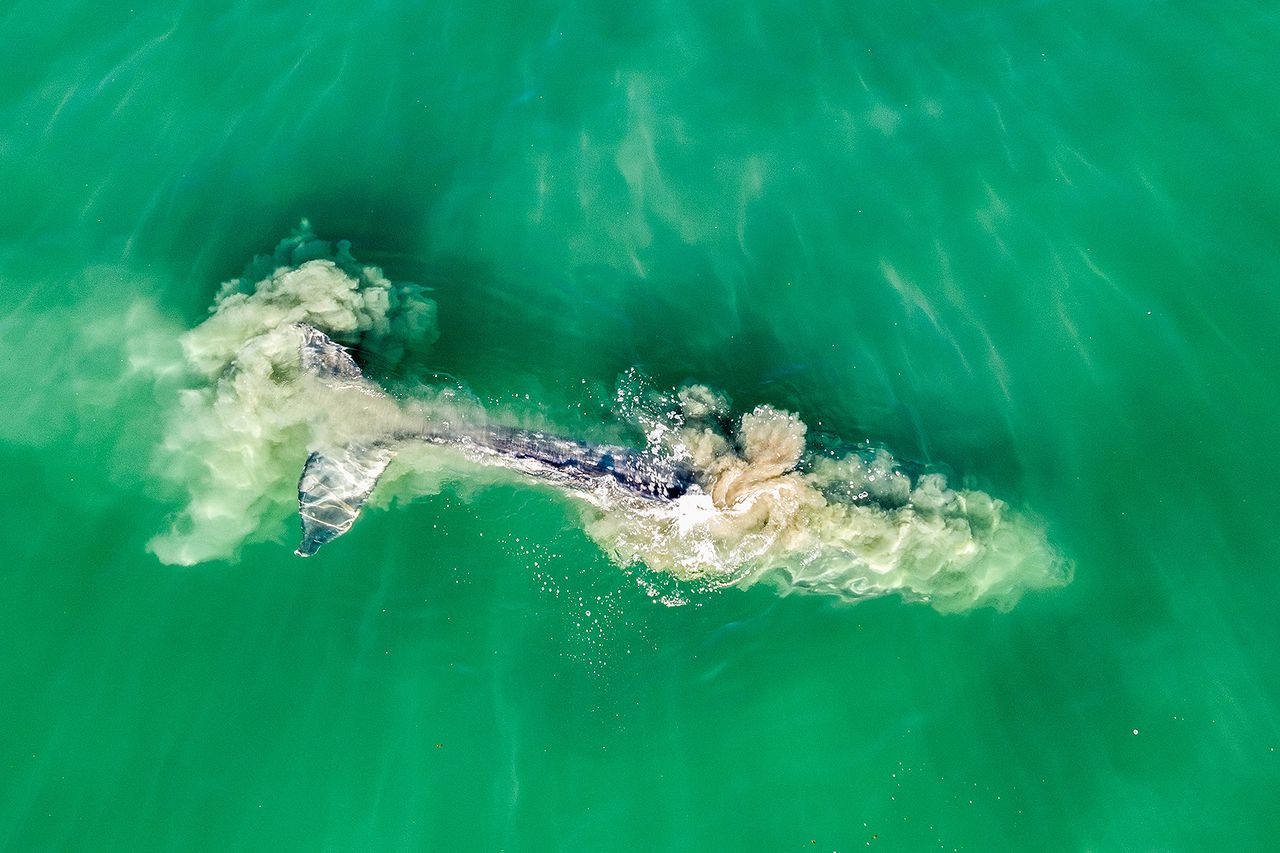
Employees of the Beringia reserve believe that the fishing of the sea beast with a manual harpoon does not cause a significant damage to the population. In fourteen Chukotka villages, the annual quota allows the fundamental to the fundamental legally mining one hundred and forty whales a year - less than one whale per village per month. Old -timers recall that in the fifty whales they mined here on an industrial scale, shooting from anti -tank guns. About a third they drowned, managed to swim to the rest, put the hose inside and pump up with compressed air. After such a procedure, the meat was not good for people, so they fed blue foxes at the animal farms.
Modern ecologists call Soviet methods and volumes of industrial hunting for whales one of the most meaningless crimes against the environment in history . According to ecologists, from the 1930s to the 1980s, about 540 thousand large whales of various types were obtained in the USSR water area-bypassing all international agreements. In addition to the USSR, the leaders of the whaling of the second half of the twentieth century were also Japan, the Faroe Islands, Canada and the countries of Northern Europe. However, by the eighties, the number of large whales on the planet fell so much that the efforts of international organizations introduced a moratorium on commercial hunting. Then the global volume of whale production fell at a time from 50-60 thousand goals a year to about 4-5 thousand-hunting for the sea beast became the almost exceptional privilege of scientists-oceanologists and indigenous peoples of the Arctic. In the rest of the world, the profession of hunter for sea giants has actually disappeared. The Greenland Inuits today have the right to extract 170 large whales per year - a little more than the Chukchi in Russia. The USSR for a short time resisted the introduction of the moratorium, but the restructuring soon began - and the issue was resolved by itself. The skeletons of the old whaling ships Chukotka are still rolling on the surrounding shallows.
New boats, getting in the hangar with numbers and engines, leave the Lavrenty Bay to go through the Bering Strait to the Arctic Ocean. Summer by Arctic standards is warm, the sea is calm, and still at full speed, the wind penetrates to the bones. The steering runs to Cape Dezhnev - the eastern tip of Eurasia. It is a little more than two hours before him. To the right of the water rises a black rock - the island of Ratmanov. An hour later, a smaller rock peeps out because of it-the island of Kruzenshtern. Dozens of generations of the Eskimos built dwellings there, fishing, hunted for whales, crossed a narrow strip of water to visit friends and bring brides. Since the sale of Alaska, the border between Russia and the United States has passed here, and no one lives on the island of Ratmanov today: in the middle of the 20th century, local Eskimos evicted, and now their descendants live nearby, on the coast of Chukotka.
“Previously, when they were friends with America, products were driving from Alaska. Yes, and we sailed to the Eskimos on Kruzenshtern, ”Vladimir says, peering into binoculars. - They live there normally. Get salary as border guards. They have everything they need for life: comfortable houses, a shop, a gym ... Only the head of the community prohibits the island. If you want to get drunk, go to the city of NOM. This is a cloak of Alaska, where unemployed Indians, drunks and cakes flock. ”
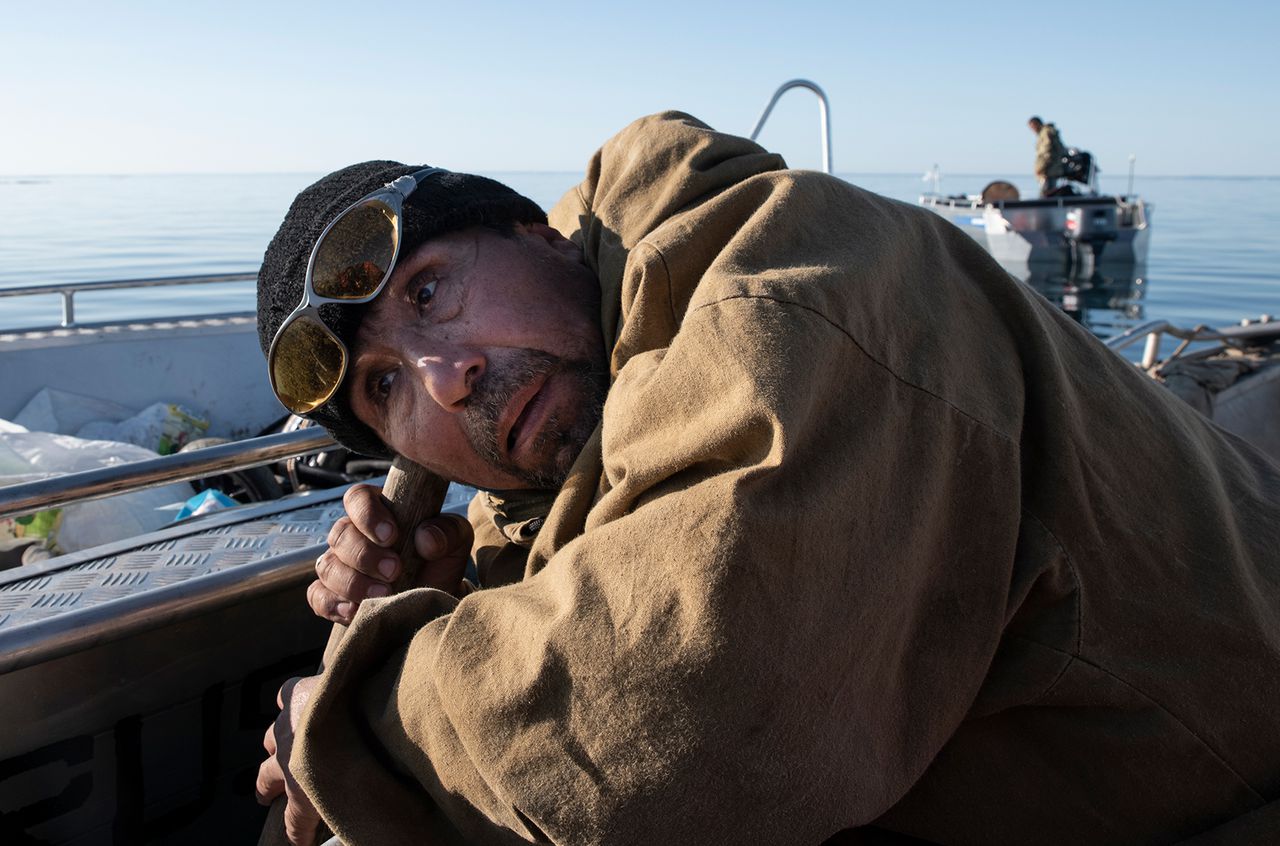
The islands are left behind. On the horizon hesitates a dark haze - either a sea mirage, or shadows of distant American mountains. The St. John's wort is stopped by boats, get carbines and muffle engines. Vladimir immerses the oar in the water, puts his ear to the handle and listens to the sea through it for a long time. The blade of the oar captures underwater sounds and passes them to the handle hunter, like a stethoscope. Vladimir rotates with a pole, looking for walruses and seals in the abyss. “In our village, small boys stuck logs into the sea bottom behind the surf line and listen to the singing of whales with their help. Those on a sandbank with leals float. Caress them, hug them. And the children will recognize them by voice. This, they say, grandfather, he has been coming here for two years ... ". Vladimir is listening for a long time, but the sea animals are prudently silent. Kitoboi hide carbines and continue the way.
Cape Dezhneva is a huge dark fist, exhibited to the east, towards Alaska. We are sailing an abandoned border station with a lighthouse, waterfalls, steep cliffs on which thousands of birds nest. Having passed the Bering Strait, the boats are turned west, into the Arctic Ocean. Behind the cape, Chukchi villages begin - rows of houses on narrow stripes of land between the sea and freshwater lagoons. Futuristic modular schools built under the governor Roman Abramovich, with purified drinking water and high -speed Internet, rise above dilapidated shacks.
The caravan loopes among the ice applied by the north wind. There are more and more of them every hour. A couple of days - and close, blocking the return path. “He leads well, cleanly. He does not look at GPS, - Vladimir steering praises. - For phones, the sea punishes specifically. If anyone is taking on the pipe, I teach it with an oars. With navigators the same thing. Young people are used to them. But the sea needs a third eye. You need to understand where the wind blows, where the wave goes, and not to stare at the screen. Otherwise, the battery will sit - and you are gone. ”
Each time, half a ceremony is running away to meet the boats: the St. John's wort is taken to the parcels, and sometimes fellow travelers. Only whalers, children and visitors are sober here - almost all adult Chukchi in the village of Impathel. Some beg vodka, others call on a visit. A particularly generous villager gives me a bloodied walrus member as a keepsake.
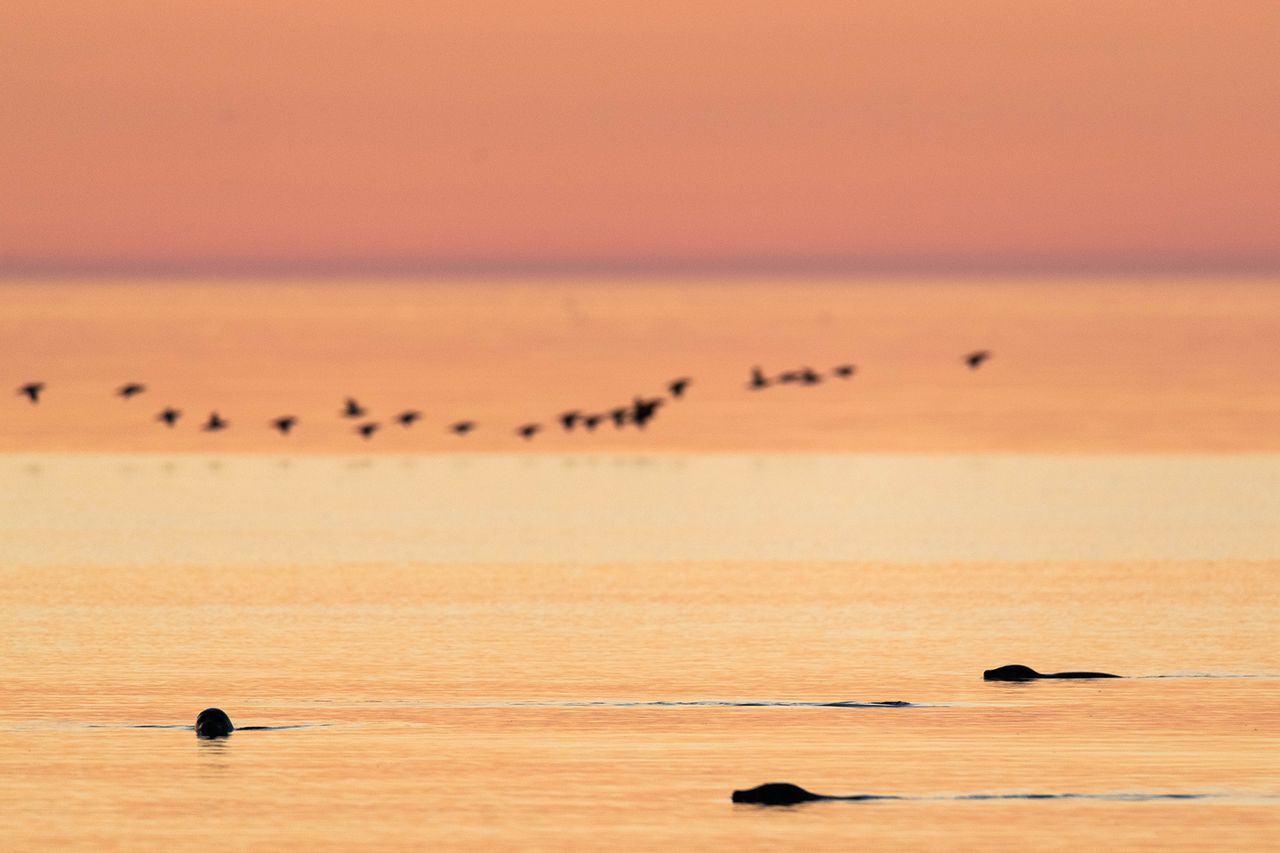
The endless polar sunset smoothly goes into dawn. The icy maze was left behind. The boats are swinging near the shore, stretched between the anchors and the berth ropes. In the golden-Alla ocean, curious heads of black seals are raised, sometimes a whale pops up in the distance.
The boy Rustam, who, for the entire trip, seems to have never thundered, helps local fishermen. Those in rowan determine the shoals of the lifting and stones drive them on the network. The fish is pulled out, muffled and immediately cut, tearing out the beating hearts like a special treat. This work is watched by a drunken woman, surprisingly similar to a beggar, begging whale skin in Lavrentia.
Against the wind
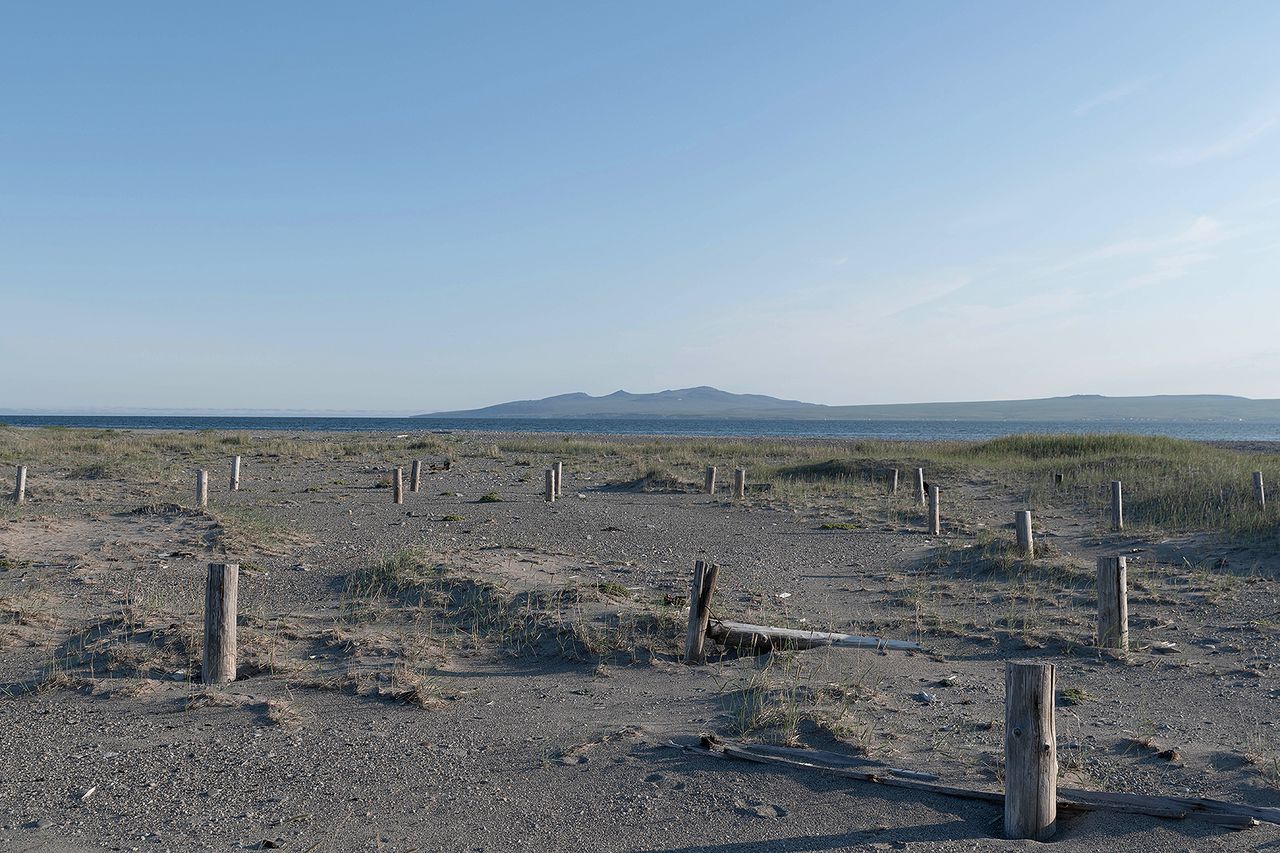
The abandoned village of Pinakul stands on the opposite bank of the bay from the village of Lavrenty. Twenty minutes on a boat between them is the road from the wreckage of the USSR to the world, doomed by this state to death - and still survived it. In the late 1970s, Pinakul fell under the “seal”-and all its inhabitants were moved to Lavrenty. But now, the whalers come here to rest and look out for the prey before hunting. “We are a plant that was torn from our native soil and planted where there is nothing,” Vladimir says about relocation. - You see - here the whales are teeming near the coast. Morzaver passes nearby. "
Pebbles on a narrow spit covering the bay are refracted in water, and it seems that the earth is breathing measuredly. In a five -minute walk from the sea, Vladimir built a house - a large, clumsy and cozy, with a wooden veranda and a ship's gallun.
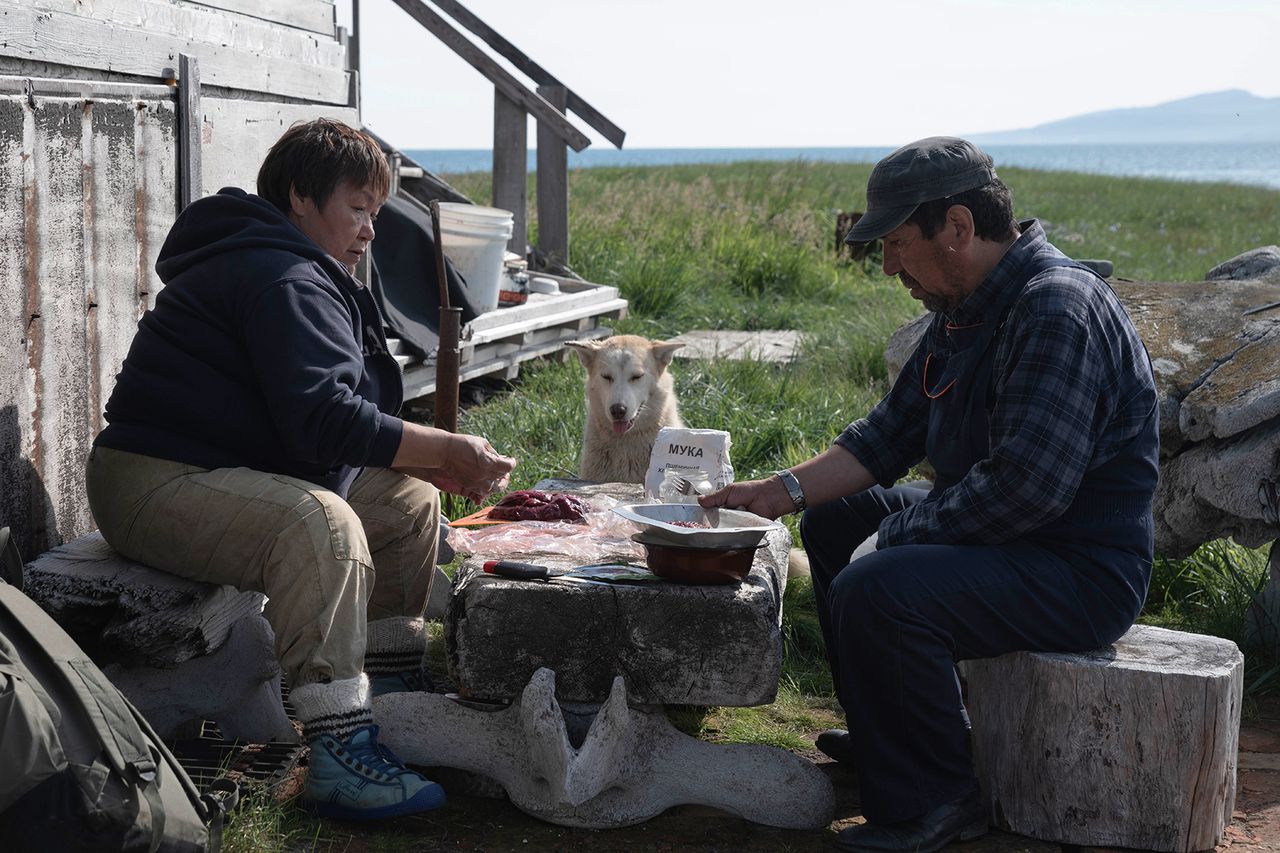
Жизнь здесь не похожа на быт хрущёвки на сваях на другом берегу залива. Хозяин дома восседает за столом, сделанным из черепа гренландского кита. Под крыльцом шныряют лемминги. Жена Владимира Анна прибралась в доме веником из журавлиного крыла и теперь старательно отбивает китятину бутылкой: мясо жёсткое, но, если правильно приготовить, на вкус как говядина. Возле дома сидят домашние собаки, за ними издали наблюдает дикий кобель. Владимир подкармливает его и явно симпатизирует бродяге: от дикарей получаются славные щенки.
На стене висит здоровенный китовый ус с резьбой, изображающей охоту косаток на кита. По чукотскому поверью, охотники, не вернувшиеся с моря, превращаются в этих хищников и помогают родичам загонять добычу. Рядом — плакат «„Единая Россия“ начинается с Чукотки» и старая карта Советского Союза. Чукотский полуостров не помещается в общий прямоугольник и торчит над ним.
— Чукчи в советское время считались низшим сортом, — вспоминает Анна, стуча горлышком бутылки. — В интернатах пугали: будешь плохо учиться — останешься оленеводом и охотником. Воспитатели не понимали наших разговоров и заставляли полностью переходить на русский. Но многие чукчи даже без запретов старались с интеллигенцией быть — и позабыли наши обычаи. А я всё, что мама рассказывала, помню. Она из богатой семьи, у неё даже татуировка на лице была.
— А у вас есть чукотское имя? I ask.
— Тынгат, — кивает Анна. — Это значит — первый луч рассвета. А Владимира зовут Тэвыл. Гребущий против ветра.
За порогом дома сразу начинается чахлая тундра с пятнами снежников возле воды, но хозяин точно знает границы своей территории. Неподалеку виднеются кости моржей и медведей. Бурых, забредающих в его владения, Владимир отстреливает. Недавно в соседнем селении медведи разрыли кладбище. Звери, попробовавшие человечину, опасны, пришлось их убить. Мясо бурых медведей чукчи почти не едят — в нём много паразитов. То ли дело белые, особенно молодые пестуны, ходящие с матерью. По закону это считается браконьерством и грозит тюрьмой, но кто запретит охоту жителю тундры?
«В девяностых приехал сюда японец с арбалетом, охотник за экзотическими животными. Мечтал белого медведя подстрелить. Заплатил долларов триста — тогда это большие деньги были. Я вспомнил одну медведицу, которая ходила на водопой с тремя медвежатами. Это много, самый слабый вряд ли бы выжил. Легли мы в засаду. Японец тетиву натянул, прицелился. Трень — и медвежонок упал. Как потом выяснилось, попал в самое сердце. Большой мастер. Думали, остальные убегут, а медведица принюхалась — и рванула прямо на нас. Я встаю — и стреляю из карабина в снег перед ней. One, another, third. Она всё бежит. Поднялась передо мной на задние лапы. Громадная, сильная. Жаль такую убивать. Я прицелился и кричу по-чукотски: «Стой! Ты же мать, тебе ещё двух детей растить». Замерла она, потом повернулась и ушла. А я смотрю — в карабине кончились патроны. Прыгни медведица — не сидел бы я здесь. Глянул на японца — он в обмороке валяется. Всё пропустил».
Неподалёку от дикаря показалась белая ободранная псина. Владимир вытирает руки, достаёт ружьё и стреляет. Она взвизгивает, бежит прочь и вскоре падает.
— Дикие суки мне не нужны, — объясняет охотник. — Щенков наплодят, будет тут бездомная стая. Хочешь зверя сразу убить — стреляй в шейные позвонки. Я же ей под мышку пальнул. Чтобы успела выбежать с моей территории, не гнила здесь.
Ближе к ужину Анна с Владимиром отправляются на рыбалку. Глава общины в крохотном каяке, обтянутом кожей лахтака, с кончиком сети отплывает метров на пятнадцать, жена держит другой конец на берегу. Работа почти закончена, когда в бухту влетает катер пограничников.
— Не отберут? — тихонько спрашиваю Владимира.
— Как могут мои сетки быть нелегальными? — не понимает Владимир. — Попробуй их отними. Я здесь родился, вырос, и потому могу взять всё, что мне нужно.
Катер тормозит рядом, пограничники вежливо здороваются.
— Как рыбалка? - asks the main.
— Будем посмотреть.
Владимир вытаскивает сеть, полную улова, и разочарованно сплёвывает: «Горбуша! Собачья еда…»
Под удивлёнными взглядами пограничников оттаскивает сети обратно в воду, чтобы рыба не задохнулась, затем выпутывает каждую по одной и отпускает.
Hunting
Охота не заладилась с самого начала. Ещё находясь в Пинакуле, Владимир защемил руку в двери гаража — кисть сразу перестала гнуться, быстро потемнела и распухла. Глава общины вернулся в село Лаврентия и обнаружил, что рулевой, которого он так хвалил накануне, пьян. Владимир в гневе выгнал его из общины и встал за штурвал сам, не успев даже зайти к врачу.
Первый кит сумел избавиться от неплотно засевшего под шкурой гарпуна и ушёл, второй оказался горбачом, которого по закону бить нельзя. Но с третьим всё пошло по плану: в огромном теле уже несколько гарпунов, привязанные к наконечникам буи колышутся на воде, не дают киту нырнуть и уйти. Три катера снуют вокруг, закладывая виражи, чтобы не попасть под огромный плавник.
Рустам замахивается и метает гарпун. Он летит по касательной, и острие соскальзывает с кожи. Вторая попытка — снова мимо. До нас долетает ругань отца: «Ты у меня лом на суше будешь кидать, пока не попадёшь с первого раза!».
Но третий гарпун Рустама всё же находит цель, буй колышется на воде. Раньше морских гигантов добивали длинными пиками. Теперь китобои достают карабины, сделанные по спецзаказу в Туле. Бронебойные пули быстро прекращают мучения зверя — на каждого кита их по регламенту отведено сто штук, но тут хватает и десятка выстрелов.
Катера сцепляются друг с другом. Охотники достают термосы и разливают чай. Это — церемония почётной встречи кита, и гигантское животное незримо пьёт чай со всеми. Зверобои не говорят — «мы убили кита». Только «взяли» или «добыли», чтобы бережно принести домой и отправить потом останки обратно в море.
The North remembers. Four stories about the connection with the reality of Vladislav Moiseev amazing journey to Leviathan’s den and vice versa: the Dead Station, a monument to the policeman in Teriberk, stolen skeleton of the whale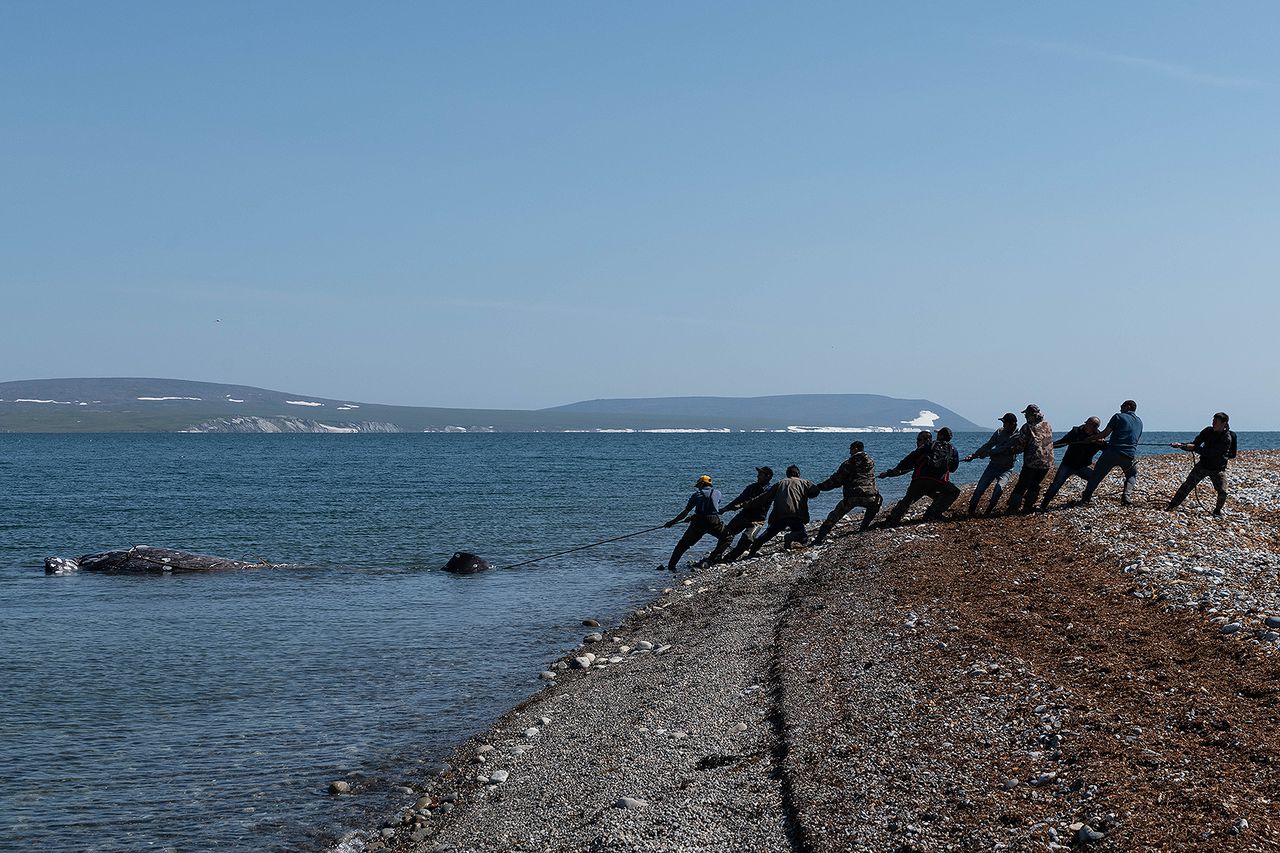
После окончания церемонии тело кита буксируют к селу Лаврентия. У самого берега двое рабочих заходят в воду и крепят на китовый хвост ржавый трос. Остальные китобои помогают поднять многотонную тушу из воды. На берег её втаскивает грузовик.
На теле кита видны старые рваные раны: «Здорово его косатки потрепали, — говорит Владимир. — Поэтому он мало сопротивлялся. Они перегрызают горло и съедают язык, больше ничего не берут. Этот отбился, но ослаб от укусов, не успел вес нагулять».
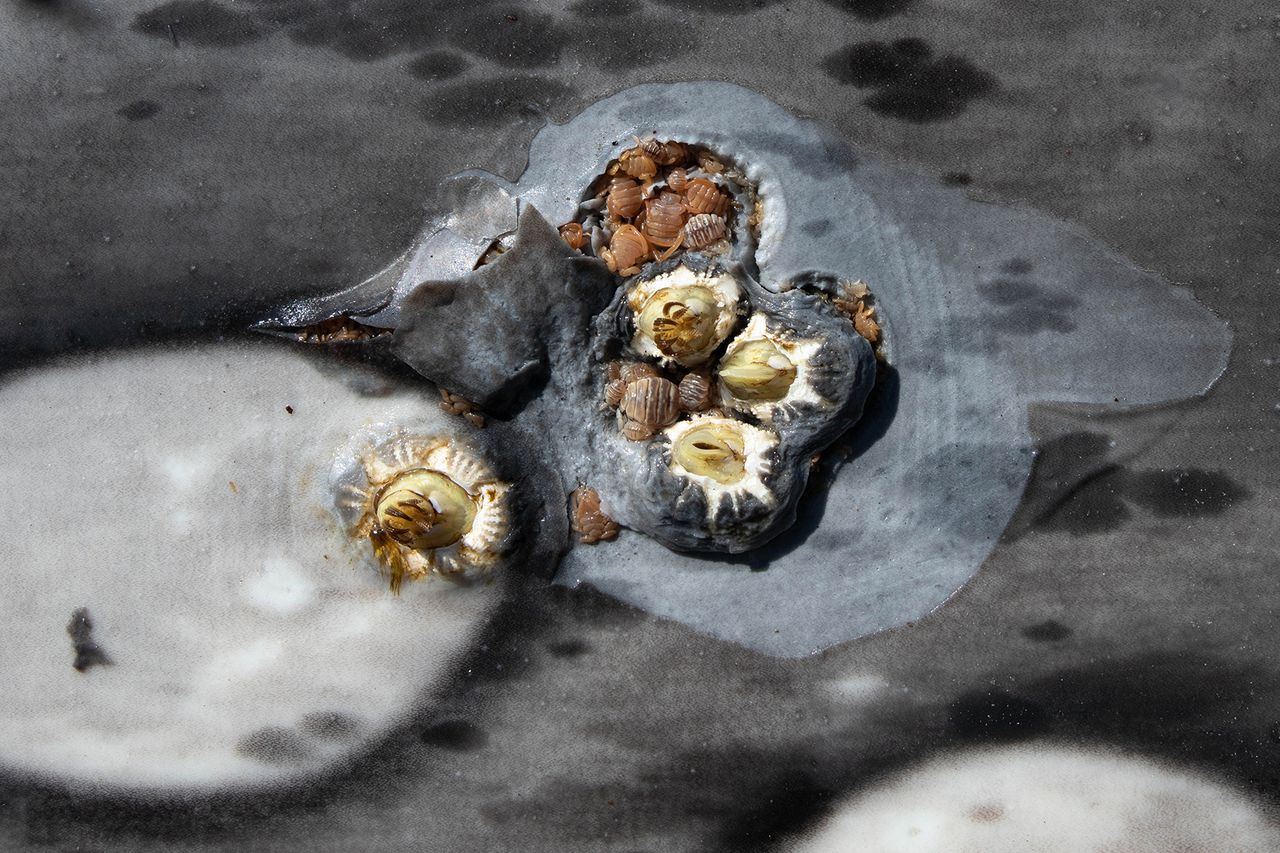
В ранах копошатся сотни рачков — китовых вшей. Меня передёргивает, и охотник усмехается: «Паразиты в ките — это нормально. Здесь, на Севере, мы даже первым мухам по весне рады. Они для нас вроде ласточек на юге. Не бьём их, а в форточку выгоняем. Осторожней со вшами, палец туда не суй — мигом вопьются».
В первые минуты вокруг — ни души, только китобои вырезают из туши застрявшие гарпуны и замеряют её для отчёта. Затем со всех сторон к киту устремляются люди. С ножами, бочками, мешками, детскими колясками со спящими младенцами.
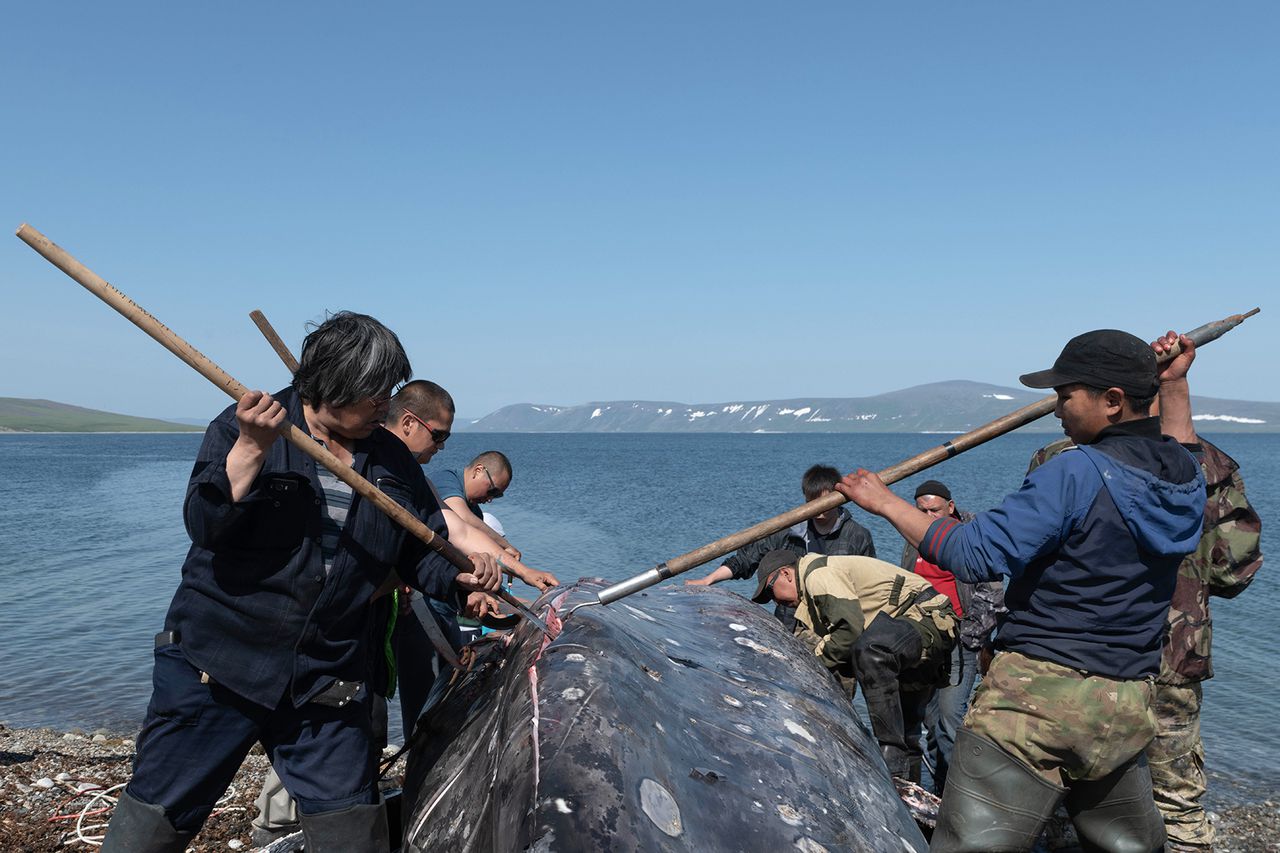
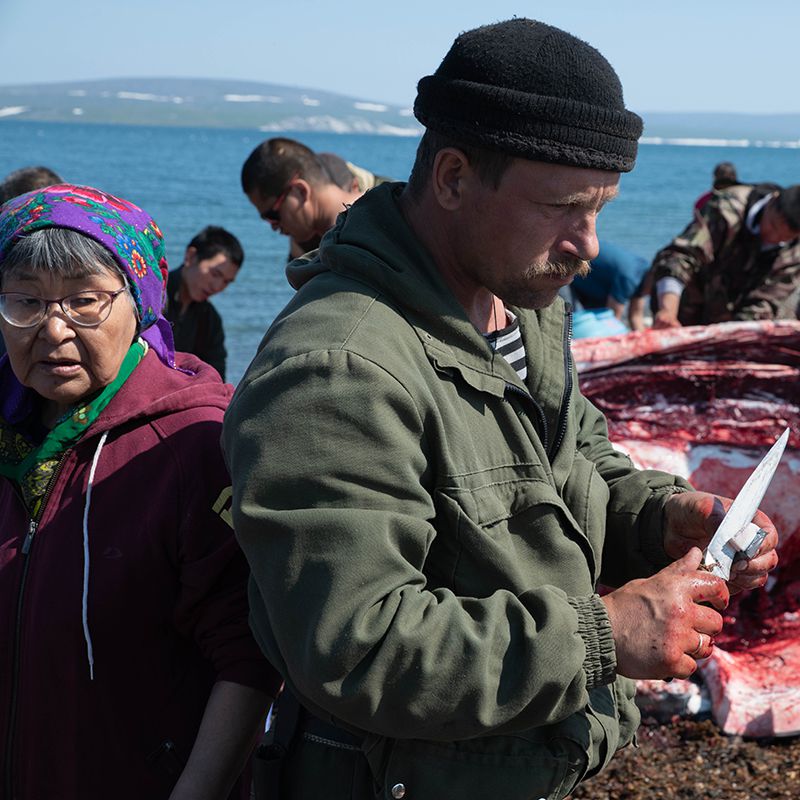
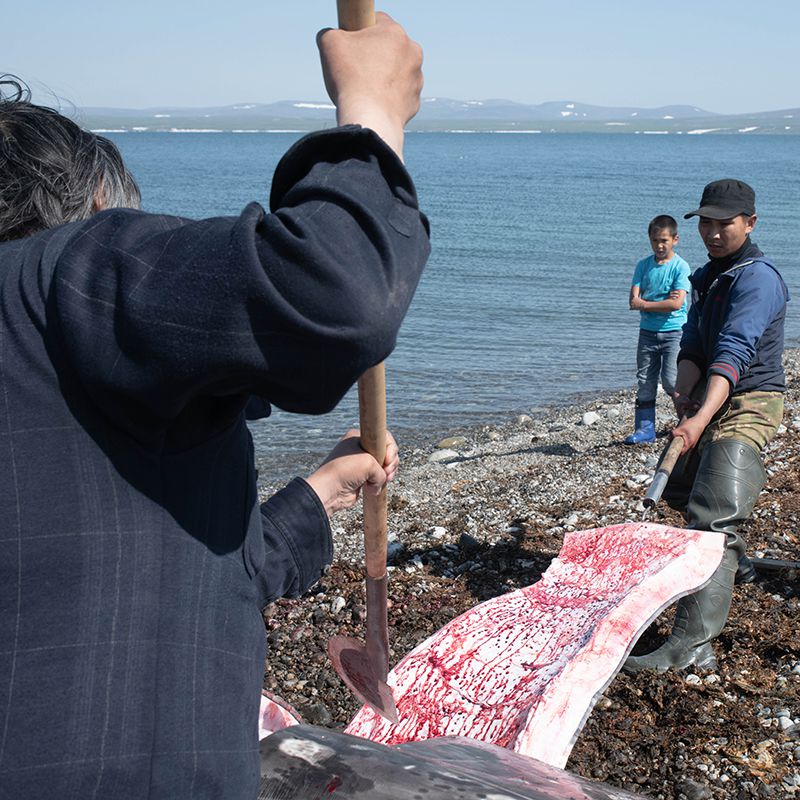
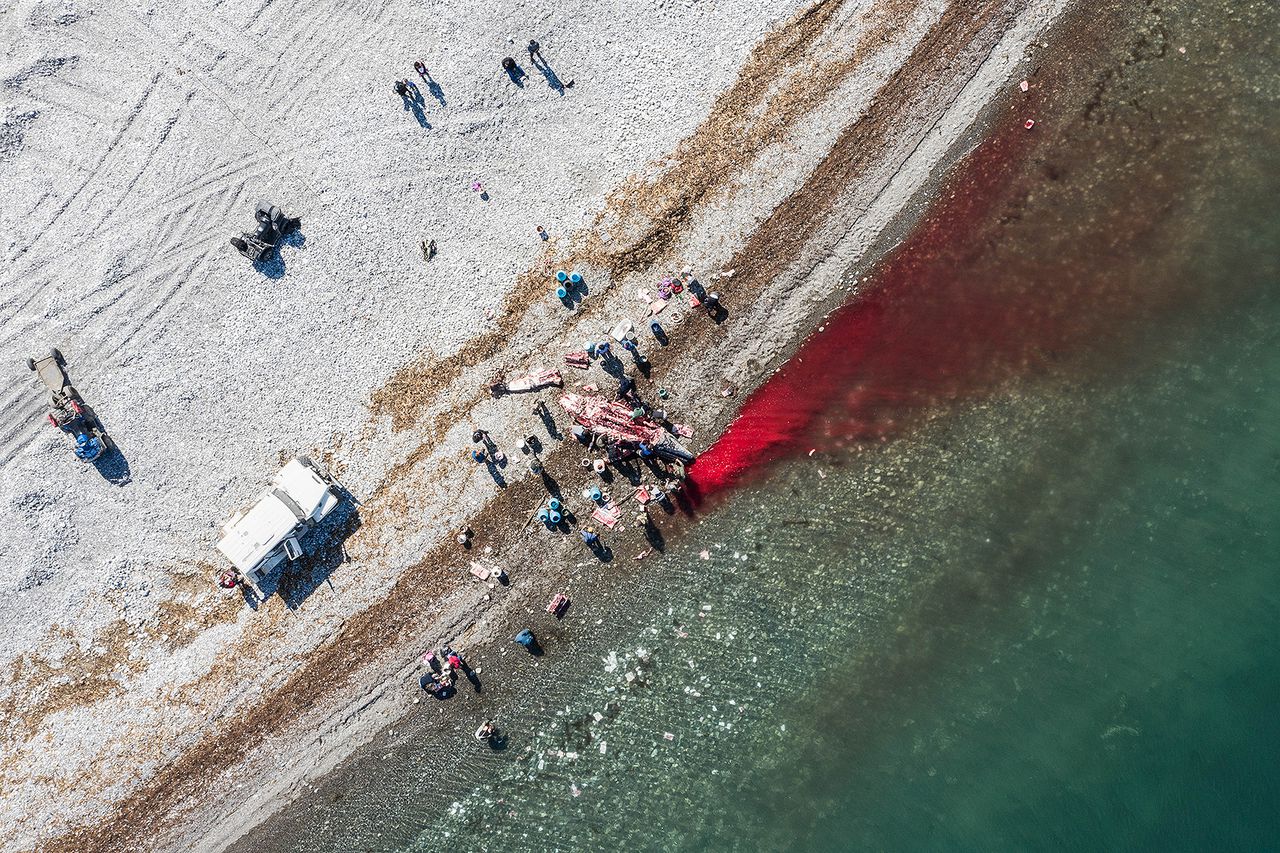
Мужики ловко орудуют крюками и ножами для разделки морского зверя, напоминающими алебарды. Топором разделывать нельзя — иначе, по поверьям, духу кита будет больно. Кожа снимается со слоем сала — и немедленно разбирается десятками рук. Кровь стекает по гальке, окрашивает море в алый цвет. Посреди толпы грызут свои куски собаки — сегодня никто не уйдёт голодным. Когда заканчиваются сало и мясо, приходит черёд внутренностям. Они считаются деликатесом. Кишки животного тоже ценятся — по виду и вкусу они напоминают мясо кальмара. Мальчик погружает руку по плечо в череп, зачерпывает и лакомится мозгом. Последним появляется местный мастер, чтобы забрать «уши кита» — костяные полусферы, в которых расположен слуховой аппарат животного. Из них резчик сделает сувениры.
Владимир покидает праздник первым, чтобы разобраться, наконец, с рукой. Отправляясь в больницу, где ему диагностируют двойной перелом кисти, он не огорчается — как не опечалился, наверное, и потерей пальца: «Говорил же я — нельзя на Чукотке ничего планировать! Здесь бесполезно гадать о завтра. Повезёт — хорошо, придёт беда — не стоит плакать. Море и так солёное. Главное, у Рустамчика всё получилось. Помню, добыл я в десять лет первую нерпу — и увидел радость в глазах стариков: есть новый кормилец. Дед тогда сказал: „Теперь я спокойно могу уйти к верхним людям“».
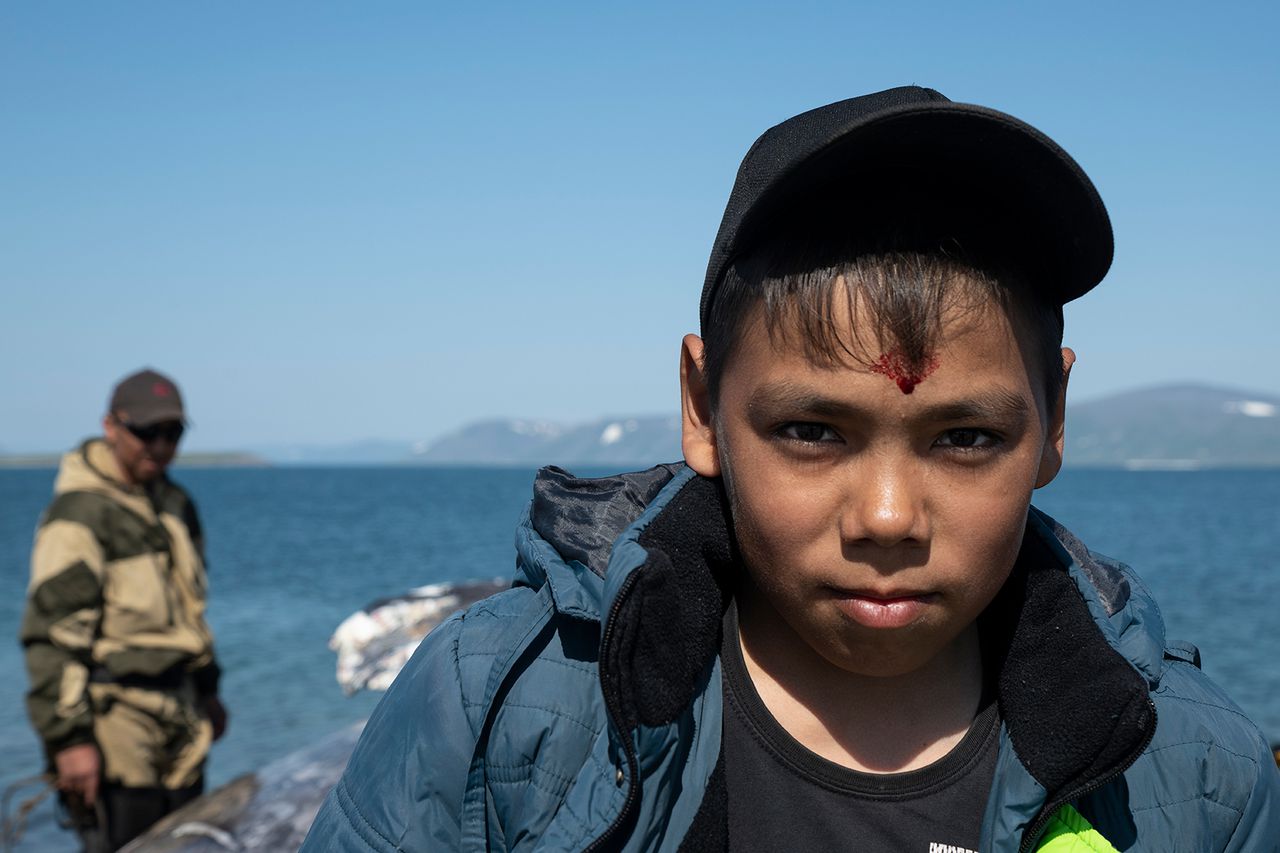
Рустам то ли не слышит слов главы общины, то ли не подаёт виду и молча режет вместе со всеми. После первой охоты его, по обычаю, пометили кровью добычи, чтобы впредь киты принимали за своего. Лицо его торжественно и сурово. На лбу — кровавая точка.