
Translated material
"Parisian" in the USSR
In the Tretyakov Gallery - the exhibition of Konstantin Istomin "Color in the window"
To be outstanding and at the same time half -forgotten is not the rarest case in history, but always offensive.
In a sense, Soviet art came out of the overcoat of Konstantin Istomin (1887–1942).
He taught the military who fought in the First World War and Civil years at Vhutemas for many years, and then the Polygraphic Institute - these forges of art personnel, was a professor, dean of the faculty of painting and at the same time, not only Fires as a teacher, with his own theories of color, but also as an artist.
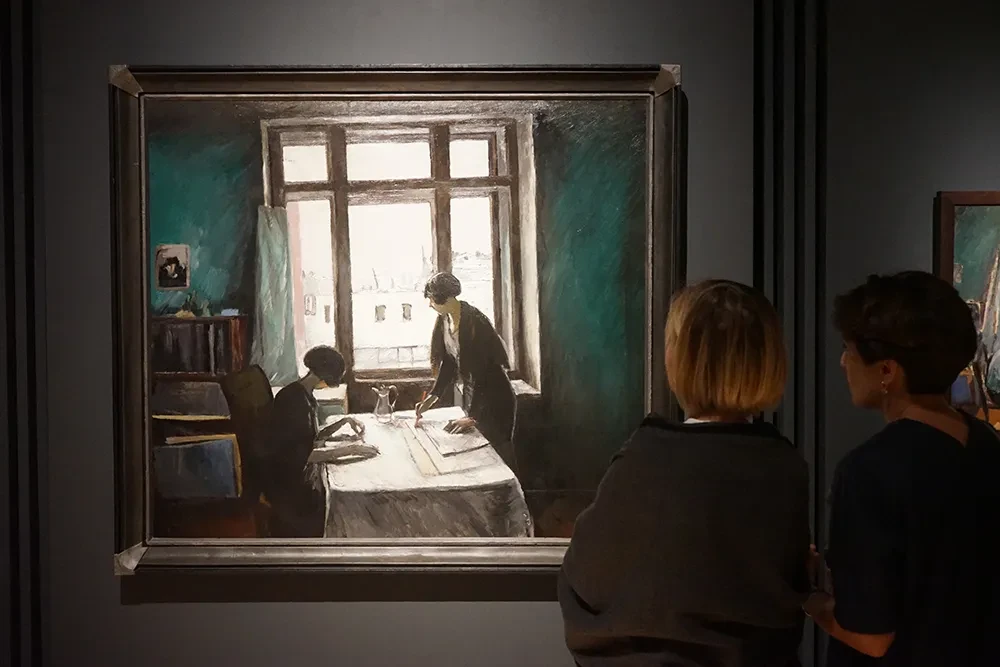
The regulars of the Tretyakov workers in the Crimean are known to his “universities”, a quiet masterpiece of the 30s, where two female figures are depicted against the background of the window.
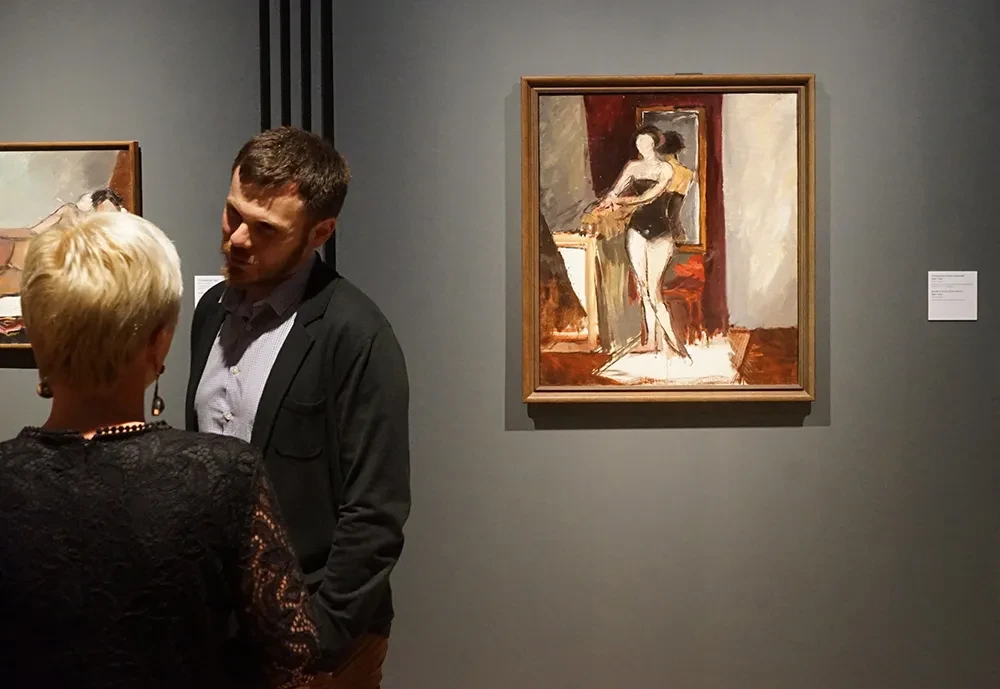
It seems to be nothing supernatural - yes, paints, yes, atmospheric, but it is impossible to break away. You do not immediately understand that both figures are identical. This is the favorite model of Istomin in the early 30s: the former dancer Variet Lidochka, who broke the spine during the performance and began to pose. After the injury, she spoke poorly, began to stall, but retained the former plasticity and grace. The best works of Istomin are connected with her.
After death in Samarkand, where Istomin was evacuated with the institute, an official story forgot for a long time, the workshop was cleared after his death, and the work was carried out on the trash. They were saved by friends and students. The retrospective in the Tretyakov Gallery owes them to many, because later the authorities also gave the leakomin canvases from the workshops of Vhutemas for the recording, they had to save them.
Contemporaries write about him as a person with an open soul, despite the fact that the pain of war - contusion, wound, typhoid, poisoning with gases - did not retreat.
Alexander Labas assisting him at the institute recalled: “He had his special, languor, loud and sonorous, who sometimes could suddenly sound in a good way ... He rarely lost his temper, but it still happened that some students took him out of patience, and he could shout and even leave and slap the door. He was thrown immediately into the paint, his face was made angry, severe.
He was always indignant when the students, without understanding anything, purely mechanically and very sluggishly began to copy nature.
This could blow him up, and he shouted, explaining: “I told you! And what is the question for? All in vain! You do not work, but sleep on your canvas. ” When I then approached him, he laughed and said: “Probably, only you can scream him!” The situation well familiar to the institute teachers of our days.
Istomin himself studied all his life. His biography is typical for the son of a military man: he was born in Kursk, then his father was sent to Vladivostok (there the artist was struck by the beauty of Japanese and Chinese art, to look for their responses in his works - special pleasure). His first teacher of painting in Kharkov was a fan of the French landscape school. In the 1935 autobiography, Istomin admits: “Barbizons, but not the Wanderers - this was my first artistic slogan,” decisively for the era, which had already begun to be suspicious of everything foreign. And if you recall that friends in his youth called him a “Parisian” ... The main education received in Munich, Vladimir Favorsky studied with Shimon Hollosh, later they initiate the creation of an art history department at the Estephil of Moscow University, but they did not give it to Istomin, in 1913 they drafted into the army.
He accepted the revolution. He fought again, illustrated Furmanov’s “Chapaeva”, later went to Crimea to write the work of fishermen, tried to capture the uprising of the Romanian peasants. But the orders were not successful, sketches are more interesting than the results. Pasternakovskaya dilemma “And don't I go to the five -year plan, / I don’t fall, I do not rise with it? / But how can I be with my breast cage / and with the fact that all inertness of Kores? " - Actual for him.
Being outside the policy is considered impossible today, the case of Istomin shows that everything in the twentieth century is somehow connected with it. Staying a European in art is also politics; To remember other horizons, to convey this knowledge to young people means to store another culture, to create a space parallel to official ideology. It is not surprising that officials tried to throw his heritage into the trash, rinse the canvases. They forgot that there are friends in the world.
Tatyana Ermakova,
Socructor of the exhibition (Tretyakov Gallery)
- In the minds of many, Istomin remains the author of one work, the brilliant picture of “universities”, is it not a few for an artist of this scale?
- In the Tretyakov Gallery of Istomin, much more, for a long time a whole wall of his work hung, behind the STO section, it was marvelous, the only thing, it was difficult to get to it. But this is true - the works of Istomin are not so popular and not so famous, even many employees of our gallery do not know too much who is Istomin, except for the picture of “universities”. In fact, Istomin is a legend artist, his fate has formed for a long time, it is dramatic and at the same time happy, because it is organized by the efforts of friends and students. The personality of Istomin and in his art laid the energy that attracts people, this is the energy of his paintings, which combines the love of nature and an amazing understanding of painting in its European vein. Istomin is a European artist, this is an artist who knows a lot, among the Vhutemas teachers he was known as a European.
- It seems to be a contradiction: a European, but quite prosperous and even loyal, if you recall the illustrations for Chapaev ...
- Few people know about them. Only now a little fell to the surface, his graphic heritage, preserved in the family of a student and friend Leonid Kazenin and shown at the exhibition of the Gallery “Ark”, became known. At our exhibition, painting is combined with graphics, Istomin is finally presented on the scale that he deserves. But his biography was not prosperous. Like all artists, he tried to do custom work. They did not work out. He left for Crimea to write the life of fishermen, spent the whole winter there, brought a bunch of sketches, beautiful drawings and watercolors, but did not write a picture, he did not develop at all with thematic paintings. He is known, first of all, by portraits, interiors, a little still lifes and Crimean landscapes.
A popular teacher, he developed very intensively, parallel with his students, wrote the same settings, visited them in practice. Having devoted 20 years to teaching, he did not create an art school. There were those who perceived his information, method, love of nature, but they were not like him, it was just that large artists are able to.
-There is something eclectic in this of his wandering in different associations, participation in exhibitions, for example, “Makovtsa” ...
-This, rather, because of his proximity with Taborsky, the appeal to the Makovtsa is the result of friendship. It is more determined by the Association of Four Arts, this is the art program that is important to him, he was there a secretary. And what then
Everyone visited the Association of Artists of Revolutionary Russia, without participating in any of its exhibition, this is a command of time.
Istomin is generally a rather faithful person, has never been against it. He accepted the revolution, fought on the side of the Reds, although the nobleman, the granddaughter of the hero of Sevastopol - Admiral Istomin.
- Is it possible to see an artistic atom in Istomin, which belonged to many directions and at the same time nobody?
- It seems to me that he did not wander. He is quite consistent, far from avant -garde movements, from a fantasy, not inclined to compositions, so custom -made and thematic things were not very obtained. “Universes” is a happy exception, they did not think as a thematic picture, but as an interior composition, then he came up with a name, and this defined fate, she was taken to the exhibition and then, in the 30s, bought it in the Tretyakov Gallery. He always wrote from nature, she was always important, he suffered very much when he could not find a model. He worshiped Van Gogh, Rembrandt, Italians, in his youth, in addition to Germany, he visited Greece and Italy, saw the Van Gogh exhibition there, in the letters of both there are a lot of roll calls about the perception of nature.
- At the same time, there is a lot of influence of wood and the upper?
-In the history of Russian painting, Istomin is a frank expressionist, and, in my opinion, very beautiful.