
Translated material
Soviet spy Hemingway
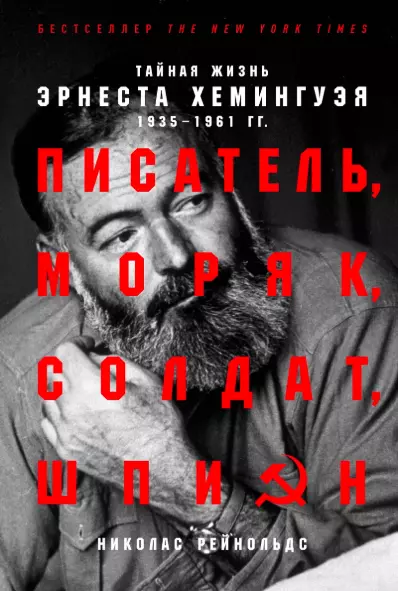
Fragment of the book of Nicholas Reynolds "Writer, sailor, soldier, spy"
The Alpina Non-Fixh publishing house publishes the book of Nicholas Reynolds “The Writer, Sailor, Soldier, Spy. The secret life of Ernest Hemingway, 1935–1961. ” We publish her fragment.At first glance, the story of Hemingway's recruitment seems shaking. Documentary evidence is fragmentary. Obvious gaps gaping between us and memories that have reached us, and their dates are confused. Copies of all documents from the NKVD dossier, like those that opened in the 1980s, could confirm it.
The disclosed FBI information allows the reader to recreate an almost complete picture of what the bureau knew about Hemingway. The story consists of messages, reports and notes on the fields of documents that were intended for the inside of it, for the most part with a very specific purpose: registration of the episode, clarifying the previous report or a request for an operation permit. This is not a story in which there is an introduction and ending that makes sense for the general public. These are materials related to intelligence. In this sense, the “complete” dossier of the FBI and the “incomplete” dossier of the NKVD are practically identical. Both are a collection of fragments, some of which are false or correct only partly. However, a certain pattern consists of fragments, and roughness reinforces its reliability.
The same applies to the circumstances in which the story sailed. It is too extravagant to be invented or appear as a result of some conspiracy. The collapse of the Soviet Union in 1991 was the same social revolution, to prevent which special services were created. The NKVD and his KGB successor served as a shield and a sword of the revolution, which in turn took care of those who served it. After the collapse of the Soviet Union, the KGB veterans felt like employees of the company, which suddenly left the business, leaving no funds to finance pension provision. They were left alone with an economic and political chaos, not to mention the public, which now could freely criticize them. How to behave in such a situation? Was there anything suitable for use at their disposal? Intelligence services are usually needed in order to steal new secrets, but they also have the opportunity to sell old secrets and direct the money received to finance the pension fund.
Crown Publishing Group, a subsidiary of Random House (now Penguin Random House), saw an attractive opportunity in this and made an offer of SVR (foreign intelligence service) - an organization that took over the functions of the KGB in New Russia. In exchange for a significant contribution to its SVR pension fund, the authors from Crown were supplied with historical information about the KGB operations. In addition to the fact that such publications aroused interest among the public, they could improve the image of the KGB, showing how well this organization served the state. The highest leadership of the SVR enthusiastically approved the agreement, despite the objections of numerous traditionalists from the KGB.
At least one Russian researcher, selected by the SVR, participated in the work on each book. He studied the KGB archives, made handwritten notes, and then summarized the information received. The SVR observation council looked at the final materials before the transfer of them to Western historians. The initial notes were not intended for transmission, but solely for preparing a resume. No one was supposed to indicate the sources if they have not yet been declassified. It was assumed that the result would be books about the best times of Soviet intelligence, not sensational revelations.
 The biography of Alexander Orlov, Alexander- the NKVD resident and the head of the intelligence network in Spain from 1936 to 1938, who met Hemingway and allowed him to visit the Rebel training camp before he himself had to hide in the United States from other hemless Stalin, was supposed to appear. (The author’s note) , the head of the NKVD residency in Spain in 1936–1938. This Soviet counterintelligence met in 1937 with Hemingway at the Gaylord Hotel, where he often visited and relaxed in a luxurious atmosphere. The book about Orlov was published in 1993 and became a model for the next volumes of this series. Orlov’s personality was represented in all its complexity without silence of inconsistency or obscuring the murderous truth. To satisfy skeptics, copies of archival documents were reproduced on the pages of the book.
It was planned that one of the books of the series will be devoted to intelligence activities of councils in the United States in the 1930s and 1940s. The Russian curator of this book was appointed by Alexander Vasiliev Vasiliev, Alexander- an employee of the KGB, who became journalism, researcher and exile. In the early 1990s. He signed a contract with the SVR to study the archival affairs of the NKVD/KGB in order to prepare materials for transferring to Western historians (the project was organized in order to attract funds for the KGB/SVR pension fund). One of the things he met was Hemingway's dossier. (Author's note) . This journalist, who worked for the KGB, could understand the essence and summarize archival materials like no other. He began to implement the project in 1993. Having shoveled the Mountain Dossier to the Americans who spied in favor of the Soviet Union, Vasiliev got much more interesting than anyone could suggest. He was allowed to make only handwritten notes in Russian. However, he often copied the documents word for word. Having gained enough materials, Vasiliev prepared a resume for official approval, which allowed one of the Western historians to start working.
In 1995-1996 The situation has changed. Crown had to stop the project due to a lack of finance. In the SVR, supporters of the hard line again took the top. They believed that state secrets should remain inviolable, and did not want to hear liberal conversations about openness. One of these implacable promised Vasiliev that “they would deal with him” after the change of leadership. Vasiliev saw a threat in this and fled to the west. Subsequently, he organized the crossing across the border of his records, including handwritten notes and copies of some documents from Hemingway.
The fact that these materials were not intended for publication confirms their reliability. Researchers of the life and work of Hemingway now have the opportunity to see copies of some Soviet documents about the writer. A complete source could be the full dossier of the NKVD on Hemingway. However, while the SVR does not declassify their archives, Western researchers can rely only on Vasiliev, an invaluable witness who did a considerable job.
Is it possible to assume that the history of the transformation of Hemingway into a spy relies on information only one side? There are an incomplete, but reliable story of the Soviet special services at the disposal of historians, but does Hemingway himself say anything about this? Probably not. A decade later, in letters to his best friend, he mentions that he carried out “random orders” for the Soviets in Spain, and after the Civil War he kept contact with the “Russians” who shared secrets with him - which one, the writer does not specify. In addition, there is no evidence that he was talking about his voice and the NKVD to anyone, even Gellhorn Gellhorn, Martha, the third wife of Hemingway, who accompanied him in Spain and China, was with him in Cuba and insisted that he write about the Second World War in Europe. (The author’s note) , which shared his political views and was in many respects a younger partner in their marriage. The connection with the Soviet intelligence service was a serious matter - what they do not share with friends behind the glass and what they do not write about, how he wrote during the Civil War in Spain and after participating in the Second World War. Hemingway understood the need for secrecy, one of the main attributes of espionage activity. He considered the ability to espionage one of his innate qualities and, it seems, was not mistaken.
When at the beginning of 1941, Hemingway handed his voice to his voice, Jacob- a fiery revolutionary who emigrated to the United States and became a resident of the NKVD in New York. He attracted Hemingway to the “common cause” at the end of 1940 or early 1941. He died on the day of thanksgiving in 1943. He played an active role in secret interaction with the Soviet spy. (The stamps were a signal that the bearer can be trusted, in many respects, like arbitrarily torn cards used by other Soviet spies, the one who presents the right half is his own.) Such material passwords are not for anything in normal everyday life, they are needed only for secret operations. If there is nothing secret in the relationship, then a simple recommendation letter is enough that Isvens , Yoris is a Dutch communist, cinema and activist of the Comintern, who worked together with Hemingway on the film about the Civil War in Spain. (The author’s note) wrote for Hemingway during the Civil War in Spain. But for a secret connection, the material password is much better. In itself, he does not mean anything. His true purpose is known only to the initiates.
Hemingway has not changed too much since November 1938, when Orlov listened to how he spoke about the Civil War in Spain, to January 1941, when he met his voice. His devotion to the struggle against fascism surprised even the old communists, perhaps because they did not see a real war for many years. Hemingway went to cooperate for ideological reasons - the voice was not mistaken about this. However, he was not similar to the "true supporters" of communism. The writer did not believe in Marxism or Leninism-he “simply” joined the anti-fascists who did something real. That is how he thought about the NKVD. He knew that this organization taught the partisans, exploded the railway tracks into the rear of the Nazis and tried to bring discipline to the Spanish Republic.
Although Hemingway was different from many recruited on an ideological basis, he had a number of common features with them. The recruitment process often began with some event that caused a shock and changed the views of the future spy on the world. For Hemingway, such an event was a hurricane in the area of the islands of Florida-Chis in 1935, which forced him to more aggressively criticize the ruling circles of America for indifference to the fate of veterans of the First World War. Then, during the Civil War in Spain, he stuck in his soul to the republic and succumbed to the romance of intelligence work. Now he took just the next step. Hemingway agreed to become a spy because a secret life, not to mention the thrill from the risks associated with it, corresponded to his needs. In many spies, such needs were born as a result of disappointment. If you take Hemingway, then he did everything he could, in the struggle against fascism, but he could not force democratic countries, especially his own country, to listen to his words. Now he turned to the help of other, secret means, like a spouse who twists a novel on the side when an existing marriage ceases to arrange him (Hemingway has done this more than once in his life).
Another feature with other spies was the confidence that ordinary rules are not applicable to it. Hemingway lived according to his own rules for more than one decade. In literature, this was expressed in a revolutionary style. Having released his grandiose political novel in 1940, he demonstrated it again. He triumphed, was confident in himself and was ready for a new adventure. In a letter to his wife , Maklish Maclish, Archibald, an outstanding American poet and writer who worked with Hemingway and Ivan on the film about the Civil War in Spain. Franklin Delino Roosevelt appointed him the director of the library of the US Congress. (The author’s note) Ada he said that he feels “almost happy” when he writes in full force, and then sees how his work is sold. Hemingway regretted that he did not have so much money "in the old days, when the whole world was opened for travel." However, he thought, a trip for thousands of kilometers to China can give "a certain freedom of action."
Hemingway was looking for this freedom of action in politics and war. He liked the military equipment, he loved to be among the military, but did not want to serve in any regular army. It was preferable for him to be informal attachment to irregular parts, especially to the partisans, this gave a feeling of involvement, but left freedom to enter and exit. He was not a communist and even sympathetic to him, but readily worked on films for the Comintern, and then joined the NKVD in the fight against fascism, which became his all -consuming political passion.
If Hemingway wrote about his meetings with his voice, he could well admit that he liked this hardened revolutionary and that his proposal was attractive. Hemingway agreed to the second meeting, then at the third, etc. Finally, in January 1941, the American writer agreed to work with Moscow. Like many other spies, Hemingway did not complain the word “recruitment”. He knew very well that he was entering into a secret connection with the Soviet intelligence service, but preferred to look at it more as cooperation, and not as the first step to work on the instructions of Moscow. However, the councils used the word “recruitment.” The adoption by Hemingway, the proposals of the voice considered the beginning of the secret relations that were fully controlled by him. It was assumed that the agent would do what Moscow orders him. In return, he will receive something from the NKVD. It can be money, refusal of blackmail, the safety of close relatives. In the case of Hemingway, there is no evidence indicating that there was something more than a general obligation to fight fascism and keep the relationship secret. But that was enough.
Hemingway did not think that he was betraying his country. He could not say anything good about the new course and was still angry with Roosevelt, who did not support the Spanish Republic. He annoyed that the United States did little to fight Hitler. But he was not going to betray his country. Once in 1940, after watching day mail, in which letters often met from fans and critics, Hemingway responded to the remark that loyal Americans were not buying houses abroad, but live with their country. The hints were listed in his telegram, that he could become a citizen of some other country except the United States, "ugly offensive." In my family, he wrote, there were many American revolutionaries, but “not one of them was named by Benedict Arnold Benedict Arnold, Major General, a participant in the US Independence War, who later switched to the side of the UK. ".
What will the Ministry of Justice say to this? Are there any signs of betrayal? Did Hemingway violate the law, agreeing to work with the NKVD? Not particularly clear American legislation of those days for espionage cannot be applied to this occasion. Hemingway was not a government official, he had no access to official secrets, the disclosure of which can be discussed. He did not provide help to the enemy in wartime. The United States was not at war, and the Soviet Union was not an enemy.
After Pearl Harbor, two countries generally joined forces. The maximum that Hemingway could violate was the law on the registration of foreign agents of 1938, which required public disclosure of anyone who acts as a “political or quasi -political agent” of a foreign state. This definitely includes a connection with a foreign intelligence service. On the basis of this law, a judicial persecution of Soviet spies (including votes) was carried out.
One way or another, the relationship between Hemingway and the NKVD was no coincidence. Even before the war, the American authorities were suspicious of the extreme left. The FBI monitored the US Communist Party, and the participants in the Civil War in Spain were persecuted. From Hemingway himself, they demanded to indicate in the statements that were filed in his dossier in the State Department that he was not going to participate in the Spanish conflict. He was useless that this (or any other) was filled and interfered with his work. Among other things, he was famous for his independence. Hemingway has repeatedly advocated the liberation of writers from obligations to governments and political parties. As he said, writers who support the work of a party work for the sake of it or believe in it, will still die like all others, and their corpses will be stink even stronger. The secret life of Ernest Hemingway, 1935–1961. I could well imagine that it was united by the efforts with the NKVD in the struggle against the common enemy, but he had no one to head the headlines screaming: "Hemingway is exposed as a red spy." He was going to take this secret with him to the grave.
* * *
What else to read about Hemingua on Gorky:
Review of the book of Scott Donaldson "Hemingway vs Fitzgerald"
Ernest Hemingway talks about the drunken Joyce, the exploding bottle of Gin and happiness
Немножко плохого Хемингуэя