
Translated material
Militants give way to pragmatists
In Kosovo there was a reboot of the legislative machine
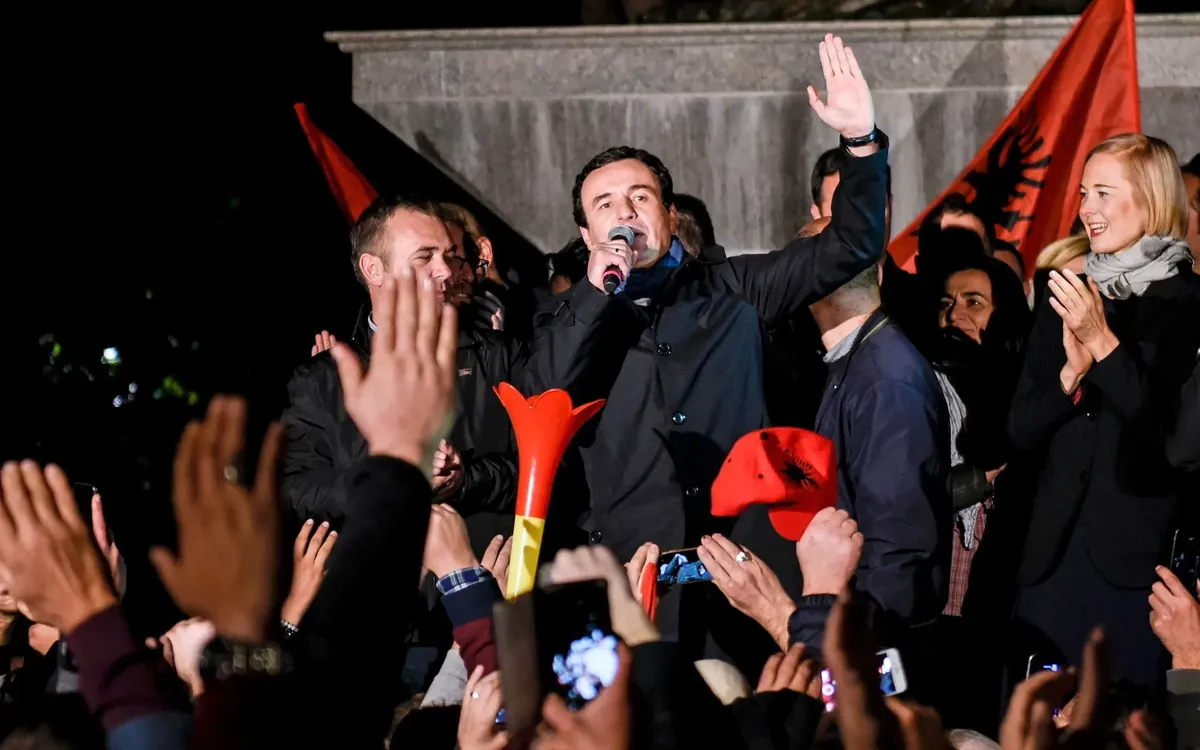
Almost two million voters registered in the extraordinary parliamentary elections, having appeared last Sunday to plots in the amount of 43% of the list of the list, gave 25.79% of the votes of the opposition Levonationalist Party “Self -determination”, whose leader is Albin Kurti. 25.05% received the "Democratic Union of Kosovo", 21.15% - the Democratic Party of Kosovo, the founder of which is the current President Hashim Tachi. No one disputed the jewelry difference between the first and second results.
The Serbian minority of Kosovo, which is 11% of the population, in parliament, according to the Constitution, ten seats are given - the same amount of minorities, including gypsies, receive the same amount.
It is characteristic that Serbia, which does not recognize the independence of Kosovo, urged ethnic Serbs to take an active part in the current elections, voting for the "Serbian list". Belgrade relied exclusively on this party, while other associations of Kosovo Serbs also claimed places in parliament - their Belgrade authorities consider the opportunists. The Serbian List won, gaining 6.21% of the vote and having won there all the same ten deputy places.
One of the fundamental issues of the election campaign was the question of negotiations with Serbia in order to recognize the independence of Kosovo. The main obstacle was the position of the previous Prime Minister Ramush Haradinina, whose government introduced at the end of last year one hundred percent duties on goods from Serbia. Thus, the contacts between Protina and Belgrade, to which they agreed in 2013 were blocked.
Once again, in the Hague in the Hague in July, to testify to the International Court of Haradinay, who was a field commander during the Kosovo War of 1998-1999, voluntarily resigned, which led to the need for extraordinary elections. The loss of his party-the “Alliance for the Future of Kosovo”, which, in a coalition with the Social Democratic Party, gained a little more than 11% of the vote, means that the historical era is changing in Kosovo. The Haradinay took a stroke with dignity. An honest and peaceful competition in the elections, he wrote on Facebook, raised Kosovo and his citizens to a higher level of political and democratic maturity to serve as a model in the region.
Thus, the Balkan Rambo admitted that the militants who won that war should give way to more pragmatic politicians.
Since for an absolute victory in the 120-seater Assembly (parliament) it was required to win 61 places, the new government would be coalition. The head of the “self-determination”, 44-year-old Albin Kurti, a former leader of student protests, from a young age, not in words, but in fact tried to prove that non-violent methods of resistance to power give better results than a club, it is now necessary to take the post of prime minister. He announced his intention to form a government in cooperation with the “Democratic Union of Kosovo” (DSK) and his leader Issa Mustafa, “a fellow in the opposition,” as he called him. Mustafa, an experienced politician, was once the mayor of Protina and the second Prime Minister Kosovo.
By announcing the victory, Kurti said that in negotiations with Serbia it would be not to be discussed that Kosovo would give Serbia in return for recognizing his independence, but by the fact that Serbia “owed Kosovo”. Perhaps he had in mind that Serbia also does not miss goods with the labeling “made in Kosovo”, and then the customs problems will again accept the political measurement. Political observers, however, tend to believe that the new government will eliminate obstacles to resume dialogue with Serbia. To this, the Power Primes encourage influential political forces in Europe and the United States.
Serbia President Alexander Vuchich repeatedly stated that duties are the only obstacle to continue negotiations in order to achieve a compromise.
Meanwhile, interest in Kosovo settlement is only growing. Josep Borrel, who will soon replace Federica Mogherini as the Supreme Representative of the European Union for Foreign Affairs and Security Policy, said that he will qualify his first official visit between Belgrade and Pristina as “unacceptable”.
President Trump surprised the appointment of the American ambassador in Berlin Richard Grenell (two days before the elections in Kosovo) by his representative in peace negotiations between Serbia and Kosovo (while maintaining the embassy position) - and this is only a month after the assistant US Secretary of State for European Affairs Matthew Palmer also became a special messenger of the State Department in the Western Balkans! .. This time! .. No one will reproach the White House for spontaneity of decisions: Palmer, an experienced Balkanist, who speaks Serbian and married, by the way, on Serk, back in 2013, took part in the preparation of an agreement on the normalization of relations between Belgrade and Prishtina. Grenell's candidacy, as reported in the press, appeared in the casting of those who could replace John Khantsman to be replaced by the US Presidential Advisor for National Security and the US ambassador to Russia.
Russia responds asymmetrically. Two weeks later, the chairman of the government Dmitry Medvedev will visit Belgrade, and President Wucich was invited to Moscow until the end of this year to meet with President Putin.