
Translated material
Open Source 3.0: a new big idea of venture capitalists
Venture investors are in search of new ideas: the billionth rounds of Vision Fund, who first stumbled with Uber, and then failed with WeWork, inspire less and less, and entire market sectors show signs of overheating.
Peter Levine from Andreessen Horowitz, the valley venture fund of the valley, under the control of which there are assets of $ 10 billion, is sure that the “next big thing” is commercialization of the open source codes.
Typically, the Open Source product is a program whose source code can be viewed, and often according to the rules of the license agreement and use or distribute further. Hundreds of developers usually work on such programs, and the larger the community, the more reliable and in demand the product itself. For a long time, the basis of the business of the teams that invented or actively developing open code solutions was paid support. Now that the programs turn into cloud services, it is profitable to invest in the developers' community and then get an impact on the decision implemented by hundreds of corporate clients.
This assumption is confirmed by real money. For control of GitHub, the largest repository of open projects, Microsoft in the summer of 2018 agreed to pay $ 7.5 billion. IBM in July 2019 gave $ 34 billion for the Red Hat, specializing in the implementation of open code in enterprises.
To figure out why technohigants begin to spend billions on Open Source, we must look at the venture market as a whole.
This note was written specifically for the weekly technology building of The Bell. You can subscribe to it here
.card [Data-Color = " #000000"]: Before {Background-Color: #000000; } .card [Data-Color = " #000000"]: After {Background-Color: #000000; }
How are things in the venture market?
Brief answer: According to Crunchbase, in the third quarter of 2019, 9,100 transactions were enclosed in the world for a total of $ 75.6 billion.
The volumes of venture transactions reached a historical maximum, and the main driver-investments in the early stages, when success is not guaranteed, and the business model is fragile. In total, at the previous quarter at an early stage, at 2572 transactions, $ 27.63 billion was invested, according to Crunchbase.
This market is not safe from reduction in the future. For example, due to the uncertainty of investors in China, the world growth rate of venture investments remain at the same level, and the total volume is far from the record of the second quarter of 2018, when investors invested $ 87.4 billion in startups.
In addition, although investors are invested at an early stage more often, the volume of the average transaction is reduced. This can lead to problems for investors who prefer to invest later. Funds and accelerators increasingly require distinguishing features from the project from competitors. This allows you to bring Open Source on stage - a set of open technologies increasingly attracts corporate customers.
.card [Data-Color = " #000000"]: Before {Background-Color: #000000; } .card [Data-Color = " #000000"]: After {Background-Color: #000000; }
Why did corporations want to work with Open Source?
According to Levine, Open Source gives the client three possibilities at once:
- Do not depend on the supplier of certain decisions;
- buy from those who wrote the code or most of it;
- To convey the implementation of people with an examination that the company itself cannot ensure.
Any modern solution requires support. The main difference between the open code and the traditional commercial software is that people and organizations can not only work with technology, but also change it for their needs or even finish part so that it becomes part of the main product. A closed decision will not allow this.
A simple example: many browsers (Chrome, Brave, Vivaldi) did not write a browser engine from scratch. As a basis, they use the Free Chromium browser, building their own functions. Any person can correct the error in Chromium - and all browsers will become more stable. Anyone can create their own browser based on Chromium and get equal functionality. Anyone can download Chromium and see how this browser looks without add -ons.
The same is impossible if you would use, for example, Internet Explorer - a closed project with a closed source. In the best case, you would have to pray that he remained popular and continue to work. Such addiction is dangerous for business, and corporations no longer want it. Moreover, in addition to the Microsoft programmers, the Internet Explorer code did not exist - and now you can take Chromium as a basis, and tens of thousands of people are not only aware of it, but any other programmer is able to figure it out.
In other words, now the business has the opportunity to hire the inventors of the hammer to beat the nails. This opportunity is so important that they are ready to pay for it.
.card [Data-Color = " #000000"]: Before {Background-Color: #000000; } .card [Data-Color = " #000000"]: After {Background-Color: #000000; }
Is Open Source not a synonym for free programs distributed?
Brief answer: No. This is a synonym for a potentially successful business. Usually - infrastructure.
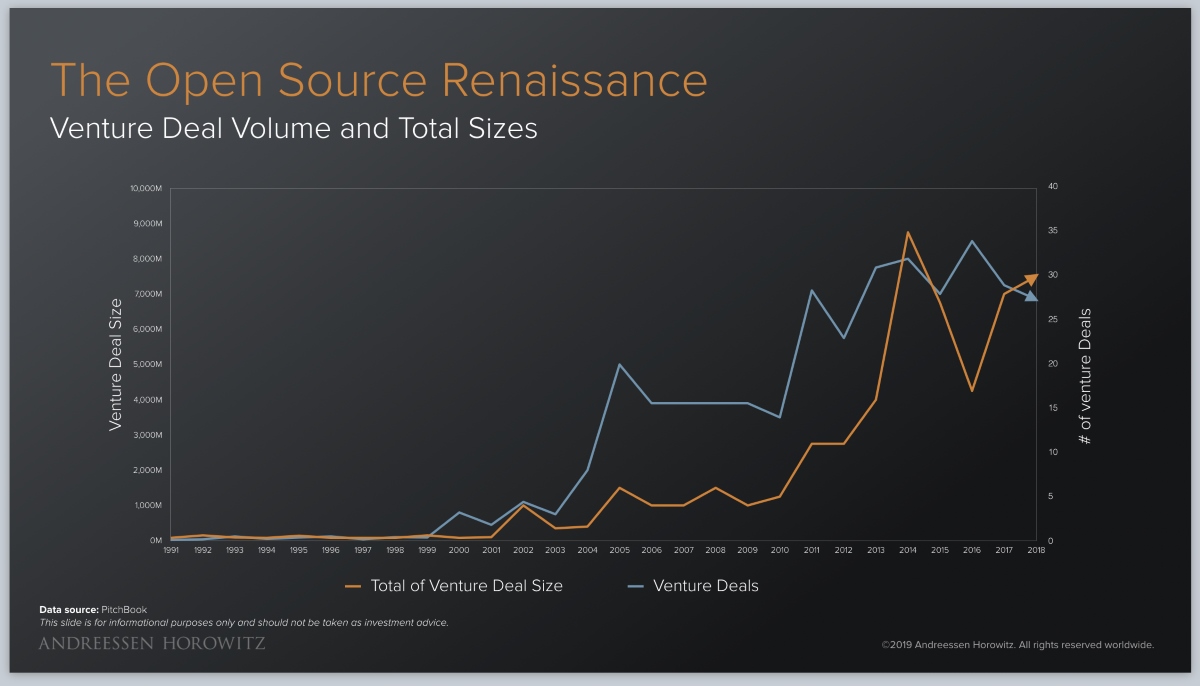
Now Open Source, once a marginal direction of software development, is experiencing flowering. The number and volume of transactions in this area is growing.
In 2008, when Sun MicrosyStems purchased MySQL databases for $ 1 billion, even venture visioners who later organized the Andressen Horowitz fund were sure that these were a ceiling with Open Source projects.
But later other companies held billions of IPO or became objects of large transactions.
The market capitalization of Cloudera, which has done a lot for Apache open solutions, is $ 2.3 billion Mongodb Inc., which develops the same database, costs $ 7.5 billion Mulesoft, which developed the AnyPoint Platform platform, Salesforce was bought by Salesforce For $ 6.5 billion Elastic, which created an open search engine Elasticsearch, costs over $ 6.5 billion on the New York Stock Exchange. GitHub, as we already wrote, was bought by Microsoft for $ 7.5 billion - and this is not the limit.
All these projects unite one thing - without them, the Internet would work much worse. In fact, many Open Source projects are the choice of any sane developer by default.
.card [Data-Color = " #000000"]: Before {Background-Color: #000000; } .card [Data-Color = " #000000"]: After {Background-Color: #000000; }
Where is Open Source money?
Brief answer: in the demand formed in the developer community.
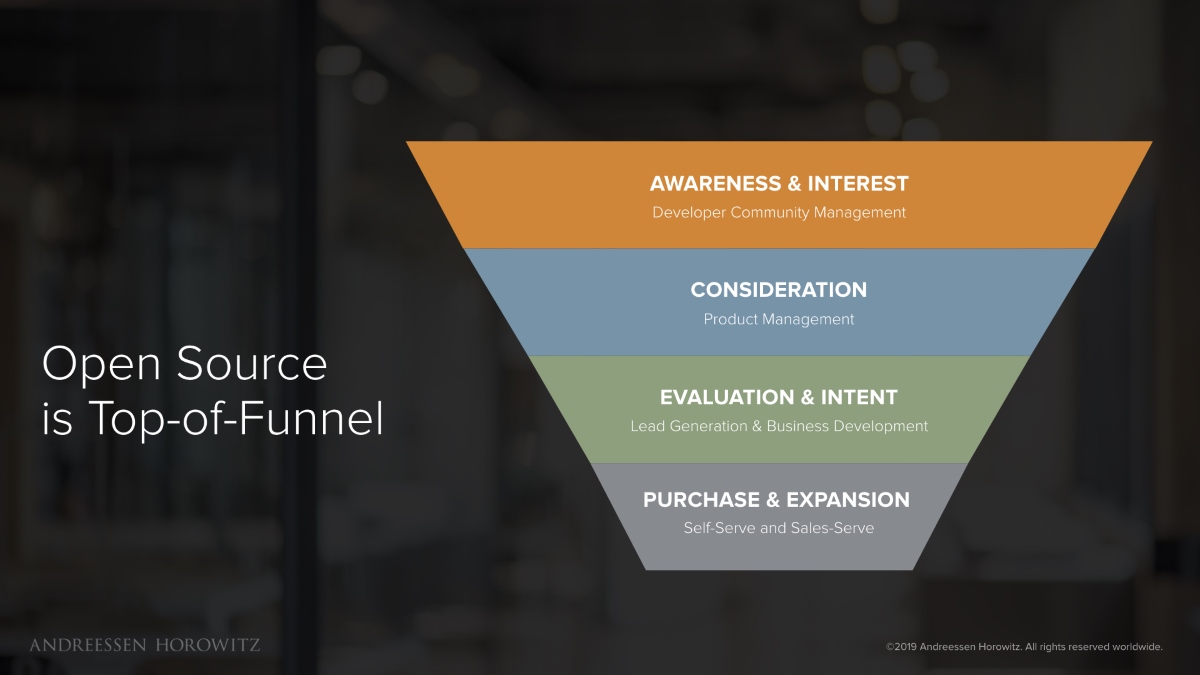
According to Levine and Lee, open source projects make up the upper part of the funnel, and below is a commercial product, the development of which is directed by the found value for the community.
Thus, open projects undergo a natural stage of wems and filtration, when a community of developers spreads the product. At the same time, effective management of the product based on user requests is very important.
From managing the product, it is already a stone's throw to the development of business and evaluating the possibilities for introducing corporate customers on the side of corporate customers.
.card [Data-Color = " #000000"]: Before {Background-Color: #000000; } .card [Data-Color = " #000000"]: After {Background-Color: #000000; }
Open source projects do not fail?
Brief answer: fail, and how.
Levine gives three scenarios of failure:
- Firstly, your user may not lead you to corporate customers;
- Secondly, the growth of your project is significantly lags behind your corporate sales;
- Thirdly, your corporate sales kill confidence in your developers.
The authority of the instrument in the community of developers should be in strict balance with the demand among corporate customers. It is likely that not every idea can be designed or “shoot” according to the new model.
.card [Data-Color = " #000000"]: Before {Background-Color: #000000; } .card [Data-Color = " #000000"]: After {Background-Color: #000000; }
What is the importance of a new concept?
Andreessen Horowitz was the first to offer the phrase “software devouring the world”, bearing in mind that he will penetrate all spheres of life - and awareness of this fact indicates the direction of investment.
Now they say that while the world is devouring, Open Source projects are devouring along. Everything goes to the fact that open solutions and tools become part of each software company. Airbnb has over 30 open source projects, Google has over 2000.
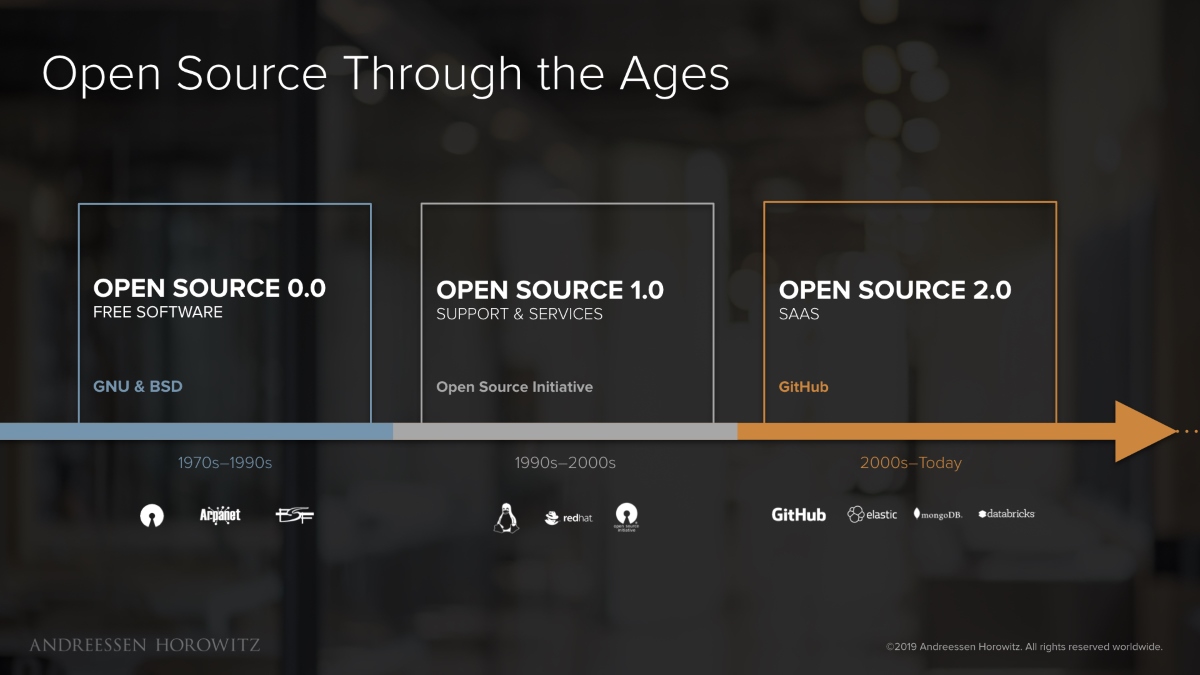
Levine lists the stage of evolution Open Source:
- The zero version developed along with the Internet and the concept of free software;
- The first - in the nineties and zero - allowed us to earn on support and services;
- The second - brought in based on Open Source into a cloud and turned into services.
What appears now, Levine calls Open Source 3.0.
He suggests that open projects will become not only fashionable solutions to which technohigants pay tribute, but also a key part of their business. In this case, the venture flowering of Open Source is only the beginning of a new business model.