
Translated material
The election man is not for everyone
Records from video cameras that worked in the areas in St. Petersburg can only see the court - if he wants
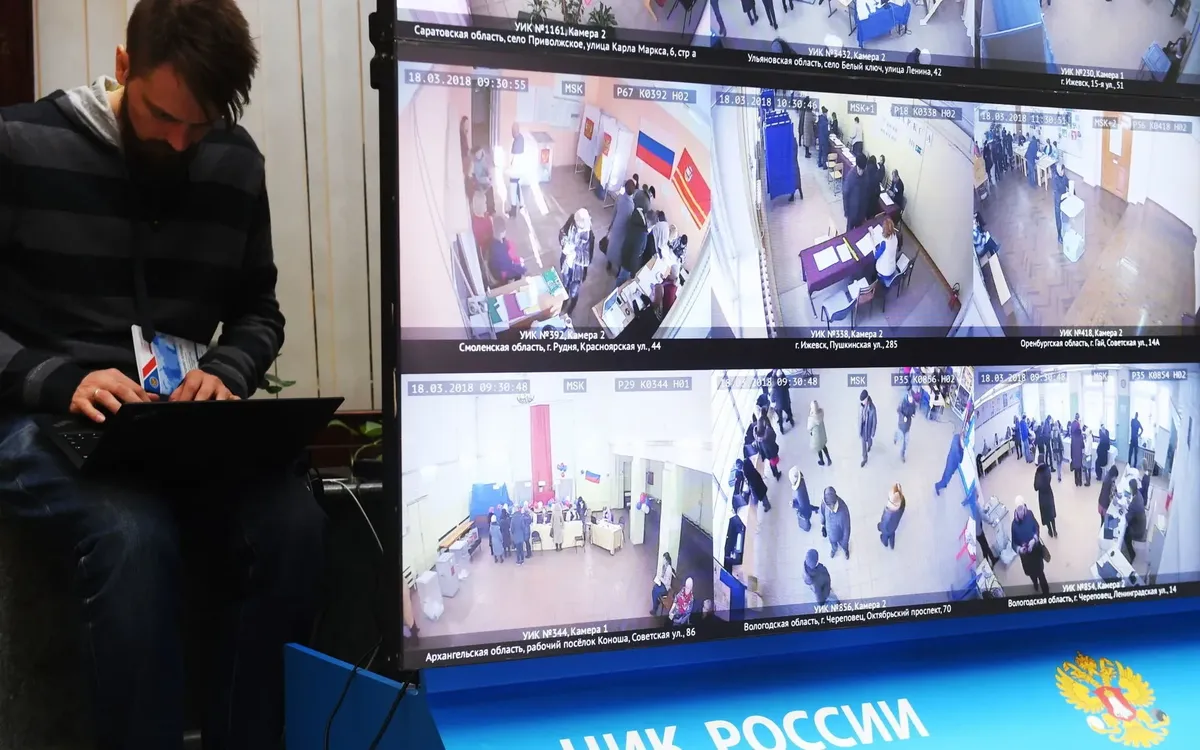
On October 10, the St. Petersburg Horizobirk forbade his decision to citizens who applied to the court with complaints of election violations, to access the videos of the results (establishing results (establishing results) at polling stations and in the premises of election commissions. This access is now provided only to the court - and only at his request. The meaning of this decision is crystal transparent: to hide the certificates of crimes against electoral rights as much as possible.
When the video surveillance system was introduced, we were happy at first: now the crooks can be grabbed by the hand.
Then it turned out that free access to video surveillance of citizens is available only in online mode on the voting day.
And getting this access after voting is not so simple-with decisions of the CEC and the St. Petersburg GIK a fairly bulky procedure is established.
First, you need to file a complaint with the election room or court, and only after that you can write an application to the Gorizbirkom to provide video recording. At the same time, it is important, in the application it is necessary to indicate the specific time “the beginning and completion of the required event in the video” and “an indication of a violation, committed, according to the applicant, at the indicated time in the voting premises or the premises of the territorial election commission”.
It would be more logical to the opposite: having free access to video recordings, a voter, candidate for deputies or observer watches an entry, discovers a violation - and only then writes a complaint. But the mountainizer established the order in which you must first complain, indicating a violation, and only then request a video, where it is recorded. It is clear that it is much more difficult to do.
Now, with the decision of the GIK of October 10, access to video recordings has become even more complicated.
The decision of the GIK (supported not by everyone - a member of the GIK from Yabloko Olga Pokrovskaya, Ekaterina Fesik from Just Russia and Nikolai Levshin from the Communist Party categorically against) as follows) as follows:
“In the case of an application from a person participating in an administrative case in the proceedings of a general jurisdiction, as well as a request for access to video recordings received during video surveillance in the voting room, a tick premises, from a general jurisdiction court considering this administrative case, access to the corresponding video is provided only to the court.”
We will translate from legal into Russian. Imagine that a candidate for deputies, an observer or voter complains to the court on election violations and wants to rely on the video in court, where these violations could be recorded.
He may ask the GIK to provide this video, but even if the court also sends the corresponding request to the GIK - this video will still not be given the applicant. It will be given only to the court, which will decide how to use this entry.
This is a direct restriction of citizens' rights to information (as Olga Pokrovskaya spoke about at a GIK meeting).
How do they prepare for the courts without preliminary access to video recordings? How to explain to the court what exactly to watch in the many hours of recording?
Try to get acquainted with the records in the Court's office? It is not the fact that there will be the necessary technical equipment for this, and to spend several hours in the office, watching the record in search of the desired episode, is not so simple. It is much easier and more convenient to do this at home, but the solution of GIK closes this opportunity. And if it is not enough to indicate in detail the violation and not know its exact time of its commission, the court may well refuse to request a video.
The problem, of course, is also that nowhere in the electoral legislation on video records is said. There is not a norm in the law that they are mandatory, nor about the fact that their viewing is possible not only in online mode on voting day (which anyone can do today), but then, after the election, when such a need arises. Everything related to video surveillance, today is regulated exclusively by the decisions of election commissions - the CEC, regional and other election commission. And they, as practice shows, are not at all interested in an excess of publicity.
It is noteworthy that two weeks before the specified decision of the St. Petersburg GIK, at a meeting of the CEC, the recent St. Petersburg municipal elections were once again considered. And once again they exposed the work of the GIK to destroy the work, like the entire city electoral system. That's just the slightest sense of these loud words, as before, there were.
The Chairman of the CEC Ella Pamfilova and her colleagues did not spare the devastated epithets for St. Petersburg colleagues who, in their opinion, worked badly.
And they cited statistics: almost 1200 complaints during the election campaign were received in the CEC from St. Petersburg, and only 800 from all other regions combined.
They recalled that mass violations were in St. Petersburg even in the municipal elections of 2014 - but at the leading posts in IKMO (election commissions of municipalities), many of those who were convicted of lawlessness and falsifications remained. And all that was five years ago was the secret purpose of municipal elections, closed IKMOs, gopniks and pitching, blocking the opportunity to hand over documents, frauds during a subordinate vote, illegal “recalculations” of the results, dramatically changing the initial results ( I note: exclusively in favor of the “party in power.” - B.V. ), - repeated in much large scale. It is precisely due to the impunity of past violations.
All this, of course, so. And the work of the St. Petersburg GIK (which, in many cases, either washed her hands, closing his eyes to flagrant violations of the law, or supported the crooks from IKMO, who replaced the documents of the candidates and falsified the voting protocols, or showed strange myopia that did not allow the numerous violations that occurred in the polling stations) deserves a negative assessment. But it is impossible to ignore the CEC itself, which met thunder and lightning against the St. Petersburg elections and stigmatized violations on them - but practically did nothing to change the situation.
In many cases, the CEC refused to register candidates who were illegally withdrawn from the elections, although by law she had the right to do so. Instead, she sent a question for a “new consideration” to St. Petersburg commissions, which often ended with new failures.
The CEC complained about the lack of authority to influence the actions of IKMO-forgetting that in accordance with the 31st article of the Federal Law “On Basic Guarantees of Electoral Rights ...” it has the right to apply to the court within three months after the election to disband those IKMOs that did not fulfill the court decision, or the decision of the GIK, or the CEC itself. There are such cases (for example, the infamous IKMO “Black River”) - but nothing is known about submitting applications to the court on behalf of the CEC.
The CEC “threatened” the head of GIK Viktor Minenko, but modestly silent that he was appointed to this position precisely on the representation of the CEC, and political responsibility is undeniable here.
True, Pamfilova suggested Minenko (and most of the GIK) write an application for care. But no one doubts that this is a purely rhetorical sentence. Meanwhile, in recent years every time the issue of appointing (on the proposal of the CEC) of the chairman of the GIK has been considered, only candidates were proposed from Moscow, in the other way related to the administration or there are workers. And this is in a situation where the administration is not a body that technically ensures the holding of elections, promoting the election commissions, but an active player in the electoral field. And relatively independent from the authorities, the candidate for the post of head of the GIK deviated.
As for the city electoral system, nothing is known about the CEC attempts to at least put on consideration (and not just calling for this) really naughty issues.
For example, about the essential reform of the election commissions themselves, which are today appointed precisely those bodies whose elections they should hold. As a result, a considerable part of the commissions are the current officials, state employees and other persons subordinate to future candidates from the party of power.
It is very simple to change this state of affairs - to form commissions not according to the administrative, but on the party principle that only parties participating in the elections are appointed to their members.
Alas: nothing is known about the receipt of such proposals from the CEC.