
Translated material
The genuine story of the "pit"
This summer, the amphitheater on Pokrovsky Boulevard from the ordinary consequences of Moscow renovation turned into one of the main sources of the capital's news and the hearth of the incessant uprising. Exhibitions, lectures, fruit swaps and constant drinking are held in the “pit”. Some build their small media business on the wall of the White City, others want to close it, and others follow the example of Tesak and in the company of the Moscow riot police are trying to disperse everyone or make a name on mass fights. At the request of Samizdat, the researcher of urban social communications Olga Pichugina explains how the “pit” opened the portal into the world of old Moscow, where pure ponds are still called a filthy puddle, and the remains of the ancient fortress remember the torture basements of Malyuta Skuratov and the concentration camp within the walls of the Ivanovo Monastery.
On Summer Friday, it was worth the good weather to spread out, finally, in the city’s boulevards, the inhabitants of the Ivanovo Gorka and Pokrovi Street froze in horror. “Maybe it's still raining? ..”-they thought hopefully, looking into the cloudless sky.
Meanwhile, the people flocked to Khokhlovskaya Square on Pokrovskaya Boulevard. Students, tourists, local drunks and district deputies were seated on huge steps, leaving the amphitheater down to the rest of the wall of the White City, ancient Moscow. An old masonry, similar to a number of giant teeth protruding from the land, was used by visitors as a background for an exhibition of empty bottles. For a third -party observer standing on the edge of the amphitheater, the bottles were formed in the inscription "Leo Huylo".
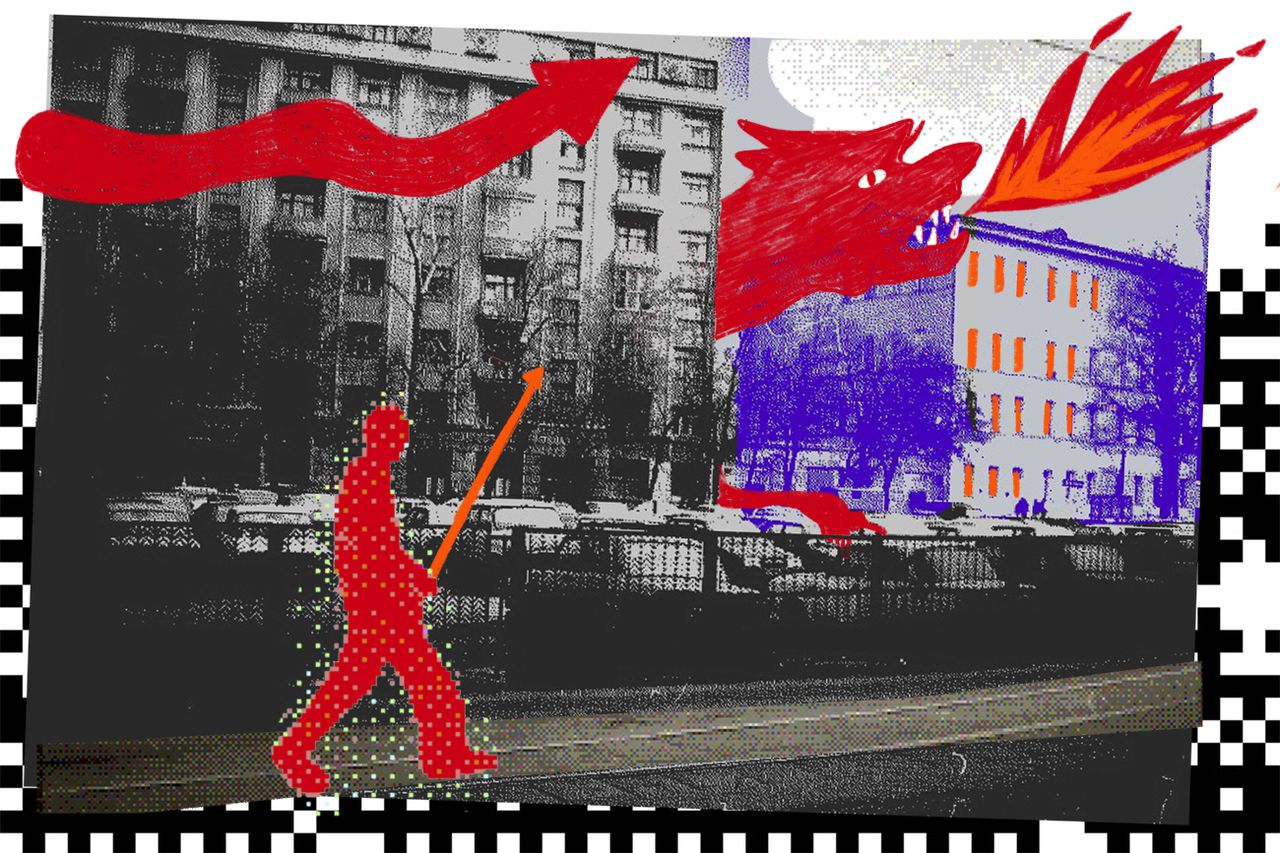
The people arrived. The polyphonic rumble of conversations, music, laughter, tears and ringing of bottles took off and headed straight to the open windows of the inhabitants of the surrounding houses. From their balconies, in the evening, the audience in the square mixed with shadows and finally turned into one indistinguishable something, spewing out of a fragment and swearing, drinking and leaving where she wishes. The monster living in the "pit". Monster from the Ivanovo hill.
On the corner of Kolpachkaya Lane and Pokrovsky Boulevard stood the guardians of the surroundings - Shaman and Olga Vladimirovna - and habitually watched what was happening.
Awakening
In the middle of the zero on Khokhlovskaya Square, construction began. The “pit” was supposed to become an underground parking, but the construction pile rested in the remains of the White City, the project was frozen, and the foundation pit stood under a green net for many years. In 2016, an “active citizen” chose a project for the reconstruction of the place - and so the amphitheater appeared here. The wide steps, the faceless gray space, which, obviously, had to fill the visitors with energy.
The amphitheater was not particularly popular until the summer of 2018, when the final of the World Cup was held in the capital: “Russia was surprisingly in the championship further than everyone expected, and the bars in the center were scored,” says journalist Viktor Bulgakov, one of the leading instagram-account by Yamamoscow, which has about twenty thousand subscribers today. -Having once gathered to watch one of the matches in “Pine and Lip”, we realized that there was too crowded, and we went out to look for another place until we wandered into the “pit”. An empty huge space, where only a couple of people sat and ate pizza. We also sat down, watched football and parted. The next few days we stably came our company there and spent evenings there, drank and had fun. ”
Why to grow up is a trap Julia Kozlovskaya , Alexei Sukhov (sukhmen) Samizdat found age and consisted people who did not want to leave youth communities, and figured out why each of them refuses to grow up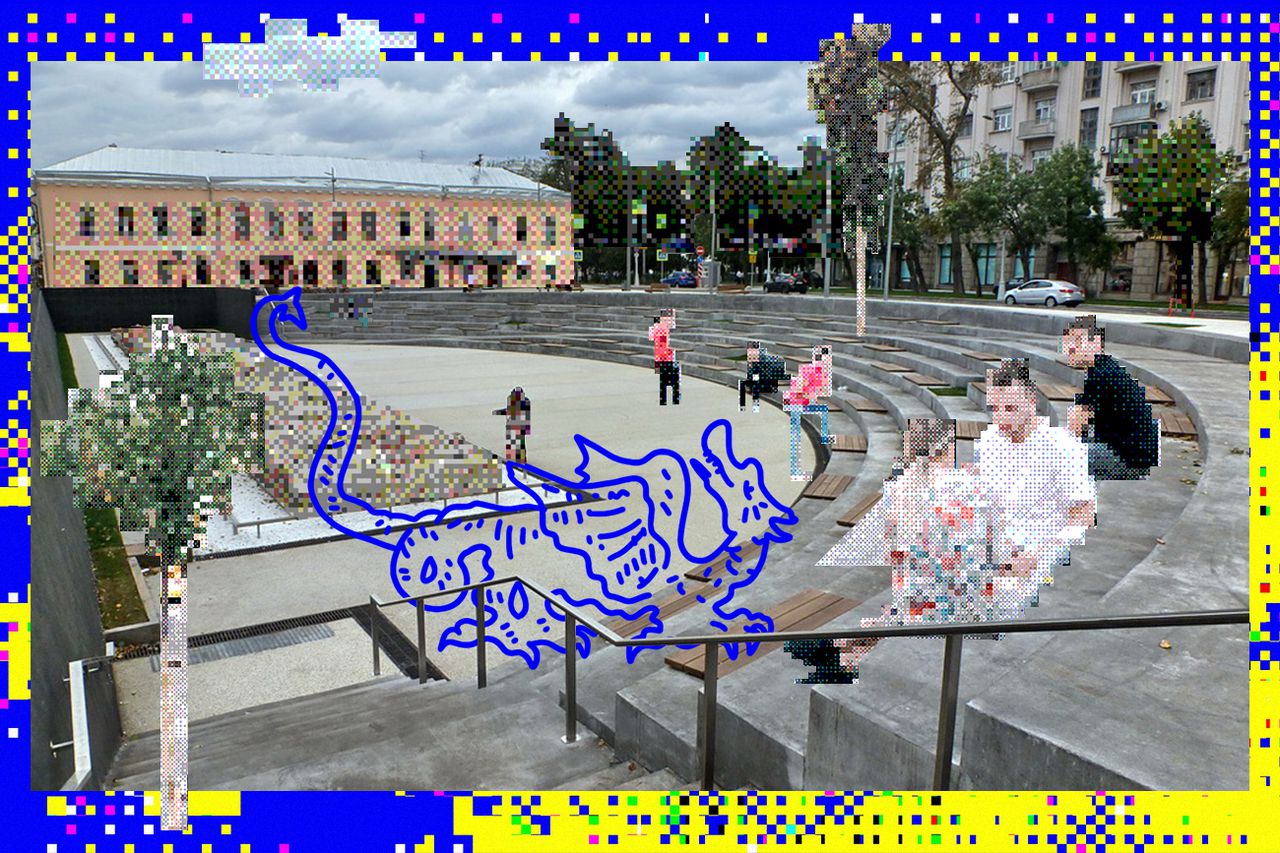
Victor finds it difficult to name the moment when and how exactly in their company this place began to be called “pit”, and he himself explains that it is so simple and more convenient than the “wall on Khokhlovskaya Square”, especially if you are a impulsive. However, it can be said for sure that in June 2018, when an Instagram of the same account appeared on Instagram, this epithet was already in use.
“The girls from our company decided that it was time to collect all the ridiculous moments taking place in the“ pit ”in one place, and created an @yamamoscow account on instagram for friends and acquaintances. He went very strongly to everyone, and the “pit” was constantly noted to the story so that we lay it to ourselves, and then we realized that this has our own potential. Soon in the “pit” there was a fight with the participation of our acquaintance of Dani, and we used his photo with a broken face for leaflets . Then they made a small stand with a board and a marker, on which everyone could write something, and it was a turning point. The stand was completely painted in a couple of hours and tried several times. But we drove these people. ”

Shortly after the account of the account to the company, which consisted of Viktor Bulgakov, Ani Aristarkhova, Dasha, the honor, Barbara Kuifman and Zhenya Ostrovskaya, Dmitry Koyifman joined, and since then the Kostyak of the project remained unchanged. Friends conducted the daily chronicle of the life of the “pit”, and Yamamosco -scored her first thousand subscribers in a month. They began to contact the owners of the account to jointly conduct non -profit events, exhibitions, public lectures and swaps, and in the same summer the project for the first time earned an advertisement for the Tele2 mobile operator, which promoted his events in the amphitheater through social networks.
By the fall of 2018, the project scored about 2000 subscribers and went to the plateau - in winter no one was going to in the “pit” and the project did not grow. But its founders have already begun to make plans for 2019:
“In the spring, we decided to make the official opening of the Yamamoscow season,” says Victor. - We arrived to the music from the “brigade” on the limousine, went along the carpet, made a photo station, treated everyone with champagne and canapes with cheese and grapes, turned on the music loudly and danced in the center. Then more than a hundred people came to look at our performance, and then the police began to go to the “pit”, but for some reason they did not touch anyone on that day. At that moment, we realized that it was fascinated to make similar large things for the people for their money and on their own, and earn money on commercial projects such as the story with Tele2 when they suggested that we advertise our temporary pavilion in the “pit”.
We made an open drawing lesson, yoga morning, a free distribution of cider and all sorts of such nishtyaki. Everyone liked it, everyone is happy, the subscribers are growing, the residents are very rare, but they write to us in the account that we must monitor people so that they do not litter and not yell. We tried and called the people to this. ”
From that moment, life on Khokhlovskaya Square only gained momentum. During the summer, the number of subscribers in social networks increased by an order of magnitude, the surrounding cafes organized free delivery to the “pit”, mossy “Dixie” on Pokrovka, made huge revenue on the sale of cheap wine and beer. They agreed in the “pit”, bought, stupefied, and recently, they say, they began to sell film cameras.
While residents of the surrounding houses area thought how to arrange a pond on the site of the “pit” and launch crocodiles in it, while the priest read passers -by in the morning, and the city authorities put temporary barriers, the amphitheater on Pokrovsky Boulevard was rapidly turning into the only place in the city where you can be anyone and do everything you want. However, on the Ivanovo Gorka it was already once.
Hibernation
Journalist and writer Vladimir Gilyarovsky created the brand of Ivanovo Gorka at the beginning of the twentieth century, and this reputation lives, as if there are no statements and urbanism. No matter how hard the developers try to turn the area from the Kremlin into an oasis of a high culture of everyday life, nothing happens: the sinusive place of the Khitrovka on the Ivanovo Gorka and the surroundings remain the center of the accumulation of Moscow marginals.
Major General Nikolai Khitrovovo, after the fire of 1812, was about to arrange a garden here and give the city, but after his death, the market and taverns grew on the site of the pallets-the new owner of Khitrovka completed its improvement.
After the abolition of serfdom, the people poured into Moscow. On Khitrov, you could find a part -time job, buy, sell, spend the night, drink, remove, steal. The place was boiling, boiled, buzzed. The authorities tried in every possible way to fight the Khitrovka, but, of course, nothing came of it: the people of the trick were needed, and the people defended their right to it. Here, as today in the “pit”, there was no struggle of classes, class disputes. Former nobles and peasants were cooked in one boiler. In the archival brochure “On some conditions of the life of the population of the market of the market” of the late 19th century it is said about 35 officials, nobles and one baroness, adjacent to the bunks with yesterday's convicts and peasants.

Gilyarovsky savored the details of the dirty trick and became for her something like an evangelist. Stanislavsky and Nemirovich-Danchenko turned to him for the consultation when preparing the play based on Gorky's play “At the bottom”. True, during the excursion of Khitrov, one of the directors almost broke his head with a bottle, but the premiere was successful.
The Soviet government entered with a trick cruelly: she rolled the market with a bulldozer, arranged a square, put beer machines and broke the square. However, local residents recall that in the 70s and 80s to live on the hill and in the vicinity it was scary. At the sunset of the USSR, the area was teeming with the elderly, there were almost no children; Waiting for their trains at the Kursk Station, which was fifteen minutes on foot, and the visitors spent time in the area. Locals also recall the crazy pilgrims near the Ivanovo monastery, the poor and the holy fools.
The Ivanovo hill always seemed to attract what I want to close my eyes and pull away. With its fame, Khitrovka overshadowed other events that occur here in different eras. Many are connected with the Ivanovo monastery, which gave the name to the place. Earlier, the Ivanovo hill was called kulishki, which means, according to one version, the swamp, according to the other - the wasteland after cutting down the forest. They say, at night at the walls of the temple you can still hear the crying of Princess Tarakanova - the nun of the pre -men who pretended to the daughter of Empress Elizabeth II and Razumovsky. The famous psychopath of the Saltychikha, who scored to the death of their peasants, also served a sentence in Ivanovsky.
At the end of the 19th century, the monastery received a large amount for reconstruction, according to the plan, a “little Florence” was supposed to appear here. But the hill was against. While developing a reconstruction plan, the First World War struck, and then 1917 happened. After the revolution, most of the territory of the Ivanovo Monastery was transferred to the forced labor department of the NKVD and transformed into a personalized - concentration camp. The prisoners were dragged into the camp through the Holy Gate. After the war, there was also a prison here, and almost until the 90s the most part of the territory of the monastery was in the department of the Ministry of Internal Affairs, which, however, did not affect the well-being of the region.
Another local attraction is the underground river River, which stems from a reservoir, which was once called a filthy puddle. Now these are pure ponds. The puddle has not gone anywhere, just once the city administration decided that there could be nothing filthy in the city center, but there can only be clean ponds. In the summer in the morning, homeless people swim in them, and in the evening - trained nutria.
The crustacean pouring into the rack for a long time was caught in underground pipes, but she still managed to destroy the bell tower of the Trinity of the Trinity of the Life -Giving Trinity at the Gryuzch at the Pokrovsky Gate in the XVIII century. “On mud” is about the crustacean. She made a stench wherever she found herself. Nothing came out with the first project of the pipe to imprison the crustacean - and I had to build a wooden bridge. The crustacean, of course, demolished it. But in the end, she was still caught and locked in the collector. But every time the clouds above the hill and spilled rains, the crustacean woke up. "Our Rachka is a hysterical!" - the locals said and prepared to walk knee -deep in the water. The program "My street" seems to have overcome it, but for some reason it seems that it is not for long.
Indigenous
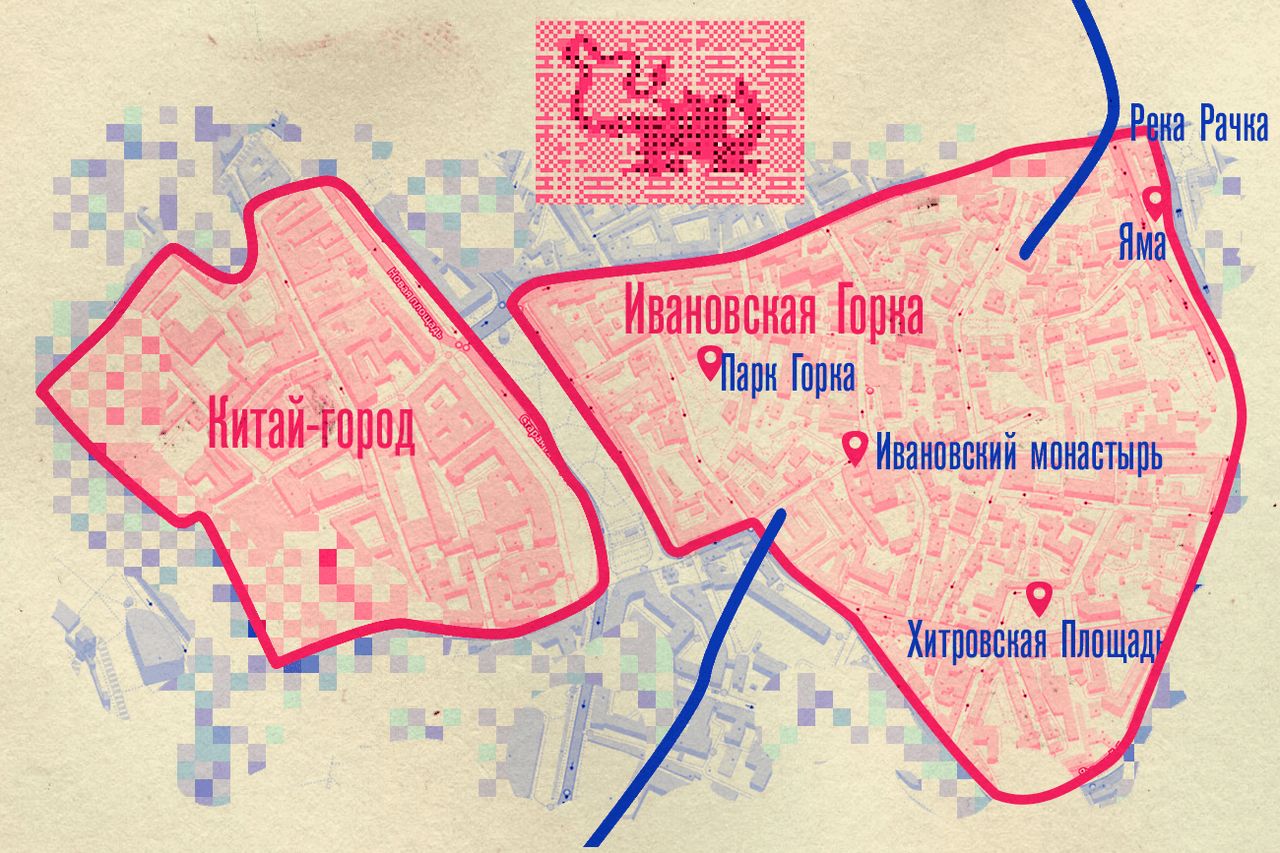
Locals are very jealous of the fact that the Ivanovo hill is often confused with Kitay-Gorod from because of the metro station. Kitay-Gorod is Zaryadye, Nikolskaya, Ilyinka, Barbarka. Adjacent area, but full of a hill antip. Kitay-Gorod is a sparkling tourist paradise soaring a bridge. The Chinesegorodsky is in a hurry not to thump into the “pit”, but from work in government institutions home, in order to return to the impeccable world of bureaucracy in the New Square in the morning. Gorka is a reflection of Kitay-Gorod in a crooked mirror. However, the locals see in her “living life” and are very proud that the district did not become elite, unlike the Patriarchal and the “golden mile” of Prechistenka.
The main fighters with the dressing of the area are the Kulishkin Shaman and Olga Vladimirovna. Olga Vladimirovna grew up on Ivanovo Gorka and believes that she played a huge role in the formation of her hostile independence. A person who calls himself a shaman is in reality a financial lawyer Dmitry, in certain circles, known as a participant in the five seasons “What? Where? When?" He is about forty, he lives in the Lane neighboring with the “pit”, always walks in the cylinder, a checkered jacket and with a cane. Rumor has he studied in London. All local residents know him, and although he is not old hill, upon moving, he immediately earned a reputation as a local tricster and began to restore order.

The methods of Olga Vladimirovna and Shaman Dmitry are different, but the essence is the same: to give the area to live the way it lives, and nothing that sometimes has to put up with the pungent walls and night bars. The desire to control the hill and let it be itself generated by the shaman quite paradoxical judgments:
“Explaining to Yamsky hipsters is not a problem. You just need an adequate police outfit. Making comments and offering a wishes to be deleted. And knitting only those who do not fulfill legal requirements, ”says the shaman.
When asked whether this is realistic in principle, he replies: “So we will be pioneers again. We came up with a hill, a “hole”, we will come up with a new park police with a human face. We must begin to dream more specifically. We have such a place - desires are fulfilled, dreams come true! ”
Olga Vladimirovna walks in the Park "Gorka" in Spasoglinishchevsky Lane of the white and fluffy, like a cloud, a dog. She came up with the park and achieved its creation for this. And also in order to plant roses. Therefore, the locals sometimes call her a flower fairy.
Park "Gorka" is the predecessor of the "pit". Ten years ago, a wasteland formed between Spasoglinishchevsky Lane and Zabelin Street. The Earth was a draw, and all the time someone attempted it. Olga Vladimirovna looked at this wasteland from the window of her house on Bolshaya Spasoglinishchevsky and thought: "I need a park here." She and his friend from the neighboring house began to collect information and found out that this territory is an environmental zone and is included in the general concept of the street. Under the leadership of Olga Vladimirovna, local residents united and began to act. Soon a park with the name "Gorka" appeared. The surrounding teenagers, students and drunks quickly settled in it. The “hill” for a while even managed to light up in the headings of the media: they say, they made a cloak from the park. But Olga Vladimirovna arranged duty, talked with visitors and the police. Silence reigned briefly, but then the “pit” appeared.
Shaman Dmitry does not want to close the “pit”. He likes the “pit”. He knows: she is in its place. For her good, he thinks how to calm her down a little. The Flower Fairy Olga Vladimirovna says that it is necessary to create conditions for good, and then everything will be fine. Who knows, maybe she is right.
The monster goes to the streets of the city

Meanwhile, over the past season, the growing popularity of the “pit” among the city marginals was an unexpected continuation in the person of Mikhail Lazutin, who took the nickname Lion in honor of his own zodiac sign.
“I remember this day perfectly,” recalls Viktor Bulgakov. - Friday evening, in the “pit” a complete landing. And some screams, laughter, or, the people stand abruptly, and we see the “lion against”. I have his first parish and the second mixed into a single whole, it was different on Fridays, but I remember that it was the most fucked up: pepper cans, the first detentions, fights, all that run from him, then follow him.
This was some kind of turning point in the history of the “pit”. For five weeks, every Friday at 21:00 we all went to the “pit” after work and waited for him, and he, of course, came. Each time it was more and more prepared, each time more and more people cited. At first he was with the team, then with the police simply, who brought out warnings to everyone, and then with a riot police, which grabbed random people and took away. It was interesting for five weeks, and then everyone scored on a lion and began to be afraid only of the police. He came - everyone ran away and waited for him to leave with his patients.
Then there was a situation with a phantom poisoning, we heard about this once in our directed, but there the guy did not go into details, and we did not pay attention. And then it touched our friend Lyudmila Chizhova - and it began. Through the “pit” we began to look for people who were poisoned, and there were so many who responded that we processed these stories for several hours a day. Andrei Yakovlev [journalist The Village] folded them together, and as a result, the “pit” became such a great assistant in the detention of a man who poisoned more than twenty -five people.
Ещё за август-сентябрь мы сделали там первую костюмированную собачью вечеринку „Пёси Пати“, и это было самое доброе мероприятие лета, а потом ребята из Stand-Up Club #1 устроили в „Яме“ „прожарку“ „Льва против“, на которую он, правда, не пришёл.
Сейчас там стоят автозаки почти каждые выходные, народу становится меньше и холодает, ну а мы постепенно готовимся к официальному закрытию сезона».
Когда в московском правительстве решили огородить «Яму» специальными заборами, она тут же материализовалась чуть ближе к Китай-городу у Политехнического музея. И ещё немного — на Маросейке, 13, где во дворе стоит алая руина. На лавочках и широких ступенях всё так же спят бомжи, а молодые люди рядом галдят, пьют и слушают музыку.
Детёныши «Ямы» живут во всех районах столицы годами, десятилетиями. «Ямы» появляются в дорогих и дешёвых ночных клубах, у торговых центров, в захудалых кафе, у метро. С ними безуспешно борются местные «шаманы» и «феи», а они, как грибы после дождя, растут и растут. Может быть, именно в «Яме» и кроется настоящая Москва.