
Translated material
Paris at eye level
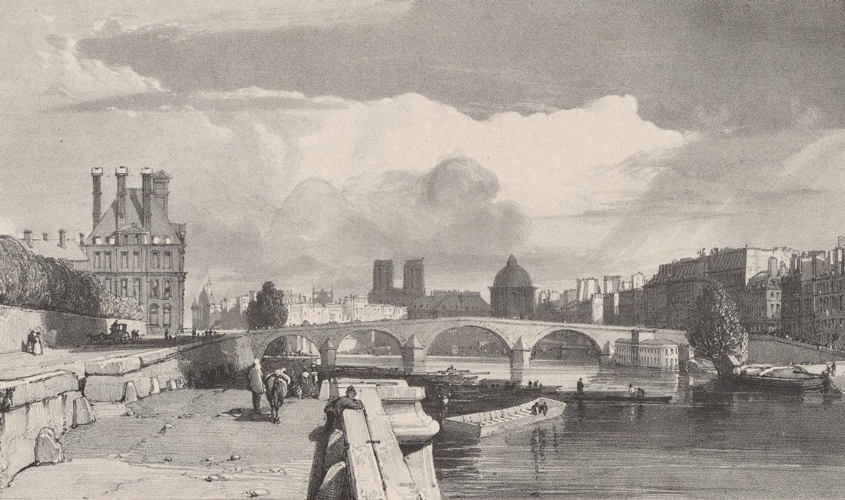
Paris in the Russian (although, of course, far from only the Russian) culture of the 19th century occupies an exceptional place - mods are formed there, including intellectual ones, styles and directions are developed, they are approved and further spread throughout the world of practice of life. At the same time, often not so much even developed as they say: something can arise anywhere in Europe or on the other side of the Atlantic, but in order to get distribution around the world, to be recognized as worthy of attention and replication - fashion, style, way of thinking should get their share of Parisian success. As Metternich Hall, the inventor of Frenology said: "Go to France <...>, if you laugh at your cones, you will become famous." At least, such advice was invested in the Austrian chancellor Balzac in Ursul Mirue (1841), and the historical sociology of literature in the person, for example, Pascal Casanova describes and detail these mechanisms of recognition and distribution.
Already this one thing is enough for the descriptions of Paris of Paris of the beginning of the 1830s-so Russian fiction is penetrated both of the years and subsequent years, responds to them or repelled-and, in turn, they not only, and sometimes not so much allow you to see the details of the Parisian life of those years as they are a source of subsequent literary images (starting with Gavrosh) and commentary to the “large texts” French literature that did not turn out to be quick reading, but have become the ever -present factor in Russian literature for decades and centuries.
“Parisians ...” Vera Milchina give magnificent material for such observations and notes, telling about one of the most famous books of that time dedicated to the description of the city - “Paris, or the book of one hundred and one”, which is not only significant in itself, but also gave rise to a number of similar publications.
However, the interest of this book is by no means connected with the realities of the Parisian life of a long -gone era. A lot has been written about this, including the wonderful “Paris in 1814–1848” (2013) Vera Milchina, recently released by the second edition, is a detailed essay on the daily life of Parisians. The new work of Milchina, on the contrary, is, first of all, a book about the book, the story of how the “Book of one hundred and one” was created and how it was created.
 © Publishing House "Delo" RAMS, 2019
The new publishing project was called upon to help Pierre-France Ladvoka, the famous Parisian book trader and publisher, who became famous, first of all, by multi-volume luxurious publications and the publication of romantics and close to them, whose affairs by 1831 had been going down the mountain for quite some time, although Ladvoka himself sought to observe the former surroundings-being a bright and loved man of bright and loved. Attract delighted eyes.
Publicly, the project itself was a voluntary giving writers in favor of the beloved publisher - as a result, the number of its participants exceeded 170, and there were even more signatories. Ladvoka himself in the last, 15th, volume of “Books of one hundred and one” reproduces the fax of the signature sheet-the subject of his pride. However, as the researcher cautiously notes, some circumstances force the doubt to what extent the project was really philanthropic by the authors - at least the preserved letter of Georges Sand (if it really refers to the edition of Ladvok) says that some authors were paid (63–64). Nadezhdin, who reviewed the publication in the Telescope, was confident in the commercial nature of relations and believed that the publisher’s statement was nothing more than an advertising gesture. Be that as it may, many authors were really involved in the publication - from celebrities of the first magnitude like Chatebrian, Viktor Hugo, Lamartine or Jules Zhanen, the author of the sensational novel “A Dead Donkey and Hillotinized Woman”, and up to those, about whom it is almost impossible to find any information about. The titled authors, as usual, mainly wrote about their own, at best, formally responding to the proposed common frame of the publication, while the authors who had not yet had either so and sank into obscurity, on the contrary, tried to comply with the publishing project, and it was their essays that are of the greatest interest.
The “panoramic” effect that Benjamin spoke about - including in connection with the “Book of one hundred and one” - arises due to the description of the variety of Parisian life in itself, but the multiplicity of copyright votes, the combination of which the publisher thought by analogy with the “salon”. The latter image will subsequently leave this kind of enterprises, because, in turn, it is associated with nostalgic experiences, the image, the pre -revolutionary, the world, in which it seemed possible to adhere to different opinions, be immigrants from different environments - and calmly get along with each other, moreover, even to some extent hear each other, and not just tolerate.
A big conversation about the book is impossible in separation from it-and the publication includes fifteen essays from the “Book of one hundred and one”: from the description of the Parisian “Beotians” (here for the first time acquiring the firm meaning of the synonym of the “fools”, opposed to the inhabitants of the Attica) to the portrait of the “flaer”-the only anonymous essay in the 15-ton Flaner, which creates the image of the “flaer”, as opposite to the “lady”. The Flaner figure, here conceptualizing, also seems significant because the similar publications themselves, the fashion for which was stable in the 1830s-1840s, are a kind of intermediate link between literature and journalism, artistic description and scientific.
The popularity of this kind of descriptions of Paris, Parisians, French are a reflection of the need for social knowledge. This time is covered by passion for taxonomies, classifications - and interpretations: the same “flaer” is an observer of the city that interprets it, capable of reading and understanding the signs that remain unknown or (if he suddenly notices them) is incomprehensible to the usual passerby. Throughout the 19th century, it is literature and journalism that will take on the role of interpreters of urban space - adjacent to statistics arising in the same years as a collection of information about social reality for management purposes. The fact that already in the 20th century will become the subject of interest of the sociology of the city (from Zimmel to the present day) is first designated by fiction by fiction - and since the space is free, there are no disciplinary boundaries yet, the writer describes, and calls, write down conversations and immediately declares them typical or exceptions. And for the modern reader, this is both a picture of how the first descriptions and explanations of the realities of the big city are built, made not “from top to bottom”, but horizontally, from the environment of the inhabitants themselves, and the images of the past, where the movement that often escapes the observer's gaze becomes noticeable. As, for example, in the essay of Ballara “Fashion in Paris”, an unexpected way for the reader, the author makes the subject of description exclusively male fashion, so that only in the last chapter to recall the existence of the female mod - and bring them as an example of taste, regularly violated by men, that is, to put forward as a standard to which male habitations should be equal. Here, very little time has passed since those years when the variety of fashion was equally related to both the female and the male suit - the bourgeois age only sets in, establishing the uniformity of the “pastoral costume” in order to begin retreat after more than an extra years. Or, for example, in the essay of d'Utepon dedicated to the Parisian Boy (Gamenu), the narrator mentions wigs with braids, whose owners can still be found in the crowd: the detail is quite natural, if you recall the asynchrony of the appearance, but what you forget about, representing the times of Louis-Filippa-and that at that time the possessors of the end of the wigs of the end were still roasted along the Parisian streets XVIII century.
This historical function is fully recognized by the authors themselves - at least some of them. So, Jules Zhenan, in the preface to the later similar collection, “The French painted by themselves” (270) not only marries questions, then giving up the “History of everyday life”, but at the same time discusses how difficult it is to find answers to them. The everyday life of the authors simultaneously appears as a historical for them - that in a more or less distant perspective it will change so much that it will become incomprehensible to the descendants: the fixation of the present is a way to see yourself, a “mirror”, and at the same time a portrait for another - for a provincial, a beginner in Paris, a foreigner, for a future historian. To see everyday life, it needs to be sharpened. And here the look, taking into account the conditional “historian”, is a way to achieve excision; Thinking in a historical perspective means to get the opportunity to conduct speech of this kind with contemporaries.
V.A. Milchina. Parisians about themselves and their city. “Paris, or the book of one hundred and one” (1831–1834). - M .: Publishing House "The case" of the RANEPA, 2019. 696 p.
Subscribe to the COLTA.RU channel in Yandex.Zen to miss nothing