
Translated material
Turkish march
Erdogan strengthens his influence in the Balkan countries
The parliamentary elections in Kosovo obscured the event that took place immediately after them - an official visit to Serbia of Turkish President Recep Erdogan. Having settled from a ramp to the red carpet, he exchanged with the Serbian colleague Alexander Vucic with a symbolic European kiss - with his cheeks with his cheeks - and asked him: “How are you?” “Fine,” said Vuchich.
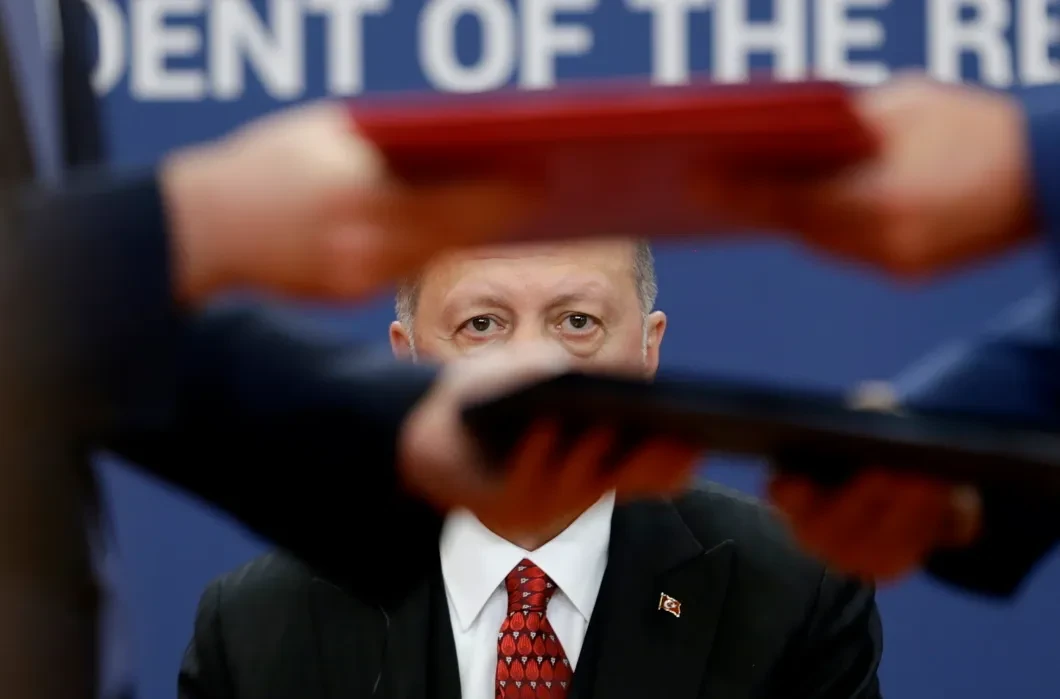
The last time Erdogan was here two years ago. This time has passed, as, in fact, all the previous decade. In 2008, the annual volume of trade between the two countries amounted to $ 340 million, and now, according to official Turkish data, it has grown to $ 1.2 billion. The Turkish, which almost absent then, are registering in Turkey today. During the current visit, two leaders set the following bar in trade - $ 5 billion amid an increase in investment.
Like the last time, Erdogan brought two hundred businessmen with him, opened either six or more enterprises built in Serbia with the participation of Turkey, signed a dozen any agreements, as befits an official visit. However, a more important content of the meeting should nevertheless recognize the political and to some extent military.
Firstly, the Turkish “Sultan”, as it is sometimes called in the Balkan press, said in an interview with Serbian “politics” that Turkey will arrange any agreement on Kosovo, which Belgrade and Primetin will agree on. He did not share the idea of a conservative party of democratic action (traffic rules), expressing the interests of the Muslim population of Bosnia and Herzegovina, about the state reconstruction of this country. Türkiye supports the Deuton agreements as a “minimum compromise”, which now exists in Bosnia and Herzegovina, Erdogan said, and they should discuss their improvement under the auspices of the UN.
This position strengthens not only the position of Vuchich, but also other projuroral forces in the region, which, despite all the thorns, seek to get into the constellation Brussels. And Erdogan adds any points in the same instance in which his Syrian campaign against the Kurds causes concern and rejection.
Secondly, among other final documents of the meeting, there was an agreement of the two countries “On Strengthening Cooperation in the Field of Defense”. It was unanimously perceived as the application of Vuchich for the acquisition of Turkish weapons. And, in all likelihood, correctly understood. The sensation did not occur, since the Serbian president has long been trying to diversify the sources of the acquisition of weapons. However, sales from Turkey, when they take place, will undoubtedly affect the Balkan military solitaire.
Finally, Erdogan would not be himself if he had not forced the economy once again to serve politics. He managed to turn a visit into Serbia into a tripartite meeting, putting the members of the Presidium of Bosnia and Herzegovina (Bosniy presidency) at one table and Vucich: Shefika Dzhaferovich (from the mentioned traffic rules), Gelko Komshich (from the Croats, he is now the current head of the presidency) and Milorad Dodik, representing the Serbs of the Republic of Serbian. This happened in the town of Sremsk-Rach in the north-west of Serbia-the construction of the bridge over the Sava River begins there. It will become part of the highway 290 kilometers long, which will connect Belgrade and Sarajevo. Turkish capital, embodied on the road and the bridge, reconciles the antagonists - the Federation of Bosnia and Herzegovina and the Republic of Serbian, forming the state of Bosnia and Herzegovin. Now the decision has been made: the highway will receive a branch, one part of which will pass through the Republic of Serbian.
During this visit, spectacular announcements were made, for example, about the opening of the Consulate General of Turkey in the city of Novi-Pazar, the actual center of the Muslim community of Serbia. Erdogan is already an honorary citizen there.
Its authority as a patron of all Muslims in the Balkans, including Slavic origin, is very great.
The same contingent draws up the Turkish support base in the region.
However, in fact, everything is not so dressed. Attentive analysts notice that in the last period, namely after the coup in Turkey, its economy experiences such deformations that can seriously undermine it. The economic activity of the Turkish leader in the Balkans begins to look not strategic, but tactical, and it is not very clear how depth it can be designed. Next:
Both Türkiye and Serbia come closer to Russia-but not because they realized the historical need for this, but because of the orphan complex in their relations with the West and the USA.
How promising is such a geopolitical circuit and how long can it last?
An exacerbation on the Syrian chessboard, initiated by the very recently Turkey, has introduced a noticeable confusion to the Balkan political space. Then they thought about what could happen if Erdogan really releases millions of migrants from his camps and they would scatter on a local landscape. Bulgarians, for example, as the most vulnerable, bless Erdogan for further exploits in Syria. Other countries reassure themselves that they are not so interesting to the former (or future) ISIS (which are prohibited in Russia, but not here) than the countries of Europe.