
Translated material
The machine we collect
The premiere in the workshop of Peter Fomenko looks like a report from our life
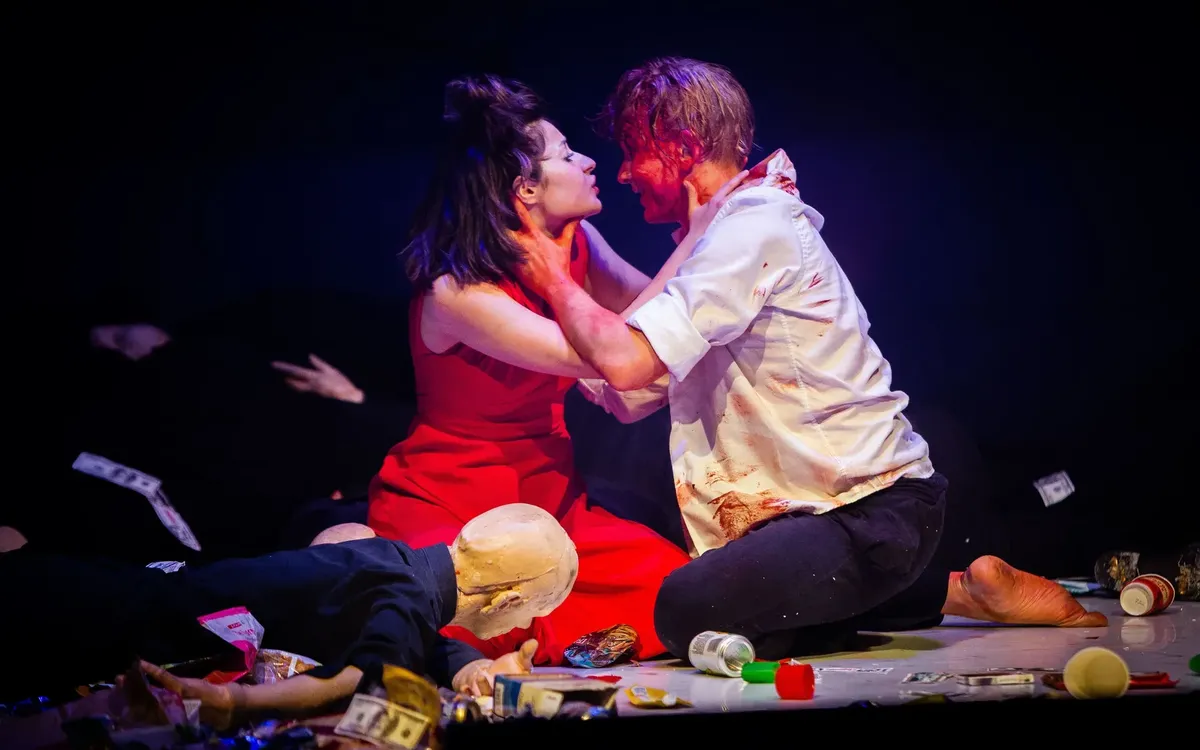
Fedor Malyshev began early and, I hope, will go far. His performance on the small scene of the “Fomen” based on the play by Ilya Kormiltsev is modern not imitated, but seriously with rhythm, form, message. Ilya Kormiltsev wrote a play based on the opera libretto Brecht, and Fedor Malyshev made a performance based on today. What, in fact, does that mean?
Not a roar of music, although it is. Not movie screens with a projection, although they are available. And not even the speed of development of action, although the performance accurately constructs the same darkening acceleration, the same numbness of feelings as our everyday life. Being 12 years after the death of Kormiltsev, the play migrated from thoughtful twilight to post-apocalyptic skepticism, from a healthy mockery to a patient, gushed by absurd Age of today. And the fact that Kormiltsev in the “take -off and fall of the city of M” looked like a parable, a prophecy, a possible projection of the future, in Malyshev sounds a report from the streets.
Mahagonia Brecht is a country of vice created by convicts, in Kormiltsev - the state of happiness, designed by the entire -line. There is only one community - in both Mahagonias as a new covenant they worship money.
And at the same time they refer to the Bible (the most important book for Bertolt Brecht, according to his admission). But the Bible, of course, edited by the latest times. The space built under the commandment “Money can do everything” (it would seem, vulgar banality) comes out on the stage so impudent-causing that the theater just in case “from itself” gives a moral interpretation: “The city of pleasures where there is no place for human, spiritual, personal, where the only law is money, and the crime is their absence, where“ the most intimate judgment becomes a fair trial Fars, and the death penalty is a television show. ” Easy to be identified, isn't it? Everything happens in the format of the show. Intimate as public and public as mandatory. Crossings of associations are beaten by sharp rays: the sticky, toxic substance of the social wedding is spreading, an echo of judicial lies sounds, the familiar intonations of the star leaders are screwed into the brain, a weak current of mercy pulsates, and the spite of the day, the anger of the day smokes and foams in the distance.
... The beginning: a certain dude, he is a presenter (hair in a bun, hanging strands, hefty legs sunken to the knees), introduces the hall with the flight instructions: belts, the back of the chair and so on, but his speech shows and burns. Kirill Korneychuk (Toby Higgins) in this role is a sign of the current swing of everything and everything: a man-automatic person, everyday life: on the one hand, now we kind of take off, on the other-ripples are going on all over this possibility. The text obligation, toned by distortion, becomes a tuning fork what will begin to happen to the heroes - and is already happening to us.
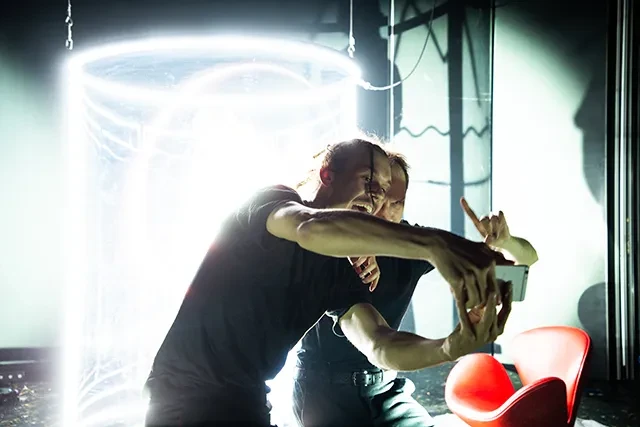
Fedor Malyshev gravitates to Balagan, not in the household, in the Bakhtinsky head of this genre. That is, not to the stem, exhausted faster than sound, but to the booth as a rigidly necessary, sufficiently square statement. It is the booth that is the type of theater that the protest wind of the modernity drives into the center of attention of society. The retelling of the plot is excessed: everything that Brifli gives is destroys the dignity of the event. We must look.
By the way, there is something. The scenographer Alexander Dashevskaya, a full co-author of the plan, created the image of the environment for the habitat on the stage of Morok-a black city, and this is a darling Moscow City, across the river from the theater. Artificial light, gray towers, the Black Sky - the image of not only Mahagonia, but also the current one. There is no doubt: the young director is busy with the elusive matter of our time. But how much now, this word has gained ambiguity everywhere, especially in the theater. Being modern - good or bad? Everything, I believe, depends on what features in the phenomenon are designated as relevant. In the range from narcissistic calculation to dignifying fashion formats, from theatrical service to strategic construction of the biography - many steps and shades. In the performance of Malyshev, relevance is the ability of ironic fixation of a new type of life and a corridor of meanings that opens up. An unfamiliar text sounds fresh and sharp (and how is it essential for the theater to open unfamiliar texts instead of hackneyed). Kormiltsev, albeit in a dispute with the root, but after Brecht, is busy with the study of the original human composition: delusions, seduction, sins;
The plot branches between the sale of the body and the thirst for eternal love, the mighty adhesion of lumberjacks and the murder of a friend, the madness of greed and the fornication of publicity, the death of a person and the death of the soul.
He transfers the action, as it were, to Western soil, but it is rather the Ural, dashing, native, rigid earth. However, as far as I can judge, a lot in the play is composed by a staging group and read into the original text, say, Dostoevsky (where are we today without “demons”?). Malyshev twice arranges a catastrophe on the stage - at the very beginning and closer to the end (shapeless pile of bodies, a crucified, electric cross, a crushed universe). But, perhaps, the White Hell of the postscript is much more monstrous: without hopes and options, the transformation of new humanity in Mahagonia-2.
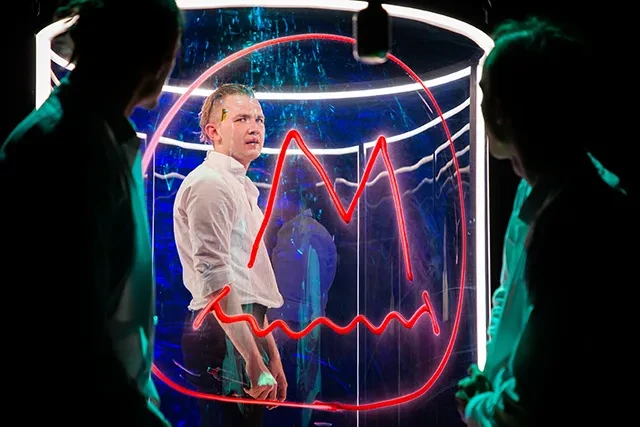
Well, this is the third performance of the season (following Vladimir Pankov and Yuri Butusov), in which there is a crucifix and a cross. The main event and the main symbol of Christianity, it seems, are not just exploited by the scene, become a way of time. The artists work in documentary style, and this is a group of yesterday's interns: Alexander Keselman, Anatoly Antsiferov, Igor Kuznetsov, Alexander Maovov, Rifat Alyautdinov and others do not even look like an ensemble. Two main characters seemed to have left the screens of YouTube. Both are reliable. Their dashing cheerful corruption, their natural movement at once in all the necessary trends are fascinated. Both the first and the second (Peter Alekseenko), whose scoundrel - so happens - appears in all appearance, from boots to hairstyles.
The director invisibly kneads in all the greasy rainbow-black colors of Tarantino, a drug drug, but the main thing is a purely personal, truly dramatic sensation of the circumstances of the place and moment. “Mahagonia” is a talented attempt to ridicule and comprehend everything that is rushing before our eyes: the norms of madness, the abolition of the rules, the triumph of instincts - and the brilliant bare whiteness of the prospect.
Maybe that is why the premiere went quietly, heavy, without fanfare. Because from the line built by Malyshev, from his dry states arises, right along the poems of Kormiltsev, "... such a feeling, as if we were collecting a machine that will crush us all."