
Translated material
"Die in the ditch" with a delay
The British parliament on Brexita voted against Johnson again

The UK parliament at an emergency meeting on Saturday discussed the Britain's withdrawal agreement, which was recently agreed upon by Prime Minister Boris Johnson with Brussels.
The situation in the parliament and the discussion once again showed that the pressure and pressure, which was almost in half in half, did not work. Various calculations said that the number of supporters and opponents of the agreement differs in several votes and the government has an advantage from two to five votes. But the “technical” amendment of Lyutvin, which was introduced yesterday in the evening, stole a victory from Johnson.
To the essence of the transaction, deputies have many complaints: Laborists fear that standards for protecting the rights of workers who exist in European legislation will be canceled. Deputies of the Democratic Unionist Party of Northern Ireland consider Johnson's agreement a betrayal, since, despite all the promises, they are disconnected from the country, proposing to build a border between Britain and Northern Ireland. Deputies from the Scottish National Party, liberal democrats, the party of Wales, the "Green" in principle against "Brexit".
Combines the opposition and adds forces and votes several common problems. Firstly, the prime minister and chancellor refused to present any calculations, analysis or forecasts. The deputies received a document in 500 pages in the morning on the day of the meetings and had no opportunity to study, evaluate it, or get a professional assessment from the outside.
Secondly, there is a steady distrust of Boris Johnson in particular and his government. As it turned out, Johnson and his closest environment informally promised that in fact, at the end of the transition period, Britain, in spite of everything, would still leave the EU according to the most stringent option. Interviews about this appeared in the press very at the wrong time for the government - on the night before voting.
The premiere and his team answered demagogical, sometimes even mocking replicas to the puzzled and indignant questions.
As a result of the many -hour classical and very acute parliamentary discussion, the House of Commons put an amendment proposed by the former conservative Oliver Lyolin, which prohibits the agreement with the EU for voting, until all the laws necessary to execute the ordered exit from the EU are adopted. 322 deputies supported the amendment and 306 voted “against”.
This means that on October 31, Brexit, which Johnson promised, is now extremely unlikely: it is difficult to imagine that in two weeks you can discuss and accept the entire package of documents included in the Agreement on the exit from the EU. The adoption of the amendment of Summer actually triggers the procedure, which, in accordance with the specially adopted law, requires the prime minister to contact Brussels for the next delay.
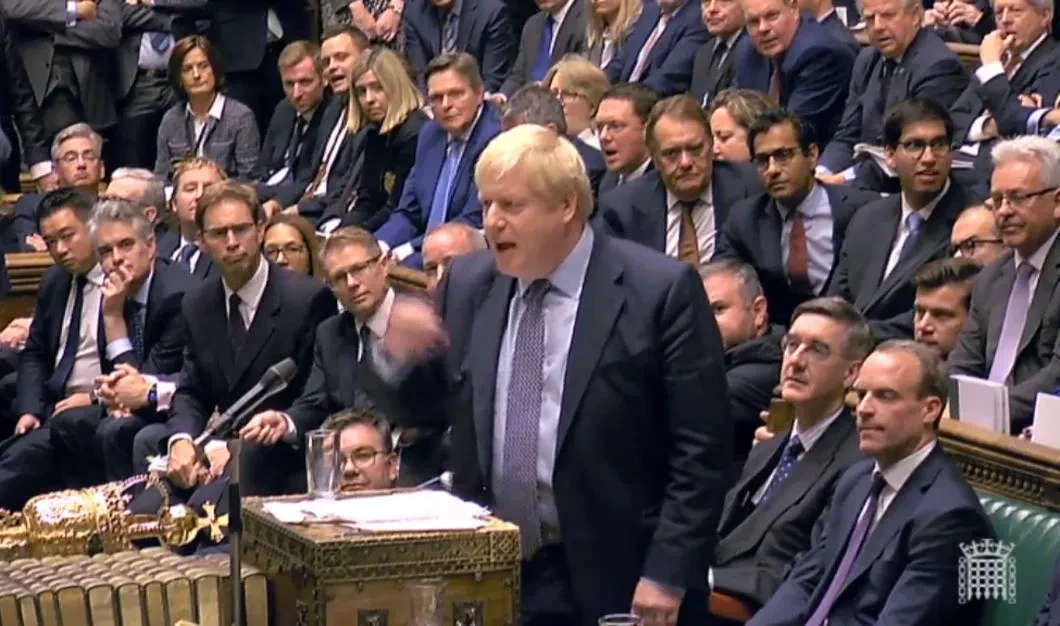
The defeated prime minister has already stated that he would not do this: he promised to “better die in the ditch” than to ask for delay. But the speaker of the House of Commons John Bercow confirmed that he was ready to send a letter to Brussels instead of Johnson, if such a court decision would be. The Scots in advance requested what to do if the prime minister refuses to fulfill the law. The court promised to make a decision on a priority on the fact of refusing to fulfill duties.
Thus ended the historical extraordinary Saturday meeting of the British parliament. Hundreds of thousands of people marching on the streets of London for the second confirming referendum regarding the exit of Great Britain from the European Union, with glee, they met the news about Johnson’s next defeat in parliament: he has not yet won a single vote during his premiership.
London