
Translated material
Bone by either police or Venezuelans are guilty
That local residents talk about the reasons for the largest protests in Chile's history
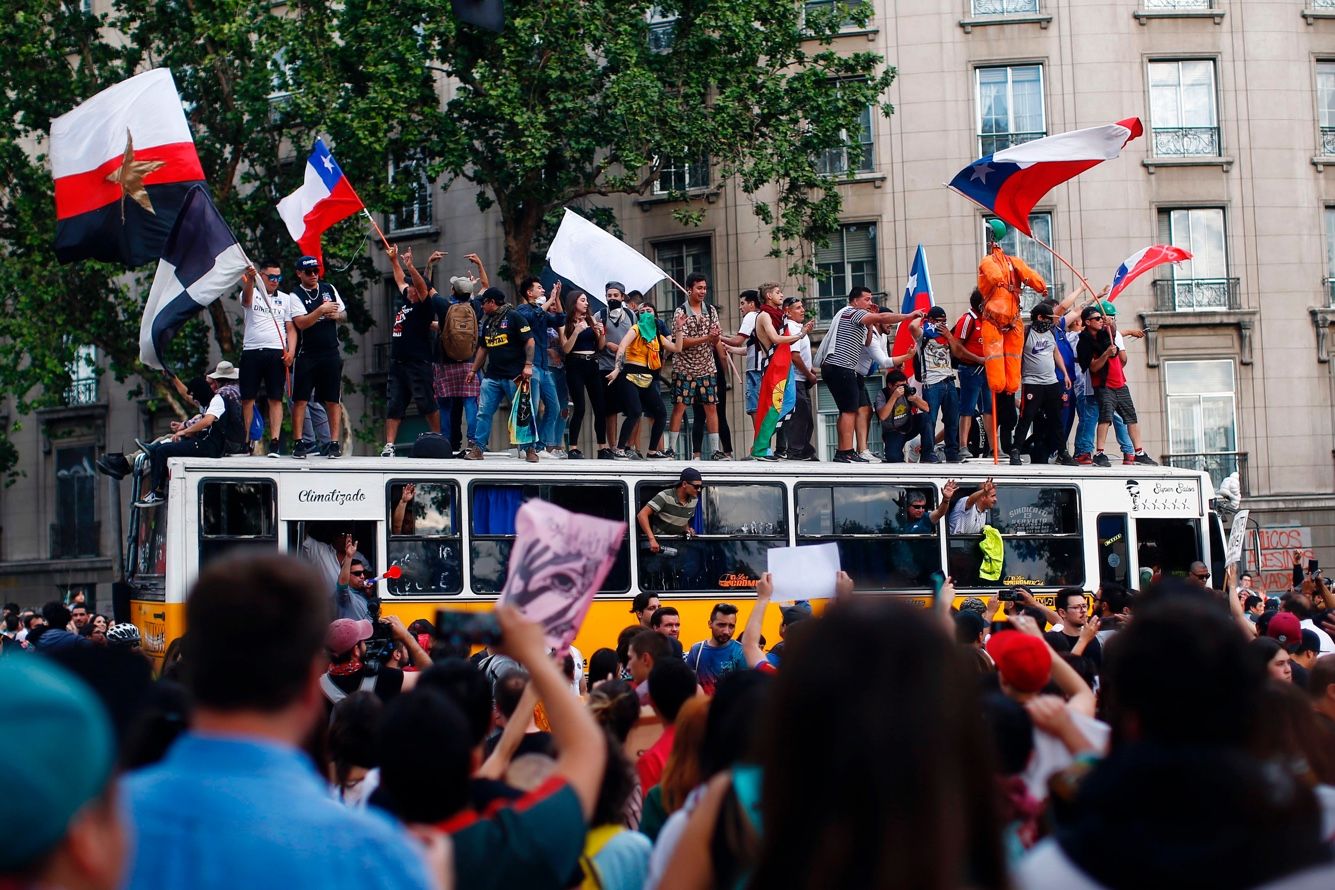
In Chile, the largest protests in thirty years last for more than a week. At least 18 people died during the riots, for the first time since the Augusto Pinochet, the authorities brought the army to the streets. The beginning of the protests was laid by a small increase in the metro travel, but the reason was in the high level of social inequality, which is observed in Chile through almost the entire length of its existence. On Friday, October 25, the largest demonstration in the history of the countrytook place in Santiago - more than a million people took part in it. Medusa talked with two inhabitants of the Chilean capital about who, in their opinion, was to blame for what had happened, and how riots influenced the life of the city.
Claudio Andres, 19 years old
I am a student, learning to a pianist at the Chilean Conservatory, I speak a little Russian, because I want to enter the Moscow Conservatory in two to three years. I live in the commune of La Floride, one of the poorests in Santiago. My parents do not work for hiring: dad has a small business, my mother does not work on an ongoing basis. I participate in protests; My friends and I are engaged in musical performances, this is our form of peaceful protest. Now there is a strike at the conservatory, so there is no lesson, as in many other educational institutions. And we are talking with older people so that they are not afraid to go out onto the streets, because many have fear since the time of the dictatorship [Augusto Pinochet].
Movement around the city, of course, became more complicated, because the metro is the fastest mode of transport . Then, there is a problem with supermarkets that are closed for security reasons or open only for a few hours, as well as banks and other institutions. But small enterprises, small shops, vegetable shops continue to work, and their owners support protests.
Now, compared with the first days of protests, the number of acts of aggression by the protesters has decreased, the situation has calmed down a little. On the other hand, during the curfew, the authorities behave tougher. There is evidence that someone was even tortured, so the threat to people has become higher.
It is clear that radical groups are joined by any protests that use the reason to make acts of vandalism. But now, many people are trying to record the actions of police and military on cameras, and on these records that apply on social networks, it is clear that many of them, dressed in civilian clothes, organize arson themselves, are scrapping supermarkets, banks and institutions. I think that they do this so that the protest is asleep, and everyone focuses on the fight against the so -called “violence”. So much was simply provoked.
Before that, there were many peaceful demonstrations, but if they were not suppressed, they were not welcomed by the police. There are many reasons for the protest, they accumulated, but special discontent caused the latest government reforms, including increasing the cost of travel in transport. The increase itself was very small, but the price of travel is already very high for the standard of living that is in Chile. The minimum salary is very small, so most of it and so went on transport. In addition, state medicine is very low quality, so you have to resort to the services of private doctors, and they take a lot. Housing rent is expensive, paid education - people live in constant need.
The biggest problem is that people with a low income cannot give their children the education of the same level as those who earn more. The stratification, of course, is not such that the segregation is directly and someone, for example, is not allowed into some institutions. But in one of the "tall" areas, that is, at the same time richer and above in the mountains, I saw how the owner of Starbucks did not let those who were clearly not from these places.
We have many goals - first of all, so that the president [Sebastian Pigner] resign, because this is the first president from the time of Pinochet to withdraw the army to the streets. In addition, we require raising pensions. The pension system here is in private hands, the funds take most of the money for themselves and spend only a small part on the pensions themselves - I know this by the example of their grandparents. Even the President and the government support large companies that move away from taxes and come across at prices - this was the case with chicken and toilet paper. This is the government, among other things, involved in the murders of the Indians Mapuche, who protested in the south of Chile. The perpetrators are still not punished, they do not give information to relatives.
Yes, Chiles are a very rich country, but in what sense? We have a lot of resources, and these resources generate huge money, but this is very little reflected in the life of the Chileans themselves. There is a lot of money, but they are very poorly distributed. This is obvious because public services, what low pensions, how many pensioners are forced to work in order to survive. Only 3% of the population manage huge funds. You can grow and develop, but it is much easier to do this if you initially have a base, and not when you are a simple person from a working people.
Now there are no politicians who represent our interests, there is disappointment. Despite the fact that different parties are presented in the power, no one really knows the real needs of people and does not protect them. Many of them have false ideas about life in Chile, and they do not rule very skillfully. They have money, so they do not know what to live without them, how ordinary Chileans do. Few people leave their offices to better know how medicine, education, transport work.
Marcelo Rivas, 49 years old
I work in an export company selling dried fruits; I live in Santiago. Life in the city is practically paralyzed: some state institutions work, but most of the private companies are closed, people are divided into those who support protests, and those who are against it. Right now it is very difficult to lead a normal everyday life. Half of people do not work at all, some work half: partly because people simply cannot reach [to work], well, and just the country is not used to events of this scale. There are protests, but they last one or two days, and now the authorities do not know how to react.
The protests began unexpectedly, and it is obvious that they were caused by a set of reasons that had long accumulated. First of all, social inequality. It is great, but it arose not today, but distinguished the whole historical path of our country.
I think both parties are responsible. This is not to say that these are only protesters or the government. But, generally speaking, we ourselves choose the power that controls us. The current government is in power for two years, and the problems against which people protest arose at least half a century ago. After all, even the dictatorship did not arise on its own, but came to power because of the problems that created the political class before it. And now the same political class is in power again.
When there is an opportunity to travel and compare life in Chile with other countries, you understand that there is a certain stability that provides a decent life, despite the inequality with access to education and medicine. Compared with Argentina, then there is no huge economic crisis . If we take Bolivia, then we have a democracy and the president is changing every four years , and there Evo Morales has been in power for 20 years. When compared with Brazil, they are just leaving the crisis caused by the presence of the left-wing power in power, and now there are many trials related to large corruption. In Venezuela, a communist dictatorship and such an outcome of people who have never been before. In Colombia, there are also problems due to corruption and outflow of people. Ultimately, if we consider the situation on the region of the region, then Chili is one of the best countries for life.
Chile - a country with the largest economic growth in the region, 3% per year; unemployment level, possibly the lowest; The transport system is the most modern; She accepted the most emigrants over the past five years - from Haiti, from Venezuela, Colombia, Peru; Large international companies want to invest here. Why should such major discontent arise here? There is no sense in this!
But, since Chilean society is very much divided into classes, there is a class whose access to education is seriously limited, and it is there that groups of anarchists, radical communists, lumpen are formed. It is important to distinguish them from people who are dissatisfied with the situation in the country and go to peaceful protests. The goal of the marginals is to take advantage of the situation and arrange violence. These are the same people who go to football matches to arrange riots there, and almost every weekend they mix with some of those who go out into the streets under political slogans.
People can agree with the goals of protesters, but, of course, not with violent methods. There is good organization in what is happening. Here, for example, supermarkets are set on fire at ten different points, or several metro stations set fire at the same time. Chileans are not capable of such self -organization, they are quite calm people who are not inclined to such powerful protests. We do not have all the fullness of information, but there is an assumption that these radical groups can receive support from the Venezuela or even Cuba government, a lot of Venezuelans have come here recently. In addition, for the Chileans, the metro is a national pride, so it causes great suspicions that they set fire to him, that the Chileans love so much.
When a situation arises in which half of the population protests, because they are not satisfied with the state of affairs, and the other is not, because it is generally satisfied, I believe that the government had the right to withdraw the army to the streets, seeing that the police could not cope with violence. Here, for example, on February 27, 2010, a very strong earthquake occurred, and, in addition to destruction, riots, pogroms in stores, attacks on private houses began. And then President Michel Bachelet decided not to withdraw the army, and this did not end in any good. The military on the streets is not because of the political situation, but because people are scared. First of all, they protect the life support systems of the city: water supply, electricity, transport.
By 90%, people understand the causes of protests, understand that even in countries where everything functions even better than in Chile, there are still protests, and this is normal. What people do not agree with is with destruction and robbery. The problem is that when there is only one reason - such as in Hong Kong, where they do not want to live under the rule of China anymore - it is clear: either yes, or not. And here, when a whole complex of problems, it is not clear how they can be solved at all.
Dmitry Kartsev talked
Translated by Anna Nikolaeva