
Translated material
"The country is arranged on the principle of a vacuum cleaner." Who actually "feeds Moscow"?
In the Altai Territory, the XVII International Economic Conference "Western Siberia: Region, Economics, Investments", or, as it is called, "Siberian Davos" has just ended. Experts - economists, businessmen, political scientists, social activists - discussed the main problems of the Siberian regions and the ways to solve them.
Natalya Zubarevich , professor of the Department of Economic and Social Geography of Russia, made the Faculty of Geographical Faculty of Moscow State University, made a report on the Economic Potential and Prospects of Siberia. During the performance, she advised the Siberians to "stop looking at their navel" and "proceed to specificity, instead of singing songs about the revival of Siberia."
"No one is going to help you"
- Natalya Vasilievna, the Siberians have a persistent conviction: we feed the whole country (primarily implied - Moscow), and we live for "donors" poorly. Is there statistics that would confirm or refute this opinion?
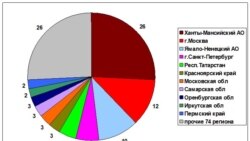
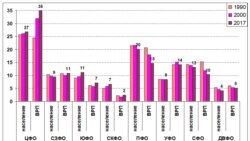
-Well, firstly, you do not feed the country. You can quite clearly say where the country is in the country. So, they, firstly, with oil and gas sowers: the Khanty-Mansi Autonomous Okrug gives 28% of all revenues to the federal budget, Yamalo-Nenets-10%. Both enter the Ural Federal District. Moscow accounts for 16% of all revenues to the federal budget. And her own, completely space budget - in 2019, its revenue is 2.3 trillion rubles - 90% consists of tax revenues. In turn, half of them - the tax on individuals and more than a third - the income tax of organizations. The share of Peter in the federal budget is 6%. That is, the deductions of the four of these regions together give 60% of the federal budget. And Siberia is about nothing for him. The total "contribution" of all regions of the Siberian Federal District to the federal budget is 8.4%. Well, the Krasnoyarsk Territory still somehow stands out against their background with its approximately three percent. The rest are either at an average level in the country, or worse. There are deeply subsidized among them - for example, Tuva. So I would not exaggerate the "donation" of Siberia.
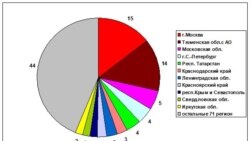
The same with investments. Leader is the Tyumen region, in second place is Moscow. Of all of Siberia on the graph, you can notice somewhere there again, the Krasnoyarsk Territory thanks to its oil projects. The total share of the Siberian regions in investments in the Russian economy is no more than 10%.
- How long has the alignment you described for a long time?
- The share of Siberia in the country's economy has been reduced since Soviet times. 25 years ago, the Krasnoyarsk Territory was the same in leaders among the Siberian regions, Tuva was almost completely subsidized, by 70–75%, and the rest were among the middle peasants. Such economic inequality is preserved and will last a long time. It is high time to understand: you are the same as everyone, you are no different from other regions, and no one is going to help you.
"There are still people, but there is no one to work"
- And about the standard of living, what does statistics say there? At one time, it was believed that in Siberia people still live richer than the national average-with the exception of the capitals, of course. Are we rolled up to the average level?
- The oil and gas north, perhaps, live better, but not as good as in the zero, because they took away oil rents.
As for Siberia, before the crisis of 2008-2009, she may have lived poorly, but still not as poor as Central Russia. Now everything has been left. Even if you look at Siberian salaries excluding local prices (which are higher than many where), then these salaries are not so higher than average in the country.
At the same time, Siberia is still not cheap enough so that there is an advantage in the presence of inexpensive and more or less qualified labor. At the same time, in Siberia it is higher than the national average in the country, an informal, that is, shadow, employment: in Russia this figure is 21%, and, for example, in the Altai Republic - 41.3%. That is, it seems that there are people, there is a potential for labor in the Siberian Federal District. But it is very specific: that has lost productivity and continues to degrade. All qualified labor in our country in Moscow. And if some rich uncle drags some large plant to Siberia, he will have big problems with personnel.
Everything between big cities is black holes
Another trend: the number of people employed in large and medium -sized enterprises is reduced. In Russia, when the Soviet Union only broke up, 61 million people were busy in such organizations. Now - about 32 million. This process is not so fast in regions, where, again, large oil and gas companies work, but in general in Siberia in this sense - as everywhere.
- Apparently, this situation is long, and people who have no high salaries, nor high -quality jobs will leave Siberia?
- Yes, enough for you - I mean, Siberians - to look at their navel! I understand that you are the patriots of Siberia. And I am a patriot of the Russian Federation and I see that the same processes go throughout the country. You complain about demography - what to do to the Far East, where there is even more migration outflow than yours? What to do the Volga, the northwest-the same thing happens there. You have only one demographic specificity: there is a Trans -Siberian Railway, there are large cities along it, they concentrate people around them. And everything that is between these cities is black holes. But the population and everywhere is tightened in large cities. Yes - first of all to Moscow. If the whole country is arranged on the principle of a vacuum cleaner, then this principle is also manifested in demographic processes too. If the money is sucked on to the federal level and is spent mainly there, it will inevitably suck there.
By the way, about vacuum cleaners. I follow with great interest how and where the consolidated groups of taxpayers, that is, large Russian business, pay income taxes. The policy of large business does not change - for it, regions are nothing more than the territory of prey. And the regions can only be asked for the regions to fall off at least something from them earned.
"Everyone knows what to do, but no one will do this"
- You have repeatedly said that the situation could change the decentralization of the economy. How real is it now?
In the current political and economic cycle, this is impossible. But there are no eternal political and economic cycles
- Yes, everyone knows that decentralization is needed, everyone understands what to do. Let the governors cease to be muddy boys, and they finally have real powers. Let the same Krasnoyarsk Territory return three percentage points of income tax, instead of giving endless benefits for everything to Igor Ivanovich Sechin. Let the regions have some levers in land use and subsoil use, and they will not need to solve these issues exclusively through Moscow. Let small and medium -sized businesses develop, without these crazy state corporations that have sucked the whole economy of Russia. Let the big Siberian cities become centers of science and education ... All this is understandable, but no one will do this. Now the Russian Federation is actually not a federal state. Is decentralization real? In the current political and economic cycle-no. But there are no eternal political and economic cycles ...
- Then, as and due to what can Siberia develop in our time?
"Development Strategies" are now written in tons, but there is no sense
- In our country, in general, due to what the regions are developing? Either this is the capital, or there is oil and gas, or it is a new, very fresh love of federal authorities - like Crimea. It turns out that Siberia is now, by and large, nothing shines. I do not see any prospects in those many "development strategies" that are now written in tons. Something there about the expansion of markets for local products ... You see, what is now being produced, for example, in Kuzbass, is suitable only for Kuzbass. And then these products will probably have a problem with the ratio of price and quality. Complain about the dominance of all Chinese? But what the Chinese produce, they do for their country, and only then they are taken to us. And even in our north, where oil production is undergoing, Chinese equipment is full. Yes, Chinese products may not have a brilliant quality, but for this quality it has the right price. And Siberia continues to look inside itself and sing songs about its revival ...
Let's already cross our brains and rise in specifics
Do not be offended - this applies not only to the Siberians, but, of course, all Russians. Well, we do not want to understand that we live in a global economy, and competition has long been not within the country, and business makes decisions based on this global competition. Everything is transformed - the oil and gas north, industrial cities. It will not work to make life in these cities go according to Soviet principles, and the infrastructure is updated.
Let’s already cross our brains, jump into specifics and learn to see what can really be corrected. Here, for example, the agrarian resources of Altai. They are extremely promising, but here we need the help of the state - transport, logistics; We need long -term subsidies for grain removal. If we want to see Siberia competitive, the role of the state should be approximately such.
We have no nervous ones at the top - you can’t unclench anyone there. You can only communicate with them from the standpoint of a sound and even somewhere a cynical analysis of the situation. It will not work differently.