
Translated material
"Levada Center": Russians sympathize with the defendants of "Moscow business" more than Navalny
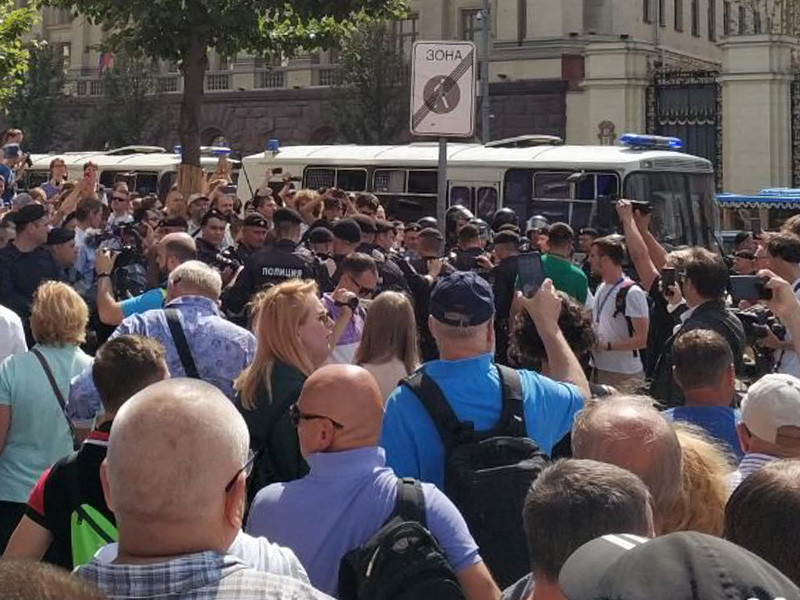
The specialists of the Levada Center found out how the Russians relate to the defendants in criminal cases against the opposition. According to Vedomosti , almost a third of Russians (30%) believe that the searches in the Fund for the fight against the corruption of Alexei Navalny and criminal cases against his employees are explained by the real need to protect the country from foreign influence and the fight against money laundering.
18% of respondents said in this way the authorities want to suppress independent anti -corruption investigations. At the same time, 9% of respondents are positively included in Navalny’s activities, 25% negatively, and 31% are not known about it or indifferent.
The defendants of "July 27 case" are respondents with greater sympathy. According to sociologists, 57% believe that things are excited in order to “frighten the opposition public,” and 34% believe in the guilt of the organizers and those who resisted law enforcement agencies. 30% of Russians know about criminal cases against participants in the protest in Moscow, they heard the same amount about summer events and their consequences, but do not know what their essence is. At the same time, the inhabitants of the capital are better informed about the Moscow Affairs, and the share of disagreements with official accusations in Moscow is higher than in Russia: 74% associate it with the intimidation of the opposition.
As the sociologist of the Levada Center, Natalya Zorkaya, explained, in general, Russians are dual in Navalny: some supports his anti-corruption activity, but the other part treats him with distrust and fear. Conspirological versions and a version of money laundering are strong with respect to his money. There is more sympathy to the defendants in Moscow, since people heard how tough the propagation of protests was and how much the engaged justice turned out to be. At the same time, a third of Russians, mainly the older generation and are more dependent on the authorities, support sentences on this case. In 2012, support for the participants of the "swamp" protests was higher, since in general the approval of protests was more obvious.
Other experts note that the revolutionary attitude of the Navalny does not find support from Russians, while the defendants in Moscow business have no relation to him. Thus, people draw a border between the opposition that fights for power, and a society that expresses discontent and falls under excessive police violence. The fear of police arbitrariness increased sharply in 2018 and remains at a high level, but sympathy for Navalny is a privilege of a minority, which is extremely displeased in the country and advocates a change of power.
In early August, the Investigative Committee opened a criminal case against the FBC under Part 4 of Art. 174 of the Criminal Code. According to the investigation, from January 2016 to December 2018, FBK employees received a “criminal way” in rubles and foreign currency and for their legalization and entered these funds through ATMs to the settlement accounts of several banks, after which the money was credited to the current settlement accounts of the fund.
The courts also blocked more than a hundred bank accounts of individuals and legal entities, including the account of the Fund and Navalny’s headquarters, through which 1 billion rubles were allegedly legalized, obtained by criminal means. The fund says that we are talking about the donations of supporters. Where the amount of 1 billion came from, it is not known, in official documents it does not appear.
On the eve of the election on September 8, searches were held at the St. Petersburg headquarters of Navalny. There , on the fifth attempt in the toilet, they “found” the ballots supposedly for stuffing. A little earlier, searches were held in Moscow in the office of the FBK, the Navalny Live studio and the city headquarters of the politician. Also, searches were held at Navalny’s headquarters in Samara, Ufa and Perm, as well as among employees and headquarters.
According to human rights activists , the Basmanny court in late August - early September issued at least 152 orders for searches in houses of more than 150 employees of the regional departments of the fund. All of them were the same and differed only by the names of persons whose dwellings were supposed to be searched. At the same time, the judge turned out to be enough "to believe that evidence confirming the accusation could be found." The searches were accompanied by a mass write -off of funds from the accounts of regional activists of Navalny, and the amount of write -offs reach hundreds of billion rubles .
On October 9, the Ministry of Justice of Russia included the FBK of Alexei Navalny in the list of foreign agents , seeing in his activities the signs of financing abroad. Navalny called the Ministry of Justice's actions "absolutely illegal" and suggested that the department was acting, "obviously, according to Putin's direct orders." He emphasized that the FBC exists on donations from citizens of the Russian Federation and demanded that the proof of foreign money provide.
FBK Director Ivan Zhdanov suggested that introducing foreign agents into the list of pressure aimed at terminating investigations regarding high -ranking Russian officials. According to him, two tranches came from the United States and Spain in a blocked account, and in the case of Spain it was a foreign organization with a ruble account, which in itself is very unusual. Zhdanov suggested that the fund was faced with a provocation by Russian law enforcement agencies. Later it became known that a translation from Spain came from a boxer who does not speak Russian and has no friends in Russia.
Earlier it was also reported that in the hacked correspondence of the consultant of the presidential administration Konstantin Kostin , a "plan of the fight against Navalny" was discovered, prepared by pro -Kremlin analysts a few years ago. In it, in particular, it was about organizing provocations with the translation of donations.