
Translated material
Stalin style
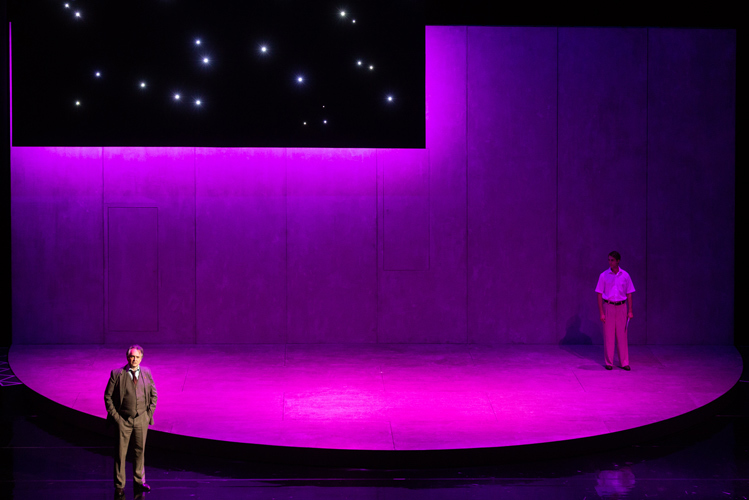
On October 31, at a press conference in Moscow, the nominees of the Golden Mask 2020 were announced . The absence of one of the most obvious favorites of the past Theater season in the short list of the contest - “Glory” by Konstantin Bogomolov provoked a fierce discussion in the professional community. Colta.ru invites all interested participants to continue it. Today, Alexei Gusev joins the polemic around the non -movement of “Glory”.
Last week, when the expert council of the Golden Mask announced a list of nominees included in the short list, there was a scandal. The Chairman of the Expert Council Dina Hooder announced that the performance of the Glory Grand Drama Theater did not get into this short list. His professional qualities did not cause doubts; He did not enter "for ethical reasons." There is no exemplary-style play by Viktor Gusev of 1936 ethical assessment in this production. Both the Bogomolov, of course, is not a Stalinist, and the performance, of course, is not Stalinist - but there is only an ethical assessment there. And Dina Hooder is convinced: for the performance to get into the short list, she must be there. Because the country's main theater award creates, so to speak, canon. And the play “Glory” should “return to the discussion field”, and not, in the words of the venerable chairman, “be bounced”. It should be discussed, not honors. In short, there are performances that are so unambiguous that they need to be canonize prizes, but there are those that are so ambiguous that, on the contrary, a scandal is more suitable. And those and others can be professionally solid and successful, but they need to prepare a different fate. Here is the chairman of the awards and refused the prize prize worthy of the scandal, which caused a scandal. Well, it's consistently. As if added a little prince, "and even poetic."
The scandal turned out; The severity of the author’s plan, however, underwent some damage in the process of implementing. That is, not so much a scandal came out as a skkandal. The goodness rustled that Dubravushka, the sides went to measure the aplombs. Supporters of Heroder convicted Bogomolov in teenage immoralism; The supporters of Bogomolov gave in response an expert establishment with a symmetrical “-ism”-ethical realism (they say that it is to him that critics force the domestic theater). In general, as is usually the case, the skirmish has a long time simplified the initial positions that one, the other side. Some strictly care for ethics and responsibility, others neglect and mud. It hurts one and funny, the other threatens his window. Everything is familyly, nevertheless, his own: Heroder respects Bogomolov (his “Crime and Punishment” received a whole garland of nominations), the mantis respects Hoder (hoping that this is “temporary aberration”), and all this discussion is hardly spilled beyond the limits of the theater world itself. The son of the working people and the working people simply quarreled once.
... There is no need to re -review the "glory" in the light of the circumstances that opened. From the "glory" of glory will not accuse. However, once again, a sawing ball of banalities - “censorship”, “immoralism”, “ethical assessment”, “aesthetic value”, etc. - It requires that they deal with them with all in essence, a thesis and without dust. Well, yes, too - once again. And - in two, say, stage.
Because:
1.
“... I believe that this performance is ethically ambiguous,” Dina Heroder explained the magazine Theater. ” “He manipulates the audience in the ethical field.”
Hooder is a professional critic. Says exactly what he means. There is no reason to suspect her errors of usage.
So: it doesn’t happen.
There is no manipulation of ambiguity in art. The purpose of manipulation is to bring the audience to the desired conclusion/effect. One, one. To the emotional, plot, ethical - to whatever, but the only one. Manipulation creating ambiguity is called directing. In general - artistic creativity.
And that's why.
The art of definition is the creation of works (objects or phenomena), the status of reality of which is equal to the status of reality of the author himself. The picture, film, poem and performance become facts of objective reality along and along with a person, wood, star or stone. They are not a fantasy, not an abstract formula, not a proshing imagination. They gain authenticity, become independent from the circumstances of their creation and turn out to be part of the world. For the evening or for eternity - this is as necessary, but they are objective. On these rights, they become objects of criticism, on these - adjust the appearance and history of mankind. They are.
This formula insists on one thing, this idea calls and leads from the disgusting point A to the alluring point B. They can become the subject of ethical proceedings, for the verbs of human behavior associated with the choice are insisting and conducting the essence. The tree does not insist on anything. The bird flying over it does not call for anything. And even a star, no matter how guide she seemed to us, is generally not going to lead anywhere. “A stone itself,” wrote Twardowski, “it is neither good nor evil.”
If the play “Glory” is “immoral”, then not like a teenager, but approximately like a Neva.
Any work of art is ambiguous. Just like any medal two sides and any stick has two ends. It has a volume, it is ethically indefinitely, it destroys the moral clarity that we have gathered from ideas and formulas, and brings turmoil and doubts about the human consciousness. The ambiguities “Hamlet”, the ambiguities “Ivan the Terrible”, are ambiguous “Girl on the Ball” Picasso and “Rozhdestvensky romance” by Brodsky; All of them swing to the right, swaying to the left. It does not depend on whether the author is good or bad, his intentions were bad or good; It depends only on the professional quality of the work performed by him. If the performance is not ethically ambiguous, it is not worthy of a professional prize, because it means that as a work of art it is inferior. Unstable. In order for the world to be built of atoms (and it is from them), in each of them the number of protons should be equal to the number of electrons; The atom must be neutral to exist. Manipulation, which creates the ethical ambiguity of a work of art, is a debugging of the internal balance that guarantees its authenticity. If the play “Glory” is “immoral”, then not like a teenager, but approximately like a Neva.
And if the bonus has the ability to make awarded performances “fermented”, then it is necessary to award precisely those performances that are “in a discussion field”. Those that do not have an ethical assessment that they exist.
Even the most ethically impeccable formula cannot be cast in bronze. She is signs, convention, ethereal fiction.
Neva in granite - you can.
 © Stas Levshin Scene from the play "Glory"
2.
All this does not mean that the concepts of “ethics” and “art” are incompatible at all. It’s just that the first in the second is not there, not at the level of “assessment”. Like people, in works of art, ethics means the individual logic of the device that determines the way of existence in the world. And called the style.
When Dina Hurder, faced with the heritage of Stalinism, recalls the repressed grandfathers and experiences an “emotional-ethical reaction”, she, in short, is in her right. The Golden Mask Prize is not the work of Burkhardt on ancient art, it exists here and now. In 2019, a citizen of Russia probably does not have the moral right not to experience such a reaction. Perhaps someday individual works of Stalinist art will be able to be perceived “detached”, outside the traumatic birth memory; So now the “triumph of will” and “Olympia” by Leni Rifenshtal, the films are outstanding, serve as the exposure of Nazism as successfully as 80 years ago served its support, because they are exemplary works of style, allowing aesthetically analyzing the Nazi phenomenon and thereby identify its structure, cultural ties, anthropological specifics, etc. But this is how much you need to overcome and how much to renounce. With Stalinism, this work, for everything, is barely starting.
However, the fact of the matter is that in the performance of Konstantin Bogomolov “Glory” there is nothing Stalinist. In the play by Viktor Gusev, on which he was set, is. And in the play - no.
The style is different. Quiet style.
There is no manipulation of ambiguity in art. Manipulation creating ambiguity is called directing. In general - artistic creativity.
The memory of Stalinism, the emotional reaction to its essence is obliged to awaken at every look at any of the Stalin high-heights, at the VDNH, at the amazing sculpture of Mukhina, on the frames from the Volga-Volga and Alexander Nevsky, with the sounds of the march from the "funny guys" ... in the style of each of these works-that lounging fuel, that triumphant assault, that triumphant assault. The aspiration of the bright future that demanded the victims in the form of the lives of millions and the dignity of everyone else. As if in the insight of the hero of the Langovsky “Metropolis”, in the solemn pediment of the Leningradskaya Hotel, you can see the expansion of the mouth of the Moloch, who has stolen fate and the nation. And every time the actor on the stage becomes magnifying, Staten and a concert, as his gaze, directed from the forefront somewhere into the distance, will lead the offensive of the coming universal prosperity, and his speech rolled out under the grates, any sensitive domestic viewers in front of his eyes stand in front of his eyes, stacks, stacks of forest lines. They have no right not to get up. Even if any very correct ethical assessment is made in the play.
Especially - if taken out.
Stalinism, like any other totalitarian system, gave so few full-fledged works of art precisely because he insisted on the unambiguity of works, and art-see paragraph one-does not carry it out. He was not at all alien to ethics; It was just ethics that he had cannibalist. Taken as a style - whether in the “first” or in “Two Captains” - he demonstrated as a course of history, ruthless and immutable, like a rock of ancient tragedy, he himself pronounces a sentence to all reactionary elements trying to complicate the universal movement to the onset of communism. The logic of the deployment of the plot, established by the author, made an unambiguous ethical assessment to all its participants.
This is exactly what Dina Hoder was lacking in the performance of Konstantin Bogomolov.
The lack of ethical assessment of Stalinism is an ethical assessment of Stalinism.
And if the expert of the Golden Mask encourages the presence of an ethical assessment, then the prize begins to roll towards Stalin. And the performance is not staged by the Stalinist play “Glory” so that the glory of the same kind is destined for him. This would mean that the Bogomolov did not stop the play of Gusev, did not take only as a material for the development of a different style, which allows you to look at the play unequivocally, that is, the opposite way to it, but this is not so. The fact that it was thanks to this view that was in the play “See” was already written on Colta.ru: no less than the modern analyst will see in the “Triumph of the will”. Well, that means the author of the performance has already been able to overcome and renounce. And swayed to the right, swaying to the left.
No wonder that many are so unhappy with them.
Look, rush.
Subscribe to the COLTA.RU channel in Yandex.Zen to miss nothing