
Translated material
People's Artist of the Empire Ilya Repin
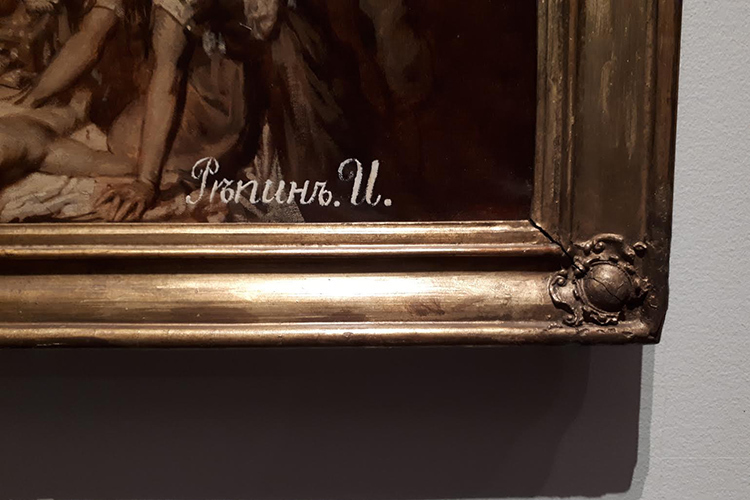
Exhibition "Ilya Repin. By the 175th anniversary of his birth ”she died out in the Tretyakov Gallery and moved to the Russian Museum. The “solemn meeting of the State Council” returned to the “native” hall, “Cossacks”, “Burglaki”, Nicholas II and Alexander III moved from the extensive bright spaces of the building on the Crimean shaft to the much more modest halls of Benois corps. The Moscow exhibition almost physically aroused his appetite to the “great Russian”, glorious, and holding art. At the exit, stopping at Gopak and looking back at retrospective splendor, it was difficult to get rid of the feeling of excessive audience satiety, as after the New Year's feast.
Ilya Repin - “our everything” from painting, the main one of the “great Russian” masters. He is loved as Alexandra Pushkin and Alla Pugacheva - the whole “people's mass”, they will recognize by the color inserts of school textbooks. Build not only and not so much the talent of the painter as the vitality, performance and the happy creative realization of charismatics. It seems that our spectator with the heart loves just such talents: remote and tenacious, they become "great Russians." From the heritage of Ilya Efimovich, you can always collect the best version of history, a certain theatrical truth, consonant with the requests of both the official upper reaches and the “masses”. His painting has a healing property - it reconciles with reality. From the TV you can only hear what about Ukraine? How successful that the chief Russian artist was born in the Chuguev of the Kharkov province; Here is his binding "Little Russian" things ("Evening", 1881). Does the intelligentsia frantically seeking the points of interaction with the authorities? Here you have the "reception of volost elders Alexander III." In the artist’s epistolary heritage, you can find an illustration of at least a class struggle, at least protective values like the current bastards, in parallel, having proved that the work of a Repin-artist is not an illustration of impulses of a repinant, and with a pure conscience to enjoy his spectacular directorial studies.
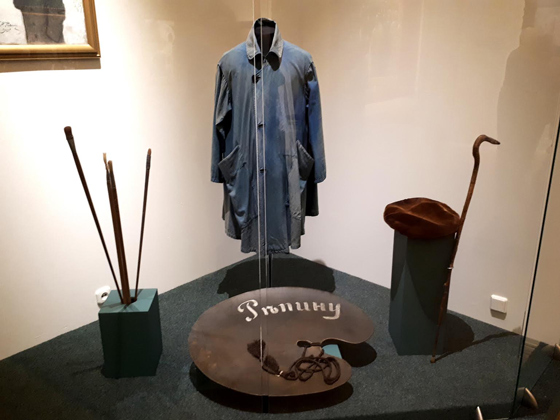 © A. Semenovich Memorial things of I. Repin from the estate "Penates"
The Moscow exhibition was traditionally richer and more powerful than St. Petersburg. Not only at the expense of more modern halls, but also because of a clear desire to delight, stun the viewer, fill with pride - at once on painting, literature, social thought - for all the “great Russian”. In Moscow, curators allowed themselves a gesture that, outside the context, could seem too theatrical: they put an empty wall in the place of the ill -fated “Ivan the Terrible”. In the Tretyakov Gallery, Repin was shown on shields of the color of clay soil; A warm, dense flavor accompanied the artist from the academic period to late things that Petersburgers are accustomed to see in Penators (the artist’s estate in the village of Kuokkala/Repino, in which he lived since the beginning of the 20th century; in 1918 it was on the territory of independent Finland). The Russian Museum was more restrained, by the very choice of things by instilling in the viewer the research logic, and in the design of the exposition, showing practicality: by placing repinsky work on shields from exhibitions, for example, Vasily Vereshchagin or “Karl Marx Forever”.
Is it worth blaming the St. Petersburg Museum that “poorly, modestly” (but here - depending on what to compare with) that it does not compete with movie blockbusters? What does a certain restraint make it clear that Repin is more likely one of the galaxy of the “great Russians”, and not the author of the attraction called “Gather your history of Russia”? Ideally, I want the exhibitions to go in parallel. Do not ask how-maybe by the 200th anniversary of the master will learn to clone the painting of the 19th century and print on the 3D printer not two, but ten of Repin exhibitions, and all with different concepts.
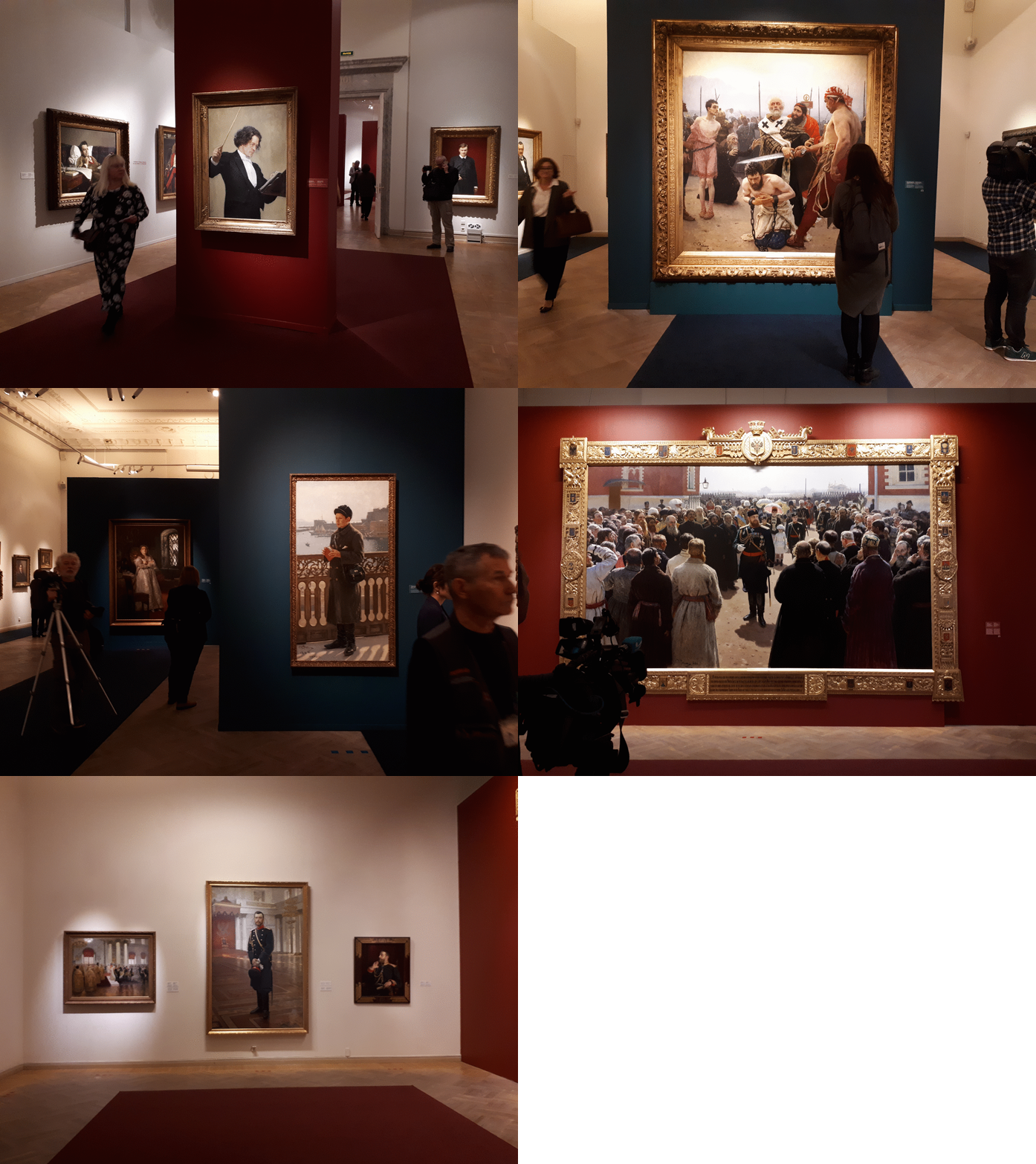
© A. Semenovich
So, the St. Petersburg exhibition not only shows the “ceremonial” Repin, bringing down a continuous stream of masterpieces on the viewer, but also exposes a little more “permitted” as part of a hit blockbuster. Continuing the analogy with the film distribution - the Russian Museum offers the directorial installation of the film instead of the production. Near the Sadko you will find a sketch of the mermaid - or rather, quite an earthly woman who slightly spilled her breasts into the shoulders, who had lifted her hand to randomly gathered hair, shamelessly exposing hairy armpits and folds on the torso. Not Degas, but surprisingly close - not seeing a study, not everyone will believe that this naturalistic lady will migrate into Sadko, gaining academic roundness and smoothness of the lines, as well as the aesthetics of dynamics instead of the angular fatigue of the model. In the corner of the hall with the “Sadko”, “Ivanushka-Durachk” modestly smiles-a decorative plate painted by Repin in the Russian ceramic workshop in Paris in 1876. The elite “souvenir”, which was not in the Tretyakov Gallery, and just something decorative, sweet and reducing pathos.
It is even more curious to observe preparations for the newly absent “Ivan the Terrible”. On the graphic sketch (which was also in the Tretyakov Gallery), the king resembles a warrior or spirit from the Japanese engraving (or Ekorche's gypsum head-“without skin”, with bare muscles)-this is how the tertratic contrasting repena sculs facial expressions. At the same time, the image is deprived of this “backlight” on the preparatory picturesque portrait of the model, and on the final canvas the image is closer to the graphic sketch. The theatricality of Repin, as a rule, is called the ability to dramatize, build a non-academic composition-designer, but a mise-en-scene.
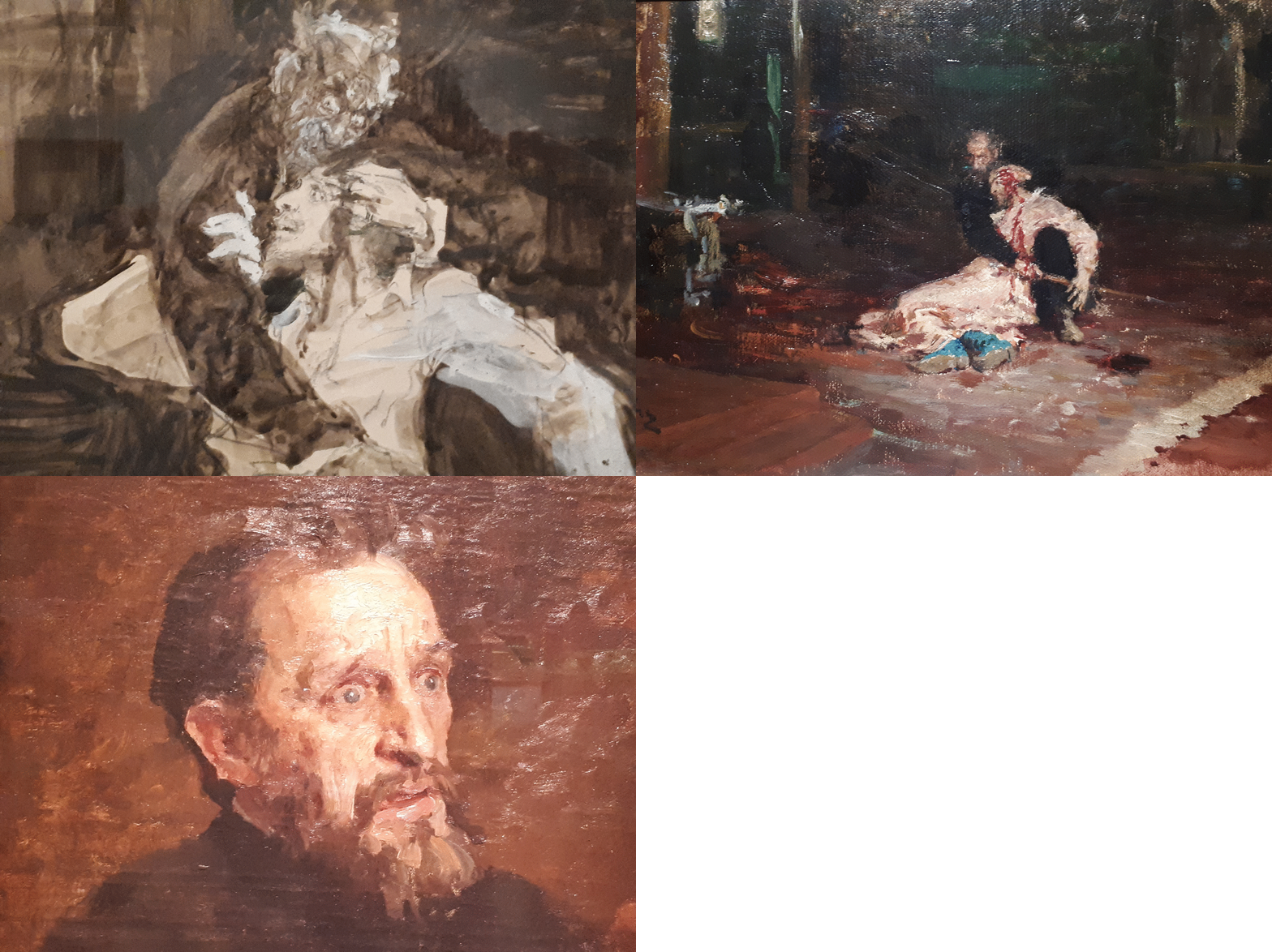
Ivan the Terrible and his son Ivan on November 16, 1581. Variation, sketch and sketch to the picture. 1913 (timing). 1883–1889 (GTG). Men's head. 1883 (GTG)
© A. Semenovich
On the example of Repin, you can trace the etymology of the “great Russian” phenomena in art, and the timing, as I said, shows the artist in the search for nature and characters, making an attempt to bring the apparent repinsky monolithic to bring the contradictions to be visible. Soviet art historians loved Repin, as they say, with a strange love, forming the image of the artist as a construct. Dmitry Sarabyanov in lectures on Russian art of the second half of the 19th century discusses a lot about the genre and about the place of Repin-in paradoxically, reporting that Repin was “following the feather”, then “blocked” the genres of the 70s and 80s, that in Paris the artist “reached the level” of early impressionism, but it sounded proudly-“did not go proudly-“ did not go about this. ways. " One way or another, Sarabyanov emphasizes Repin’s “special path” through the genre-not chamber, Burgher, like the Dutch (whom Repin, studying at the Academy, contrasted all academic and unanimous), and panoramic. Instead of “peeping into the keyhole” (frequent characteristics of the compositions of “small Dutch”) - shooting with a wide -angle lens. “In the 60s, Repin, like other artists of the 70s-Kramskoy, Myasoedov, Savitsky, Yaroshenko, Maksimov, passed by the then dominant social genre. Then all these masters advanced in the early 70s with their successes in the genre or portrait due to the approval of a positive principle. Following this, the process of increasing generalization and coverage of life turned in painting; Artists went to the monumental interpretation of the genre ... ”(D.V. Sarabianov,“ The history of Russian art of the second half of the 19th century ”).
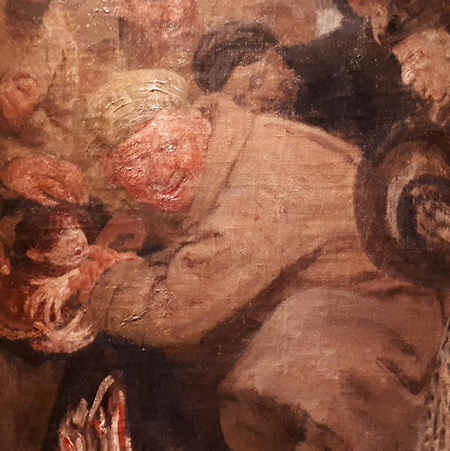 © A. Semenovich Bolsheviks. 1918. Fragment. The state complex "Palace of Congresses". The scene from life told by a friend of Repin is captured: drunken soldiers-revolutionaries take bread from the girl
With all the hit of the Repin talents according to the receptors of the domestic viewer, he would not have such a strong status if the artist had not endowed them with a variety of forces, among which not only Vladimir Stasov and Soviet art of history. Konstantin Korovin in memoirs wrote about Repin something opposite to Sarabeanov’s opinion. Having listed the advantages of the Repin-living signal (and giving us a chic formulation “Forged form”), he notes: “But Repin also had an enemy: tendentiousness, literature. Stasov had an influence on him, from the hands of Stasov, Repin pure, the artist, directed, accepted the bowl of our Russian civilian sorrow, and in it, inside his emotional experiences, torment and requests, the struggle began. The artist soaring highly above the vain world, the artist was now and then and the Apollo's heights from the heights of Apollo ... ”As you can see, the same“ overthrow ”, which became the basis of the image of Repin in the Soviet period, was a sighted deviation from artistic tasks for Korovin - that is, work on the form. According to the "Russian impressionist", Repin wasted time and talent, answering the question "What?" Instead of "how?" You can bring this statement under the illustration of the complexes of the Russian artist: he seems to agree in absentia that his school is dependent on powerful national literature, that Russian culture is literary and unlucky and he was unlucky to be a painter in it, and Repin is also voluntarily surrendered to Literary.
I would like to make a retreat and characterize the nature of the Repin's “dramatization”, which Literary Literacy fell so well. In the “distant close” (the book of memoirs of Ilya Repin, written by him in Penators), a separate chapter is dedicated to Ivan Kramsky, at that time to the inspirer and the half-workers for the student-painting students. Once Kramskoy invited Repin to visit, he “hit the paint and sweat”, but soon the student gained courage and ended up in the apartment of the master on the 6th line of the Vasilyevsky Island. Kramskoy at that time worked on the image of Christ (the future “Christ in the desert”), for which he wrote and sculpted the hero's head. Kramskoy for a long time and enthusiastically shared his thoughts about the temptation and embodiment of God, and soon Repin began his composition on the same topic. “I put Christ at the top of the cliff before an boundless distant distance with the seas and cities. He turned away with a tragic expression from a tempting look and closed his eyes. With one hand he frantically squeezed his huge forehead, and with the other he removed from himself an inevitable thought of earthly glory and power. He put him in a short chiton, and bare legs were in scratches ”(I. Repin,“ distant close ”). It is easy to notice that Kramskoy is looking for a sustained form, working on it intellectually, while Repin gives a scene in the decorations, explaining the torment of the hero; Compared to the search for the Kramskoy, the path of Repin Student looks simple and theatrical.
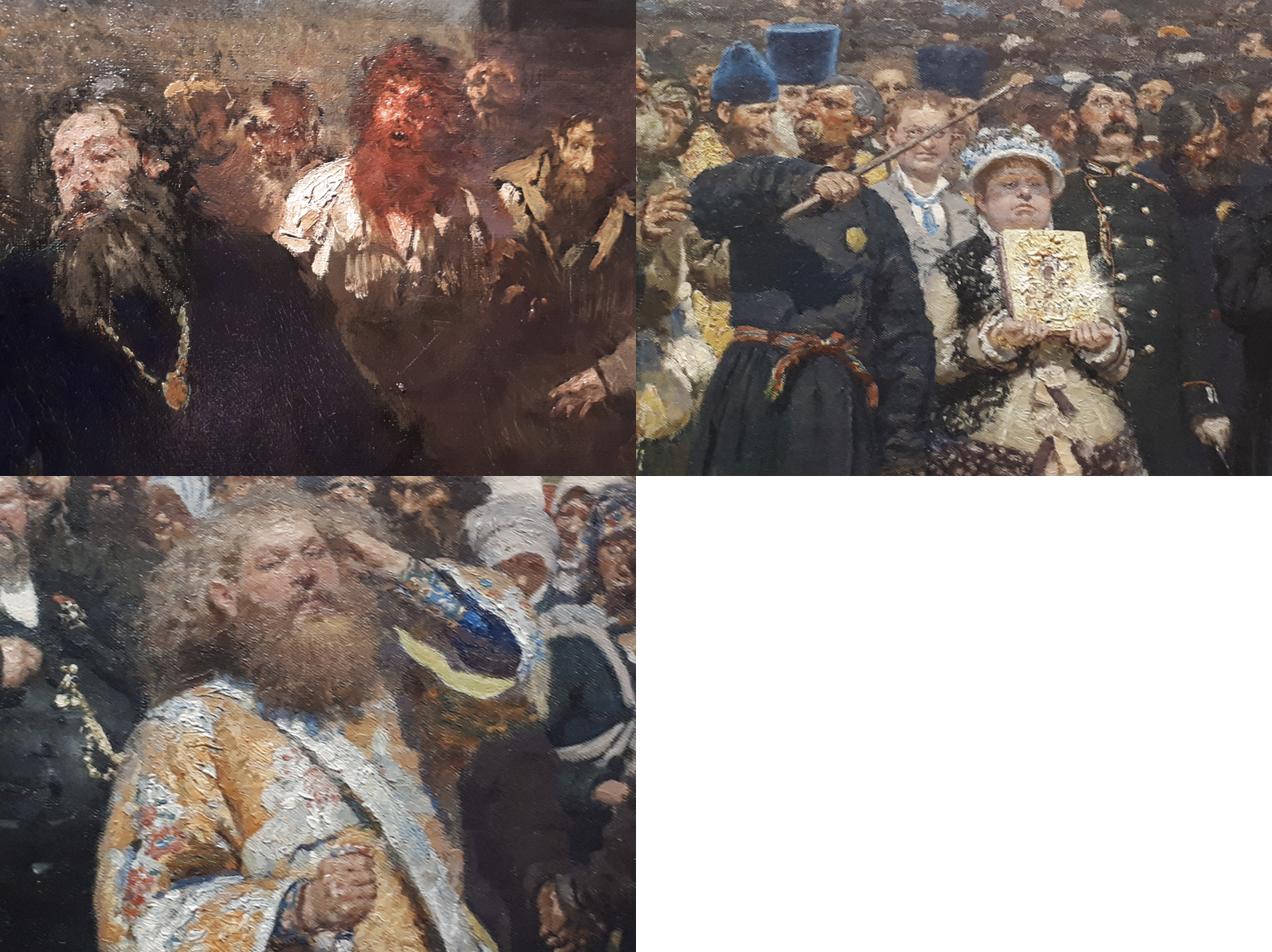
The procession. 1877 (timing). The original sketch of the picture. Fragments
© A. Semenovich
If you try to get out of decades the images of Repin and Russian realism, it turns out that the artist succeeded convex, characteristic images (“burglaki”, “procession in the Kursk province”, “Cossacks”, “Bolsheviks”) and dramatic moments (“The arrest of the propagandist”); At the same time, most of Repin’s works are arranged as if this is the last frame of the episode of the exciting series - so the viewer wants to know what next. And you can watch the story at least about Chernobyl, even about the mother of dragons, about revolutionaries or kings. Repin also reaches grotesque scenes and characters (a fight in the sketch version of the “procession”, like an academic sketch “Beatering of the first-born of the Egyptian”, heroes of the second or third plan). Strictly speaking, Repin is not quite realism, as in, for example, Gogol. Probably a banal parallel, but it shows that the traditional narrative of Russian painting does not always accompany realism or "serves civilian sorrows." If Repin in the genre captures the texture rather than the illustration of ulcers, then his heroes are not obliged to torment us, to put pressure on his conscience and demathy - to pity (to talk about Perov). Repin, with all the temperament noted by contemporaries, does not morallyization and does not judge. It is this intuitively felt as the mental warmth of his painting and again reconciles the viewer with reality.
Since we started talking about the political aspect of Repin’s understanding, we note that the flagrant absence at the exhibitions of “Ivan the Terrible” is perhaps a successful coincidence. The controversial two-dimensional (!) Image, capable, as it turned out, even in the age of cruel computer games, when Tarantino’s new film is perceived almost like family cinema, excite the psyche of the viewer, the king-sonnubean does not represent the “title” Russian artist. Sarabianov believed that this was a unique work for Repin: it does not contain a continuation of the action. Mindful of the analogy with the theater/series, this is not the mise -en -scene of the climax before the intermission, but the final, the failed tragedy. The Moscow and St. Petersburg exhibitions were left without this terrible result - as they say, while the Titanic is floating. But the corps of works on the "Little Russian" topics is alive and well and plays an unobtrusive imperial motive. Today, the coverage of the repnition of the colorful Ukrainian nature looks just like that, although in the 19th century, such research was natural for the artist from Chuguev.
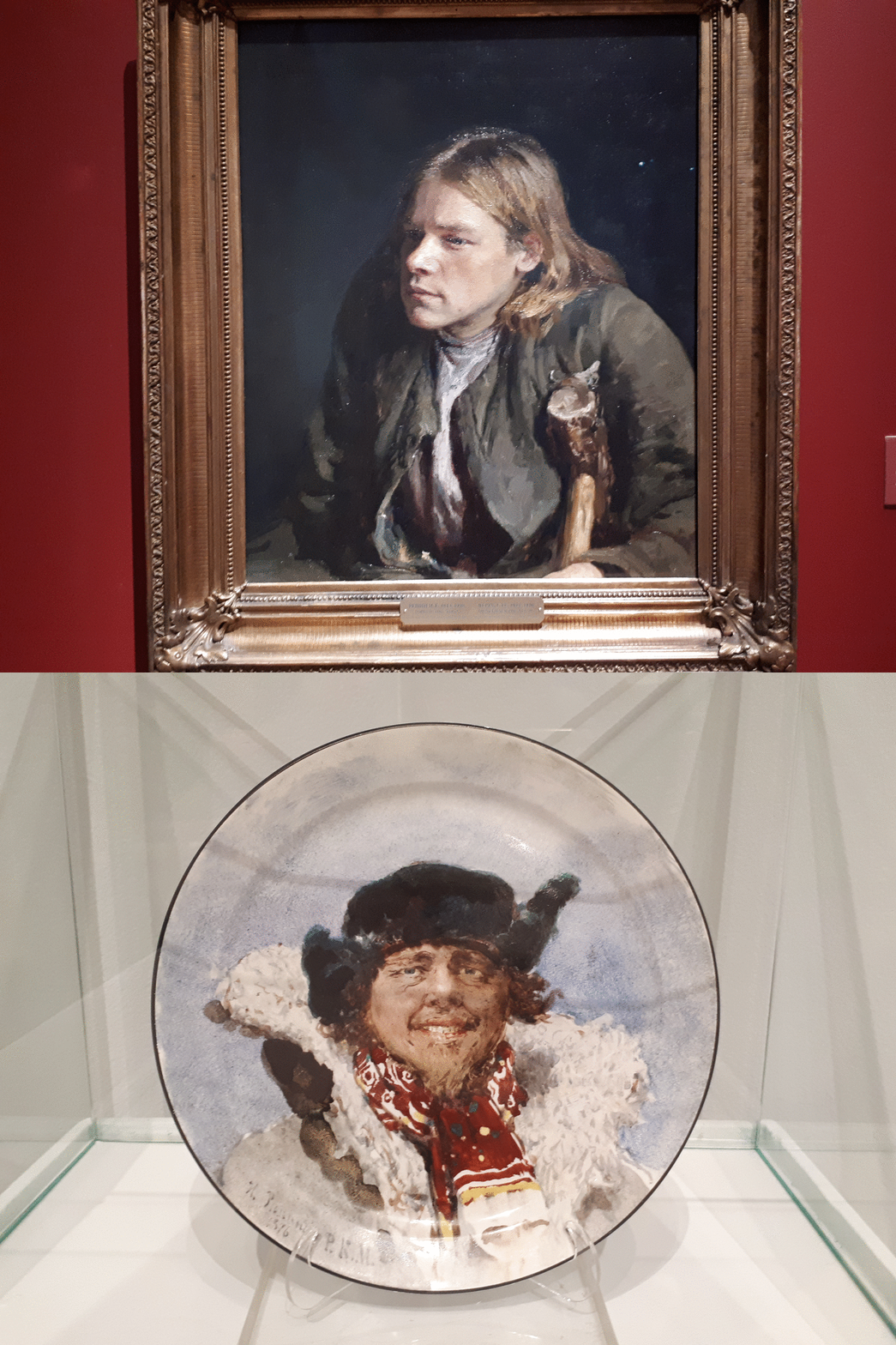
Decorative plate "Ivanushka-Durachka". Russian ceramic workshop, Paris. 1876 (timing). Hunchback. 1881 (GTG). Sketch for the picture "Cross in the Kursk province"
© A. Semenovich
From St. Petersburg, the exhibition will go to Paris and Helsinki-the organizers coquettishly notice that in the French capital the exhibition will be held in the bird Palais , that is, very close to the bridge of Alexander III through the Saint, the picturesque Repinsky Alexander III will settled for a while. The Finnish side modestly adds that since Ilya Efimovich was old and died in Finland, there he is also a little “his own”. In my opinion, to carry (at least to Paris) the epic exhibition of the Russian classic is a bold, but unenguried step. That is, the pride of the Russian representative office, maybe he will warm emigrant souls, but it is difficult to imagine that Repin will fit into the European context differently than in the form of peripheral curiosity with a raid of barbaric splendor. Exhibitions of the collections of Sergei Schukin and the Morozov brothers are another thing, one might say, duty: to show the French of their artists, on which the rich Russians successfully hunted a little more than a century ago. Repin is a product for domestic consumption. In the picturesque-technical plan, he, not possessing the eccentricity of the Russian avant-garde, will be uninteresting in Paris (“reached the level of early impressionism”), narrative (“literary”) for an unusual viewer is intrusive, and in terms of texture and thereby he is too imperial (for the Western European spectator; for the Russian still national). In general, everything that Ilya Efimovich is so hot for us, “there” is unlikely to the court. And the exhibition of Repin in the heart of Western Europe is a kind of exhibitionism.
In Russia, it is worth visiting the "Penates" - now the Repin estate is in forty minutes by train from St. Petersburg. This is a cozy house near the Repino station, similar to the old intellectual cottage, where they will tell you how Ilya Efimovich slept in the air all year round - even in winter with open windows - and wrote long -term brushes at the end of his life. From here the most touching self -portrait of the artist arrived at the exhibition - 1920, in a look like a children's hat covering his ears, with a palette in his hands. Cold light in warm color, a look, according to Korovin’s observation, straightforward, and as if blue-blue eyes-the first time when I saw a portrait, I did not believe that this is the work of Repin: so children-old-skinned eyes and the look contrast with the usually replicated self-portraits of the master.
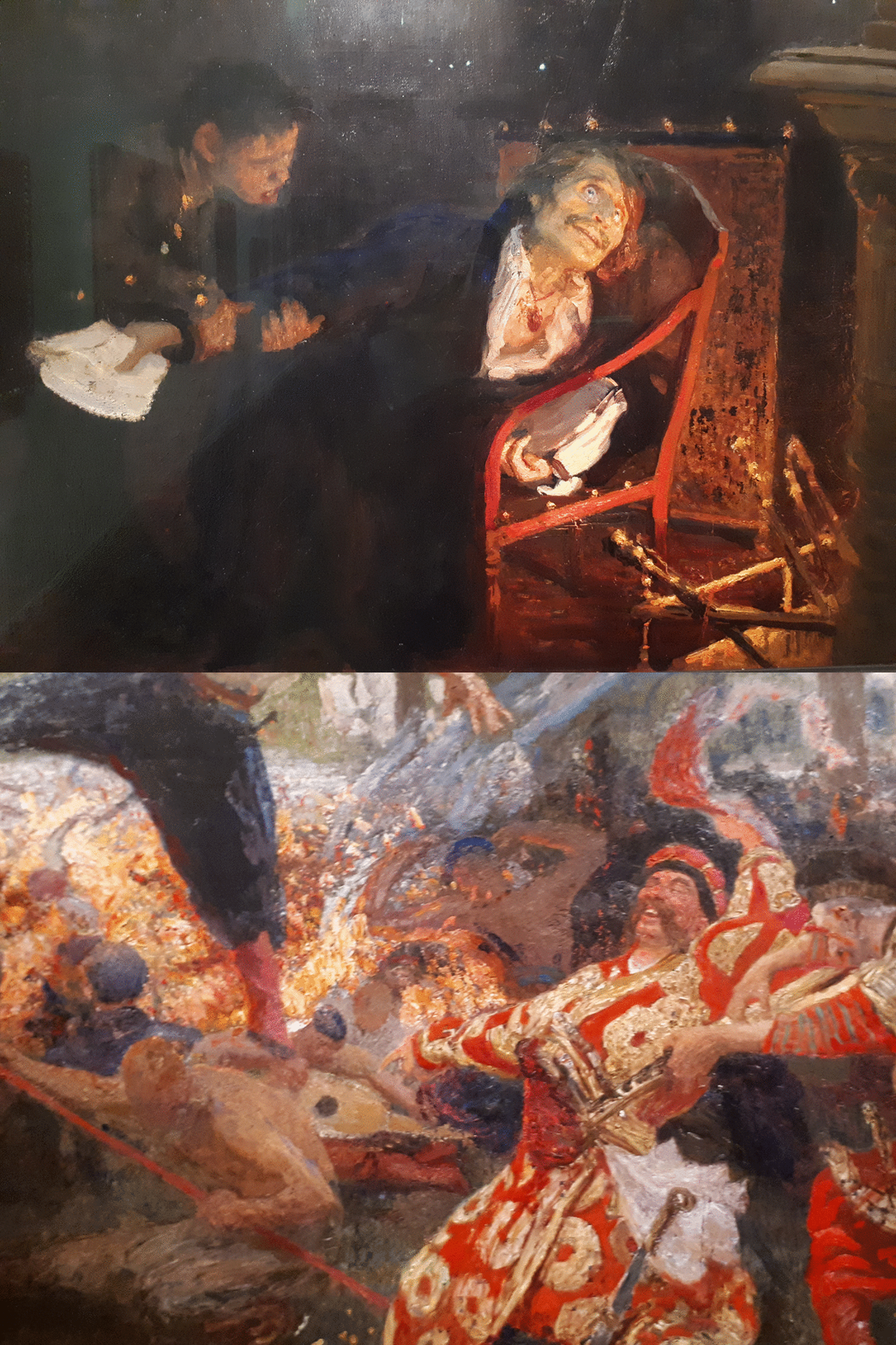
Gogol's "self -immolation". 1909 (GTG). Fragment. Gopak. The dance of the Zaporizhzhya Cossacks. 1926-1930. Private meeting. Fragment
© A. Semenovich
Interestingly, how the “imperial” motives in the “Penates” decomposed to admire the Gulf of Finland and the memories of the Motherland (“Gopak. Dance of the Zaporizhzhya Cossacks”, 1926-1930). It is known that Repin loved Gopak very much and was afraid not to have time to finish - he put so much into the work. The picture is stored in a private collection, it may infrequently see its wide viewer. And in it, in addition to the nostalgic “Ukrainian” topic, the primacy is obvious to Repin of the texture, energetic (if not - stormy) dynamics.
In the Benois corps, perhaps there are not enough photographs that the Museum of the Academy of Arts releases: the artist in a heap of blankets descends from the “cold bedroom”, Repin in a long fur coat, similar to Santa Claus, slides along the snow on the background of berets, but his curly gray hair is whitish under a flowering apple tree. Repin more than once tried to bring to the RSFSR, and this is a separate gloomy and almost espionage story. When it became clear that the avant -garde was not suitable for new official art, and it was decided to return to the realistic “figure” manner as an understandable working class, Repin with its background would be in handy. The old artist refused to leave the house and remained in Finland - the fragment of the empire, the “people's artist” of which he became.
Subscribe to the COLTA.RU channel in Yandex.Zen to miss nothing