
Translated material
Inside the lava
Memory of Leo Anninsky
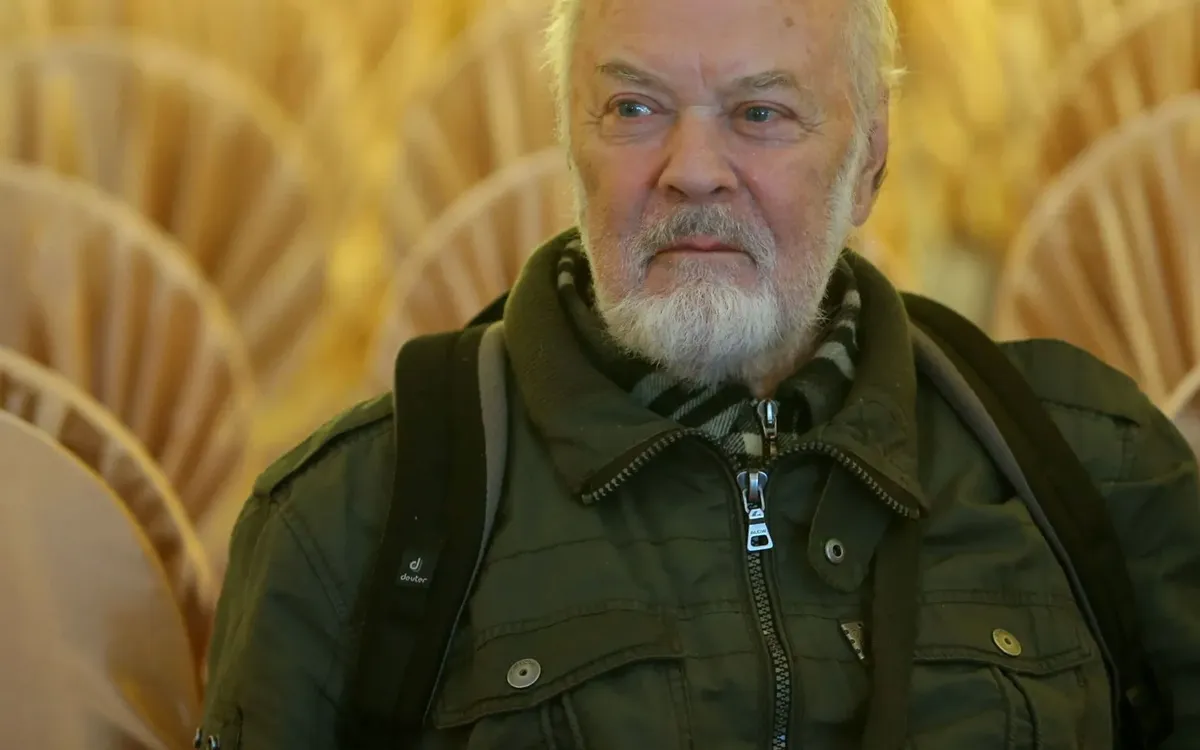
At the age of 18, the parents of my bride Asi Druyanova invited me to a campaign (Vologda region, Ferapontovo, a route passed through these places) - probably to better see the groom near. In the campaign, besides us four, there was a couple of Anninsky - relatives of Asi - Lev Aleksandrovich and Alexander Nikolaevna.
And after some time, they gave me to read, as a close relative, “Ivanov’s life”. These were such gray bindings with typewritten and photographs, also planted on glue (5 or 6 copies were made in total), about 15 volumes, rather heavy and weighty, which, I must say, were then read simply as “Monte-Cristo Count”.
My friends instantly swallowed the notebooks: Sasha Morozov, Sasha Furman, Ira Gorbacheva, Valya Yumashev - in a word, those who were at our house. By the way, the author himself belonged to this Asina idea - to give all this to read - not very approving: he sincerely believed that it was “only for family use”, and, in addition, the guys unfamiliar to him could well be “other views”.
But we were not other views.
In the book “Ivanov’s Life” there were several amazing features. Lev Aleksandrovich wrote a book about his father, Alexander Ivanov-Anninsky, the son of a school teacher, the grandson of the Don Cossack. In Soviet times, Alexander Ivanovich worked as the head of the association at Mosfilm, went as a volunteer in the Moscow militia and went missing in the very first months of the war.
Since childhood, I heard a lot about sorrows for the dead, about the tragedy of the people, about the grief of every Soviet family-everyone was killed, wounded, shell-shocked, was captured (then it was added to this “or to the camps”). I knew all this, like any Soviet child.
But in the "Life of Ivanov", the pain of a son, who had lost his father at seven, was expressed with such a deafening and, most importantly, new force that this could not not hit me. And in this pain there was not even a micron of official, official, that could be calmly printed in any Soviet publishing house.
Anninsky presented the bill not to the Germans, not to war, not to the enemy - he presented the score of the whole era, the whole twentieth century.
And it was, of course, fantastically accurately and fantastically new at that time.
The scale of the 35-year-old at that time, that is, was also amazed at a quite young man (Anninsky wrote his book in the early 70s, and we read it in 1978). It was a real documentary novel, saturated with letters, diaries, documents of the era, the author talked with dozens of witnesses, went to many addresses, found everything that could be found, restored every step and every day of the short life of his father, and at the same time it was a strong, powerful prose. Prose of the level of the greatest Russian writers. Moreover, documentary.
And finally, the main thing is the last.
Alexander Morozov, who responded to the death of Anninsky yesterday, called this the word "distance". Anninsky’s view of Russian history, expressed in this book, was neither Soviet nor anti -Soviet, and this was amazing for us, the first “outsiders” readers of the family saga - he described the dispossession and party cleaning, Soviet life and Soviet work, the terrible and formidable events of the war and the pre -war pores from the point of view of an individual independent man who lives inside this heated fiery lava and Movies with her to its end.
It would be impossible to print all this in Soviet times. But now, when the previous view of society on history has changed to the exact opposite (I am not about our slippery officialdom, of course, I say), this book will not be in demand. Because the division into "their" and "strangers" is still ongoing. Or maybe it is forever.
In short, I was very lucky.
Yes, I did not see in front of me the “great” Anninsky, but I saw just a person, practically a relative who knew the answers to many questions, but never passed sentences. He thought he was thinking, he raised these questions, and did not answer them. And this is not a phrase, not a slogan, not a postulate, this is exactly how it was.
Anninsky, in general, many things, it seems to me, opened and did then for the first time. And perhaps this innovation will not be evaluated at all in our era, but much later.
Well, for example, he was the first to record on a tape recorder. The first notes of Okudzhava, Vizbor, Yakusheva were made to them. He dragged the then huge and heavy tape recorders on his shoulders in Moscow, because he quickly recognized the gigantic possibilities of this “new song”, a new genre, and he sang them, by the way, beautifully and peculiarly. And then he described these songs in his articles.
He was the first to describe the literature of the 60s precisely from the point of view of “generation”, introduced into criticism and literature this concept in the book “Nut of a nut”, without dividing the sixties into “their” and “strangers”, into soils and Westerners, into Soviet and anti-Soviet and at the forefront, putting the era as a soil.
He was the first to find that thin line between different layers of art, social consciousness that you will not find, being only “film critic” or “literary critic”, or “historian of literature”. But yes, sometimes only on this subtle face and new worlds open.
Such was his book “The Mirror of the Screen”, where the usual Soviet films gained the status of a world artistic phenomenon, such was his study “Leo Tolstoy and Cinema”, which he devoted for many years, having looked at hundreds of Tolstoy’s adaptations and showing how closely the life of all mankind was read with reading these novels and their interpretation.
And of course, he was an amazing, great storyteller, making his oral speech a special genre, a special kind of creativity-fortunately, the Culture channel retained some of this, although what I heard during the family feasts was sometimes much more acute and paradoxically.
But for me personally, one of the most wonderful results of his creative life is still his family sagas. In addition to the “Ivanov’s Life”, he wrote several more such family epics. About the life of the three sisters of the Aleksandrov, among whom was his mother Hannah, about the life of his wife Alexandra Nikolaevna and her family. And all these books will someday fall into the foundation of a completely new literature.
And again, these family multi-volumes, the fruit of fantastic labor, saturated with documents and evidence, he never gave to any publishing house to any edition, being sure that today's world, of course, is not needed. Yes, these books describe the phenomenon of man and history from some completely new, paradoxical point of view for us-this point of view lies outside the ideology and outside the party and political “truth”, “final truth”. But someday we will still come to this view of history as a self-sufficient movement .
He was as producing as much as a person could be producing: thousands of pages, thousands of reviews (he was simply littered with books of people who begged him to write at least one, at least two pages), teaching, television, editing ...
But still, Anninsky became famous as a critic.
Not as the author of books and family sagas, not as a TV presenter or philosopher.
He was a critic. But the fact is that the “criticism” itself at that time meant completely different -
Not recommendations or reviews of “book novelties” and not publicly available in every sense a blog on Facebook, but an intellectual position expressed as a whole book volume or in one hundred newspaper lines, but it is intellectual, and precisely the position.
In Anninsky, this turned out to be brilliantly, sharply, sharply, exciting sometimes (it is impossible to forget his article about the film “War and Peace” by Bondarchuk, when he describes a huge queue for the “Russia” cinema and conversations in it), and in this sense he was probably a symbol of this powerful phenomenon-“late-Soviet criticism”.
From this phenomenon, a lot, by the way, was born. Entire parties were born, for example. On the one hand, the magazine "Spark" with Sarnov and Rassadin was born. On the other hand, soils and Russian nationalists. The whole culture of literary magazines of the 70-80s was born, with its leaders and banners-from Lakshin, on the one hand, to Kunyaev-on the other. Of these, new publishers were born later from this nutrient environment. She absorbed this nutritious environment, and printed and unnecessary, and samizdat, and Tamizdat, and underground circles, and closed “editorial tips”, where the fate of the authors performed.
So, Anninsky in a sense was the main voice, a symbol of this phenomenon.
Therefore, thinking about his departure, it is impossible not to admit that the phenomenon itself is-this huge, tense spiritual and creative life, it also went somewhere in a sense or went somewhere.
Probably, this should not be grief: apparently, all these people, books, authors, editors, critics had their own historical mission-to prepare a turn in the mind that occurred in the late 80s-early 90s, space in scale. Prepare - and gradually disappear.
I must say, Lev Alexandrovich did not accept new times.
Although they gave him many new opportunities-for example, television or university department, trips abroad, a whole open world-but still did not accept. And I think it's not just that he never wanted to belong to any party. And not that he always incredulously reacted to any fashion.
It seems to me just, he, with his gigantic instinct, almost the first of us understood how the social scale of what he was so passionate about all his life was crumbling. Literature. Words. Thoughts.
Yes, it was difficult to accept.
A bright memory to him, my beloved man.