
Translated material
Revolution and we. Sociologist notes
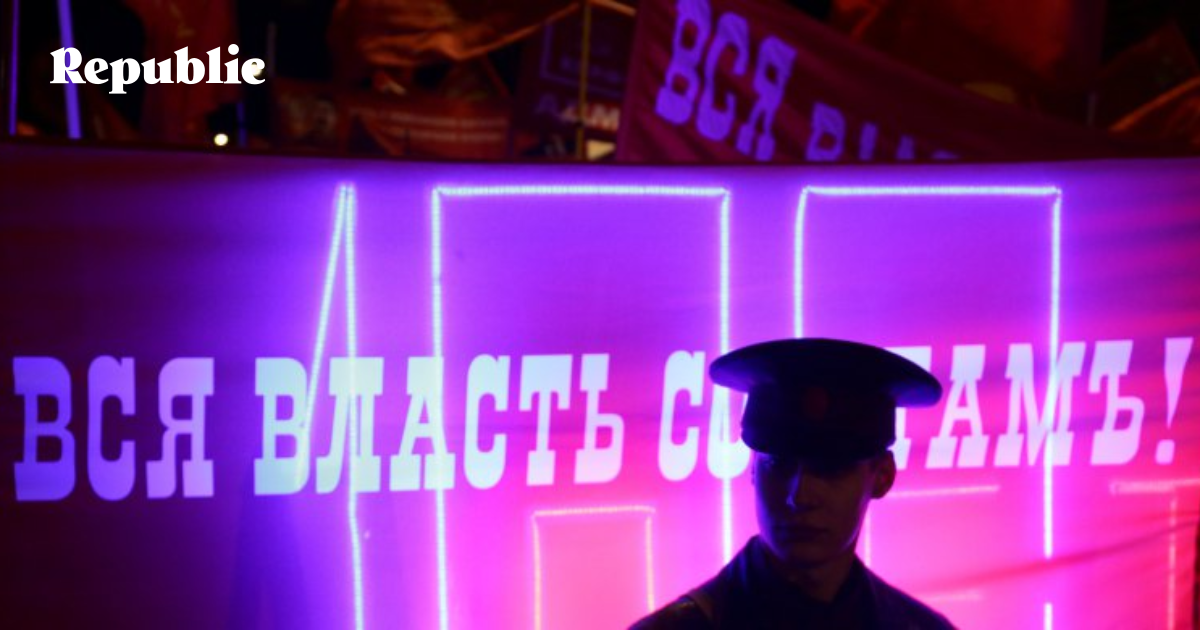
The October Revolution remains one of the least reflected points in history. It can be accurately argued that this event cannot be attributed to closed - when it seems to be given to the archive and becomes the subject of purely professional interest. Although this is a feature of Russia as a whole, unlike Western Europe, to keep many situations incomplete, despite a serious temporary distance. They can pass for centuries, but at the same time we continue to feel the energy of the action, as if much in it remained unproven. The event does not fade away, but on the contrary - at certain points it begins to actualize.
This happened, for example, with the oprichnina of Ivan the Terrible, when in the 30s of the last century it was necessary to pull out this “case” again. In recent years, they often began to recall two epochs at once-first Nikolai the First, when they started talking about crawling in some timelessness, and then Nicholas the Second, as if a foreboding of some fateful and dangerous breakdown arose.
Unlike the last century, however, we have neither art nor philosophy today to express these sentiments in a crystalline form. However, any person with good social sensitivity captures draft from the past. In general, Russian history does not go anywhere, and this is more likely our risk than the advantage, taking into account all costs on turns. The nation, as Professor Auzan would say, falls into the rut and is forced to reproduce already seemingly played outings. But even among the national archetypes, the revolution stands apart as the most powerful generator of historical meanings, images and tension.
What are the main difficulties of her understanding?
Poses and gestures
Firstly, it will be mistaken to think that with regard to the revolution it is easy to decide: you are for the red, for white, for green and so on. The point is partly that there were too many flowers, and now the ability to distinguish shades is lost. October events were a direct continuation of the processes that began in February 1917, contemporaries did not share them much. Therefore, it is not very clear here what to take as a reference point, including moral. When the fall began, who is to blame, if it is generally appropriate to talk about fault? It is necessary to determine inside a very complex and mobile period without clear temporary boundaries.
This blurry and fuzziness itself creates many complex allusions, even at the present stage. Zelensky, for example, in Ukraine, was recently witty with Kerensky. A definite, albeit slippery, there is a parallel here.
Subscribe to read the whole
Make a subscription Redefine.media to read Republic
Subscribe [you can pay for a Russian or foreign card. The subscription is extended automatically. You can unsubscribe at any time.]
Where are the money subscribers going