
Translated material
Breton is a closet: six books of the week
The most interesting book novelties according to Gorky
The “Young Tolstoy” by Eichenbaum, the memoirs of contemporaries about Harms, the new novel by Mcueen, the first Russian monograph about Breton, the cognitive practices of pre -revolutionary peasants and a thorough commentary on the main novel by Trumen Kapate. Ivan Navparenko - about the book novelties of the week, deserving the most close attention. 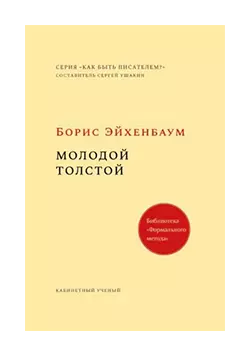 Boris Eichenbaum. Young Tolstoy. Yekaterinburg - M.: Cabinet scientist, 2019
The book opens the series “How to be a Writer”, on the compilation of which a cultural historian Sergei Ushakin works; The name of the series is borrowed from another text by Boris Eichenbaum.
In the “young Tolstoy”, the theoretician and practitioner of the formal method burrows into the diaries of Leo Nikolaevich in order to demonstrate how he creates a writer out of work on a word. At the same time, a small and clear work can give some idea of what the research rate of Eichenbaum is generally: not psychological portraitism, not “vulgar sociologism”, but a demonstration of how literary life, context, historical conditions make literary work possible.
“Already in 1855, Tolstoy came to the“ great, enormous thought ”, which he is ready to devote his whole life; “This thought is the foundation of religion corresponding to the development of mankind, the religion of Christ, but cleansed of faith and mystery, practical religion, which does not promise future bliss, but giving bliss on earth ... to act consciously to the combination of people with religion - this is the foundation of thought, which, I hope, will pass me away.”
In the diaries of the young Tolstoy, we see, thus, the embryos of his entire future work. Receptions have been prepared, the general foundations of poetics have been considered. There is already a soil on which Napoleon and Kutuzov, Pierre and Natasha, Anna and Levin, the “Kreutzer Sonata” will gradually grow. “Confession” has already been prepared, but now it is clear that there is a method of distortion and generalization, and not at all the real mental life of Tolstoy. ”
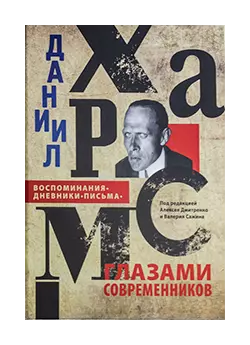 Daniil Harms through the eyes of contemporaries. Memories. Diaries. Letters / Alexey Dmitrenko, Valery Sazhin. SPb.: Vita Nova, 2019
“We have to state,” say the editors of this weighty volume, “that henceforth the emergence of new original memories of Harms, for objective reasons, is unlikely.” Nevertheless, out of eighty texts that have entered here, a tangible share for the first time leaves the darkness of archives, some are written specifically for the book, others are presented in the last author's edition. Under one cover, these memoirs have never met, and together they give an intelligible idea of how Daniil Ivanovich saw the people of his circle. The publication is practically gift (perhaps this is a sign that a canonization has replaced the study) - on a thick, albeit loose paper, with hundreds of photographs, drawings and other visual artifacts, some of which were also not previously published.
“Daniil Ivanovich Harms was like the English dog, very well -mannered, very thoroughbred, even super -patterned. It was the dog, because it differed from the total mass of people with some of its emphasized independence, as DOG differs from dogs of other breeds. Dogs usually look at the owner into the eyes, and in relation to other people are evil. Dog is the only dog that is absolutely independent. Dog almost never barks. (...) So, Harms had the same thing with a laugh. He never laughed. He only smiled. Everyone who knew him is indicated. He only smiled a little. In one corner of the mouth, the tube, in the other, smiles a little. In general, he was always absolutely serious. Even when he told something funny. Everyone is lying with laughter, the whole editors are laid down with the bodies of laughing, and he is at least something. ”
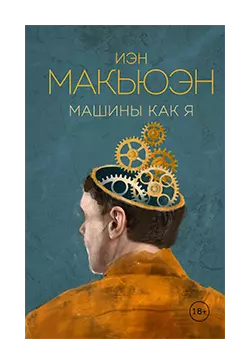 Ian Macouen. Cars like me. M.: Exmo, 2019. Translation from English D. Shepelev
The fresh action - the original came out in the spring - the novel of the British writer occurs in the alternative 1982. Britain lost the war for the Falklands, Alan Turing did not commit suicide, but continued to revolutionize artificial intelligence, androids indistinguishable from man in free sale. With one of these replicants, the protagonist and his neighbor form a love triangle.
The central question that naturally arises in this setting: what is the essence of being by a person, and the answer that Maceween offers is also predictable is to make mistakes and spoil everything. Despite predictability, the story is distinguished by horror and grace, for which the author is appreciated.
“Adam was not a sex toy. Nevertheless, he was able to have sex and had mucous membranes, for which he needed to consume half a liter of water daily. Looking at him, sitting at the table, I could not help but note his thick and dark pubic vegetation and an uncircumcised member of an impressive size. This high -class model of an artificial man undoubtedly reflected the addictions of their young developers. Adam and Eve - this was conceived - should differ in a flowering look.
In advertising, he was presented as a companion, a partner in intellectual battles, a friend and a personal assistant who could wash the dishes, refuel the bed and “think”. Every moment of his existence, he recorded everything that he heard and saw, and could use this data. However, he was not allowed to drive a car, swim and take a shower or be in the rain without an umbrella, as well as work with a chain saw unattended. (...) Adam's life cycle was twenty years. He had a neat figure, angular shoulders, dark skin and thick dark hair combed back; A narrow face with a slightly hooked nose, as if hinting at a sharp mind, thoughtful eyes under heavy eyelids and tightly squeezed lips, the color of which changed before our eyes from the cadaverous yellow-white to a rich bodily, and the corners of the mouth seemed a little relaxed. Miranda said that he reminds her of a “port loader from the Bosphorus”. ”
Elena Galtseva. The work of Andre Breton as an encyclopedia of surrealism. M.: Publishing house IMLI RAS, 2019
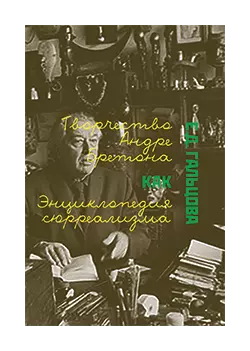 Surprisingly, this is the first Russian monograph on the founder of the surrealist movement, which, however, the author is inclined to interpret as a curiosity, not a pattern. The name indicates not only that Breton's work is a kind of closet where you can find any elements of surrealistic theories and practices. The researcher gives Breton surrealism as an encyclopedic project, as a continuation of the initiatives of Didro and D'Alamber, aimed at summing up the culture, as well as a specific generalization and dissemination of knowledge. Interesting, although patchwork and abstract, work can be recommended to everyone who wants to better understand the most “long -playing” avant -garde course of the 20th century, which retains influence to this day.
“The attitude of surrealism to the occult sciences (the so -called high science) is a special question that has many times raised by researchers and so did not receive an unambiguous answer. Recall that in 1929, in the “second manifestation of surrealism”, Breton called for “deep, true occultation of surrealism” (Occultation Profonde, Véritable du Surréalisme). The famous expression of the Rimbo “Alchemy of the Word” is interpreted here literally and transfers the reader to Nicolas Flamel, Cornelius Agrippe, Hermes Trismegist, Jacob Boehm, Emmanuel Swedenborg, Eliatas Levy, etc., as well as to the contemporaries of Breton - the mysterious Fulkanelli, the author The Secrets of the Cathedrals, and the Shuanaru field, French mathematics and astronomer, made an attempt on the basis of the theory of probability to build mathematically accurate astrology. (...) The main problem that Breton’s interpreters are faced with is the interpretation of mechanisms for combining esotericism with anticlericalism, atheism and materialistic worldview. The question of the “miraculous” - the concept of stated in the first “manifesto of surrealism” and constantly returning in the work of Breton, including in his late article “Wonderful against mystery”: for all its vague, this category is reacted with primitive trends, with interest in primitive cultures and ethnology, is added to this. Filling the European history of the occult sciences, to which Breton addresses. ”
Boris Mironov. Russian modernization and revolution. SPb.: Publishing house "Dmitry Bulanin", 2019
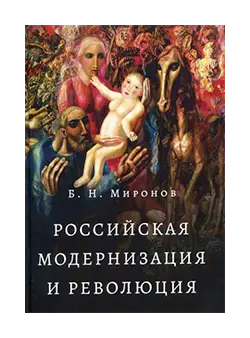 Boris Mironov owns the term "Cliotherapy"; It is meant that historians can be “social doctors” who save patients (Russian citizens) from “various complexes”, manifested in relation to their history as catastrophic and “abnormal”.
One of such “abnormalities” with which the author works is a revolution, which, it would seem, paradoxically interrupted the quite successful way - Mironov argues a lot of statistics - royal modernization. The author removes the paradox in a rather original way, turning to the “cognitive practices” of Russian peasants and workers introduced into temptation by the leaders of the revolution. With rather controversial work, you should be a familiar due to the research conscientiousness of the unconditionally influential author and a huge amount of data attracted.
“It is interesting and important to note that the peasants in the XVII - beginning of the XX century. They did not perceive the world in the direct perspective. E. A. Andreev-Balmont (1867–1950), translator, wife of the poet K. D. Balmont, a relative of the famous Moscow publishers of the Sabashnikovs, came from a rich merchant family and was distinguished by a rare education. In the second half of the 1880s. She worked as a librarian in Moscow Sunday schools for workers who recently come from the village, and noticed a lot of “strange” in their perceptions: the students did not recognize the elements of the familiar world in the pictures, did not distinguish in shades of colors. “Our students, all adults did not understand what was depicted in the simplest pictures in the book. For example, there was a boy on the corner of the street under the street lantern, there was a dog near him. In such a picture, it seemed not to be unfamiliar - our students, especially young people, were born and grew up in Moscow and every day a boy and a dog could see on the street, but not one of them could tell what was depicted in such a picture. “See the boy? Dog,” I asked them. They turned the picture in their hands and were silent. “Here's a dog,” I pointed a finger at her. Then someone exclaimed with surprise: “In fact, the dog is really, please tell me the dog ...” And the book went in the hands, and the dog was recognized in the picture ”.”
Denis Zakharov. Commentary on Roman Trumen Capote “Prayers heard”. SPb.: Find the lumberjack, 2019
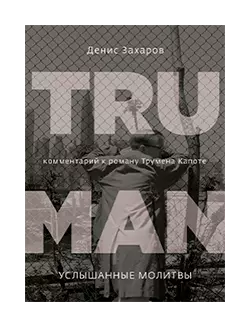 “Prayers heard” is an incomplete and not published by the hood of a hood about the American bohemia, which he considered his main work. The chapters who saw the light, while the writer was alive, cost him reputation, he was considered a traitor; And indeed, not knowing all the relationships of this strange text, it is not difficult to take him for a rude farce. The Capote Creativity Researcher brings clarity to the author’s plan, clarifies the context and autobiographical background of “prayers”. At the same time, the “Commentary on Roman” itself is read as a detective novel about disappointment and in a wove of writing ambitions.
“Kapota gathered“ spoiled monsters ”in one work to show the flip side of the medal. He wrote about people whose glossy life looked festive, in reality they were all similar to capricious children locked in hotel rooms with chic services. Locked by their own free will!
So is it time to gain freedom and stop lying to yourself?
With this question, Kapota went to the forefront of American literature. He believed that his ingenious move would be appreciated, and the press would reward the praise of the protrusion of the author, who spoke of the approach of the “consumer society”, but it turned out exactly the opposite. Fragments of the novel were read too literally. His gossip did not become great literature, and in the text they saw nothing but an attempt to take revenge on the offenders and evil to get even with friends. Too small for a writer of this scale. ”