
Translated material
The future is no longer a cake
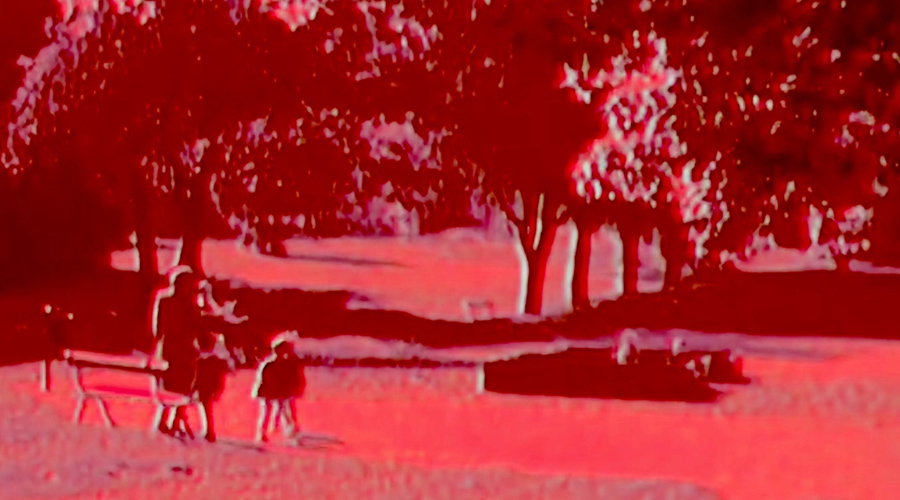
On November 24, in the Moscow cinemas "Star" and "Youth" begins the retrospective of the Finnish video artist Mika Taanila ; The shows will also be held in St. Petersburg, on the new stage of the Alexandrinsky Theater and in the “Word Order” . Inna Kushnareva talks about the heterogeneous work of this artist .
Mika Taanila is a Finnish director and musician associated with electronics and industrial, with Pan Sonic and Miku Weinio. I shot clips, short films, two full -length films. I made installations and videoart, exhibited at the Venetian Biennale, Manifesto, Document. Multifaceted and diverse. The plots of his films are insomnia, a six-day race in New York, the early Russian industrial scene, the World Cup among robots, Finnish finished Futuro houses, an atomic power plant on the island of Olkiluto, “rethinking” of the films “My Dinner with Andre” Louis Maly and “The Man who fell to the ground” of Nikolai Rogue ... Perhaps, you need to need Just fix these heterogeneous interests and not look for the unifying author's principle. So further - some notes on several films of the Taanila from those that entered the Moscow retrospective (it is almost exhaustive).
“Tectonical Plate” (2016) is a hostile film about the fear of flights, Jetlag and checks at the airport. Removed without a camera. There are no images in the 8th films, only the text. If not, then the camera is not needed - logical. There are no texts as original, belonging to the Finnish poet Harry Salmennia: Taanila uses numerous fragments of instructions and symbols that can be seen at airports and aircraft. From these materials, he made a photocopy, directly exhibited on the film. The material trace of the thing on the film, around which Rolan Bart built his photo ontology, in the “tectonic plate” is left by a simulacrum, a copy with a propagated copy. That is, this is a materialistic film consisting of simulacra. Cinema using photocopy is literally technical reproduction or a strange product of the aura through this reproduction. For the first time, Taanila tested this method in a short meter “optical sound”, in which he rebuked on a 35-mm film the score of the composition of the group [The User] .
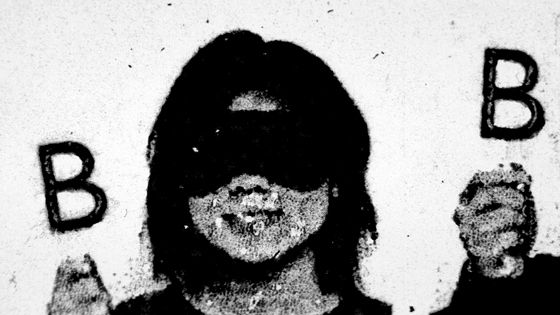 © Testifilmi Frame from the movie "Tectonical Plate"
If you use the terminology of the art critic David Joshty, what Tanila produces can be defined as a population of images, not individual images. The latter can be easily reated, turned into an object and commercialize. With a population of images, this is more difficult to do. Images, of which, for example, the film “The Return of the Atom” consists, are not self -concerned. None of them carry the truth in itself, separately. All images and all formats are equal: drawing, interviews, technical visualization, documentary shooting, archival chronicle, black and white shots from the Japanese Gamer. They form a spatial environment like the one that Pierre Yug constructed in their installations, when the film “Dog Noon”, the reenactment of the bank’s robbery, which is based on the film, and the chronicle of the event reflected in the press, combined in the “Third Memory” project. Taanila's films are also peculiar environment, they feel the expansion of the collected heterogeneous information.
Taanila works a lot with the finished material, as it should be for a modern artist who does not produce content, but renews and rewrites it. New content arises from this manipulation itself. From “My dinner with Andre”, Taanila removed all the “conversations”, which, in fact, is famous for this film. The hero of Wallace Sean leaves the house, descends to the subway, gets to the restaurant, sits with the hero Andre Gregory, eats, Gregory pays for dinner and leaves tips. Of the one and a half hours of the film on the installation of Taanila, about twelve minutes were left. Due to the carved personnel with the dialogs and the internal monologue of Sean, the image is all the time, but it turns out that the film does not fall apart, its structure is preserved, as the structure of the relations of the heroes is preserved. And it seems that Sean always wants to say something or ask, and Gregory is organic and so, even with these hesitation, his charisma is not lost at all. But these remote conversations themselves seem to reflect a sudden disappearance, the departure of the famous director Andre Gregory from the theater after his career seemed to have reached a climax. The whole procedure resembles Georges’s novel “Disappearance”, written without the letter “E”, and is generally close to the formal games that were engaged in Ulyopo. On the same principle of disappearance, the video installation of Taanila "Earth that fell on a person" is being built. If the “tectonic plate” is a film without a camera, then the “world”, according to the director, is a “film without a film”. From the "man who fell to the ground" Rogue is removed everything except desert landscapes, animals, interiors and cars. And, of course, no David Bowie.
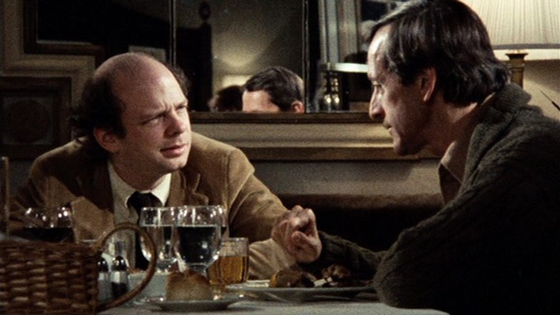 Frame from the movie "My Dinner with Andre"
The Return of the Atom (2015) is not just the first full -length film by Taanila. It was a kind of Work-In-Progress , which he began along with his co-author Yussi Eerola in 2004, when in the Finnish town of Olkiluto they began to implement the first nuclear power plant after the Chernobyl disaster of the nuclear power plant. Filming lasted until 2015. In the “return of the atom”, a utopian impulse is obvious, which is simultaneously approved, and consists in quotation marks. Finland seemed to freeze in the 50s and 60s, in that era when it seemed that atomic energy would help to carry out utopia. The Finns on a small island are stuck in this utopia and do not want to get out of it. On the contrary, they plunge into it even deeper: having built one line of the nuclear power plant, then they build a second, third ... As emphasized in the film, they come to their solutions democratically. The story with its Chernobyls and fukushimas is suspended, excreted by brackets. For the completeness of utopia on the island, it is planned to arrange a reserve and a reserve - fish, moose, and birds. As in the novel by Jeff Wandermer's Annihilation. Nature is not afraid of the atom, on the contrary, only magnificent blooms from radiation. The endless power lines, towers and wires, densely covering the island, organically look next to idyllic houses and kindergartens.
In the Finnish paradise, however, you will not have to sit back. Finns are a hardworking people, and one of the heroes is crushed in dismay that he, as a hereditary reinforcing person in the third generation, will not be proud of the fact that he worked for Olkluuto - everything is very poorly organized. They build a power station, however, not so much the Finns (they will serve it) as the Polish workers who arrived under the leadership of French and German managers. This is a normal international project-experts, foreign labor. No one is sitting in one place, there is a constant transit, the leadership changes, the lag is accumulating from the schedule. By the end of the film, it reaches some completely absurd 11 years. In principle, this is a film about utopia, which has not been able to build. And not only because all atomic programs were rolled up after Fukushima. But because it is utopia: “U-topop” translates as “non-month”. You can only endlessly look to the music of Pan Sonic at the overshadowing forest of reinforcement, at the lifting cranes and on the fussing, as ants, workers in specialists with fluorescent stripes luminous in the night darkness. Their flickering on the accelerated shooting rhymes with the movement of abstract figures and ornaments in fragments of popular science cartoons about atomic energy, also included in the film.
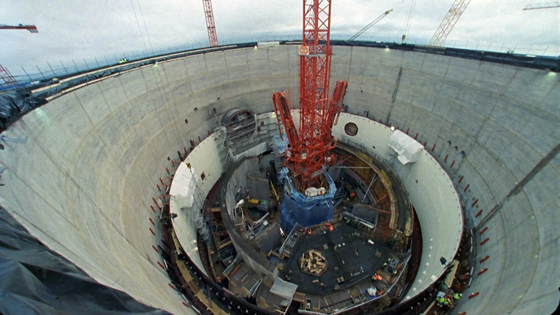 © Jussi Erola Kinotar Frame from the movie "Return of the atom"
However, nothing can shake the unanimous desire of local residents to surrender to the arms of the atom: they are even ready to make nuclear waste not exported, but to be at the same island in a rocky rock. The only disagreement, who worked as an electrician at the station and searched for the incriminating evidence for all the years, rushes around the village as a partisan, and is more and more imminent in isolation and madness, becoming similar to Unabert.
Everything that happens in the film is well described by the category of Eerie (strange to creepy), introduced by the English cultural critic Mark Fisher. Eerie arises where the uncertain presence of something that should not be, or, conversely, the absence of what it seems to be present is felt. Two examples given by Fisher: the cry of a bird, where you can feel a strange excess, subjectivity that should not be in it, and Stoneenge, built by an incomprehensible one - seems to be people, and maybe not. In both cases, what he calls the “problem of agency” is manifested. Another examples: empty cities in anti -utopias. Or the same installation “Earth that fell on a person”, which was mentioned above. The topic of radiation, of course, is Eerie in its very essence: some kind of power acts, but what and how-at the everyday level is incomprehensible. It will not work to imagine it in any way. In the beautiful shots of the “Return of the atom” with wooden houses and filling all the free space by power lines, as if climbing each other, the sensation of Eerie is created an excess of the technological, while organically built into the pastoral picture. This quality of Eerie passes through the entire film: it seems that we are shown many agents and subjects-workers, managers, officials, activists, residents, and the feeling is that something happens besides them is not explained and is not exhausted by their actions and decisions. And even the unconditional consent of the inhabitants of the village for everything is also Eerie . They are so calm, friendly and not inclined to panic related to radiation (a local priest even thanks in his sermons for God for being so lucky with an international project) that it begins to seem that the matter is unclean and they are in an “wicker person”.
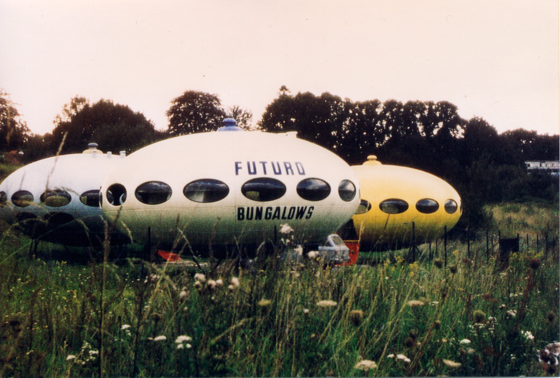 © Kinotar Frame from the movie "Futuro - new installation for tomorrow"
 If on the slope of the mountain in Dombai there was now a house in the form of a flying saucer, standing on thin legs, it would probably also be Eerie . But the film “ Futuro is a new installation for tomorrow” (1998) dedicated to this phenomenon of Finnish architecture, on the contrary, tells about it so exhaustively that nothing remains behind the scenes. Futuro houses were produced in Finland in the 60s-70s. It was an attempt to commercialize futuristic design, and the Finns even entered the international market with her. Ellips on light steel supports fits perfectly into the surrounding landscape. As its architect emphasizes in the film, it is close to natural forms like polished pebbles. And inside it is a mother’s bosom gently covering it. It doesn’t matter that the house is actually all of plastic and a cat, getting inside, does not find a place for itself. Natural and artificial, as in the "return of the atom", harmoniously coexist. Selecting shots from the chronicle, illustrations and clippings from newspapers, interviewing everyone who was involved in the project, Taanil painstakingly builds the story of one invention. First, the mountain house belonging to everyone and anyone (in this capacity was going to purchase a Soviet tourist agency "Sputnik"), or a mobile place for family vacations, advertised in universal stores. Then, already in America, Futuro began to be positioned as a portable bachelor's den. But the oil crisis began, and the crazy money in America ended. Atomic energy would certainly help here, but alas: Futuro’s future ruined gas prices. But he began to seem an ideal place for an artistic residence, where it is so good to experiment on himself and on others and where it is not a shame to bring that Warhol, that the king of Saudi Arabia. But this did not help either. People did not want to live in plastic children's toys, placed on the slopes of the mountains or clusters hanging on the towers (there were such projects). Slowly but surely Futuro turned into a dead end branch of the evolution of housing construction. From an art object-to a cheap fair attraction with Santa Claus, at the time of filming of the film rusting in the wilderness somewhere in Estonia. In the finale, against the background of sunset, a helicopter takes a round house to an unknown distance. He flew away and did not promise to return. Humanity has missed another utopian opportunity.