
Translated material
"Absolute indifference." How Russia proves to the UN that he is successfully fighting domestic violence

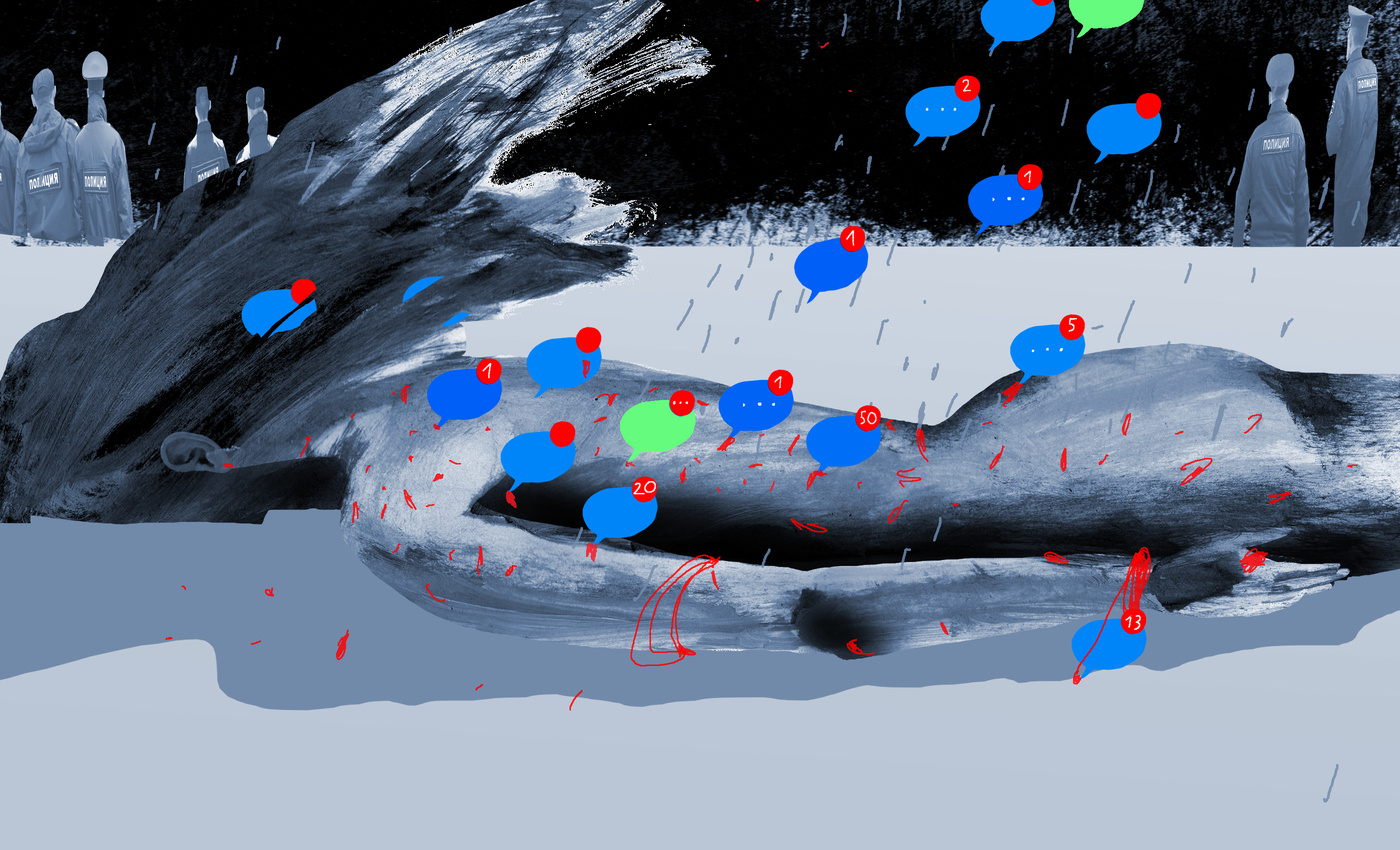
Illustration: Anna Makarova / Mediazone
The government is confident that the scale of domestic violence in Russia is “quite exaggerated” - this became known fromthe response of the Ministry of Justice to the European Court of Human Rights, which considers complaints of four injured women. Similar answers are a typical rhetoric of representatives of Russia in international organizations. "Mediazona" talks about this on the example of two conclusions of the UN Committee on the Elimination of Discrimination against Women.
Beating a house, beating with witnesses and not a single sentence
40-year-old Elena Sizova lived in marriage with Mikhail for four years -from 2009 to 2013. Already in the second year of marriage, her husband began to beat her.
On November 8, 2010, he hit his wife at an eight -year -old daughter. Elena's injury turned to the doctors, but did not tell that her husband beat her - Mikhail accompanied her to the hospital. In December, he beat Elena again: pushed him onto the sofa, threw a blanket on top and began to beat. More than twenty beats with fists on the head and body. This time, Elena told the doctors that her husband had done the beatings. In her hospital, bruises on her body were recorded, and information about the beating was transferred to the police.
All the names of the injured women and their relatives in this text are pseudonyms. These data in the UN materials are also classified.
After that, Elena sent a daughter from St. Petersburg, where the family lived, to her grandmother in Irkutsk. In October 2012, Elena gave birth to a younger daughter, and a few months later she left her husband and moved to another in the apartment. Mikhail began to pursue her: he regularly called, threatened, insulted, and at the meeting beat. In April 2013, he attacked Elena, when she came with his child to see a pediatrician - he hit his wife three times in the face. On the same day, she turned to the police.
From there, the materials were transferred to the justice of the peace, although Elena asked to initiate a public prosecution, since she has neither legal training nor money for a lawyer. The magistrate court considered the case as a private prosecution - this means that the applicant herself should be engaged in the collection of evidence, calling for witnesses and their interrogation. If the case implies a public accusation, the state in the person of the investigator, and then the prosecutor, is engaged in guilty.
Elena Sizova turned to the State Center for Social Assistance to families and children of the Krasnogvardeisky district of St. Petersburg. She was placed in a shelter for women who fell in a crisis, but on June 3, 2013 Mikhail attacked his wife - he was not even embarrassed by the fact that his own mother was nearby.
Although later the police both Mikhail and his mother admitted that he hit Elena in the face, but from there they simply handed over the materials to the justice of the peace. During the year, Elena tried to get a criminal case against her husband, whom they did not formally divorce, but all the time received refusals. Michael continued to pursue her.
46-year-old Maria Alekseeva lived in marriage with Nikita 19 years . During this time, they had three sons - 1996, 2001 and 2011. Nikita regularly beat his wife.
In August 2007, Nikita beat Maria in front of children. In the hospital, she was diagnosed with bruises of the shoulder and pelvis. The woman turned to the police department of the Moscow district Zyablikovo, but they did not initiate a criminal case there. The beating continued. Maria first regularly contacted the police, but over time she began to ask for help only in cases of the most cruel violence.
This happened on the night of June 12, 2012. Maria turned to the clinic and filed a statement to the Zyablikovo police department. During the audit, her husband denied violence, and one of the sons confirmed the testimony of her father. On this basis, they decided not to initiate the case.
In February 2013, Nikita beat Mary for refusing to have sex with him. Once again she went to the district department and once again received a refusal to initiate the case. The police reported that she could submit an application to the justice of the peace for persecution in private, but Maria did not do this, frightened by her husband.
In the fall of the same year, marriage was divorced at the request of Mary. According to the amicable agreement, the apartment passed to her, but Nikita continued to live there and beat the former spouse. Despite the bruises recorded after beating on the night of August 7, 2014, the police did not open the case. The court later ordered the man to free the apartment.
What Russian authorities say
Responding to the Russian woman’s complaint to the UN Committee on the Elimination of Discrimination against Women, Russia's representatives first noted that the victims did not reach the cassation instance, appealing refusals to initiate criminal cases. The state also reproached women for living voluntarily with their husbands, despite violence. “The authors [complaints] began to live separately from husbands only after a long period of time,” Russia's position is given in the conclusion of the UN Committee.
The authorities insist that the victims provided psychological and legal assistance in specialized institutions near their place of residence, and Elena Sizova was given a shelter in the shelter.
In fact, Sizova, who turned to family and children for free legal assistance to the district center and children, instead advised to hire a private lawyer. Maria Alekseeva in the Moscow Center “Nadezhda” was also able to get only a free consultation, but they refused to represent her interests in court there. The law on free legal assistance adopted in November 2011 does not apply to victims of domestic violence.
The authorities admitted that the police did not find in the actions of men a heavier corpus delicti than Article 116 of the Criminal Code (beatings; later this article was decriminalized), and women should contact the justice of the peace so that their cases were considered in a private prosecution. The fact that such matters have the burden of proof of the victim, the Russian authorities do not see a problem.
What the UN says
In July 2019, the UN Committee on Combating Discrimination of Women came to the conclusion that the Russian authorities violated the rights of Elena Sizovaya and Maria Alekseeva, when they could not protect them from domestic violence. The UN notes that in Russian legislation there is no concept of “domestic violence” and does not provide for legal protection measures against it. At the same time, in 2015, the Committee already recommended that the authorities urgently adopt integrated legislation to prevent violence against women, which would imply criminal liability for aggressors and protect the victims.
They also criticized the fact that the cases of domestic violence are usually related to a private prosecution when the victim must collect evidence, call and interrogate witnesses. This, according to the committee, violates the equality of the parties and cannot be considered the appropriate mechanism to suppress domestic violence.

The Committee indicated that not only legislative changes are needed, but also working with gender stereotypes in society and a change in law enforcement practice based on them: “This is both a fundamental cause and a consequence of women's discrimination. The stable nature of gender stereotypes is supported by various means and institutions, including laws. <...> The Committee emphasizes that the use of stereotypes affects women's right to a fair trial. ”
The UN was recommended to the authorities to sign the Istanbul Convention devoted to the measures to counteract violence against women, to adopt a law on the prevention of domestic violence, to initiate criminal cases of public prosecution on such crimes, and to women, if necessary, to provide free legal assistance and protection.
The Committee also advises to develop standards for considering complaints about home violence at the level of police departments for a timely investigation of such cases and protection of the victims, as well as to conduct appropriate professional retraining of judges, lawyers and security forces.
Another point in the recommendations of the committee is the creation of rehabilitation and educational programs for offenders and training programs for non-violent methods for resolving conflicts. Another recommendation to the authorities is to develop measures together with non -profit organizations to eradicate prejudices, customs and practices that justify or encourage home violence.
It is expected that in a few months the Russian authorities must inform the UN about the implementation of these recommendations.

Illustration: Anna Makarova / Mediazone
Threats, persecution, attack
34-year-old Irina Vinogradova lived with Alexander for two years . Alexander insulted it, consumed drugs and alcohol, suffered dependent on gambling. Irina left him, after which Alexander began to pursue her.
At the end of 2010, Irina had a new partner, but Alexander still demanded to return to him, sent offensive messages, waited at the house and tried to get into the apartment. A year later, by December evening 2011, when Irina, who was living on the second floor, did not let him in again, he climbed into the apartment through the window and hit the woman in the face - her son and a new lover were at home. Then Alexander ran out into the street and broke the window with a stone.
Irina turned to a non -state crisis center for women in St. Petersburg. Together with Valentina Frolova, who then worked as a lawyer of the center, she achieved the verdict - on February 21, 2013, the justice of the peace found Alexander to be guilty of the beatings (part 1 of Article 116 of the Criminal Code) and sentenced to correctional labor. Alexander had to pay Irina three thousand rubles of compensation for moral damage, but she still has not received this money. In the appeal, Irina asked to tighten the punishment, but he was left unchanged.
A day after the sentence, February 23, Alexander again began to send messages to Irina with insults and threats of murder. Irina filed an application with the police, but they refused to start a case, since the police could not interrogate Alexander - he simply did not come there. After this, the threats were repeated more than once, but the woman failed to achieve a new criminal case.
“Absolute indifference. I called the district police officer and said that now he was under the door, I am afraid that he could harm me - he threatened with reprisal. And the district police officer replied that I have half such cases, and what, will I put up every guard? ” - recalls Irina Vinogradova.
In total, the police issued seven refusal decisions - they were all explained that the police could not interrogate Alexander, because he did not come to the department.
Irina asked for state protection, but the court considered that there was no threat to her life and health. In addition, the law on state protection does not apply to the victims of domestic violence. In her complaint to the UN, Irina pointed out the inefficiency of this measure, which should be applied immediately - and in her case, the state protection request was considered only three weeks after its submission.
“Until the last, I hoped that they could protect me, especially since I was alone with a small child, my mother lives in Chelyabinsk, my elder brother in Chelyabinsk, too, had nowhere to wait for help. I fought until the last, otherwise he would just kill me somewhere and that’s all, because a completely inadequate person and you could expect anything from him, ”says Irina.
In a complaint to the UN, she noted the lack of concepts of domestic violence and Stalking in the legislation. “According to the author, the circumstances of its cases and the reports of the NPO show that the general provisions of criminal legislation are unable to ensure the answer to the problem of domestic violence in a timely and effectively. The authorities in this way ignored the situation of persecution, ”Irina’s position is given in the imprisonment of the committee.
What Russian authorities say
As in the case of Sizova and Alekseeva, the authorities replied that the woman did not reach the cassation instance, but her appeal to the UN Committee - “abuse of the right to fair trial”, since all court decisions in her case are based on national legislation and do not contradict international law.
Responding to the dissatisfaction of Vinogradova in the absence of the concepts of “homemade violence” in Russian laws, the authorities indicate that “this significance depending on the circumstances of the case” can qualify as an end (Article 117 of the Criminal Code), the threat of murder (Article 119 of the Criminal Code) or insult (Article 5.61 of the Code of Administrative Offenses).
Irina’s conflict with a former lover does not consider the authorities to consider domestic violence, since during the attack and persecution she already lived with another partner.
What the UN says
In November 2017, the UN Committee did not agree that the case of Vinogradova did not fall under the definition of domestic violence, and concluded that the state violated its rights without protecting from persecution.
The Committee emphasized that the Convention signed by the USSR in 1980 on the elimination of all forms of discrimination of women to bring national legislation in accordance with it - in particular, it is necessary to introduce the concept of “domestic violence” there. The Committee also recalled that the Convention obliges the state to change not only the laws, but also the traditions and practices that have developed in society that discriminate against women; Courts should not be based on stereotypes about domestic violence.
“The case shows the state’s failure to fulfill the obligation to modify social and cultural patterns of the presentation of men and women,” the UN concludes.
The Committee has prepared a list of recommendations for the work of the authorities with the problem of domestic violence, which mainly repeat the recommendations on the complaint of Alekseeva and Sizova. True, this time the Committee still advised to return the criminal liability for the beatings in the family under Article 116 of the Criminal Code.
The reaction of the authorities to the recommendations
In their answer sent to the UN in December 2018, the authorities insist that in Russia there are “sufficient legal mechanisms for bringing to criminal liability of persons committing family and living violence.” Although there are no criminal articles on domestic violence and stalking, according to the authorities, to solve these problems, sufficiently existing articles of the Criminal Code. They also offer to refer to an administrative article on beatings (Article 6.1.1 of the Code of Administrative Offenses).
Valentina Frolov’s lawyer, who represents Vinogradova’s interests, criticizes this position: “The law that is now is not enough because there are not criminalized and there is no responsibility for all forms of violence that are committed in relation to women in the family. For example, take the simplest article on the threat of murder, 119th [article of the Criminal Code]. We have criminalized only a threat to the murder and causing serious harm of health. Physical persecution, as in the case of Vinogradova, again remains unpunished, because everyone does not care. And the police faced the fact that she could not even qualify it. Our law is imperfect. ”
The recommendation to develop a special procedure for considering complaints about domestic violence in the police department of the Russian authorities decided to ignore, saying that such complaints are considered in a general manner. The authorities also rejected the advice to refuse a private prosecution in the case of domestic violence and ratify the Istanbul Convention.
In its response in December 2018, the government reported that the bill “On the Prevention of Family-Houseful violence” has already been completed-it has not been adopted to date. The authorities also spoke about the concept of state family policy until 2025 , approved by the government, which involves the development of crisis centers for victims of domestic violence and work on people who violate their family members. There is no exact data on the creation of specific centers and programs in the response.
Editor: Yegor Skovoroda