
Translated material
In Russia, they will create an analogue of Wikipedia. The publisher of the Orthodox Encyclopedia will take up the project for two billion rubles
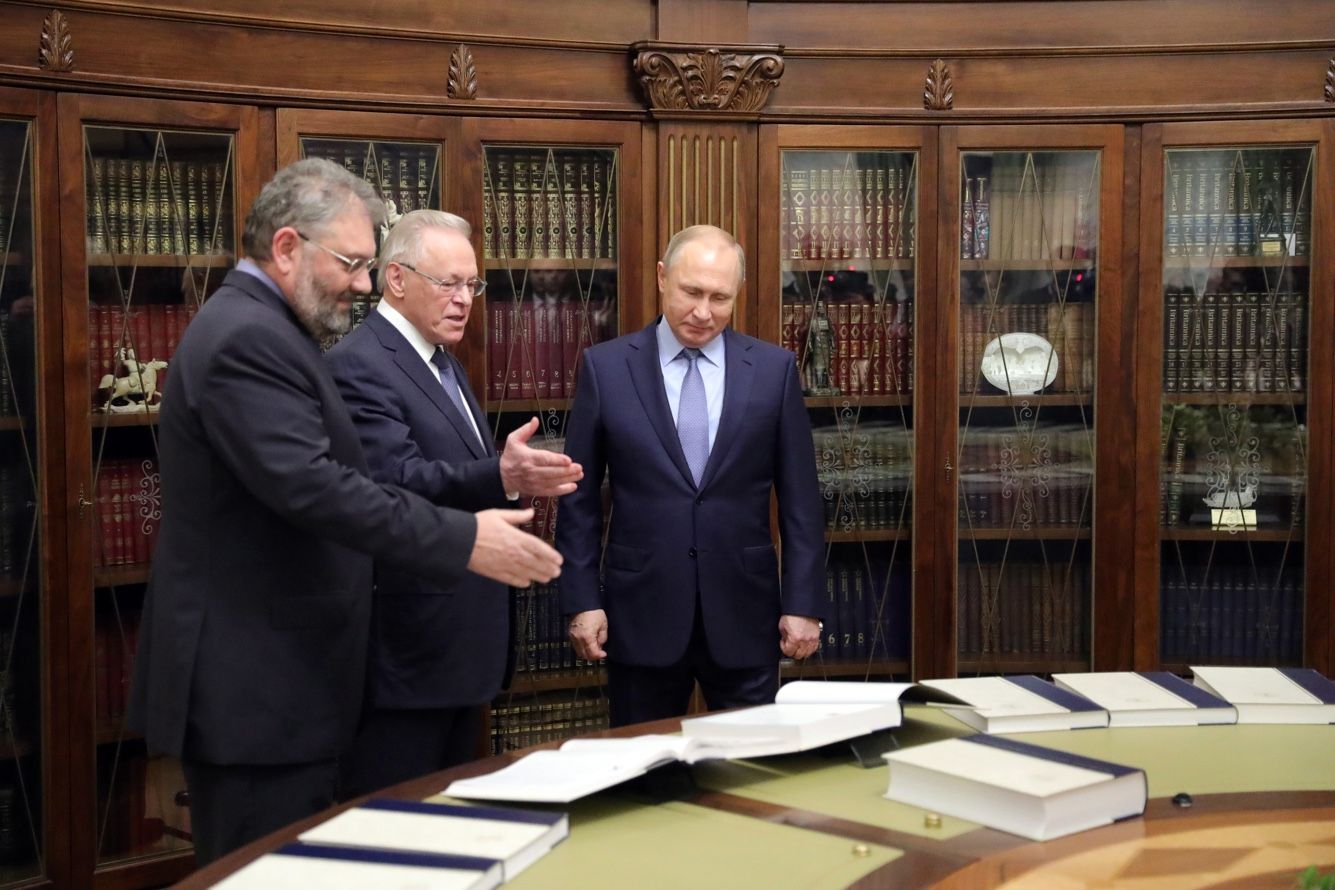
On November 21, the responsible editor of the Scientific Publishing House "Big Russian Encyclopedia" Sergey Kravets said that in the spring of 2022 a site will appear that the media and President Vladimir Putin are compared to Wikipedia. Officials decided to create such a resource back in 2010; In 2019, the government allocated about two billion rubles for it. Kravets, who will be responsible for the Russian Wikipedia, is known for his work on the encyclopedia for the Russian Orthodox Church.
For the first time, they decided to create a “competitor of Wikipedia” back in 2010. Two billion rubles were allocated for the project
Officials expressed the idea of creating an analogue of Wikipedia in Russia several times. For the first time this happened back in 2010-then the agency Rospping announced the intention to implement the “Knowledge” project, “which the whole Internet environment that reads in Russian could take advantage of.
The authors of the project said that following the Russian -speaking audience “Knowledge” will gain popularity in the BRIC countries. The main competitive advantage of the Russian project was called that the articles in it would be written not by enthusiasts, but by experts - since the texts will be made on the basis of a large Russian encyclopedia (BRE). The resource was supposed to start work by the end of 2011, but was never launched.
In 2012, the responsible editor of the Scientific Publishing House "Big Russian Encyclopedia" Sergey Kravets said that the new site will still appear and will be "as" Wikipedia ", only better." According to him, the site could become commercially successful and would pay off for three years thanks to paid access. But neither a paid nor a free analogue of Wikipedia never appeared.
Four years later, in 2016, the then director of the Russian National Library, Alexander Visly, said again that the Russian “competitor of Wikipedia” would be created on the basis of the Great Russian Encyclopedia. In the same year, the government ordered the creation of the site, and Prime Minister Dmitry Medvedev approved the working group, which was supposed to create an electronic encyclopedia.
The Russian competitor of Wikipedia never appeared, but in the spring of 2016 the electronic version of the BRE began to work. According to the SimilarWeb service, in October 2019, users visited the electronic version of the encyclopedia 742 thousand times. For comparison, the Russian Wikipedia is more than 176 million times a month.
Although the BRE website has already been launched, in the summer of 2019 the government again returned to the idea of the Russian analogue of the most popular encyclopedia in the world. The Ministry of Communications has developed a bill on the allocation of subsidies for the creation of a “national interactive encyclopedic portal”. At the end of September, the size of the subsidy became known - one billion 989 million 304 thousand rubles (until 2021), it has already been laid in the country's budget.
In early November, at a meeting of the Presidential Council on the Russian language, Vladimir Putin personally spoke out of Wikipedia. “It is better to replace it with the new large Russian encyclopedia in electronic form. This will, in any case, will be reliable information in good, modern, by the way, form, ”he said.
The Kremlin then clarified that the authorities would not impede access to Wikipedia in Russia.
The encyclopedia is presented as new, although it will be created on the basis of BRE
Two billion rubles from the Russian budget will receive the Scientific Publishing House "Big Russian Encyclopedia", which produced 35 volumes of BRE. Articles for the new site will write about 200 researchers of the publishing house and hundreds of invited authors, the names of the authors will be indicated under all materials. But Internet users will not be able to edit articles (as is done on Wikipedia), although visitors registered on the site will have the opportunity to offer the compilers of the update.
The head of the Marketing Communications Department of the Big Russian Encyclopedia publishing house Anna Sinitsyna explains to Medusa that the budget subsidies will go to the development of the site and other technical tools, as well as the creation of new materials for the electronic encyclopedia. “We have all the authors for fees. This is not “Wikipedia” where anyone writes for “thank you,” she says.
Some of the articles will be based on materials from the already released BRE, Sinitsyn admits. “Of course [Internet encyclopedia] will not write from scratch. Some part of the materials will partially take from the written. But there will be a lot of work on their updating, ”the representative of the publishing house says.
When asked why then the creators do not want to simply update the already working BRE website, Anna Sinitsyna says that “this is a completely different project”, and the new site is a “more difficult thing” compared to the electronic version of the Russian encyclopedia. For example, according to Sinitsyna, many specialized encyclopedias, educational and archival materials will be available on the portal. In addition, the site will combine about 500 “professional discussion sites”. How exactly they will look is still unknown.
The publishing house plans to launch an electronic encyclopedia in 2022 - the developers intend to spend 33 months on all work.
The creators of the encyclopedia promise that the articles will not be “ideological and political coloring”
In early October, the Big Russian Encyclopedia publishing house announced a competition for the provision of brand development and marketing strategy for 2020–2022 for the Encyclopedic Portal. The procurement documents emphasize that the new encyclopedia is designed to protect users from inaccurate information, and “modern knowledge” from “erosion”.
“In the context of an avalanche -like growth of any kind of falsification (including scientific, historical, statistical, demographic data) and fake messages generated by some media and private users of the network, the task of creating the subject to update and replenish the safe (that is, verified by the scientific community), which is especially important for our target audience,” explained in the target audience, ” explained in The conversation of RBC Anna Sinitsyna in early October. She also emphasized that all materials of the site “will be free from ideological or political coloring and will be purely scientific and educational in nature.”
The target audience in question in the statement of Sinitsyna is the teachers of educational institutions of different levels and their students, as well as civil servants, journalists and scientists. At the same time, the creators of the site emphasize that in the end it is intended for a wide range of users, and in the future it is planned to use a resource to teach schoolchildren.
The publishing house also believes that the BRICS countries, as well as Cuba and Iran, will want to join the project (as planned almost ten years ago), since the “English version of the universal encyclopedia (“ British ”) does not largely satisfy these countries due to pronounced English -centrism (primarily in history and culture).”
Anna Sinitsyna in a conversation with Medusa says that the potential Russian-speaking audience of the site has 15-25 million people. At the same time, according to purchase documents, the site architecture should be adapted to maintain 15 million unique visitors per day. Wikipedia, according to Mediascope, in July 2019 in Russian cities with a population of more than 100 thousand people there were 2.9 million users per day and 29.4 million a month.
The project is led by the compiler of the Orthodox Encyclopedia
On November 21, in Ufa, the responsible editor of the Bolshaya Russian Encyclopedia publishing house Sergei Kravets presented the project of the Russian Internet Encyclopedia. He said that the name has not yet been defined, and also emphasized that the project should not be compared with Wikipedia. For example, because all articles in the Russian encyclopedia will be signed and the editorial office will be responsible for the reliability of the published materials. Kravets emphasized that, after the launch of a new resource, “its own audience is an audience that is not so important, the reliability of knowledge in details,”.
“We conducted a study and know about all electronic encyclopedias. There are a lot of good projects, but not one of them in scale and elaboration reaches what we are going to do. And there is “Wikipedia” - a wonderful project, to which we probably are not trying to reach. We have reliability at the forefront, and they can publish all articles. How can you compare? " - says "Medusa" Anna Sinitsyna.
Sergei Kravets has been working in the publishing house "Big Russian Encyclopedia" since 2001 - he held there the positions of the director and editor -in -chief, in recent years he has been a responsible editor. In addition, Kravets has been publishing church literature for more than 20 years. He worked on the publication of the History of the Russian Church in 12 volumes in the publishing house of the Transfiguration of the Valaam Monastery back in 1997. After the multi-volume department, the Patriarch of the Russian Orthodox Church Alexy II ordered to create the Orthodox Encyclopedia on the basis of the publishing house. The center issued 56 volumes with information about Orthodoxy and other faiths (in total it is planned to release 75 volumes). Since 2001, the Center has been leading the Sedmitsa.RU website, and since May 2003, the TV-Center has a weekly television program “Orthodox Encyclopedia” on the TV-Center TV channel.
The Christian encyclopedia is distributed, which is published by Sergey Kravets and its associates, primarily through the libraries. The Board of Teaching on the publication of the encyclopedia is headed by Moscow Mayor Sergei Sobyanin, the Public Council - the chairman of the State Duma Vyacheslav Volodin, and the observation - the patriarch of the Russian Orthodox Church, Kirill.
Pavel Merzlikin