
Translated material
“Tails” stretch
600 tons of nuclear waste from Germany were brought to Russia. What you need to know about it

On the afternoon of November 26, in the Kronstadt area, the Mikhail Dudin ship, which was in St. Petersburg from Amsterdam, anchored. On board the ship there are 80 containers with a depleted uranium hexafluoride (OGFU). The cargo got to the capital of the Netherlands by train from Urenco enterprises in German Gronu.
The uranium -enrichment factory leaving the wagons chain in early autumn was noteworthy European eco -activists, after which an international scandal flared up. Protests against the transportation of uranium “tails” are held in many cities of Russia and Europe. Activists and environmentalists talk about violation of all possible legislative norms governing export and import of radioactive substances. Participants in the transaction deny the prosecution, stating that we are talking about innovation and concern for the climate.

Russia is already holding more than a million tons of OGFU. Their origin is definitely not known
The substance in question is a by -product obtained as a result of enrichment of natural uranium. The latter consists of two isotopes-U-238 and U-235. When enriching uranium, isotopes are separated: waste of this production-uranium “tails”-almost entirely consist of the U-238.
In Russia, OGFU began to be obtained with the heyday of atomic energy in the late 40s. Now, according to the Council for Human Rights and Ecologists, more than a million tons of this substance are stored at domestic training grounds. No one knows what part of this remains of its own production, and which imports.
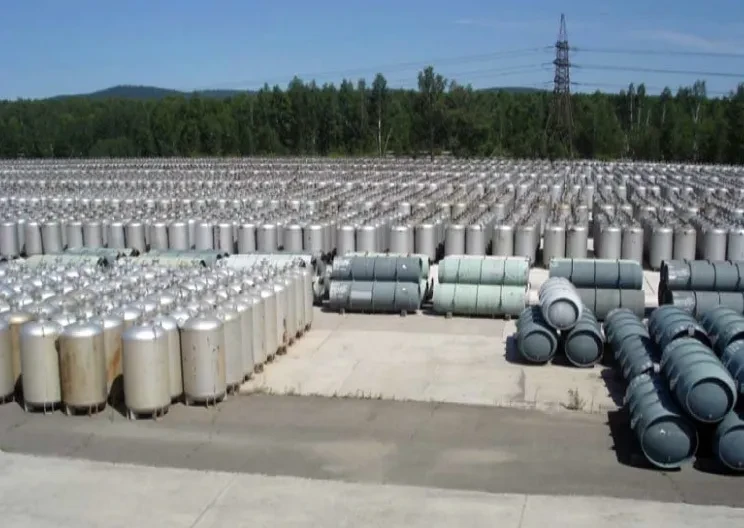
The fact that Russia accepts the depleted uranium from abroad became known at the beginning of the zero, when the contracts of the 90s came up, concluded by the Ministry of the Russian Federation for Atomic Energy (Minat) with corporations for the enrichment of Uranus-the British Urenco and its Dutch and German branches. In 2006–2009 In the wave of a mass international protest campaign, these deliveries were discontinued.
Again, they remembered the problem this fall. Responding to the needs of the Bundestag deputies, which German eco -defenders addressed, Urenco recognized the existence of a new contract for the supply of 12 tons of implements uranium to Russia for processing . The final destination in the document was the Novouralsk of the Sverdlovsk Region. The party from which Mikhail Dudin sailed to Petersburg is far from the first: a significant part of the OGFU under this agreement has already been transported.
OGFU is not more dangerous than natural uranium. But it depends on how to store
According to the experts of the IAEA, the impoverished uranium hexaftoride is not a radioactive waste. The same says Russian legislation.
OGFU is even less radioactive than uranium ore, but this does not mean that he is not phonit: the expert Greenpeace of Russia Rashid Alimov managed to measure the radiation background of those very wagons following in Amsterdam: it exceeds natural radiation by about six times.
In addition, according to ecologists, the transportation of substance through densely populated cities, and then through all of Russia, will make unjustified risks: if the OGFU enters the environment, this will lead to its long -term pollution.
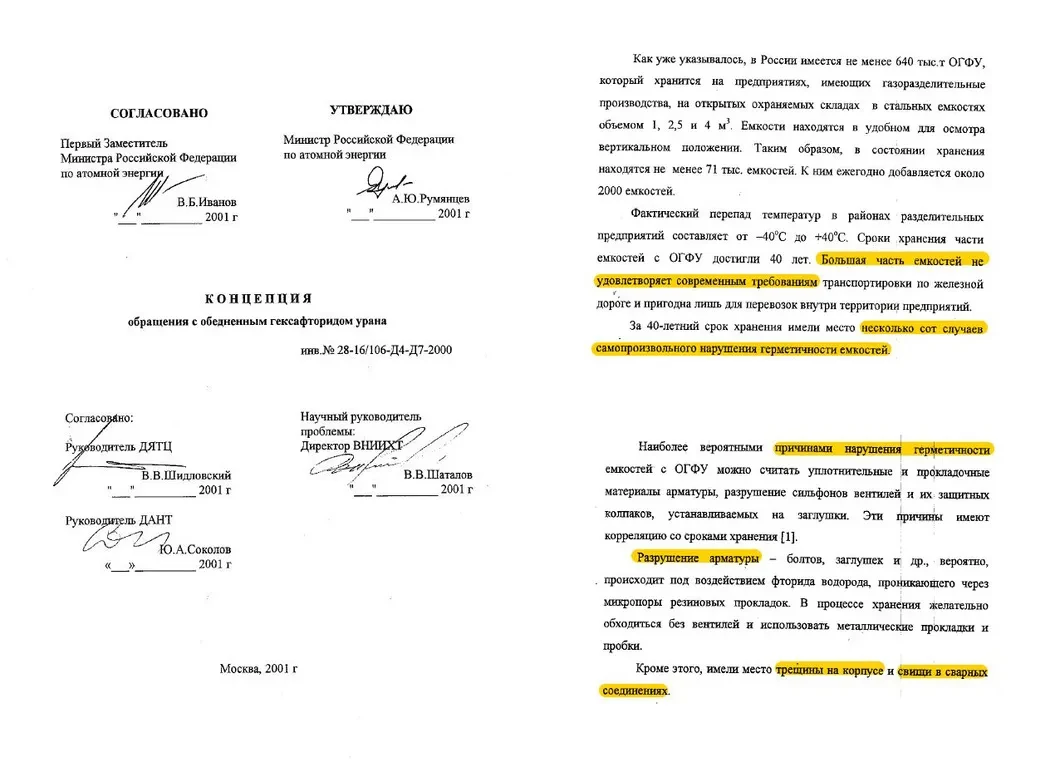
Problems may also arise in places of storage of uranium “tails”. According to global practice, OGFU is contained in steel cylinders at open -air training grounds. At the same time, the container should be changed and updated periodically - and there are also questions to this in Russia. So, in the documents of the Minatoma for 2001 (there is at the disposal of “new”) it is said about hundreds of cases of depressurization of such containers.
Rosatom promises to devastate the reserves of the OGFU by 2080. Ecologists do not believe in it
According to the current FZ-89 “On Production and Consumption Waste”, the import of nuclear waste into Russia is prohibited for their burial or neutralization. Until the last moment, the Rosatom company did not report anything about the deal with Urenco. After the information leaked from the German side, the state corporation recognized the existence of a contract for the enrichment of Uranus . At the same time, to disclose the content of the documents for which the import of the OGFU was refused in Rosatom. The financial side of the issue remains a secret.
But against the backdrop of international resonance by Rosatom, he announced the launch of the program to handle the OGFU, in which the uranium “tails” are called raw materials for the atomic energy of the future, a source of hydrogen fluoride and fluorine. One of the goals of the program is the complete elimination of OGFU reserves at all Russian training grounds by 2080. “Our activity can be designated by the signcling sign,” said and. O. CEO of TechsnabExport ("Daughter" by Rosatom) Yuri Ulyanin.
Indeed, if you re-load uranium “tails” into centrifuges, they can be brought to the state of the product again (a small amount of the U-235 isotope in the impaired uranium still remains).
The substance also has military significance: when using ultra -suffering reactors, plutonium used in the production of nuclear weapons can be obtained from it.
“The position of Rosatom looks strong enough,” agrees Andrei Ozharovsky, a physicist, expert of the Radioactive Waste Service Program of the Russian Social and Ecological Union. - In theory, there really is such an opportunity [secondary processing of OGFU], but in relation to Russia I do not believe in it. Back in 2008 [at that time, Rosatom CEO Sergey] Kiriyenko promised to build 26 new reactors. Now they say that by 2080 we will have hundreds of new fast reactors who will devour all this impoverished uranium. All these projects are not implemented, and this means that there was no need for the U-238, no, and will not. At least that million tons that is already in Russia now, it will never be spent. ”
The expert notes that after the accident at the Japanese Fukushima NPP, the demand for atomic energy in the world is steadily declining. And the desire to get rid of by -products of atomic production is growing.
Germany refuses atomic energy. But the waste inhibits the process
At the beginning of the zero, the German government approved the plan of the phased stop of nuclear power plants - it is expected that the last nuclear reactor in this country will stop working in 2022. One of the main problems standing on this path is what to do with atomic production waste. Thus, the profile parliamentary commission published a document from which it follows: the process of burial of nuclear waste into a non -constructed bunker, for which a place has not yet been found in Germany, can take from 30 to 80 years.
The national program of Germany includes uranium “tails” to radioactive waste, which are prohibited from the country, unless they find use . In this regard, eco -defenders suspect, Urenco and agreed on the import of OGFU into Russia - in order not to be responsible for storing a dangerous substance on its territory.
German eco -activists call this contract “immoral”. “The Atomic enterprise of the Federal Republic of Germany should dispose of its waste in Germany,” the Aktionsbündnis Münsterland Gegen Atomanlagen mattias Aikhoff quotes the DW of the DW. - They take them to Russia and are simply not interested in what will happen next to them. This is irresponsible. "
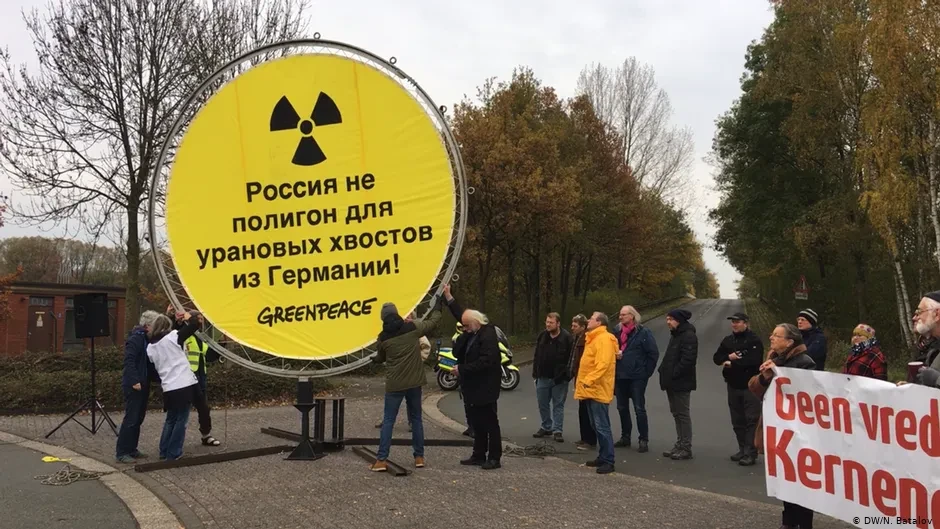
On the evening of November 25, the action against the import of nuclear waste into Russia was held at the German Consulate General in St. Petersburg. The deputy of the city Legislative Assembly Boris Vishnevsky and co-chairman of the Russian Consumer Union Anatoly Golov sent to Governor of St. Petersburg Alexander Beglov and the general director of Rosatom Alexei Likhachev, demanding to transfer hazardous substances from the city feature to the regional port of Ust-Luga.
The city parliament has already achieved the ban on the import of OGFU into the port of St. Petersburg in 2009 - on the wave of the first public indignation with this problem. In the current composition of Zaks, this issue has not yet been raised and has not been discussed, ”Mikhail Amosov, member of the Permanent Ecology Commission in the St. Petersburg Parliament, explained to the“ new ”member of the Permanent Commission. The deputy promises to pose the OGFU problem at a meeting of the commission on Thursday, November 28. “Of course, everyone will say that it is safe,” Amosov commented on the “new”. - But there are psychological moments inherent in an ordinary person who is afraid of radiation as such. Moreover, as we know, our different fears for some reason sometimes turn out to be true. ”