
Translated material
The series "Liquidation"
The murder of political emigrant Zelimkhan Khangoshvili in the center of Berlin did not go according to plan: the killer came across, Germany was forced to react at the diplomatic level. The cyclist Vadim Krasikov is a successor of a long tradition, which was interrupted only in the Yeltsin years. Against dissidents, political emigrants, defectors, Soviet and Putin agents in Europe more than once used bullets, bombs and poisons. Here are just some episodes.
On May 25, 1926, the head of the Directory and the main chieftain of the Ukrainian People’s Republic Simon Petliura was killed in Paris. The killer Samuel Schwarzburd took revenge on him for Jewish pogroms, committed in Ukraine by the unit of Petliura by the troops. The lawyers of the Petlyura family claimed that Schwarzburd was associated with the OGPU. However, the court did not take into account the performance of the witness Elia Dobkovsky, who gave written testimonies about the participation in the case of the agent of the OGPU Mikhail Volodin, as well as the evidence that Petlyura, as he could, tried to suppress Jewish pogroms. In 1927, the jury court was fully justified.
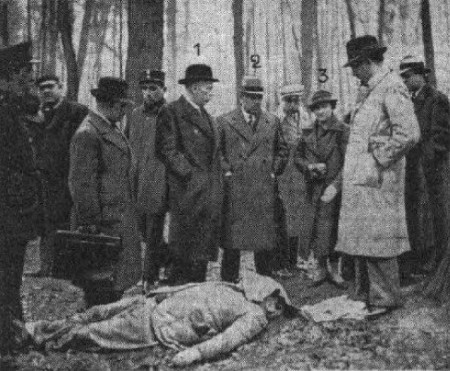
The murder of Navashin. Photo: gallica.bnf.fr
On January 25, 1937, the banker Dmitry Navashin , the former director of the Parisian Banque Commerciale Pour L'Europe du Nord, and the former secret employee of the OGPU, was killed in the Bolesky Forest. In 1930, he left the bank. The OGPU suspected him that he disposed of the foreign funds of the Trotskyists. The murder of Navashin was suspected of OGPU, but the killers were never found. There were rumors that he was going to make the exposure of Moscow political processes.
In August 1937, Georgy Agabekov , a former resident of the Foreign Department of the OGPU in Constantinople, was killed in France. In 1930, he fled to France and published memoirs exposing the activities of Soviet intelligence and repression in the USSR. Agabekov’s body was not found. According to Lieutenant General of the State Security of Pavel Sudoplatov, a group of the NKVD, who eliminated Agabekov, was led by Alexander Korotkov, who worked under the mask of the representative of the People's Commissariat of Medical Sciences under the USSR trade in Germany. He also led the illegal group operating in France, which was entrusted with the liquidation of "traitors". Agabekov’s direct killers have not been installed so far.
On September 4, 1937, Ignatius Reiss (Nathan Poretsky), a former resident of a foreign department of the NKVD in Paris, was killed near Lausanne in Switzerland. In 1937, he was recalled in the USSR, but, knowing about the campaign of political repressions, he refused to return, and on July 17, 1937 he performed in French newspapers with an open letter that denounced Stalin's policy. Reiss also warned Leo Trotsky about the impending attempt, and he moved to Switzerland. Reiss was killed by a group of NKVD agents under the leadership of Sergei Spiegelglass. The direct killers were Boris Afanasyev (Atanasov) and Vladimir Pravdin (Rollan Abbia). None of them were caught and convicted of killing Reiss.
On May 23, 1938, in Rotterdam, as a result of the bomb explosion, the leader of the organization of Ukrainian nationalists Evgen Konovalev was killed. The bomb, disguised as a box with sweets, was handed over to the NKVD agent Pavel Sudoplatov, who pretended to be a member of the OUN from the territory of Soviet Ukraine. Sudoplatov was not caught and convicted.
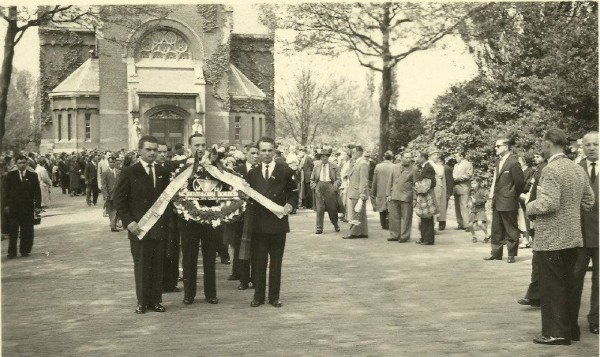
The funeral of Stepan Bandera
On October 12, 1956, one of the leaders of the organization of Ukrainian nationalists was killed in Munich, the head of the foreign OUN Leva Kep . The killer was the KGB agent Bogdan Stashinsky, who shot an ampoule with cyanide potassium in Rebet. In the same way, on October 15, 1959, the head of the organization of Ukrainian nationalists Stepan Bandera was killed in Munich Stashinsky. For both killings, Stashinsky was awarded the Order of the Red Banner. On August 12, 1961, he fled to West Berlin and admitted to the murder of Rebet and Bandera, describing in detail the circumstances of both attempts. Stashinsky was sentenced by the West German court to 8 years in prison, of which he served 4. Alive so far, is under the program for protecting witnesses.
In 1957, at the conference of the People’s Labor Union in Munich, the former state security captain Nikolai Khokhlov was poisoned by the radioactive connection of Tallia. He was one of the organizers of the murder of the General Commissioner of Belarus Wilhelm Cuba in 1943. At the beginning of 1954, Khokhlov was sent to Frankfurt, Main for the murder of NTS leader George Okolovich, but, disappointed in Soviet reality, told Okolovich about his mission and offered his NTS services. He was arrested by the Americans, but then he was released and settled in the United States, where he was published in emigrant publications and collaborated with the CIA. After an assassination attempt in Munich, he survived, as he was in a hurry to a meeting of the conference and did not have time to drink the entire cup of coffee in which the poison was dissolved. But almost a year Khokhlov had to spend in the hospital. The Americans had no doubt about the involvement in the attempt on Khokhlov KGB agents, but the attempts were never found.
On February 13, 2004, the former president of the Republic of Ichkeria Zelimkhan Yandarbiev was killed in the capital of Katar Doha. His car was blown up by a radio -controlled mine attached to the bottom. The 13-year-old son of Yandarbiev Daud was seriously wounded, and two guards died. Two employees of the Russian embassy, known as Anatoly Vladimirovich Belashkov and Vasily Anatolyevich Bogachev, who were the organizers of the assassination, were GRU employees and did not have diplomatic status. The third organizer of the attempt, the first secretary of the Russian Embassy in Doha Alexander Fetisov, had diplomatic status. All of them were arrested a few days after the assassination, February 26, with the assistance of the special services of Saudi Arabia and the USA. Fetisov was soon released, and Belashkov and Bogachev were sentenced to life imprisonment in June 2004. On the day of their arrest, the Russian authorities arrested in Moscow two Qatari athletes as hostages. They were released on March 23 after a telephone conversation between Vladimir Putin with Emir Katar. In December 2004, Belashkov and Bogachev were returned to Russia for further departure of punishment and released. The then Minister of Defense Sergei Ivanov met them as heroes, with a carpet at the ramp. According to some reports, for the murder of Yandarbiev, Russia paid Katar a large monetary compensation.
On November 1, 2006, the former FSB Colonel Alexander Litvinenko , close to businessman Boris Berezovsky, was poisoned in London with a rare radioactive isotope of Poloniy-210. He died three weeks later. His alleged killers, former KGB officers Andrei Lugovoi and Dmitry Kovtun, are hiding from British justice in Russia. The nature of the used poison indicates involvement in the poisoning of Litvinenko of the Russian state.
The Russian businessman Alexander Perepilichny , who emigrated to England and collaborated with Bill Bill Bill, the founder of the Hermitage Capital Management Foundation, was found by a dead evening on November 10, 2012 at his mansion on the outskirts of the town of Waibridge (Surrei County). In January 2016, at the preliminary hearings in the case of the death of a peeping case, it was announced that the examination organized by the insurance company of the deceased found traces of an extract of a rare Chinese plant of helmets, whose poison causes spinal cord paralysis and death from suffocation. Death from Helzemia is outwardly indistinguishable from death from heart attack. Presumably peasant was poisoned in Paris, from where he returned on the morning of November 10. He handed over to the Swiss prosecutor's office evidence that officials from the Russian Ministry of Internal Affairs appropriated three subsidiaries of Hermitage Capital with the help of false documents and carried out illegal tax refund. According to unconfirmed information, American intelligence officers informed Mi6 that the sawdown was probably "was killed on the direct order of Putin himself or people close to him." Until now, the cause of the death of a peasant is considered unidentified, there are no suspects in his case.
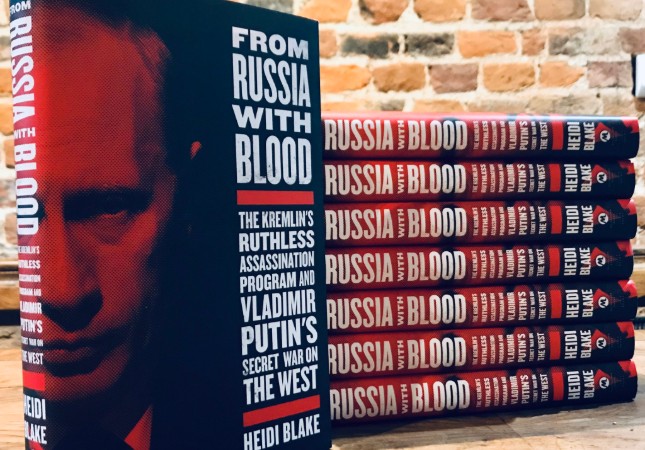
Hidie Blake Book Cover "From Russia with Blood" about the murders of Putin's enemies abroad
On March 23, 2013, businessman Boris Berezovsky was found dead in the bathroom of his villa in Ascot, the county of Berkshire, 40 km from London. Initially, the British police adhered to the version of suicide, but in the future experts disagreed. Two of them found the death of Berezovsky suicide, and the third - murder, disguised as suicide. After Berezovsky’s partner, Aeroflot, Nikolai Glushkov was killed (strangled by a dog leash) on March 12, 2018 in his house in the New Malden, London area, most experts began to include that Berezovsky’s death was also forced. The alleged killers of Berezovsky and Glushkov have not yet been established, but their connection with the Russian special services is considered more likely.
On April 28, 2015, in Sofia, the Novice class substance was poisoned by the Bulgarian businessman Emilian Goebrev , associated with the supply of weapons to Ukraine and opposition forces in Syria. However, he survived, like his son and secretary poisoned with him. Eight officers of the Russian GRU, headed by Major General Sergei Fedotov (real name and surname - Denis Sergeyev) are suspected of poisoning. None of them were held accountable.
On March 4, 2018, the former GRU Colonel Sergei Skripal , previously convicted in Russia for espionage in favor of Britain, and his daughter Julia were poisoned in the British town of Salisbury, but survived. The poisoners - Colonel of the GRU and Hero of Russia Anatoly Chepig (Ruslan Boshirova) and Alexander Mishkin (Alexander Petrov) - were unlikely to be alive after returning to his homeland. The immediate supervisor of the operation was the already mentioned Sergey Fedotov. According to one version, in April 2018, he fled to England from Italy and informed the British intelligence services for the genuine names of participants in the attempts on Goebrev and Skripals.