
Translated material
Kommersant: the chances of Ukraine to return the Donbass are minimal, and relations with the Russian Federation will be built according to the "Georgian" model
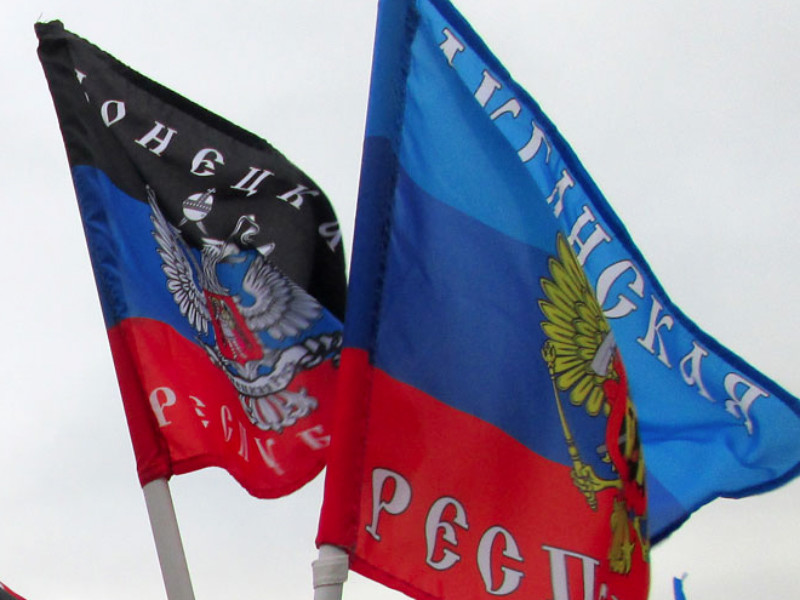
At a meeting of the National Security and Defense Council (National Security and Defense Council) of Ukraine on December 7, one of the scenarios of the reintegration of Donbass was adopted, which will be implemented as the main one. It consists in diplomatic settlement, said Prime Minister of Ukraine Alexei Goncharuk.
"The plan is to resolve this conflict with a diplomatic way to move towards the world, at the same time, of course, defending national interests. There can be no fundamental to any surrender of national interests in the sense of abandoning territorial integrity, Crimea and Donbass are the territory of Ukraine, and Ukrainians live there. And we will fight for them, for their returning home," - said their returning home. Goncharuk on the air of the program "TSN. Tizhen" on the "1+1" television channel.
He added that the peace process cannot be fast, and it is necessary to move towards it “step by step”, so the upcoming meeting in the framework of the “Norman” summit is “this is the victory of the President of Zelensky”.
At the same time, Kommersant notes that there should be no breakthrough decisions within the framework of the summit. The Ukrainian authorities understand that the fulfillment of the Minsk agreements by them will turn Donbass into an alternative, not controlled by Kyiv Center for influence on foreign and domestic politics, and intend to reconcile on this occasion. Russia is satisfied with either the full implementation of agreements or the preservation of the status quo, the article says.
As the newspaper recalls, Moscow and Kyiv have been working on the creation of a positive background for negotiations for the past six months. The presidents of Russia and Ukraine have repeatedly called up, their assistants Vladislav Surkov and Andrei Ermak met, agreed and recorded on paper the “Steinmeier Formula” , which involves the entry into force of the law on the special status of Donbass after the election there, if the OSCE recognizes them free and honest. The dilution of forces and means of conflicting parties in the village of Lugansk, Petrovsky and gold was also ensured, and in September, Russia and Ukraine exchanged convicted and held persons.
- Inopressa: The positions of Russia and Ukraine remain incompatible
In addition, the Russian Federation returned to Kiev boats and tugboats detained in the Kerch Strait: Vladimir Zelensky, the return of sailors and ships, recorded at his own expense, like the summit itself. According to him, it was Ukraine who "squeezed" the rest on the issue of unlocking negotiations on the Donbass. The main promise of Zelensky was and remains the establishment of peace in the east of the country and the restoration of its territorial integrity. The President of Ukraine said that he wanted to "bring from the Norman meeting an understanding and the feeling that everyone really wants to gradually end this tragic war."
At the mentioned closed meeting of the National Security and Defense Council on December 7, negotiation priorities for the future were indicated: the exchange of prisoners between Kiev and unrecognized republics on the principle of “all for all”, restoration of control over the border section with the Russian Federation, where it has not been since 2014, the ceasefire along the entire line of contact. At the same time, Kyiv’s control over the border should be restored before the elections in the territory of the DPR and the LPR, which, according to Ukraine, must be held on October 31, 2020 simultaneously with local elections throughout the country.
According to Kommersant, the relevant agreements were reflected in the 2014 Minsk Protocol, and in a year later later, a “set of measures to implement the Minsk agreements”, but have not yet been implemented. Meanwhile, Russia continues to insist on the implementation of the Minsk agreements primarily, according to which the restoration of full control over the state border by the Government of Ukraine in the entire conflict zone should begin on the first day after the local elections, and the elections themselves should be discussed only after the divorce of troops and the withdrawal of weapons and equipment along the entire line of contact. The revision of the Minsk agreements is unacceptable.
This position, according to Russian representatives, is also shared by European colleagues: in Paris and Berlin they have repeatedly said that there were no alternatives to the Minsk agreements. The DPR Foreign Minister Natalya Nikonorova believes that as part of a meeting in the Norman format Zelensky will “explain” the inadmissibility of adjusting the agreements approved by the UN Security Council.
In her opinion, Kyiv should extend the existing temporary law "On a special order of local self -government in certain areas of Donetsk and Lugansk regions", and then consolidate its provisions in the Constitution of Ukraine. The wording that is to be fixed in the Constitution should be agreed by the contact group in Minsk. In turn, the head of the Ukrainian Ministry of Foreign Affairs Vadim Prosiko called the consolidation of a special status in the Constitution with a "red line", for which Kyiv will not step under any circumstances.
According to the media, the special status stipulated by the Minsk agreements will turn the territory of the DPR and the LPR into a "state in the state" with alternative Kyiv by the center of influence on the adoption of key decisions, including foreign policy. Kyiv himself is not ready to go to create an enclave, not controlled by the central authority, and the exit from the Minsk agreements unilaterally will only worsen the situation. Therefore, the only probable result of activated negotiations on the Donbass can be a new exchange of holding persons.
It is noted that Moscow, in the absence of progress in the implementation of the Minsk agreements, is quite satisfied with the status quo: the prospects for Ukraine’s entry into NATO and the EU after 2014 became very foggy, and the freezing of conflicts on the model of Georgia and Transnistria remains an effective tool for inhibition of the drift of the former Soviet republics to the West. Although this threatens with a sharp deterioration in Moscow relations with these countries and sanctions by the EU and the USA, an example of Georgia shows that diplomatic problems do not interfere with cooperation in the economy and other areas.