
Translated material
Why is Zelensky's rating decrease?
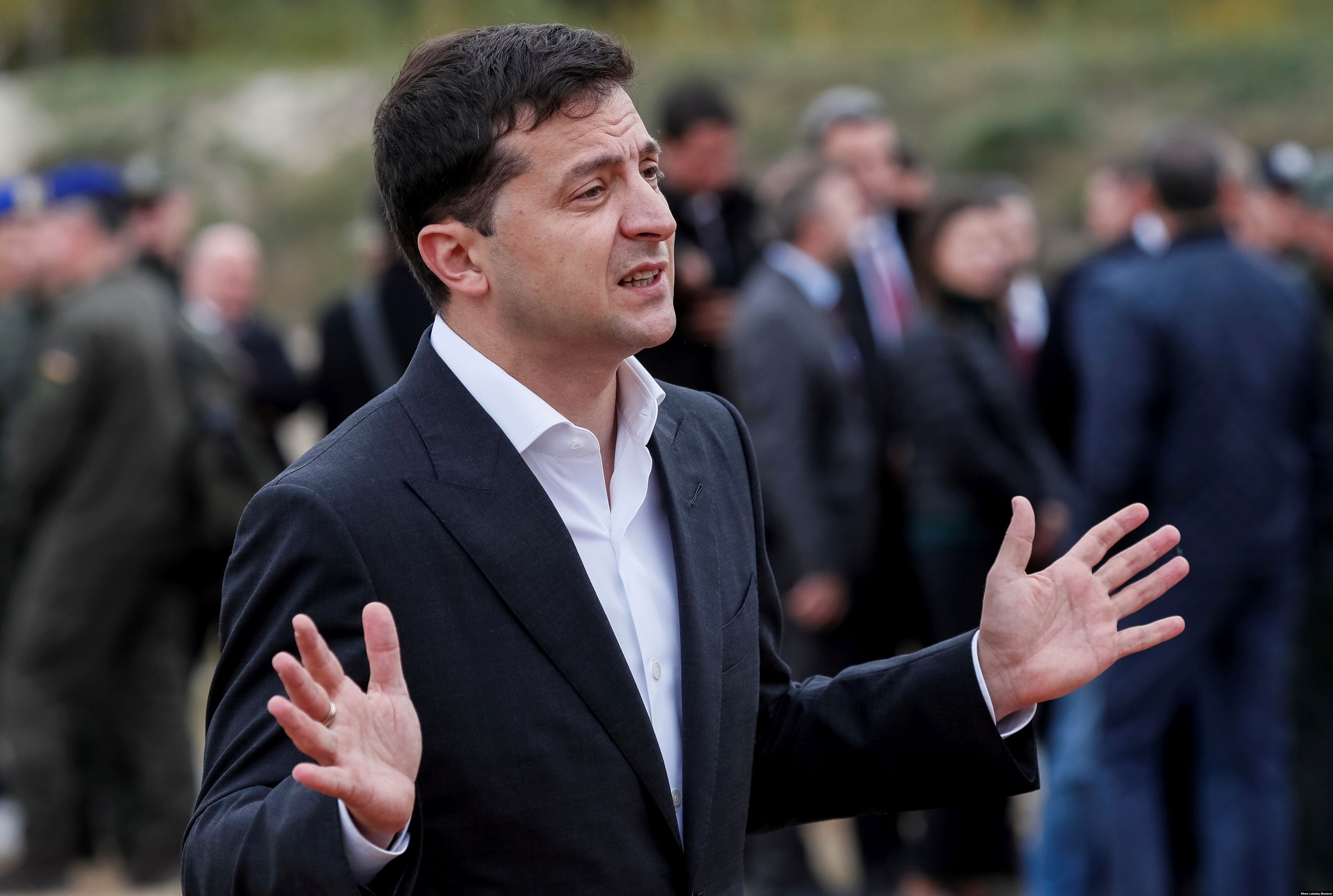
What will the team of the President of Ukraine do?
Vitaly Portnikov: What happens to the recently unprecedented rating of the new Ukrainian president Vladimir Zelensky? How does the fall of the rating of the head of state will influence the situation in Ukraine, the actions of the Ukrainian authorities, to its position on the world arena in connection with the important decisions that will be made in the late 2019-early 2020? We will talk about this today. In our studio, sociologist Evgeny Golovakh and political scientist Alexei Yakubin . At first, the plot about what is happening with sociology.
 Install the mobile application Radio Liberty
  Read freedom in telegram
  Sign up for freedom in Google News
Correspondent: the results of a recent study of the Kiev International Institute of Sociology recorded a significant drop in the rating of the President of Ukraine Vladimir Zelensky, who within a few months after taking office managed to maintain a high level of support among Ukrainians. From September to November 2019, a positive attitude towards the head of state decreased - from 73% to 52%, and negative grew - from 7% to 19%. November showed the greatest decrease in the popularity of Zelensky - immediately by 12%.
Surrounded by the president, the figures released by sociologists are not considered critical numbers, noting that the fall of the ratings of any power after the election is natural. Experts are sure: the pre-election populism has ceased to give a result, and Zelensky’s support will decrease further due to the overstated expectations of citizens and unpopular or incorrect socio-economic decisions of the authorities. The preservation of the high rating of the Ukrainian president in September was associated, first of all, with the exchange of prisoners between Kiev and Moscow. Then director Oleg Sentsov and other Ukrainian prisoners, as well as 24 military sailors captured by Russian border guards at the end of November 2018, returned to Kyiv.
For three months in the Verkhovna Rada, scandals in the presidential faction "Servant of the people" are flared up one by one. A single -party parliamentary majority is delapping. Other factors also affect the attitude of Ukrainian citizens to Zelensky. In October and November, in different cities of the country, anti -presidential actions under the slogan "There are no surrender!" Against the solution of the problems of Donbass on Russian conditions. Among the reasons for the decrease in the popularity of the head of state are also called its decision to open the market for trade in agricultural land. More than half of the citizens of the country, as prevailed by hundred -custody , negatively relate to both land reform and another proposal to the president - on the privatization of large state enterprises. During the election campaign, Zelensky promised to reduce utility tariffs and cancel the fee for them for citizens over 70 years old. Realizing that the failure to fulfill this promise is one of the reasons for the fall of the president’s ranking, a special meeting was collected in his office, at which Zelensky called on the government in December to reduce heating tariffs.
For three months already in the Verkhovna Rada, one by one, scandals in the presidential faction "Servant of the people" flare up one after another
Nevertheless, some experts predict that by March - April 2020, Zelensky’s rating may drop to 30–40%. At the same time, the occurrence of a political crisis due to mass street protests and calls for early presidential elections is not excluded. The probability of such a development of events largely depends on how Vladimir Zelensky will solve the problem of Donbass and what the real state of affairs in the economy will be.
Vitaly Portnikov: The rating is falling, but it is still very high. 52% is a programmed phenomenon for you, and it should have been?
Evgeny Golovakha: Based on my experience in studying these ratings, starting in the 90s, it has always been like this: when the president celebrated the first six months, his rating began to fall rapidly (everyone has a single presidents). Zelensky had a sky -high rating, no one had this. Now this is a more or less normal indicator, still positive for him: all the same, the majority of the population has yet approved. The share of those who do not approve so much has not grown so much - this is important. People began to look closely, hesitated, did not immediately move to those who do not approve. This is in line with the general trend. But this is an alarming signal for the president, because in the next six months, when it will be necessary to take some real steps, there will be much more serious threats for the rating than at the beginning.
Vitaliy Portnikov: I read this story: Vladimir Zelensky was asked how he would like to spend his time as president’s post, and he said: I would like to be applauded all the time for what I would do. And now, when the rating is reduced and it is clear that the applause from everyone and for everything you definitely won’t wait, how will the head of state react?
Alexey Yakubin: Indeed, 73% is an abnormal rating of the president for our country, and on a global scale. Let's look at the ratings of many world leaders: if they are around 50%, then this is considered good. Trump has 49%, and he is proud of it. Zelensky has 52%, and this is still a very high rating. A peculiar honeymoon ended, and a normal situation began.
If we talk about the reaction of Vladimir Zelensky, do not forget that he built his career on popularity to politics, popularity is his main capital, which he actively used, and it was he who led him to the presidential position. I believe that for Zelensky this is a plus and minus. Plus, in the sense that for him the rating indicators will be important not only during the elections (often our politicians only worry about their rating during the elections). And the minus is that many steps may be more slowed down. As I understand it, society expects quick decisions, and in the Zelensky team they try to watch different groups react to this. As a result, we see that decisions are made more slowly than we would like.
You need to understand the difference in ratings: there is a rating - a willingness to vote, and there is a rating - an assessment of the work of the authorities. In Zelensky, if we talk about the President’s approval rating, he is still 52–53%, that is, he is very high, much higher than the Poroshenko rating. If the elections took place now, while Zelensky does not have the main competitors of the presidential format in this regard that could challenge him. But this does not mean that they will not appear.
In general, it seems to me that some fluctuation with the rating is good for Zelensky. He can now draw conclusions that there is a certain problem with personnel (for example, according to the Cabinet of Ministers), there are certain nuances related to how society looks at the problem with the land, at some bills adopted by the Verkhovna Rada. Now you can start a certain audit and thereby adjust the further course.
Vitaly Portnikov: Mr. Golovakha, here, as for a sociologist, there is, in my opinion, an amazing political challenge. We hear that the head of the president’s office, Mr. Bogdan, says: you know how we work - we check with sociology and then make political decisions. This is a completely unexpected recognition for a politician. I well remember how in the first Soviet perestroika years, when sociology only appeared, it was treated with great fear, and Raisa Gorbachev perceived the party authorities almost as a witch, because she talked about sociological surveys. And here we suddenly see entire groups of people who came to power and want you, sociologists, they control them.
Evgeny Golovakha: This is a great misconception that those decisions that are supported by public opinion are fair. If we made political decisions, following him, then we would have a monstrous country. This is far from the first important criterion, although it must be taken into account. In particular, Angel Merkel made some of his decisions only after measurements of public opinion. What to reckon with and what not to be considered when to be considered, and when not to be considered, this is a matter of politician skill. Precisely because these are inexperienced politicians, and they have not yet developed political skills, up to instinctive internal methods of assessing the situation, they go along a simple path: yeah, so thinks public opinion, and we will make such a decision. This can be very detrimental by making decisions.
Alexey Yakubin: It is important that the authorities offer some options. And the orientation towards an average public opinion is the path to nowhere.
Evgeny Golovakha: Without a strategy, they risk not getting a normal consistent policy. Once I called it the moment: make decisions at the moment, knowing that someone is thinking there.
Vitaly Portnikov: Vladimir Putin is also very painful about his rating. The main news from Russia we receive is a decrease or increasing its rating.
Evgeny Golovakha: For Vladimir Putin, this is a kind of entertainment, the joys of the dictator: it is important for him to be loved, and he, of course, watches this. In fact, this matters because the opposition is waiting for the moment when the rating falls: then you can really activate. Therefore, you need to try to hold the rating if possible, but not to follow the public opinion.
Vitaly Portnikov: People have conflicting desires.
Alexey Yakubin: That's the point: if people have chosen politics, then they believe that they know a little more than him. Otherwise, why choose a person if he will ask you what to do? In the program of Zelensky, the first was the point of democracy. So far, we have not seen a referendum law or some consolidated ways to measure the rating or support certain initiatives. I think that now, after a fluctuation with the rating, most likely such work is activated. Judging by the statements of the same Razumkov, they began to move more actively in this direction. It is strange when in the program to paragraph number one they wrote democracy, but did not create any tools for this.
Vitaly Portnikov: What, very similar to the early Kuchma? You remember this period well.
Evgeny Golovakha: Having come to power for the first time, he was confused, he first asked everyone: “What should I do? I can build, I worked at the design bureau, I know how to do, but I don’t know. I should disappoint them about the land, supporting public opinion, it is categorically against the privatization of large enterprises.”
Alexey Yakubin: I think that the current rating is above 50% is, including because Zelensky took these steps against Donbass, and people support this.
The rating must be tried if possible to keep, but not to follow the public opinion
Evgeny Golovakha: And the Earth has greatly reduced the rating.
Alexey Yakubin: That is why we see that Zelensky is trying to distance himself from the government. Another question is, how much this is a successful step, given that we understand: in many ways it is a technical government. There is already an attempt to show that here is Zelensky, but the cabinet of ministers.
Evgeny Golovakha: I think this government is not very long, it can be used as a balance to make the rating take off or not fall.
Alexey Yakubin: And people will applaud. The same goes for the Verkhovna Rada.
Evgeny Golovakha: Our people are so tired of the post -Soviet reality that they always support repression. This is a dangerous thing.
Vitaly Portnikov: Will there be a feeling that the rating can be raised with plantings, repression, the fight against corruption, with the old political elite, that you can do not reforms and not even the world, but give people what they would really like: we have everything behind bars.
Alexey Yakubin: I think this card is present. Another thing is whether it will be actively involved. A lot will depend on the agenda around the world and decisions on the issue of tariffs. If progress occurs here, perhaps that card will be a little delayed. Indeed, the company has a request for justice. Another thing is how justice, even selective, which can be proposed, is really justice. I am a supporter that justice should be institutionalized in relation to everyone, and if it is only in the context of raising the rating, then this step can ultimately hit the power itself.
I think there is such an option in power. If you look at the rhetoric, it can be seen that the Zelensky team is already building the model, that we are good, and the system of the oligarchy, old politics is bad, they are all against us, they resist, they are connected by corruption connections. We are trying to accept anti -corruption legislation here, and they are against us ... This model is already partly present.
Vitaly Portnikov: If the rating will continue to fall, how much the confusion of power can lead to some inadequate actions, to the search for rescue circles in the form of sociology, satisfying folk requests? Maybe there is no need to privatize the Earth if people do not want?
Evgeny Golovakha: Their actions are unpredictable. They really may find themselves in a situation of a catastrophic fall in the rating and make decisions that we cannot foresee. These are inexperienced people. An experienced politician is predictable, you can build some models of his behavior. And they can make any decisions. Zelensky said: I will leave, I do not hold on ... how does he not hold on? You were chosen for this to hold on!
Alexei Yakubin: On the one hand, we see a colossal concentration of power, and on the other, some of these people did not go through some stages, immediately being in a high position. There are a lot of such people in the office of ministers. It is necessary to do something, but the person does not fully know that, although the request for some positive changes is present.
Evgeny Golovakha: I know a little people who came: basically these are grant activists, they taught what they need to do so that the country was in the right direction. But they have no experience. Many suggestions are in reality simply not implemented.
Vitaly Portnikov: Maybe we need to talk about the state of society: the same problem?
Evgeny Golovakha: These are very young people, they are contempt with science, and in vain, because no one except scientists will tell them what is possible, and most importantly, what cannot be done.
Vitaly Portnikov: Maybe this is not a relationship to science, but to professionalism. After all, if you relate to this differently, then you can ask yourself the question: what am I doing here - I'm an artist, not a politician?
Alexey Yakubin: I watched the numbers when I did a study for the European Parliament in the context of assessing changes in the authorities of the authorities in science in recent years. Take, for example, such a criterion is the amount of funds that are supposed to be spent on promising research: next year they are planned less than on this one. Take specialized ministries of education and science: when the minister does not have a scientific degree, then part of this specialized department does not fully perceive this situation. A person has not passed some stages, and this plays a role.
Vitaly Portnikov: There is still a very big problem in communication, she can also determine the politician rating. Suppose, when it suddenly begins: you know, you need to limit freedom of speech - no one explains what is meant, what institutional measures, news standards.
Alexey Yakubin: Medium, a person who worked on the TV channel for so many years, Mr. Borodyansky, says: we must create news standards.
Vitaly Portnikov: Maybe on those television channels where he worked, there were standards that, one way or another, requested a shareholder, and this model extends to the country.
Alexey Yakubin: Let's not talk about the safety of journalists, but to introduce some kind of confidence criterion for the news, create a state organization that will control journalists, give someone the status of a journalist, and not give someone.
Vitaly Portnikov: This communication, or rather, the lack of normal communication, can also affect the perception of power.
Evgeny Golovakha: They have a weak feedback. This will affect very poorly, especially with the time, when winter tariffs will be realized, and prices will not decline. Then the citizens will already begin to seriously think: what did we get?
Vitaly Portnikov: You are talking about a normal ranking, but there is another question. What is normal for you can be completely abnormal for the fellow travelers. A large number of people who came to the party "Servant of the people", to the presidential administration, to the government, believes that this is an unshakable building. And now suddenly before their eyes the rating falls, and they might think that the building is crumbling. One of the deputies from the Party of the "Servant of the People" told me: "It is clear that our competitors will not go to the next parliament. But the question is, will we go if people are already starting to think about it. Maybe let's go, but we will get 5%, and we will have 10 deputies, and not 300. What is the point of us to participate in all this?" Of course, people surrounded by the president may have such an idea.
It may be good that the rating began to fall: now the authorities must understand that there are mistakes
Alexey Yakubin: This demotivating factor, no doubt, can play a role. In my opinion, one of the main trump cards Zelensky is a rating of trust. As soon as this rating disappears, Fleur, which exists around it, disappears, and the whole system can spill. The people whom he brought to power will think where to look for others, their own niches. But on the other hand, the authorities now have a unique chance to start taking into account feedback. It may be good that the rating began to fall: now the authorities must understand that there are mistakes. Before that, there was a feeling of weightlessness: it seemed that you do, the rating was still enormous, and you can do everything. Now the decrease has begun, and there is the possibility of sobering. For power, this can be useful.
Evgeny Golovakha: Now we need to urgently gain political experience. Experience is a profit, but you need to actively work, learn technology. In this sense, Zelensky and his team are critical for six months-literally the following, during this period it is necessary to do something real so that people feel it. I would advise you to start with small things to let people feel why they went on such an experiment. It is not necessary to immediately do something grandiose, for example, to reduce tariffs ten times. No, you have to start with small things, do at least something.
Vitaly Portnikov: What?
Evgeny Golovakha: I will not give them advice. It was they who went to power, they should know what exactly.
Alexey Yakubin: I can offer that there should be social reforms. We must think not only about investors, but also about a change in social policy. There are such opportunities, even small ones, and power could use them.
Vitaly Portnikov: Is it possible to carry out social reforms, even small ones, without tearing the oligarchic umbilical cord?
Alexey Yakubin: It turns out that here you have to choose, due to whom. When President Roosevelt introduced a new course, he was called a traitor to his class. He introduced high taxes, created the state of universal prosperity, created the middle class. This is a very important question for Zelensky: does he feel like a popular president or president of this 1%, who receives most of the income?
If there is a further decrease in the government rating, whom will it see with its key competitors? If you listen to the statements of Zelensky himself, it feels like this is primarily the same Boyko or the “OPPPPLACE”. Even we see situations with searches, SBU ... But, mind you, about Poroshenko, about Tymoshenko, this is only a dive. Regarding the "vote" of such statements, there are basically not. It seems to me that this is due to the fact that the government believes: all the supporters of Poroshenko are already in the electoral ghetto and do not pose a danger to us. And regarding the “OPPPPPLIA”, it seems to me that the president has a different impression: that voters of the southeast protrudes for it and the exits of this political force to the Russian Federation are possible.
Vitaliy Portnikov: Do you think the support of the “opposition platform” and “European solidarity” as a result of the fall of the president’s rating will grow?
Evgeny Golovakha: Non -essential. We have a fall in the rating of ruling political forces does not fundamentally enhance the opposition, so the scatter and staggering begins. Remember, before all sorts of elections 6-7%, and then suddenly a leader arises at some point? Another question is that they can create a powerful traditionalist force, following which people, disappointed in modernizers (and this was clearly a program of modernization of the country), can turn back. Here, of course, Poroshenko’s slogans are useful.
Alexei Yakubin: There is a feeling that that course of Poroshenko has already missed himself, that our society has already received a vaccine from ethno -nationalism.
Vitaly Portnikov: It is difficult to call Poroshenko a course ethno -nationalism, rather state nationalism.
Alexey Yakubin: In recent years, he tried to appeal to this.
Vitaly Portnikov: When it came to the army, language, faith - this is for all citizens. He constantly spoke about this: the Ukrainian language for all citizens is the language of interethnic communication.
Alexey Yakubin: Poroshenko, it seems to me, is no longer an emphasis on a political nation.
Evgeny Golovakha: I agree: to the ethnocultural. But there would be nothing wrong with this if this had not been closely woven with traditionalism. They can just return to traditionalism.
Vitaly Portnikov: I can conclude that as a result of the fall of the president’s rating, a request for new elites, new forces may again arise, that is, we may again face the situation that we encounter every electoral cycle.