
Translated material
I import the productions, export the voices
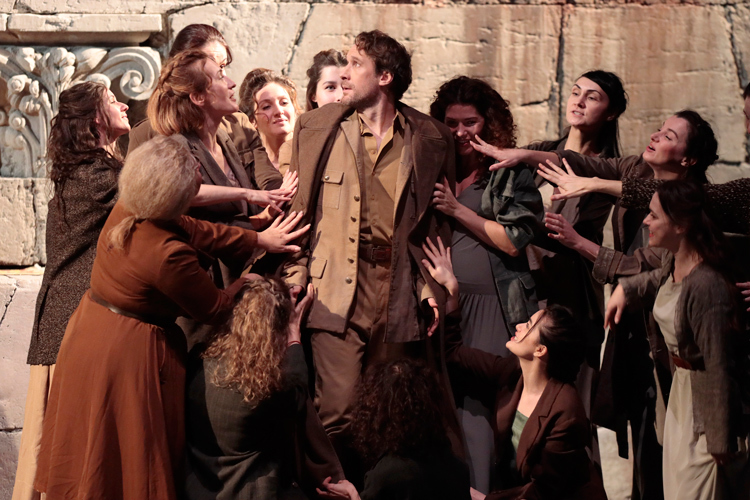
After two Gendeleev productions, the Bolshoi Theater went even further - for the first time, Handel's predecessor Henry Persella appeared in his repertoire. "Didon and Aeneas" also goes on a new scene, gradually getting used to the baroque format. The orchestra pit is raised, a long vulture of theorba sticks out elegantly, the harps of the harpsichord (albeit a little loudly called up), matt, are sung, well -known British maestro Christopher Mulds (he has already conducted a “magic flute”, “Don Juan” and “Rodelinda”) to emit comfort and reliability.
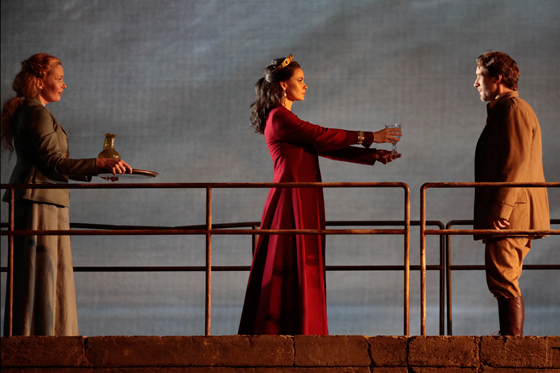
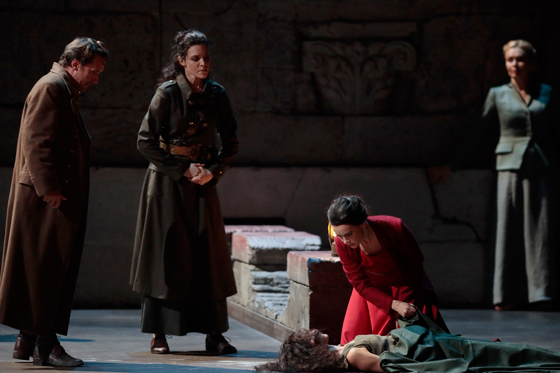
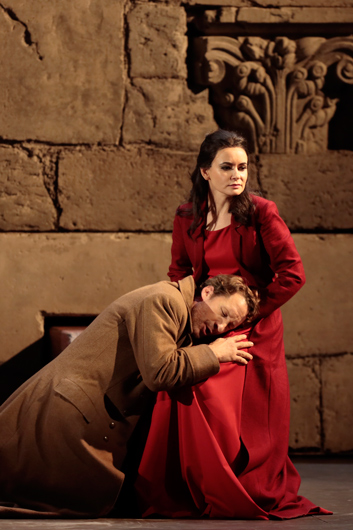
Of course, you can’t get anywhere from the fact that Theodore Krentzis set a certain Persell canon, where everything is easy, shameless, transparent and polished to a brilliance, with his performances of the Didons and Queens of the Indians. In the great drama and horror in Persella’s music, there are much more, more combustibility, all in increased tones - especially in the batch of drums and the main characters. Didon is a lonely strong woman of a complex fate in a red dress; The beautiful, saturated Mezzo-soprano of Anna Goryacheva (a graduate of the St. Petersburg Conservatory with a good European career) adds to this form of tart. She is surrounded by other, just as decisively and simply fashioned, female images: a militarized friend of Belinda (Anastasia Sorokina), a furious sorceress (Gayan Babajanyan), dangerously cheerful witches (Julia Mazurova and Alina Chertash). The weak-shaking Aeneas (British baritone Jacques Imbrailo) and other men in this female world and Persella on the side of the side of the side of the side of the Co-bell. And the performance of the director Vincent Uga and the artist Orel Maestr, in which representatives of the stronger sex are either rude or limp, emphasizes this even more.
 © Damir Yusupov / Bolshoi Theater
“Didon and Aeneas” continues the series of productions of the Bolshoi Theater, born in the right places outside and marked with the saving term “co -product” (it means joint financial investments). In this way, the big is quite successfully mastering the new repertoire territories for itself (Gandel, Britten), and at the same time high -quality modern directing (Katie Mitchell, David Olden, Richard Jones). Opera Persella is a co-product with the famous festival in ex-en-provence, where the premiere was held last summer. Important characters of the Exovsky team are the playwright Louis Zheshler and writer Meilis de Cerangal, who composed the text of a long prologue to the short operal opera. He is entrusted with the dramatic actress, who tells the story of Dido, which happened before the opera began - her, so to speak, a difficult history. About how, after the death of her husband, she fled from her native Tire with a group of male military, on the way she stole 80 girls for them in Cyprus, found a new land and founded Carthage. In the indictment in front of us is just one of the abducted girls.
 © Damir Yusupov / Bolshoi Theater
Actually, this is the main thing that the French directors want to say, adding a relevant decolonial to the current gender agenda. It is fundamentally that the prosecutor is a non -European appearance. In exse, it was a performer of African ethnic music by Rokia Traore from Mali (by the way, she performed at the Platonov festival in Voronezh). We have SESEG Khapsasov, the Moscow actress from Buryatia, very expressive, at some point, passing from the Russian-speaking text to Buryat singing with ultrasounds. At the beginning of the performance, her heroine admits that she would like to kill Didon, in the finale, it was from her that Didon accepts a bottle of poison. But, it seems, this post-colonial discourse does not work at all and does not cause any guilt of the public-that she will be 80 Cyprus girls, when some of our local history Umarali Nazarov will be fading. However, daring to Persella, the Bolshoi Theater did not mean social criticism at all.
 © Damir Yusupov / Bolshoi Theater
 It so coincided that approximately simultaneously with the "Didon" at the Bolshoi Theater, another important strategic event took place - a decade of his youth opera program. A concert of graduates and current participants in the program completely inhabited, with a full parade, was held on a historical stage, Alexander Scholkovsky stood behind the orchestra’s remote control (is it all in the know that in our vote he overtakes theodore of Cuentsis?), The festive defile of “dresses-traps” on young curvature singers was overflowing with the most amazing flowers, general director Vladimir Urin gratefully mentioned Mikhail Fichtengoltz, who was defeated by him, who stood at the origins of this story, and in the end all the participants in the concert sang a fragment from the operetta Shostakovich “Moscow, Cheremushki” to his leader Dmitry Vdovin. In the main program, the roll was very noticeable from the textbook repertoire of the Russian vocal school - for example, there are a lot of arias from French operas. But “our everything” - the Lensky aria “where, where, where did you go” - performed by Tenor Bogdan Volkov in a standard way. In addition to Volkov, the other trump cards of Vdovin also gathered, successful singers who had already scattered around the world: Bariton Andrey Zhikhovsky, Soprano Olga Kulchinskaya, Nina Minasyan and Venus Gimadieva, Metzo-Soprano Oksana Volkova. It is a pity to let them go, but what to do - the repertoire and work for their votes in the global opera market by definition more than in Moscow. But they return home with more experience.