
Translated material
Spherical trillion on the "air"
How Roscosmos competes with Ilon Mask for global satellite Internet

At the end of November, Russia began to build a plant for the production of satellites for the Sphere. This is a promising project of the global satellite communications system, the launch of which was announced in the summer of 2018 by President Vladimir Putin. According to unofficial data, the total cost of the “sphere” will be about trillion rubles. At the same time, Roscosmos has another project with a similar idea - “Ether” (direct competitor to Starlink Ilona Mask and British Oneweb), the cost of which is estimated at 500 billion rubles. The implementation of at least one of them should begin in the coming years. However, by December it became clear that the projects had no investors, the funds in the budget were not laid on them either. Against this background, the leadership of Roscosmos is brewing the largest conflict in recent years. The correspondent of Novaya and the New Air and the Spheres were versed in the history of the Ether and found out if the projects have a future.
Hundreds of satellites in half a century
Journalists often confidently call the project “broadcast” part of the “sphere” project (which is definitely not so, in any case, for now) or they are confused at all. This is not surprising: the representatives of Roscosmos themselves have repeatedly misled by those around them with conflicting statements.
The main confusion arose more than a year ago. Among the professional community, the story is widely discussed that the President of Russia on June 7, 2018
During the “Direct Line”, Vladimir Putin was going to pronnes the project “Ether”, but something went wrong, and the head of state called it the “sphere”, simultaneously increasing the promised number of satellites by more than doubled.
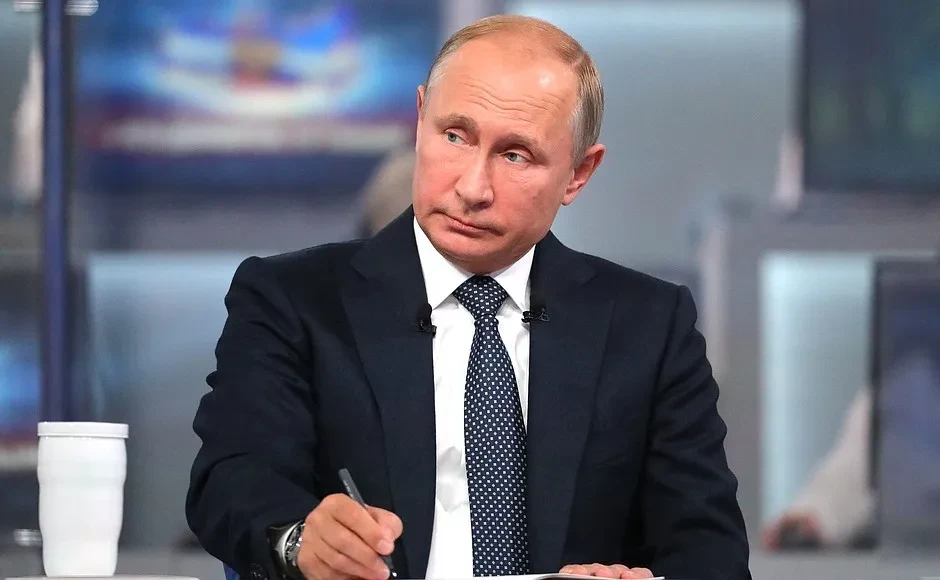
Of course, it was not possible to find any confirmation of this data, moreover, there are a number of contradictions that allow you to trace the history of both projects and clearly distinguish between them even ideologically. However, on the same day, the post of executive director of Roscosmos on the development of business and commercialization, Anton Zhiganov, told RIA Novosti that the project presented by the President of the Global satellite system “Sphere” is a finalized version of the previously announced broadcasting system “Ether”.
“The fundamental difference between projects“ Sphere ”and“ Air ”is that the first is the unification of several subsystems in one system, and the second is just a separate monoproject. It is the “broadcast” that can be freely called a competitor, for example, Oneweb, and not only him, ”say the interlocutors of“ New ”.
“Sphere” is a satellite system, which contains high-elliptical satellites for the “Express-RV” broadband access, low-speed satellites of low-speed data transmission for the Internet “Raid”, Luch's geostationary satellites with the function of inter-spine-sized relay, and the average orbital satellites of the SKIF, in addition Earth sounding (DZP), a global data transfer system "Marathon Iot/M2M", as well as the GLONASS navigation system. It is planned to launch all 640 components of the satellite system from 2022 to 2028. “That is, the“ sphere ”is a large program where there are five areas of communication, three types of DZZ and navigation. The main idea of the project is that in the “sphere” each of the systems can be a separate system and work properly, regardless of others, and the task of the “sphere” itself is to mutually mutually, and that's it, ”summarizes the source of Novaya Gazeta, familiar with both projects and participated in the development of one of them, but wished to remain unknown.
As for the project "broadcast", it should be represented by about 300 satellites in one orbit and with identical functionality. “That is, it is only telecommunications serial satellites for broadband Internet,” says the interlocutor of Novaya Gazeta, noting that the broadcast can be compared not only with the already well-known British OneWeb, as well as the SpaceX Starlink, Ilon Mask, but also with the Express RV system that is already potentially included in the sphere.
As the sources resemble, the implementation of the “ether”, which was announced even earlier (“broadcast” is differently - the global multifunctional infocommunication satellite system; for the first time, the plans to create a masses in the fall of 2017) should have occurred as part of the national program “Digital Economy”, subject to the search for co -financing. The “daughter” of Roscosmos - “Russian space systems” (RKS), the author of the project, tried to offer the participation of Rostelecom, Vnesheconombank and other players. “But this idea was not impressed. Actually, there was simply no funding, and they were crossed out, ”says a senior source familiar with the course of discussing the project. “With the advent of Tyulin ( this refers to the head of the RKS Andrei Tyulin, it has been led by the company since August 2014.-A. D. ), attempts began to make an“ broadcast ”at least in some form, but in all these years there were not a single potential co-investor, obviously, something with this project is not in order,” the source of Novaya Gazeta says.
“Let us mean: does the RKS have the opportunity to prepare several hundred satellites? For how much? About 50 years old? " He summarizes sharply.
Several interlocutors of Novaya also emphasize that the Sphere project raises no less questions in them, and not only in connection with its huge cost. “Why drain several systems together if they either function normally separately, or will not work either inside a large system or independently?” - says the source. As not very successful examples, he gives the Scythian and Marathon projects: attempts to implement the first have been undertaken for about six years, and the idea to make the second is about ten. “There are no forests for investing, so everyone went after the budget,” says the interlocutor of Novaya Gazeta. As arguments against the “Sphere” project, sources also note the disagreement from the Ministry of Defense of the Russian Federation: “It is quite difficult to convince them that they do not have something in the“ sphere ”. However, in September 2019, the project was nevertheless approved by the collegium of the military -industrial complex.
Space piles
In the fall, Gazprom Space Systems began the construction of a multifunctional satellite satellite system of the Sphere in Moscow Region Schelkovo Production of Schelkovo. On November 25, the first pile of the production building was attended by the deputy chairman of Gazprom Vitaly Markelov, the deputy chairman of the Moscow Region Government Vadim Khromov and the first deputy leader of Roskosmos Yuri Urlichich. “The commissioning is planned for the third quarter of 2022,” Dmitry Sevastyanov, general director of Gazprom Space Systems, also attended at the event.
The total area of the building of the assembly and testing center should exceed 17 thousand square meters. It is stated that the Italian Codest and Italo-French Thales Alenia Space are engaged in the creation of the turnkey plant. According to the plan, the plant will be able to produce up to four large spacecraft and up to hundreds of small satellites annually. The agreement on cooperation in the assembly of the Gazprom Space Systems and Roskosmos spacecraft was signed a year before, the construction plans themselves were first announced in the press back in 2012. The plant was then planned to be built by 2017, but then the deadlines were postponed for three years. “This is not just assembly production, when we collect something with a screwdriver from imported components. This will be a high -tech production that will include assembly and testing, and, of course, we hope for the production of configuration in Russia, ”said Urlychich at the opening ceremony.
The start of construction has not been the only event in recent months directly related to the Sphere project. So, for example, on November 12, the next day of the Congress “Modernization of Industry of Russia” was held in the Moscow “President-Helpers”, within the framework of which a meeting of the session “Space Technologies for the new industrial revolution” was held. Among the others, Yuri Urlichich also appeared on it, presenting the gathered presentation (is at the disposal of Novaya Gazeta). It said that the astronautics has now reached the level of New Space, or Space 4.0, namely, “Cosmos for people”. A significant part of the presentation was occupied by the project "Sphere".
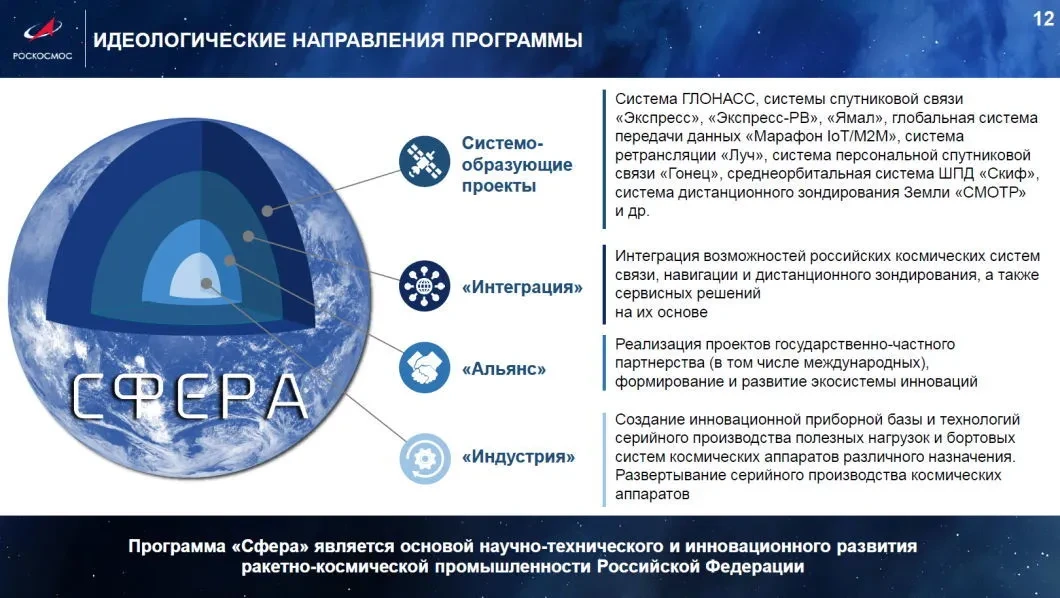
The slides indicated that the strategic goal of the program is “the creation of an interconnected space information infrastructure, taking into account the modernization of existing and the creation of new satellite communication and broadcasting systems, the remote sensing of the Earth (SPZ) and navigation, in the interests of all sectors of the Russian economy in their digital transformation.” GLONASSS SISTEM, SPETENCY Systems Express, Express-RV, Yamal, Global Database Transmission System "Marathon Iot/M2M", Ruch RETOLSITION SYSTEMS, SKIF SKIF Medium Orbital SPD system, SLOW Remote Institution and Others were called "system-forming systems-forming projects "for" sphere ". Speech about the "ether" in the materials in any form was not.
“The implementation of the Sphere program involves the expansion of the possibility of attracting Russian companies, including private, to the space industry for the purpose of digital transformation. This will give an animated effect in the development of new technologies and the economy of the Russian Federation, ”the presentation said. When the discussion was discussed about the methods of financing the project, Urlichich repeated that it would be possible to implement it at the expense of the funds from the budget and certain private investors, but could not name them.
In the September interview with Vedomosti newspaper, Deputy Prime Minister Yuri Borisov, who oversees the military-industrial complex, said that he still had not seen the final version of the Sphere project and the program, emphasizing that Roscosmos is working on it. “But I can reveal the secret: in the draft budget for 2020–2022, we laid a line on this project. “Roscosmos”, of course, will still have to protect the appearance, financing, and the justification of the “sphere,” he said, revealing that more than 10 billion rubles were laid on the project. “But you do not forget that there is still a very serious extra-budgetary financing,” the Deputy Prime Minister added. It can be assumed that Borisov said about the allocation of almost 15 billion rubles to create the first five Express-RV satellites, which became known on September 26 from the federal budget published by the Ministry of Finance for 2020 and the planning period 2021–2022.
On December 3, Vladimir Putin signed the law on the state budget for 2020, as well as for the planning period from 2021 to 2022. The document was published on the portal of legal information, and in its open part the project “Sphere” in any form, except for the already designated first satellites “Express-RV”, is absent. Meanwhile, according to the assurances of the sources of "Novaya Gazeta"
In the circuit "Roscosmos", the total cost of the project can amount to about trillion rubles.
Satellite wars
The fact that Roskosmos decided to exclude the project “Ether” from the passport of the Federal Information Infrastructure of the National Program “Digital Economy”, the Kommersant newspaper reported on September 30, 2019. According to the sources of the publication, a representative of the state corporation made such a proposal on September 20 at a meeting of the working group of the national program. “The business had no objection, and according to the results of the discussion, it was decided to support the proposal of Roscosmos,” the interlocutors of the publication said.
The New Gazeta found a letter to the director of the Department of Navigation Space Systems (GLONASS) Oleg Kem in the name of the director of Strategic Planning to Rostelecom Alesi Mamchur, which proposed to exclude the project of the GMISS (Air) from the National Program "Digital Economy" due to the absence of "financing sources" and the "project concepts".
Meanwhile, as Novaya Gazeta told several sources in Roscosmos, in October a meeting of the thematic committee on the orbital grouping and promising projects at the investment committee of the state corporation. One of the issues of the agenda was the consideration of materials on the project "Ether". Supporters of the project asked to link it with the “sphere” and finance only from the investment funds involved. “In the plan - to create a legal entity“ broadcast ”, find external funding for 476.3 billion rubles and provide the first launch of 80 spacecraft in the group for 2024 and another 560 devices after 2024 until 2026. The business plan involves the exit of the project for crazy after 7 years, ”said Dmitry Rogozin, an explanatory certificate for the proposal for the head of Roscosmos.
According to the supporters of the Ether project, they at the moment received letters about potential support and investing by VTB, Russian Railways, Rosatom, Rosatom, VEB state corporations (we note that for previous years, none of them have publicly confirmed its readiness) and other structures and personalities, for example, from the Deputy Minister of Finance Andrei Ivanov, “noting a large The animated effect of the Air project for the national economy. In fact, the authors of the letter to Rogozin argue that the “broadcast” “is a over -hand leading project that can largely save state payments for the implementation of the“ sphere ”and reduces its cost”: it indicates that the “broadcast” duplicates the “marathon”, but, unlike it, can be implemented at the expense of extra -budgetary sources.
Supporters of the project were extremely indignant that after the letter of Kem Roscosmos, he removed the "most worked out by his project of a multi -party grouping, which was tried to promote the head of the RKS, who tried to remove from office on the same dates."
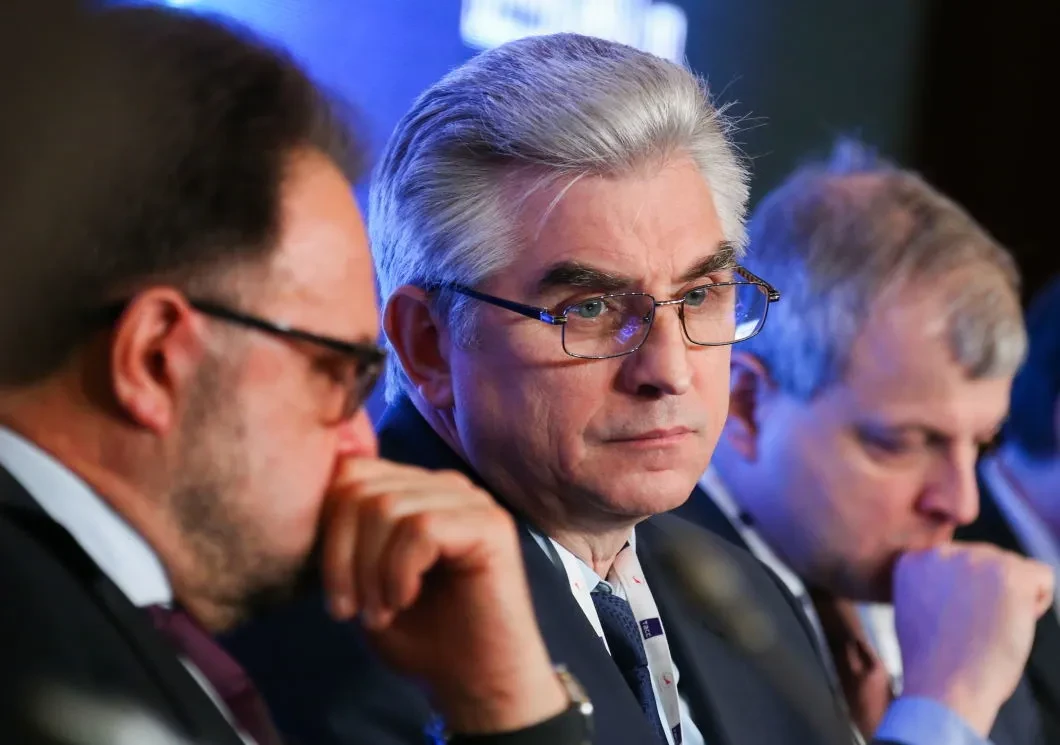
Indeed, on August 26, Moscow Komsomolets, citing the press service of Roscosmos, published a message that the RCC general director Andrei Tyulin was resigned. However, after two and a half hours, information appeared on the signing of a new contract with Tyulin. As Izvestia then reported, the notice by Andrei Tulin (presenting the project “Ether”) that they would not extend the contract with him, it really was - it was personally signed by Yuri Uralchich (smoking the “sphere”). According to the interlocutors of Novaya Gazeta, the current first deputy leader of the Roscosmos state corporation is still extremely interested in the dismissal of Tyulin. Moreover,
The top managers have not even give hands to each other recently and do not communicate at joint meetings that concern their projects.
According to Novaya Gazeta, at the beginning of December 2019, there is no final decision to include the “broadcast” in the sphere circuit in any form. One of the priority versions is the idea of the so -called “functional participation”: each system included in the “sphere” performs the task set before it, being part of the “sphere” only indirectly. This will quite allow the president to report the start of the project that the head of the Roskosmos state corporation Dmitry Rogozin will have to do in the first or second quarter of 2020. As for the “broadcast”, according to most interlocutors interviewed by the “New Gazeta”, it is extremely unlikely to include it in the Sphere project.
According to Novaya Gazeta, Urlichich personally could stop the press service attempts to provide a comment on the publication on the topic of competition of projects “Sphere” and “ether”, as well as their future. One way or another, but I did not receive an answer from Roscosmos to the request of the New Gazeta.
"Prophanation and adventure"
To evaluate how expensive the necessary financing of its projects can do, it is enough to compare them with each other, as well as with foreign competitors.
The SPACEX Starlink project Ilona Mask involves the creation of a group of 12 thousand satellites , the president and operating director of SpaceX Gwinn Shvell, estimated the costs of it at $ 10 billion ( more than 636 billion rubles ).
According to TASS, the costs of the manufacture and launch of the Oneweb orbital group are estimated at $ 3–3.5 billion, plus another billion - the cost of a contract for satellite launches. A little later, analysts began to evaluate the full cost of the Oneweb project of more than $ 5 billion, which the company does not have yet. According to the interlocutors of Novaya Gazeta, the potential funding necessary for the full implementation of OneWeb is in the range of $ 7 billion (that is, a little more than 445 billion rubles ) for 882 small satellites .
Nevertheless, this is still much smaller than Russia can do with Russia. “Air” is potentially 300 satellites, which initially required 299 billion rubles, and then, according to RBC, possible expenses increased to 534 billion .
«А уже на «Сферу» потребуется около триллиона рублей , то есть сумма, превышающая всю целевую космическую программу и федеральную целевую программу, вместе взятые, — говорит собеседник «Новой газеты». — Все понимают, что это профанация и авантюра».
ПУБЛИКАЦИИ «НОВОЙ»
А еще мы делаем макеты. Роскосмос представил свой проект глобальной спутниковой системы передачи данных: что с ним не так?Спутник и нарком. Россия будет строить свой спутниковый интернет. Так за счет бюджета спасают проект «Ангара»