
Translated material
"Why is this old man more expensive than anyone?" How Paul Walker changed the world economy
Before the floor of the Volker, the names of the heads of the federal reserve system were not particularly known, but not only the leaders of the world central banks were aware of its influence, but also ordinary Americans - for almost half a century. On December 8, the legendary economist and statesman, who headed the Fed, died for six years at the age of 92. Together with the economic portal Econs.online, we remind of its achievements.
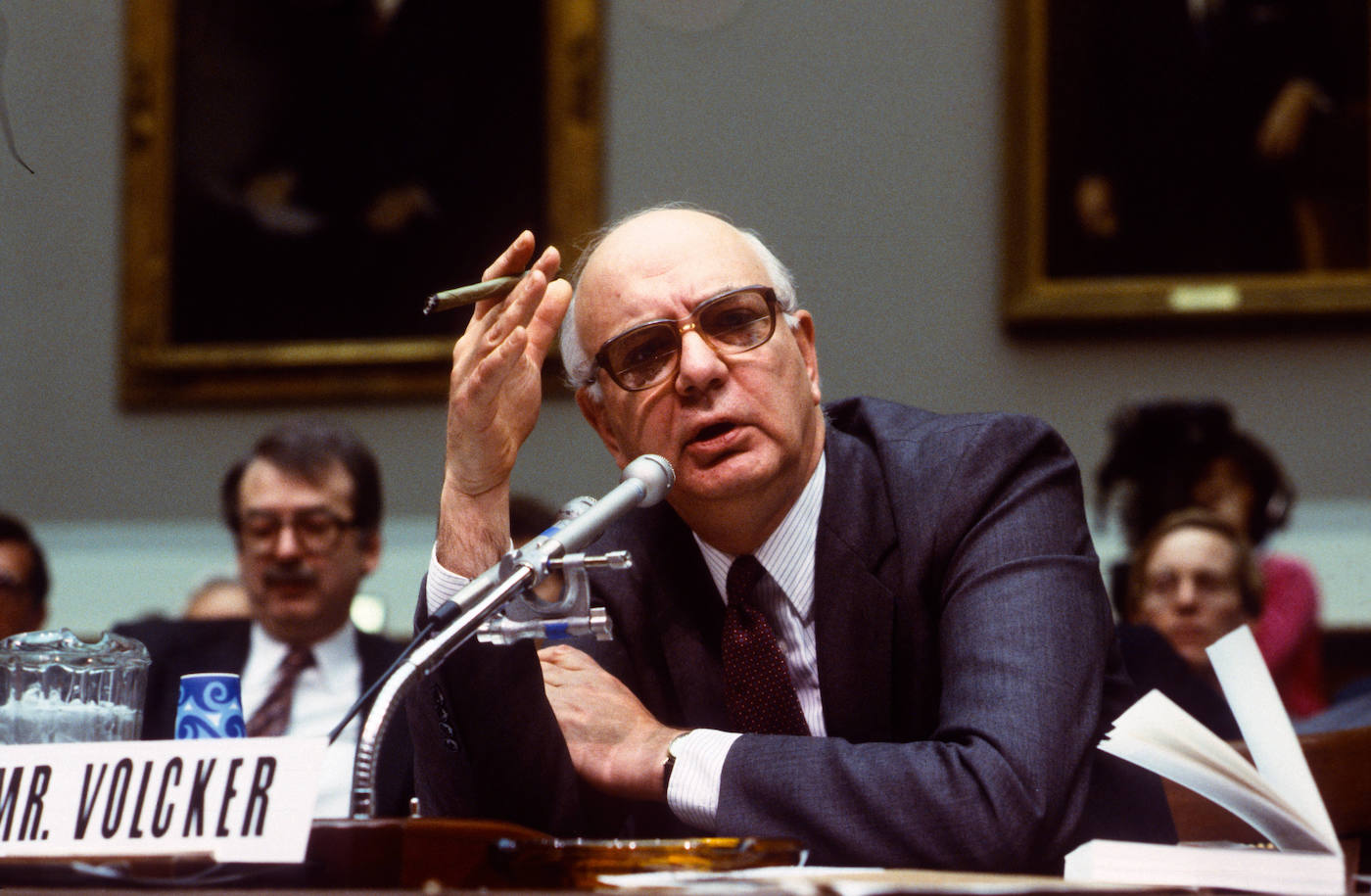
Paul Walker, 1986. Photo: Zumatass
“When someone stops me on the street or on the bus, which sometimes happens, they always recall the time when I was the chairman of the Fed about 40 years ago,” wrote Paul Walker in his memoirs published in 2018. The book begins with a joke about the purchase of a parrot. The seller offers a lone old man who, in search of the company, wants to buy a parrot, a bird with knowledge of all European languages for $ 5,000, then an even more expensive young parrot, who speaks Asian languages, for $ 10,000. Among the cost and hoping to save, the old man asks him to sell an old parrot with dropped feathers and glazed eyes, believing that this It costs almost nothing, but it turns out that the price of this bird is $ 25,000. "But how can this gray -haired old man cost more than anyone?" - the buyer asked in amazement. “We ourselves really do not understand. All that we know is that all the other parrots call him Mr. Chairman, ”the seller answered.
The joke about the Walker parrot, according to his admission, told hundreds of times, but in the book he declares: "This time will be the last."
Unassuming power
Walker, who gave the civil service for more than 70 years, did not possess neither the charisma of the politician, nor the arrogance of the boss with Wall Street, he had a guilty appearance and the manner of unconvincingly mumble, says The Washington Post. Understanding the secrets of money better than anyone else, he did little to get rich: in the 1980s, being the second most influential person in the country, he lived in a tiny apartment, which students were renting, using cheap cigars, preferred dinner in the Chinese eastern ecstatic parties instead of the table, and his costumes were always a little glossy.
Not a single head of the Fed was so famous for ordinary Americans before the Volker - the inflation tamer.
In 1979, when President Jimmy Carter chose the Chairman of the Central Bank, inflation beat records, workers demanded an increase in salaries, inflation grew again - the circle closed. The Fed could do little, its leaders did not linger in their posts. The FRS, who headed the FRS, began the fight against inflation by tightening monetary policy. To do this, he had to raise interest rates to the values that were unprecedented since the Civil War in the United States, wrote The New York Times: the federal funds rate, which in 1979 on average amounted to 11.2%, reached 20%in the early 1980s. Unemployment has almost doubled, exceeding 10%.
Construction in the country stopped, and the builders sent pieces of boards to Volker in protest. Auto -dealers whose cars stopped buying, sent him the keys to unsold cars. Farmers cut circles on tractors around the Fed. One person, armed with a gun, managed to break through the guard and almost get to the Hall of meetings of the Fed, before he was captured: he said that he was angry on Volker for high interest rates. The immersion of the economy in the recession caused a battalion on the Capitol Hill: Carter ran for a second term criticized the tough policy of Volker, but Ronald Reagan, who supported this policy, won the presidential election. “I do not kiss men, but then the temptation was great,” Walker in the memoirs described his reaction to the support of Reagan. Walker was convinced that the unpopular measures taken by him were the only way to save the country from double -digit inflation forever.
And he succeeded: inflation from the peaks almost 15% in April 1980 decreased to 4% in August 1987, when Volker left the post of head of the Fed. Since then, inflation in the United States has never been two -digit. In 1982, when the economy plunged into a recession, Volker decided to soften the policy in order to regain growth: already in 1983, the US GDP grew by 4.6%, and inflation was about 3%.
“I can explain why, it seems to me, I do not like inflation,” Volker said in 2008 in an interview for the Oral History project project. - I love to tell this story. In 1945, I entered the Princeton College, and my mother said that the family would help me - send $ 25 a month. I noticed that this is not enough and I need more, but my mother said that my [older] sisters at one time received the same amount. “But my sisters went to college in the midst of the great depression, and they did not need so much money, and we also have inflation,” I explained to my mother, and my sisters agreed with me. But my mother replied that she doesn’t care and I would receive as much as my sister. ”
Tearing the circle of uncontrolled growth of inflation expectations and starting to reduce the rates after that, Walker launched the cycle of economic boom, which almost continuously lasted a quarter century, notes The Washington Post.
Leaving his post, Walker warned that now the main threat to the American economy is not inflation, but a budget deficit.
Volker's rule
In the 1990s, Walker, whose influence remained unshakable, pulled away from public policy, was skeptical of the deregulation, which was launched by Bill Clinton. Instead of politics, he took up the return of assets from Swiss banks to the victims of the Holocaust, found violations in the supply of products to Iraq under the program “Oil in exchange for food” and corruption to the UN.
Volker returned to politics during the Presidential campaign of Barack Obama, becoming after the election by his economic adviser and heading the Presidential Council to restore the economy. He was extremely critical of banks, believing that in a crisis they behaved inappropriately and that their regulation should be intensified. At the beginning of 2009, the Volker tried to offer the Obama administration the plan of the Wall Street reform: the former head of the Fed was outraged that the banks saved at the expense of taxpayers returned to the usual pre-crisis behavior and risky transactions. He wanted to forbid banks to trade securities at the expense of his own funds, that is, making transactions for his own profit: commercial banks that use the cheap funds of Federal Reserve, “should not engage in risky affairs of the stock market,” he said to the publication The Atlantic.
But first, no one listened to the Volker: the presidential administration and the Ministry of Finance considered the proposal unrealistic. Then Walker began to act with public lectures in which he explained how Wall Street should be reformed in order to avoid repeating the crisis and change the entire banking culture. According to the results of 2009, bonuses in many banks exceeded pre -crisis rewards - this outraged Obama, said the source of The Atlantic, he doubted the financial reform of his administration and decided to return to the proposals of Volker.
In January 2010, Obama, inviting a Volker to a press conference, announced that he would call the provision prohibiting the banks of the transaction for the purchase and sale of securities at his own funds intended to cover the obligations to customers, the “Volker rule”. As the Volker himself noted, the main task of such a ban was not just the elimination of risks and minimizing the capabilities of the repetition of the crisis of 2007-2008 (large banks were invested in mortgage securities, the decline in the cost of which led some banks to bankruptcy, while others had to save the state) - this is a reform of the entire culture of trading. The inheritance of the Volker’s rules was the heyday of technologies used in the stock market, its transparency and efficiency, and ultimately the winnings for investors, wrote The Hill publication.
Walker was very proud of his reform. “This is my favorite rule. <...> I saw a newspaper in which it was written that this was the most important part of the financial reform. I never said this, but they wrote like that in the newspaper, ”he said in an interview with Martin Feldstein, professor of Harvard's economy and honorary President Nber.
The value of a good government
In recent years, Walker still actively commented on what was happening in the economy and was preoccupied with the events that occurred after the global crisis. In 2013, when he received the New York economic club for “impeccable leadership”, he admitted that he was shocked, how much the issues that the Fed has now had to solve are similar to those that he himself faced at the beginning of his Central Bank career. He defended the independence of monetary policy both as the head of the Fed, and decades after his resignation. When US President Donald Trump criticized the chairman of the Fed, Jerome Powell for low rates, Volker advised Powell to not pay attention to criticism. Walker was among the four former chairmen of Federal Reserve, who signed the open letter of Trump with an appeal to maintain the independence of the Fed.
The pricing stability and independence of the Central Bank go hand in hand, Volker explained in an interview with the Vice President of the Federal Reserve Bank of Minneapolis back in 1992.
At the beginning of 2019, Volker spoke about the US and China’s trade war, noting that “sometimes - although it sounds terrible - the rhetoric of the President of China is closer than the words of the US president: the first at least hopes for harmonious relations in the future, while the second consists of threats and requirements.”
Valker did not want to write memoirs for a long time, but still released them a year ago. According to him, he decided not to talk about the events of his long life, but to draw attention to the management crisis in which the United States ended up. “Respect for the government, the Supreme Court, the President, even the federal reserve system - it has gone. <...> I don’t know how to conduct democracy if no one believes in the country's leadership? ” He complained. Walker believed that now in the USA an “abnormal number of abnormally rich people”, convinced that they are rich due to their mind and grip. They do not like the government and do not like to pay taxes, Volker noted: "And I grew up in a world where a good government was value."
Are you interested in the economy? This week on the website Econs.online:
- Why did Croudfunding not replace the banks and what awaits it
- How home inventions contribute to progress
- And the most interesting of the lecture of Nobel lectures of the 2019 economics laureates