
Translated material
Return of the "Stalinist economy"
In the 2020s, Russia risks repeating collectivization: instead of oil, profit will be removed from people
The comparison of the Stalinist “team” economy of the USSR and the modern “market” economy of Russia seems strange. But only at first glance and only for those who imagine the Soviet Union of the time of the first five -year -olds from children's books, and modern Russia - by the air of the TV channel of the same name. A comparison interferes through the pictures, because the dams of the Stalin's five -year -olds are damn by hydroelectric power stations and melting stoves, and the symbols of the current “national projects” - oil towers and shopping centers. But the foundation of the ideas of the authorities about how and for what the country's economy should function at all over the past ninety years.

Return to the past
We will ask a hundred people about how Stalin ruled the economy of the USSR, and 99 will answer that the leader "built socialism in a single country." As you know, neither Marx nor Lenin, whose follower, Stalin proclaimed himself, never said that socialism should somehow be specially “built”. Just like no one “builds” capitalism. And the main incentive for work should be the natural desire of people to live tomorrow better than today. Actually, this was promised by the Bolsheviks in 1917.
We will take the factories from the capitalists, share the land between the peasants, we turn the “surplus value” in common benefit-here we will heal.
However, by about the mid-twenties of the twentieth century, when the land was divided and the factories were selected, it turned out that it became more fun, but not easier-the country's economy was more or less returned to the indicators of 1913. It must be remembered that the citizens of the USSR of that time, including Comrade Stalin himself, had experience in life before the revolution and could compare. And it cannot be said that the comparison was definitely in favor of socialism. As the character of the Sholokhovskaya “Raised virgin” noted, the peasants did not see the big difference between the old and new orders - “pay taxes, live, as you know. Well, won, and then what? Again for the old, go behind the plow, who has what to harness to the plow. ”
In the same way, the workers in the cities could not say that their standard of living somehow increased significantly in comparison with the pre-revolutionary. It was also necessary to stand at the machine and also give the earned to the store. And prices were not lower. And the salary is not higher. As the Russian researcher of the problems of modernization Sergei Zhuravlev wrote: “... In 1928, the volumes of production of national income and his structure were approximately the same as in the pre-war 1913 ... At the same time, another problem was identified-the lack of bread in cities ... The state could not offer manufacturers of commodity grain, and they refused to sell it because they could not realize the proceeds” ...
There is no money, and how to stay?
Stalin and his environment knew very well what the situation could turn out when the lack of goods in the village is combined with a lack of bread in the city. Actually, such a combination of circumstances overturned the royal regime in February 1917. And the famous Stalinist phrase about the fact that Russia lagged behind the advanced countries for 50-100 years, and this lag needs to “run in ten years, otherwise they will doubt it,” was not at all about the possible defeat in the war with “imperialist predators”.
Comrade Stalin hinted that the people would demolish the Bolsheviks,
At least under the slogan “For the Councils without Communists”, which his associates remembered well and whom they were afraid to death.
But to overcome the distance that the leader spoke of, one needed one, but a critically important thing - money. And there was no money. Stalin was aware of what served as the driver of industrialization of the Russian Empire. Grain export plus foreign investment, which was a source of capital for industry. On the eve of the First World War, the share of these investments in the total trade and industrial capital of Russia reached 43%.
But world grain prices after the First World War collapsed and have never recovered. And in order to attract foreign capital, it was necessary for the start to return the factories and factories to the former owners - to all these Lessner, Guzhon, Michelson and Siemens, to which Comrade Stalin could not go. That is, Stalin himself would probably return it, he was a pragmatist and a cynic, but how to convince his comrades in the Politburo?
It was not necessary to count on attracting internal capital either. There is a story how one of the leaders of the Soviet secret police summoned the noble Moscow “NEPMANA”, legal “Soviet capitalists” to a conversation.
“What do you, dear citizens, do not want to keep money in labor savings cash desks,” the honorary security officer yelled. - Or forgot, bitch children, that the Soviet government guarantees the safety of deposits?! ”
“We, a citizen, the boss,” Nepmans squeaked, “we have no doubt that your power guarantees the safety of deposits. - What about the safety of depositors? "
The Soviet government could not guarantee “security of depositors”, unlike the “safety of deposits” - for fundamental reasons.
"You’ll go to cans, but you’ll go to work!"
Money had to be sought inside - by the pockets of workers and peasants. There were more peasants. Ninety years ago, more than 80% of the USSR population lived in rural areas. The peasants had to become a "resource" for industrialization. So the current authorities rocking their teeth, calling people "second oil."
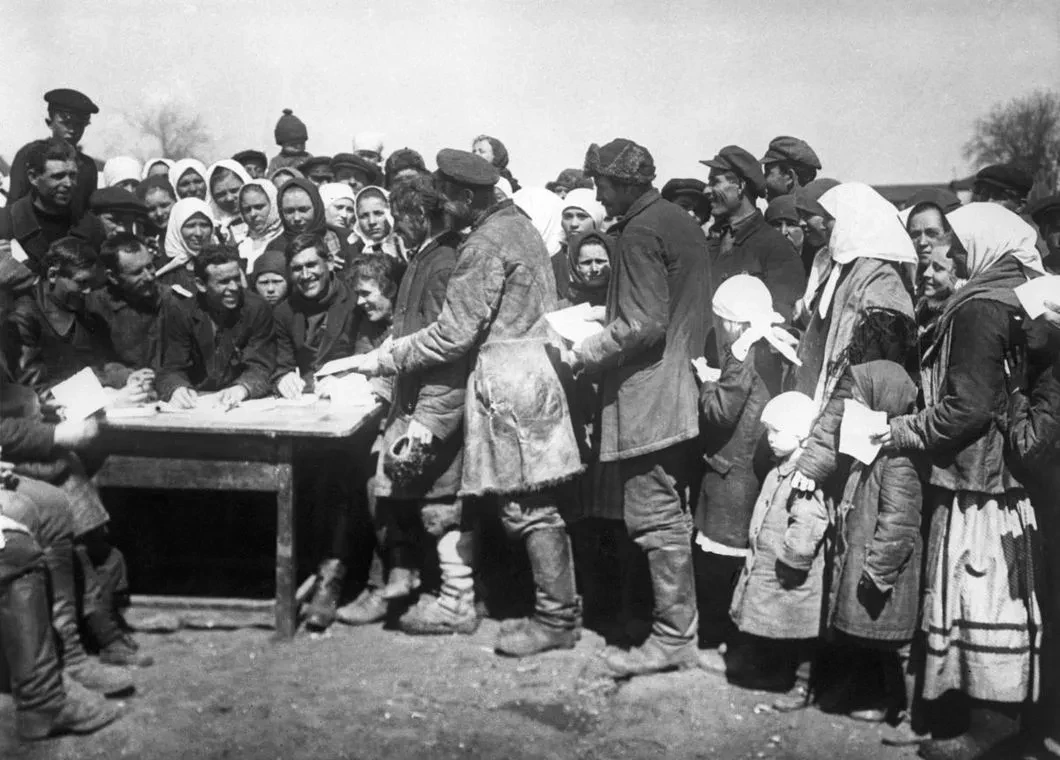
For some time, the Bolsheviks liked the idea of removing resources from the village through “scissors of prices”-we buy bread cheaply, we sell goods expensive. But nothing happened - the peasants simply began to reduce sown areas. And then Stalin decided to go from the trump card - collectivization.
From the point of view of the economy, “collectivization” was nothing more than a supernab sequential of the peasants. Each collective farmer was obliged to work out a certain minimum of “workdays” both on the collective farm and on public work. The peasants received “obligations” for state supplies - a list of types of agricultural products that the collective farm and personal farmsteads produced. Numerous cash taxes should be added to this - up to fishing tax and vegetable tax issued in the payment of workdays. And all social infrastructure in the village of collective farmers kept at their own expense. This is not counting the purchase of state loan bonds, buildings on buildings, and so on ...
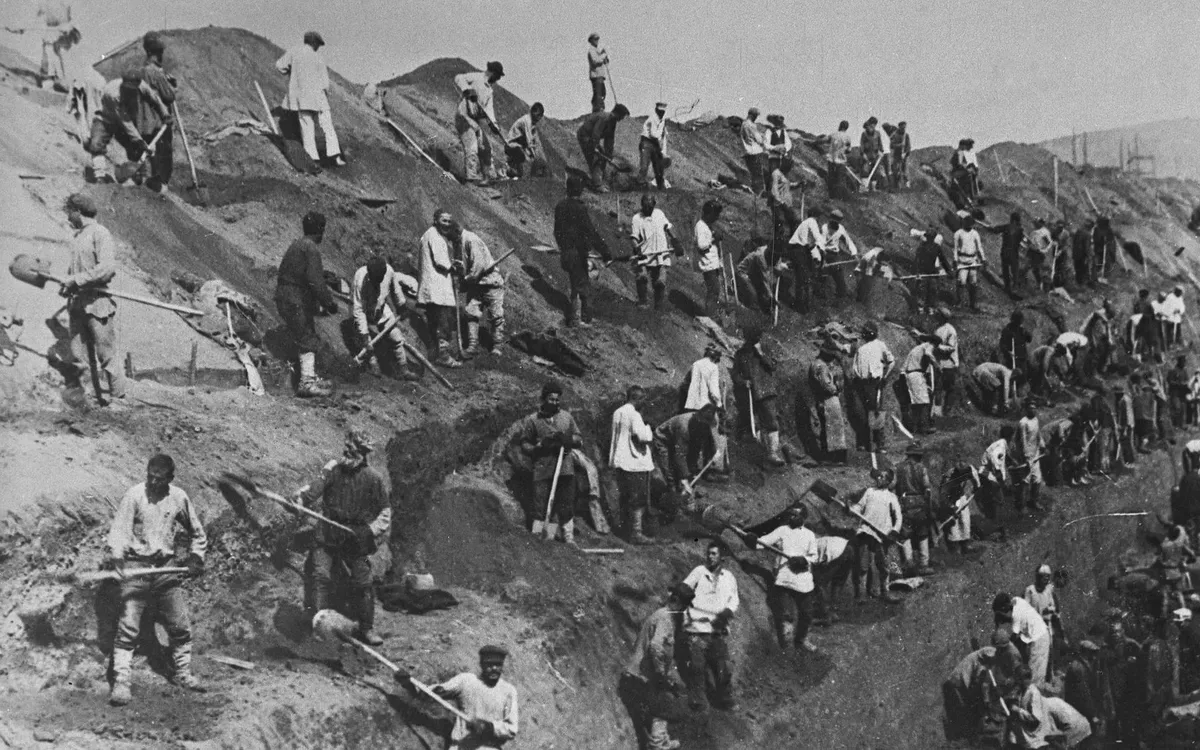
Who could, ran from villages to cities. The Bolsheviks wanted this. New workers were already waiting for shovels, stretchers and bricks for the construction of factory buildings,
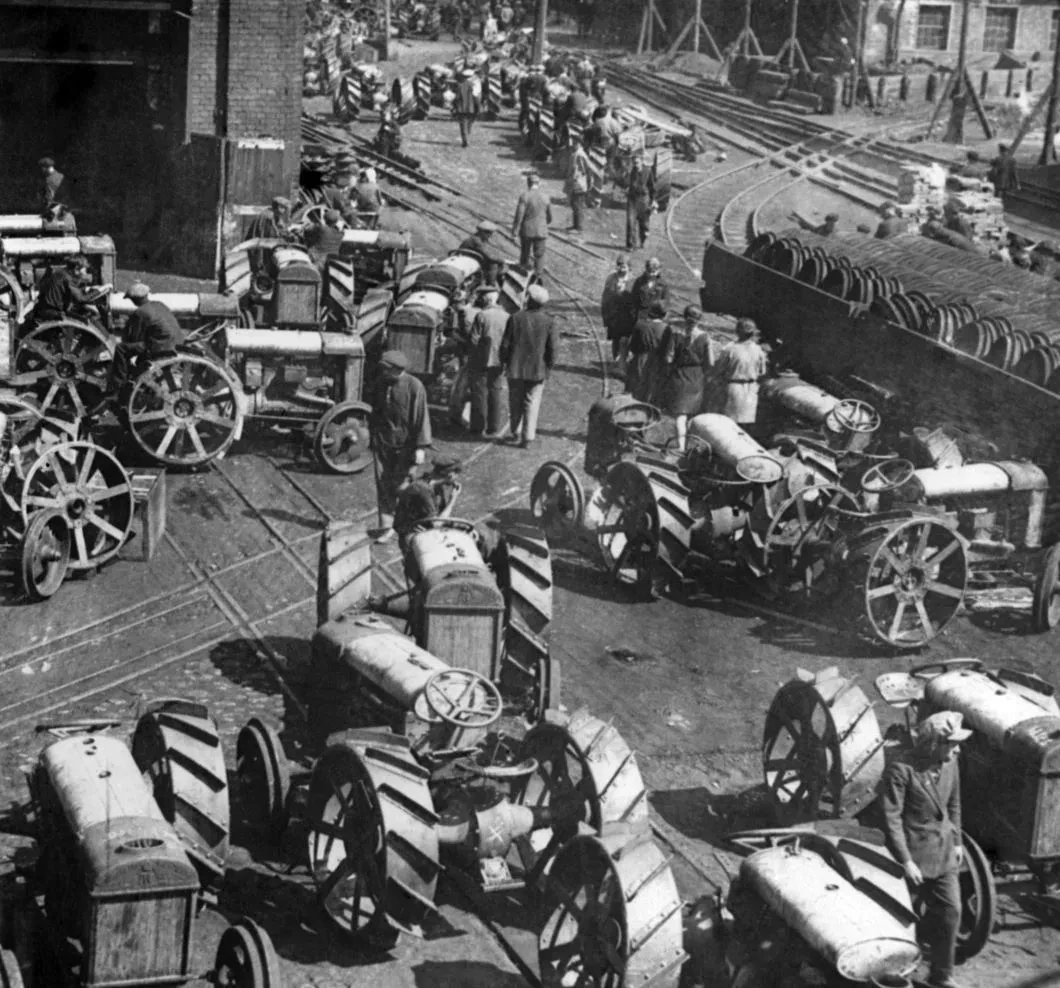
And as soon as American conveyors were brought from abroad, working hands were immediately found to these conveyors who were ready to work on any conditions, if only not to return to the collective farm.
By the way, the idea that industrialization was paid exclusively by the export of collective farm bread is not confirmed by statistics. According to the reference book “Foreign Trade of the USSR for 20 years. 1918–1937, which was released in Moscow in 1939, during the first two -year -olds due to the export of goods and raw materials, no more than 50 billion dollars managed to help (at modern prices). Where did the money for the conveyors come from? Paradoxically, from loans from “imperialist partners”, a plus of gold, which was withdrawn from the population. Comrade Stalin was a real master of removal of ladies - a minimum could be bought at solid prices - by cards, and everything else had to be earned by yourself and buy at commercial prices. Those who could not work, carried in the stores "Torgsin" hidden savings - up to silver spoons.
It is clear that such a policy meant an extreme decrease in income and consumption of the population on average. But the concentration of resources in the hands of the state made it possible to ensure the increase in the consumption of privileged groups, primarily a variety of authorities, propagandists and power structures.
No “equality” - even the official salary of the Stalin Minister exceeded the average earnings in the country by 30 times.
Apart from the chiefs of the “Main Directorate-Tom-Tam”-a complete analogue of modern Russian state corporations.
But the peasant, who went to the city, compared his life not with the life of the authorities, but with the life of his native collective farm. And the comparison was clearly in favor of the city, even a hut town next to the camp huts.
And in a decrease in the level of consumption, Comrade Stalin did not see a big trouble. As they said in his camps: "You will go to the tin cans, but you will go to work!"
Thaw: "Oil" instead of "People"
Only in the 1960s, the heirs of Stalin went to mitigate the economic regime for the peasantry, and indeed “let go of the nuts”. There were two reasons.
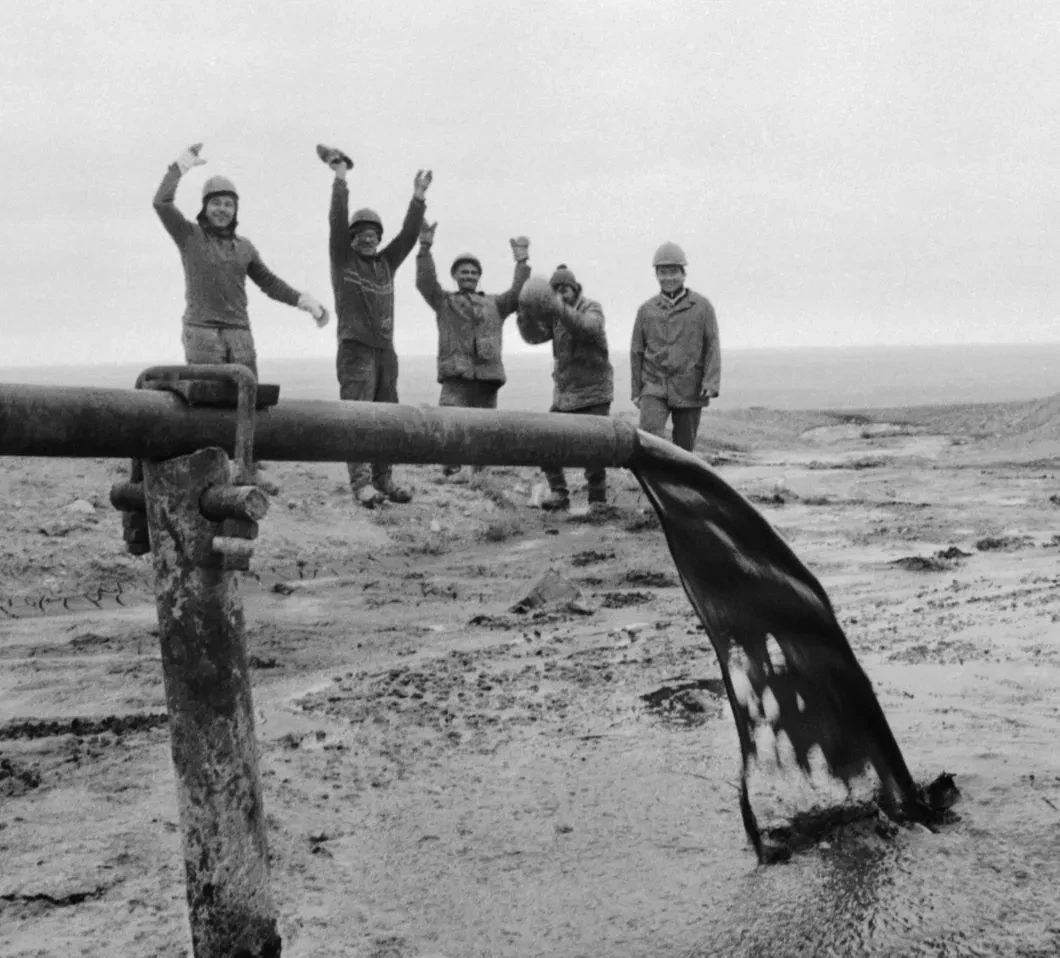
Firstly, a tool has appeared in power that allows you to solve the problem of food support for industrial cities without the participation of the village-by "oil exchange for grain". From the point of view of macroeconomics, this was a completely acceptable solution - in the spirit of “replacement of labor by capital”: oil production requires investment, but it is much less laborious than agricultural production at the then technological level.
Simply put, it is more effective to invest in an oil well than on a collective farm.
Secondly, the bosses had to talk with representatives of two relatively numerous generations of Soviet citizens. The first, born in the 1910s, built the so-called "industrial base of socialism." Another generation born in the 1920s won the war. At the turn of the 1960s, those who survived at shock construction sites and in the advanced trenches were from 35 to 50 years-the age when a person thinks about the intermediate results of life. And citizens could ask: "When is the promised communism many times?" Therefore, the people were declared "earth and will." The “land” became meters of housing in the “Khrushchevs”, and “will” - the softening of the passport regime in the villages. The CPSU program even promised communism during the life of the current generation of Soviet people, but ... communism did not work.
But-after the dismantling of the team economy-it was possible to fill the shelves of stores, eliminating the hated deficit that tormented the country since the 1930s.
Freezing: "People" instead of "oil"
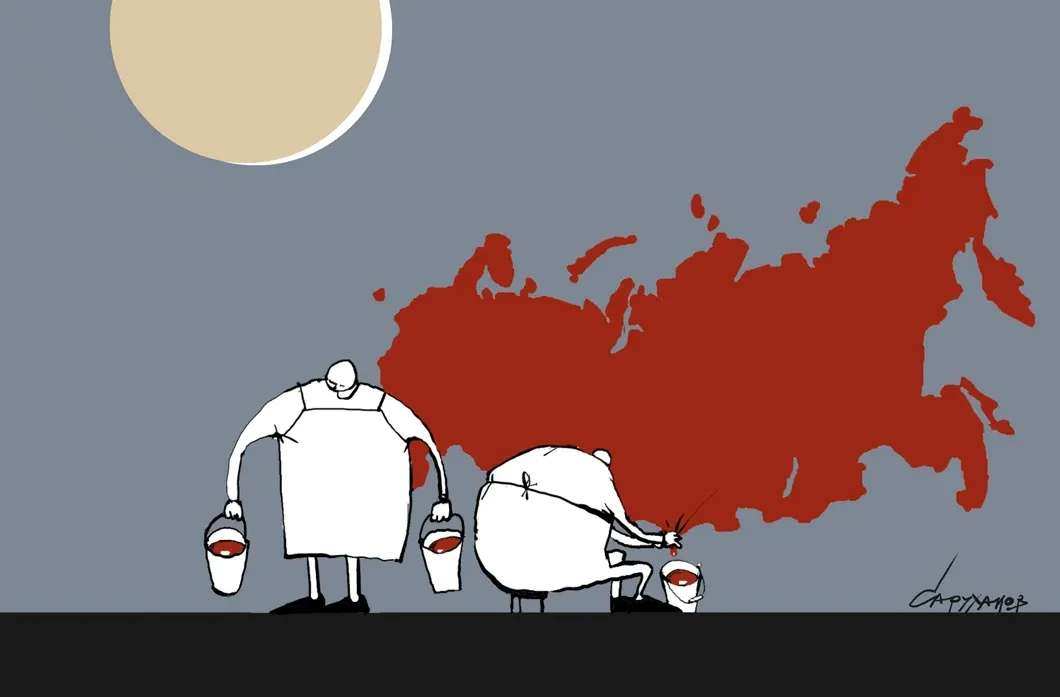
However, at some point, the economic growth of the new Russia rested on the same barrier as ninety years ago-the lack of long-term investments. The Russian government has proved its ability to ensure the safety of deposits and a complete unwillingness to ensure the safety of depositors. Even the state capitalists who were closest to the authorities preferred to keep earned away from their native land. The authorities were afraid of a bet exclusively on export revenues - the world experience took into account. And then the heirs of Stalin decided to use techniques from the arsenal of the leader of the peoples - to remove resources from consumption and direct them to investment. At the same time increasing taxation.
By the way, contrary to bossal assurances, it would be not exported at all about the most Russian budget. Economist Andrei Movchan cited a calculation according to which citizens pay not only income tax, providing approximately 10%of the total budget revenues, but also VAT (20%), taxes on total income and property (5%), social contributions (20%), part of excise taxes and customs payments (10%). In addition, private companies whose beneficiaries are citizens pay income tax, and this is another 5% of the budget. It turns out that the taxes of Russians form two thirds of the budget. But the remaining third - the income of the “state” from the extraction and implementation of minerals and income from the activities of “state -owned companies”, from the point of view of the Constitution, also belong to citizens, and the state, as the economist correctly noted, is “an intermediary in the processes of payment, and nothing more”.
Looking at the practice of building Russian state capitalism, Comrade Stalin could praise the builders for following the covenants of the leader.
Here you have “price scissors” - we buy cheap from the people, we sell expensive. Here is the growth of taxes and fees, with simultaneous investments in what seems to be an attractive chief boss ... That's how Comrade Stalin acted. Foreign technologies and complex equipment? We will buy and bring. Is cheap labor in the villages ended? Nonsense! If in the early 1930s they fled from the village to the nearest regional city, now they are fleeing Moscow and regional cities now ...
Corruption? Found what to surprise! It was a seamstress that could be planted behind the thread of threads taken from the factory, having made the case for “two hundred meters of sewing material”. And for bossy theft in Stalin's times, there was a special term “self -supply”, for which they strictly did not ask - in extreme cases, they could move to another leadership work. Now, if the boss lost “political trust”, terrible troubles could wait for him, and the suitcases of money and things dragged him from his apartment. So now some boss first “loses confidence”, and only then turns out to be a bribe taker and a twist. Not the other way around.
The people have lined up - not a problem at all.
Running without result
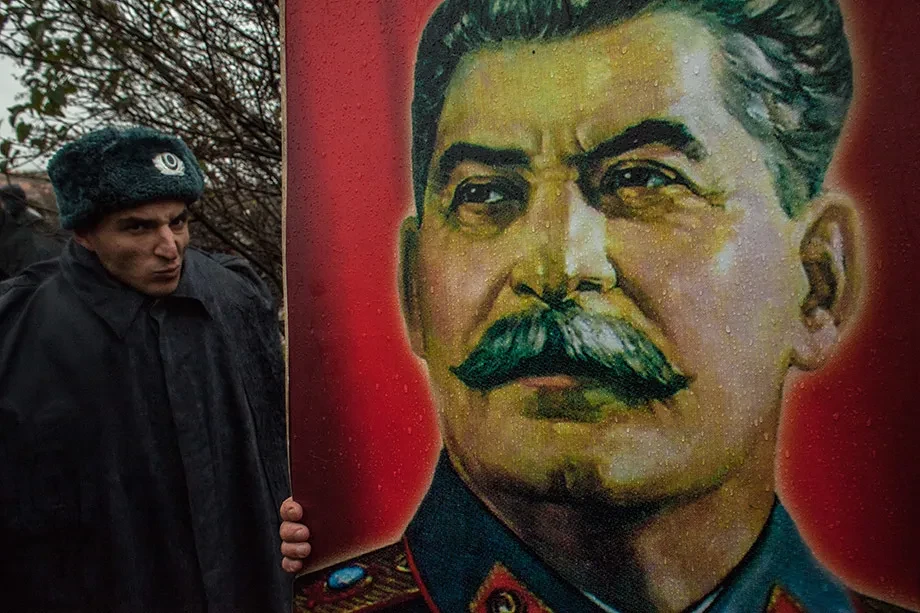
The question arises - if our bosses really follow the Stalinist recipes for managing the economy, where is he who repeatedly described by the textbooks the rise in the economy of the USSR, which is considered the main achievement of the leader of the peoples?
And who told you that there was some kind of special upsurge, they will hold his shoulders of statistics. GDP leap in the 1930s is the result of the transfer of a labor resource from a low-performance sector (agriculture) to a high-performance sector (conveyor production). But on the country's scale, such a card can be played for the only time in history, as, in fact, Comrade Stalin did at one time. He “built” not “socialism”, but a command system that allowed mobilizing resources and concentrating them in a rather narrow segment - military industry. And if you look at the economic growth of Russia throughout the twentieth century, it was even lower than average - a little less than two percent a year, which are now considered Russian chiefs an excellent achievement.
At the same time, today's “Stalin” policy of cheap labor, on which the Russian authorities have been hung up, in combination with the same policy of expensive capital (its reflection is high loan rates provoked by high risks of non -return of loans), lead to labor and retarding technologies, and not capital -intensive ones. Exactly, as in Stalin's times.
As used in the camps of the Main Directorate of Railway Construction: "There is not enough sleeper - I'll put you!"
Formally, unemployment is low and there are a lot of jobs. But these are “bad” jobs that do not allow the employee not like to accumulate capital for investment, but also to go beyond their survival. Yes, the ability to “pay little” formally means increasing the competitiveness of Russian manufacturers and the growth of their profits. But at the same time, the impoverishment of buyers and the fall of consumer demand within the country force recipients of this additional profit to look for objects for investment abroad. And therefore, the growth of the profit of large enterprises and the growth of income of their owners are not transformed into the growth of the Russian economy, expressed in the growth of the well -being of citizens.
The simplest option of attracting investments would be a real (rather than declared) provision of “rights of depositors”, that is, owners. But the decision of the issue of property will undermine the main paradigm in which the Russian chief operates - the power is the source of property. But not vice versa.
But what to do? While the authorities are operating on the covenants of Comrade Stalin, squeezes a residual labor resource from the population. Hence the words of the chief in economics about the miraculousness of raising the retirement age. Hence the words of the chief of medicine about the standard healthcare system. On the same occasion, the head of the Karaganda camps - Colonel Chechev - was more frank: “I have one disabled person in the whole camp - without two legs. But he is at easy work - it works a messenger! ”