
Translated material
"Theater is a mutation"
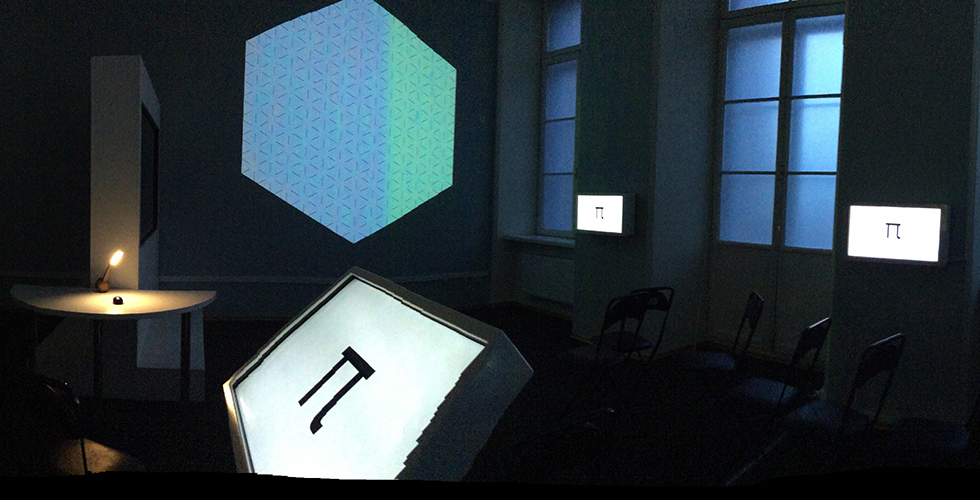
The Petersburg “Postr theater” introduced the premiere of the play “Accident”: continuing to work on the interdisciplinary field, the wards of Dmitry Volkostroelov this time made a project in the fashionable Sins-Art genre. The name of the production, the premiere of which took place in the center of the multimedia of the Russian Museum, refers to the effect of parallelism in evolution - when the same signs appear in different types almost independently from each other, when the processes seem random, and in a more detailed examination are directed and logical. Ksenia Volkova talked about “accident” with the authors of the performance - director Andrei Slepukhin and playwright Ekaterina Augustenyak.
- Last fall, the Living City Foundation held the Annigilation laboratory in Kazan, in the framework of which curators Dmitry Volkostrelov and Oleg Loevsky tried to connect science and theater. Do I understand correctly that the project “accident” originated precisely in its bowels?
Andrei Slepukhin: Moreover, from the very beginning I proposed to release this performance in Kazan, but at that time the Laboratory “Avo” did not have the opportunity to implement the project, so it is quite logical that we agreed on the premiere with Dima (Volkostroelov. - Ed .). It is great that the “annihilation” is developing - this fall, for example, the laboratory was arranged in this way: scientists offered a limited list of topics and problems that seemed important, interesting to them, and participants - directors, artists - were looking for ways to understand them, research. Last year, everything was completely different: the directors could initially choose and develop any topic related to science - complete freedom ...
- You want to say that before you decided to participate in “annihilation”, the issues of evolutionary biology worried you for many years?
Slepukhin: Well, here, of course, it was also not without an element of chance. I learned about the laboratory at the beginning of summer, I thought for a long time what topic to choose - in the footsteps of the “field” , of course, I pulled towards physics. But on his birthday, the Prime Minister of the Postr theater, Ivan Nikolaev gave me a book - of course, knowing nothing about my desire to participate in “annihilation” - and this was the book “Evolution. Classical ideas in the light of new discoveries ” Alexander Markov and Elena Naimark. “Vanya will not give a bad book,” I thought, began to read, and doubts disappeared by themselves. So the release of "randomness" in the " Posta Theater" was, of course, a foregone conclusion ...
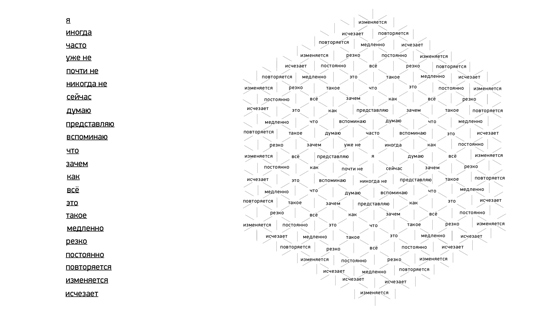 Ekaterina Augustenyak. Fragments of the play "Accident"
- ... Especially since John Cage's “ Pos Theater ” faithful to the Testaments at that time has already worked a lot in his performances with the theme of chance.
Slepukhin: An accident is generally almost a key thing for art, but in this case I was interesting, rather, the scientific aspect of the problem. Accident as an interesting phenomenon of evolution - is it possible to analyze it using theatrical tools? It is probably necessary to recall that an accident is one of the stumbling stones in evolutionary biology. Many perceive it as the lack of an algorithm, as a subordination of chaos. But this is not at all like that: an accident is the starting point with which the evolutionary change begins. That is, when copying information, unnecessary, random mutations occur. They can be harmful, useful, neutral - but if an accident gives a useful mutation, then it is fixed and in the future gives the development of the body a very interesting direction.
- At what point did you realize that for release at the POST Theater you need a playwright - and that it is precisely Ekaterina Augustenyak? From the outside, it looks like an absolutely logical software: “Accident” is your directorial debut, which began with a sketch on the “annihilation”, which was supervised by Volkostrolov. And he, in turn, gave Katya the “ticket to life” on the Fringe program last year’s “Lyubimovka” ... And now the “ Postr Theater ” , which will soon celebrate the ten -year anniversary, invites artists who have grown up to his performances to work.
Ekaterina Augustenyak: “The POST Theater” really influenced my formation as a playwright. At one time, experiencing a professional crisis, I got to “I'm free” - I well remember what shock I experienced then. It seemed to me that I was a well -considered viewer - and here it is .
Accident as an interesting phenomenon of evolution - is it possible to analyze it using theatrical tools?
Slepukhin: I have a crisis, by the way, it happened, rather, after the performances of the “ Postr theater”. Before meeting with Volkostroilov, I was all right, I lived some completely traditional ideas about the theater ...
Augustenyak: View "I am free" helped me a lot. He helped to start engaging in contemporary art, overcome his school. It was through the text that I got the opportunity to enter the territory of art, which suggests a completely different understanding of modernity - which is not at all aesthetically attractive. This was an important discovery. Contemporary art may not always be clear, not always pleasant - but this is a process in which it is proposed to participate. As for the “chance”, my appearance in the project was initiated, it seems, [the prima of the “ POST Theater”] Alena Starostina. I am initially a designer-artist, I am very interested in Sins-Art and the theme of new media in the theater. In part, all this was reflected in my last year's play “Lorem IPSUM” , whose reading wolf stirls a year ago, to an even greater extent, in “Opus DNA”, which was shown on “Lyubimovka-2019”. Studying scientific or technological phenomena, we can find some kind of special language, a special structure of the language-so when I was offered to become part of the “chance”, I was only glad.
Slepukhin: Moreover, at that time we really had a very specific problem with the structure of the future performance.
 © "POST Theater" Scene from the play "Accident"
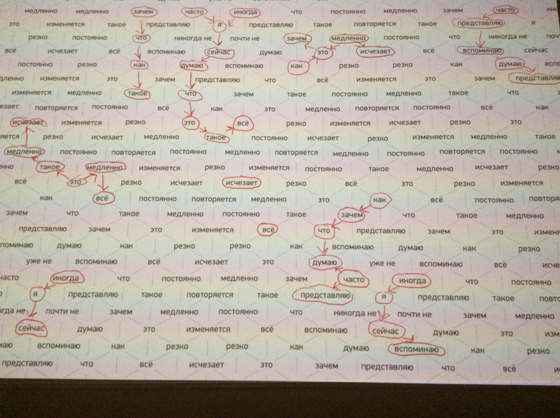
-Do I understand correctly that the text of “randomness” is arranged as a visual code, that this is a play scheme, as in the case of “Lorem IPSUM” ? I will not spoil, but in the performance, it is this structure that sets the direction of the entire multimedia component, which we will talk about.
Augustenyak: Yes, on the "Lyubimovka" I was called "a robot dramaturus" this year. I am often accused of the fact that the form in my texts is primary - although in fact I always push off in work from the idea. The structure of the “randomness” that you are talking about arose immediately - and it immediately seemed very organic. If only because it goes well with the Markov program, which Andrei used when working on the concept of the performance.
- Here, apparently, it must be explained that Alexander Markov developed a special computer program that calculates mutations - and transfers this process through the language, through the symbols.
Slepukhin: Evolution does not know what ideal he is striving for, but it moves towards it. Roughly speaking, Markov’s program is arranged in such a way that at the very beginning you have only a chaotic set of letters, and you set this ideal, adding any phrase. And then the program, based on all evolution data, begins to gradually compile this phrase - with all the mistakes, passing through many stages. If the letter stood in the right place, it is fixed. If wrong, it is rejected. And you can observe how a text organism arises gradually from chaos.
Through the text, I got the opportunity to enter the territory of art, which involves a completely different understanding of our time - which is not at all aesthetically attractive.
- “Accident” is curious as a precedent: you do not act in the genre “in simple words about the complex”, but trying to comprehend the scientific discoveries artistically, aesthetically - that is, you interact with science not on rational, as is usually accepted, but at a sensual level.
Slepukhin: It turned out, on the one hand, a response to a scientific situation, and on the other, an attempt to dialogue with her. The great impression that I received from the books read during work on the play was equally intellectual and emotional.
Augustenyak: I tried to find out - why is the theme of evolution so hurting us? Why is there so much personal response in it? For me, it was a rather difficult process: if I visualized the structure quickly enough, then it took more time to search for an adequate form for the text. After all, there is still an important point: we are not scientists, we are able to consider these stories at the domestic and, possibly, artistic level. Scientific definitions and our understanding of them are different things. At some point, I heard what Andrei was talking about mutations, and this helped to find a way to create a text. Mutations, errors - this is what underlies the search for the language for this text. The very way of speaking, when we, non -professionals, talk about science - not so much retelling as an emotional response to the information we received, imposed on other strata of knowledge that we already have in connection with this topic. A chemical reaction arises in our brain, information chains are created ...
- It turns out that the text of “randomness” is also about how scientific discourse invades our household language, how they interact, enter into a dialogue. That is, the output is literary postmodernism, “text about the text”?
Augustenyak: Yes, I work with all this - as with the method of inclusion in the topic.
- How does the "accident " interact with Markov's texts? Do I understand correctly that you highlight the basic motives, repeating concepts - and build your thought around them?
Augustenyak: That's right. With the permission of Markov, the scientific text has been introduced into the body of the performance. But this, however, is not spelled out in the play - in the text there is only the mention of terms: how we are trying to talk about them, to talk about them. At the beginning of work on “randomness”, we often met and tried to reflect on our experiences about new scientific knowledge - from these dialogs, the text of the play has developed.
 © "POST Theater" Scene from the play "Accident"
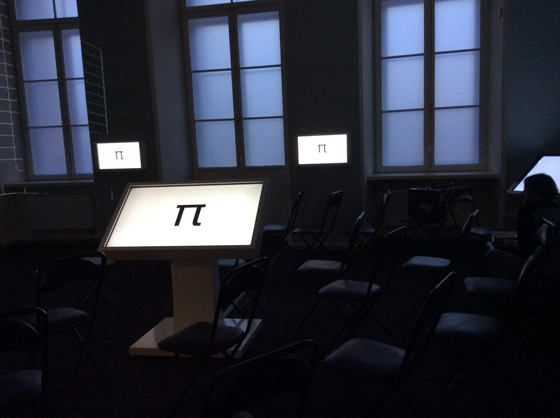
- You released the premiere in the center of the multimedia of the Russian Museum. There are a lot of important plots of the current agenda at once: the interaction of art and media, the dialogue of tradition and modernity - “accident” immediately falls into many pain points of the current artistic process.
Augustenyak: This space is ideal for the conversation, which is conducted in "chance".
Slepukhin: As soon as we came to the Center of Multimedia, everything fell into place.
Augustenyak: It's great that this is both a Russian museum - and at the same time a very democratic space opened to everything new.
- You have a democratization of science, they have the democratization of art. The Russian museum, in principle, works in the same direction as Markov, engaged in popularization - opening, say, virtual branches in cities where there is no available museum environment. What, by the way, is the role of the viewer in your performance?
Augustenyak: For us, first of all, dialogue with the public is important.
Slepukhin: I really want to - I don’t know what extent it will turn out - so that the experience of “accident” becomes personal for her. The performance works with the change of optics, with an attempt to perceive yourself not from the point of view of philosophy, for example, either sociology, or political science, but from some not too familiar angle-very authentic, in fact. I remember that on “annihilation” they asked me the question: why, they say, you are so passionate about the topic of evolution, did you know anything about this before? He knew, of course, but when I experienced this topic as a direct experience, everything happened for me.
Augustenyak: In the “accident” there is an invitation to complicity - while nothing, in fact, is required of the viewer. We do not ask, say, to speak out to the audience on certain topics - but we want to launch the mechanism for connecting to them.
Slepukhin: It is terribly interesting to analyze your life from a new point of view, to understand how your development was built. The fact that I took up the theater is a pure chance: I have never been going to be an artist in my life, and even more so the director. There were no prerequisites for this: until the eleventh grade I was going to become a football player, I first visited the theater, it seems, a year before graduation - I was dragged by classmates. The most remarkable thing is in evolution is the absence of any task. No organism knows what it will develop into. There is a certain tunnel by which you are moving-and some incredible events are needed to change this tunnel. Fate is stupidity, the development of the body is exclusively procedural.
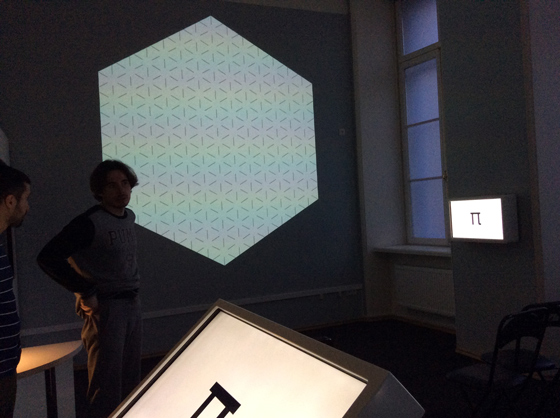 © "POST Theater" Scene from the play "Accident"
- That is, the fact that you took up the theater is a certain mutation?
Slepukhin: In fact - yes.
- And how do we evaluate this mutation in this case - is it useful or harmful? It is clear that in the development, for example, fish is a useful mutation - this is the one that led to the development of a new, more perfect, type of fish. And in a person?
Slepukhin: Everything is right. In evolution, this is called "adaptability." The more descendants you left, the more adapted. For example, it has already been proven that natural selection negatively affects the genes responsible for the ability to learn - it works against them, because more educated people, according to statistics, leave much less offspring than less educated ones. And this, note, is not an evaluative judgment, but statistics. Natural selection gradually begins to weed out the genes of formation - as interfering with reproduction.
- It seems to me that if you became a football player, you would be more adapted to life. Hand on the heart, the theater is clearly your harmful mutation.
Slepukhin: From a material and economic point of view? Maybe. But perhaps I would not become the best football player - and would be unhappy. My fitness, by the way, is equal to one. I have two children, accordingly, according to Alexander Markov, "there were two of you, there are two of you - the fitness is equal to one, you are well done."