
Translated material
From call to call
As in Russia they punish people for false messages about terrorism
This is not to say that telephone terrorism in Russia remains completely unpunished. But thousands of obviously false reports on the preparing terrorist attacks occur hundreds of sentences.
We will study the data of the Judicial Department at the Supreme Court of the Russian Federation for the first half of 2019.
The easiest category of crimes of Art. 207 of the Criminal Code of the Russian Federation is provided for part 1. The sentences for this part are sentenced in case of significant property damage (more than 1 million rubles) or other socially dangerous consequences made from hooligan motives. In total, in terms of Art. 207 of the Criminal Code of the Russian Federation, 135 people were convicted: of which 112 people were sentenced to restriction of freedom, one convicted person was deprived of freedom, 14 - fined, was assigned forced labor.
Quote from a typical case under Part 1 of Art. 207 of the Criminal Code of the Russian Federation: “Minichev in a state of intoxication <...> personally made a call to the emergency service number <...>
He made a deliberately false message about the impending explosion at the address: ..., namely, said: ... I will have terror, that's it. ”
A heavier part - part 2 of Art. 207 of the Criminal Code. This norm of the law is applied if a false message about terrorism was made in relation to schools, kindergartens, clinics, hospitals and other social institutions. According to it, for the first half of 2019, 132 people were convicted: of which 28 were sentenced to deprivation of liberty, 87 were condemned conditionally, 15 were fined. So, one of the convicts in this part informed the operator of the part that the registry office building in Orel was mined. The reason for this statement was “that on 03/31/2016, at 10.00 hours, its marriage with FULL NAME14 was planned. In connection with the financial difficulties available at that time, he did not buy a ring. ”
According to Part 3 of Article 207 of the Criminal Code of the Russian Federation, 10 people were convicted in the first half of 2019: five of them were deprived of freedom, three were sentenced to conditionally, one accused was sentenced to restriction of freedom. This part applies in the event of the intention of the convict to destabilize the work of authorities. “Gusev A.V., being in the apartment of a friend Yashin D.A. At the address: <address>, being intoxicated, caused by alcohol consumption, from hooligan motives, having a direct intent aimed at disorganizing the activities of the authorities and law and order, he carried out two phone calls to the number of the 112 dispatch service and informed the shutdown of the shutdown - “the bomb from the entrance to the police Balakhny. "
The most severe type of false message about terrorism is that as a result of which the death of a person occurred by negligence. Responsibility for this type of crime is provided for in Part 4 of Art. 207 of the Criminal Code. But in the first half of 2019, no one was convicted.
How the media reports of linterrism
A feature of the autumn-winter wave of telephone terrorism, i.e. In particular false messages about the preparatory attacks, in particular, is that in the media, in the media, when a direct search with a restriction on the date and source of messages, it is possible to find much fewer messages of the regional and federal media about certain episodes of lietering, which is given in integral numbers of state news agencies. So, TASS reports that over the past two weeks there have been a report about the “more than 3,000” explosions in Moscow. Without applying for an exhaustive analysis of all publicly accessible information, we give statistics, which can be collected by searching for individual messages.
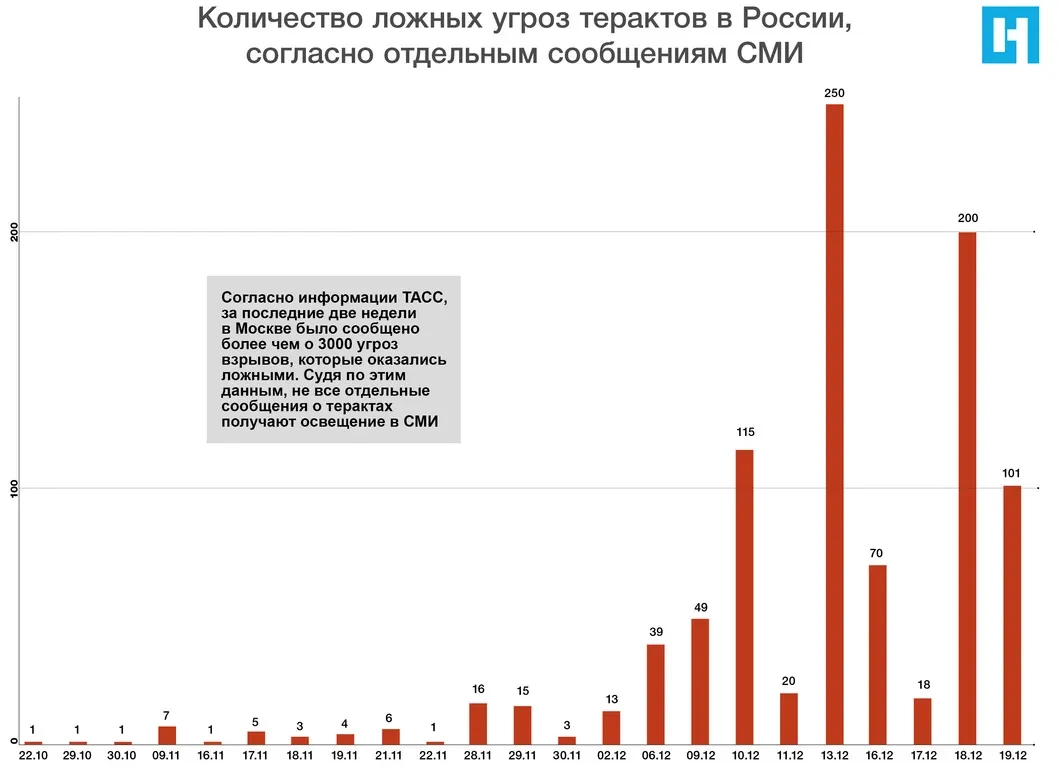
The collected statistics reveals only about 500 cases in Moscow for the specified period and less than 1000 - throughout Russia. As one of the hypotheses of what is happening, it can be assumed that in the media, apparently, there are no messages that were not related to mass evacuation. In addition, reader attention is saturated, so information about the evacuation of the school may remain, for example, in school chat and social networks, but journalists will no longer have serious interest in it. Finally, one cannot exclude the fact that the sources of information integrated in the temporary interval for TASS and other government media for those or another purposes overstate the number of messages.