
Translated material
Entertainment, self -confidence,
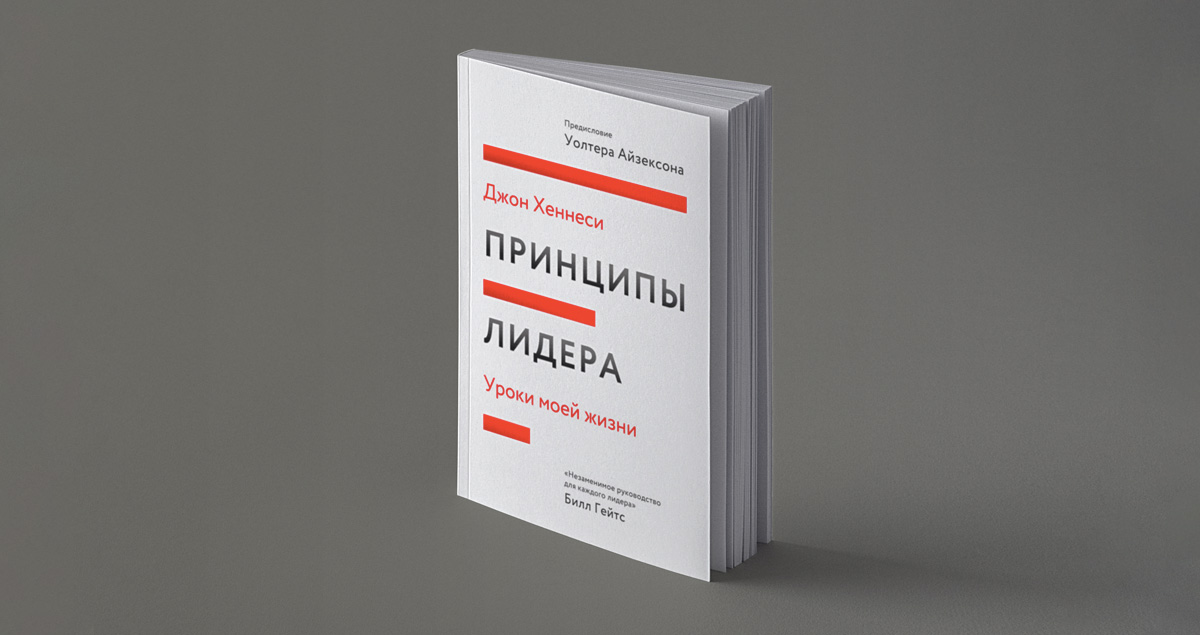
Entrepreneurship, self -confidence, healthy (or not even) arrogance, risk tolerance, selfishness and even narcissism - that, which seems to be made of strong leaders. The chairman of the board of directors of Alphabet, former president of Stanford University, John Hennessy, adheres to a completely different point of view. In the book “Principles of the Leader” ( published at the publishing house “Mann, Ivanov and Ferber”) Hennessy writes that one of the most important qualities is modesty. We publish the chapter in which the author reveals this thesis with examples from personal experience.
“It is unreasonable to be too confident in your own wisdom. It is useful to remember that the strongest can be weak, and the wisest one can make mistakes. ”
Mahatma Gandhi
Most of those who look at the phenomenon of leadership from the outside believe that the main quality of the leader is confidence. Indeed, if you are not sure of your own strategy and your role, you are unlikely to manage to lead others. Who wants to follow the leader who does not quite understand his own plans or opportunities! But what is the basis of confidence?
I think real confidence - not a mask, not an ostentatious bravado and not false confidence (the worst of all), but a genuine awareness of one’s own forces and character - does not originate in selfishness, but in modesty. Self -confidence reflects only our strengths, but does not take into account our weaknesses or other people's advantages, thereby exposing us to the risk of making catastrophic mistakes. Modesty indicates the sources of our weaknesses so that we can correct them, and makes it possible to earn the right to confidence.
<...>
Learn modesty, asking for help
Attracting funds is one of the best ways to exercise in modesty in a senior position. When you interact with thousands of employees, tens of thousands of students and dispose of billions of dollars of budget and funds, the government can hit quite quickly and tightly into the head. The modest task of attracting finance can serve as an excellent antidote.
If you calculate all the preparations accompanying the successful fundraising, it turns out that I spent from a third to half of my time as the head of the university in search of finances.
<...>
As president of the university, I well understood that I was only a tool in these operations, and I do not spend them on my own. My work - whether it is a speech before the regional assembly of graduates, a private meeting with a potential major donor or interview with a magazine of graduates - only completed the collective efforts of numerous specialists. And this also served as a source of modesty: I had to constantly remind myself that I was not making a deal. So that the other side to say yes, many people work hard, and I only closed the deal. If I made a mistake or made an incorrect impression, many months of hard work would have gone around the drain. In addition, I realized that both graduates and major sponsors did not meet with me personally, John Hennessy, but with the President of Stanford University, who would once become someone else.
At the same time, I understood the importance of my role as the main representative of the university. Large sponsors wanted to say hello to the president - not because they were, but to make sure that the initiatives that they decided to support would be met with due attention and supported by university resources. They asked me to put my reputation against their money. A serious request, but that was their right.
If we talk about especially large donations, then almost always they were made to the eye, without the presence of other employees. Only I and this famous, extremely successful and incredibly influential person. He knows exactly what he wants, gives gigantic funds for our needs and requires me to endless devotion. If this does not make you feel modest, then I don’t know what to say!
<...>
Develop modesty
The ability to act in accordance with the moment is not characteristic of me by nature, and the mastery of this skill was not easy. In the first half of my career, each of my speech was accompanied by many slides and presentations, usually abundant by diagrams, texts and equations. Having become president of the university, I found that I was now forced to communicate with groups of various sizes, from one large sponsor up to 200 thousand guests at the prom, without a single slide or presentation - sometimes there was no time to prepare time. Perhaps for someone this practice is not too complicated, but certainly not for me. I had to study on the go. At first it scared me.
Fortunately (although at that time such a prospect did not seem any “happiness”), I began to study this at the start of my career. In 1986, I was 34 years old. Two years before, we founded MIPS Computer Systems, and its affairs went uphill. Waiting for explosive growth, we recruited employees. But, unfortunately, the pace slowed down. We continued to expand, the profit remained very good, the transactions were still concluded, but the costs increased even faster. We should have started attracting funds earlier, but after the CEO change it was impossible. As a result, the money ended, and the probability was not ruled out that next month we will go bankrupt.
We had no choice: the abbreviations were brewing. Of the 120 employees, 40 had to be dismissed. The management decided to leave all the engineers, so it was necessary to choose between other employees. On Friday morning, we announced our intention, and by noon all the dismissed left the company.
It was terrible. I never thought that we would have to survive this, and did not want this to ever be repeated. Such moments - if we show enough modesty to accept them - make it possible to study by mistakes and change the course.
But on this bitter lessons did not end for me. Our CEO Bob Miller considered it necessary on the same day, at lunch, at all costs, hold a meeting for all the "survivors" and asked me to be sure to speak. I would prefer to refuse, but I realized that he was obliged to do this as one of the founders. I admitted that we made a number of mistakes, and then tried to outline the picture of a bright future company. Now I am glad that I acted then because that speech (although I could not know this), and both parts of it - recognition of mistakes and motivation of employees - served as excellent preparation for my future career.
After 12 years, when they announced my appointment by the President of Stanford University, I had to go on stage in front of an audience of several hundred people and make a small speech in which I had to briefly state my thoughts about the new position and the future of the university as a whole. Honestly, this was the first time that I spoke with official speech without relying on audiovisual material. I could give a good professional lecture or hold a seminar in the audience, but now everything was different, and I was damn nervous. How did I manage to survive it? I was imbued with modesty from the fact that the choice fell on me, and focused on what honor I had, how much my predecessor did for Stanford and how exactly I hope to help the university become even better.
The described situations prepared me for the circumstances in which I found myself throughout the professional career, including the attacks of September 11 and the financial crisis of 2008, which will be discussed in Chapter 5 “Courage”. Each of these events at the same time gave me modesty, and demanded to find the strength to accept the challenge. They helped me really become a leader.
Modesty and ambition
Before completing my discussions about modesty, I will add that, thinking about this quality, I mean not only an innate feature (although if you think about how you are at all lucky with birth, this should give you modesty). I will not mention the modesty based on self -denial. I am talking about the acquired modesty that every leader must educate in itself - it is no less important than courage and determination. The modest leader gives other people the opportunity to report his achievements - he personally does not need it. He is aware and openly admits that there are things that he may not fully understand. He willingly accept help when he feels that he needs her. He uses any opportunity to learn by mistakes and never evades calls, as he sees in them the potential for development.
However, modesty does not mean a lack of ambitions. Abraham Lincoln held modestly, but was very ambitious. I can say the same thing about myself, but my ambitions do not concern personal benefits (although I really like to win in gambling and golf): I always want to benefit the organization and the community that I serve. Perhaps the only way to combine modesty and ambitiousness is to direct your ambitions for the benefit of others.
Modesty as the basis of personal growth
Shortly before the president’s post, I indulged in memories with Isaac Stein - one of the trustees whose efforts I took this position. Isaac, who had headed the trusteeship by that time, was actively engaged in the search for my successor. He said: "You know, John, your main character trait that allowed us to choose you as president - the ability to grow on ourselves in the process of work."
I considered his words a compliment and tried not to cringe too much from horror at the thought of how inexperienced I was, taking this post 15 years ago. For Isaac, my ability to grow was most important than anything else, although, according to him, hiring me to work, he did not assume anything like that. Now the advice he head is trying to develop ways to evaluate this quality in order to put it at the forefront when searching for someone who replaces me.
But how to evaluate the ability to such a growth? I believe, through an assessment of modesty. If you understand that you still have a lot to learn, that others in this or that surpass you, that ideas are always more of many than the opinion of one, it remains only to be modest and focus on how to become better at your post.
We can say that when the leader puts modesty at the forefront, his role itself changes. I learned this to MIPS. In the conditions of a startup, when there is not enough time, and minor mistakes can be fatal, you cannot lead, separating themselves from employees: the team should be equal. Your task is not to tell others what to do, but to devote yourself to helping them better. That is why in MIPS, when we were preparing to send our first microchip to the factory, and there was no one to conduct the last checks, I sat down at the computer and began to write programs for generating tests.
The first CEO MIPS - Weimond Crane acted in a similar way. At first he announced that the general meetings were transferred on the morning of Saturday, because he wanted to convey to all employees, that at least half a year on the weekend we will work. Clenching the meeting, he unequivocally hinted that they should also have the whole leadership (including himself). True, he sweetened this demand by capturing a box of donuts. The same CEO with his own hand wiped the racks in the dining room, wanting to show that he did not consider himself above the rest. In the world's full stress, this gesture has already made a strong impression on me, and I still keep my memory of it, which in a certain sense affects my behavior as a leader.
Although I, like most people, should be more modest, I was the first to admit that by kind I am a completely not modest person. However, I realized the importance of modesty. Perhaps the most serious situations in which it is necessary to show modesty are related to incorrectly adopted decisions. Errors happen among all leaders, and it is better to accept them, have the courage to admit them and decide how to proceed. This book describes situations in which I had to do just that. Not the most pleasant procedure, but modesty greatly facilitates it.