
Translated material
Farewell, 2010s: how the middle class has been lined in 10 years
2020 will complete a strange decade, which for Russia began with hopes for rapid growth, and ends with a deep stagnation. Everyone suffered from slowing the economy and falling ruble, but the main victim of the 2010s was the Russian middle class.
Whom to consider the middle class
There is no clear definition, but there are many methods of evaluation. For some, it turns out that the middle class in Russia is 4%, in others-70%, Alfa-Bank economists write . They themselves consider to be the middle class of those whose income is from 110% to 250% of the median income of Russians.
The structure of the middle class in Russia reflects changes in the economy that have occurred over 10 years - at least in terms of increasing the share of the state in it. In parallel with how the public sector grew in it, the percentage of civil servants, representatives of the middle class, increased in it. In 2013, they accounted for 10%, in 2017-already 15%, followed by Alfa-Bank's report. And vice versa: for entrepreneurship in the structure of the middle class in 2017, it took almost half as much as in 2010: 9% instead of 17%.
Such a portrait of the middle class is very different from the global: there are mainly entrepreneurs and employees of private companies there.
How the middle class decreased
For ten years, Russia lost almost a fifth of its middle class: in 2014, 37% of Russians could be attributed to it, today-only 30%, alpha bank economists calculated . Sberbank Cib in its “Ivanov Index” also recorded similar dynamics: the share of people related to the middle class of people decreased from 60% in 2014 to 47% in 2018.

The graph shows that for ten years, the real incomes of the middle class have stagnated or decreased. The income of the poorest Russians at the same time increased by 4%, the richest-by 11%, according to Alfa Bank.
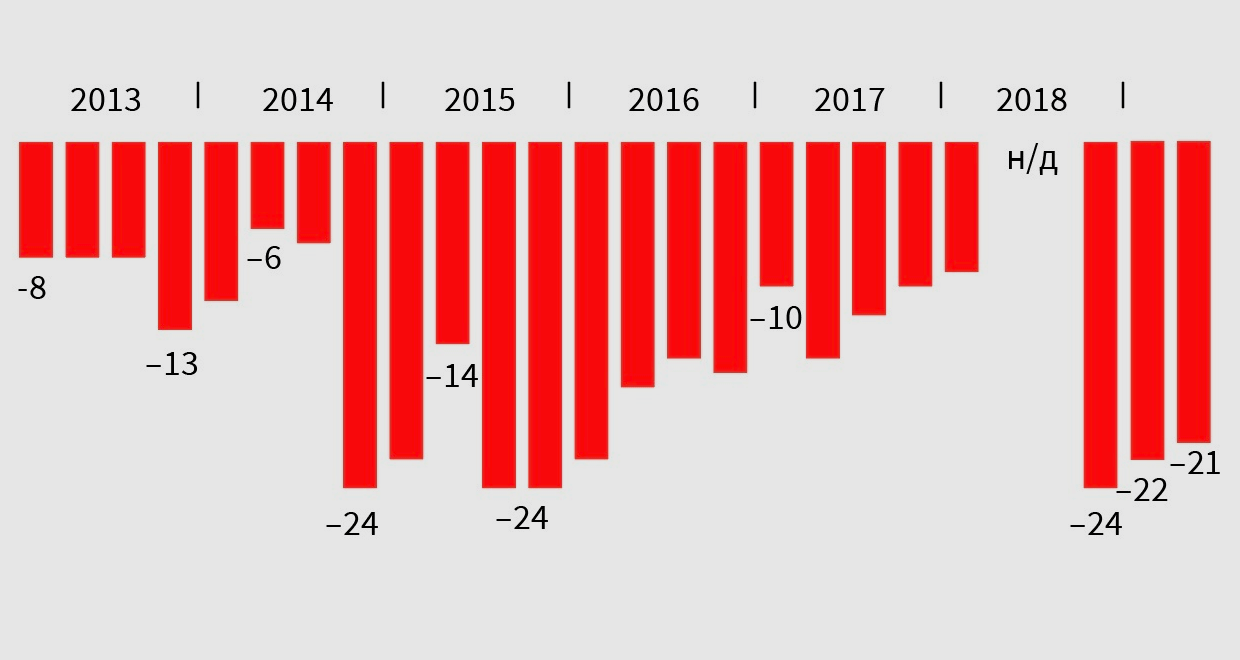
The number of the middle class began to decline sharply in 2014. At the same time, the “Ivanov Index”, which reflects the consumer confidence of Russians, also fell . If at the beginning of 2014 it was at -6%, then in 2015 it collapsed to -24%. A new deep fall occurred in 2018 - after it, Sberbank Cib for a while even stopped publishing the value of the index.
What he saves
Most of all I had to squeeze the most wealthy layer of the middle class: we are talking about the ninth decal group, which includes the top of the middle class. These are people who can afford prolonged consumption products like cars. They had to reduce the costs of rest and entertainment (2.1% to 7.8% of all expenses), as well as healthcare and education (by 1–3.3% depending on the group).
But the costs of food - grew. This is an important indicator - the higher the share of food costs in the structure of consumption, the lower the share of the middle class in the economy. In 2008, the Russian middle class already spent more on food than in developed countries. But over 10 years, these expenses have increased on average by 3 percentage points, to 26.6% of all costs (in the lower layer of the middle class) or 19.7% (in the upper), it was considered in Alfa-Bank. Sberbank CIB ratings are even more conservative: according to the “Ivanov Index”, almost 39% of income is spent on the middle class.
How life has risen in price
To better imagine how the fall in the middle class’s income looks in reality, we chose several categories of expenses and appreciated what has changed in recent years.
As we thought
We took the data of Rosstat and the Wiid of the UN about how the Russians were mediate in 2008-2018 and according to the Alfa-Bank method, we calculated the upper border, how much the middle class received on average: it turned out-29.4 thousand rubles in 2008 and 61.8 thousand in 2018. Then we chose a waste of waste for him - a trip abroad, dinner in a restaurant, buying a car - and calculated what percentage of income was ten years ago and how much now.
The nominal income of the middle class over the past 10 years has grown by 110%, but compared to 2014, which painfully hit this group, by only 21%. And real income, adjusted for inflation, has been sagging at the middle class over 10 years, Alpha Bank claims.
Here are a few examples: compared with 2014, the prices of the middle class grew up, the prices for the iPhone grew, foreign trips (night in the hotel in Milan, compared with 2008, went up by 64%, current expenses in the trip increased by at least 51%following the fall of the ruble, and all the trip by 23%). Almost as much as the nominal income of the middle class grew up, and foods also rose.
iPhone of the last model
Price increase: compared to 2008 - 261%, with 2014 - 106%
In October 2008, the iPhone of the last model appeared in Russian stores - then it was an iPhone 3G. In Euroset it cost up to 26.9 thousand rubles (for 16 GB of memory), these were the first iPhone, which were sold legally in Russia. In 2014, the latter at that time IPhone 6 was sold for 47 thousand, and in 2018 the iPhone XS Max cost 96,990 rubles. In addition to the constant increase in prices from Apple, the collapse of the ruble of 2014 affected the affordability of smartphones in Russia, when the Russians began to feverishly sweep electronics and household appliances from the shelves of stores, fearing the speed of prices. In a few weeks of December, they really jumped by 10–40%.
Ford Focus machine
Price increase: compared to 2008 - 79%, since 2014 - 12%
Over the past ten years, the car market has traveled radically twice: in 2009-by 51.8%, in 2015-by 35.7%. Then in the mass segment the fall was much more sharp (by 37%) than in premium (23%). The fall of the market took place against the backdrop of a rapid increase in prices for cars. In general, over the past five years, they jumped 76%, evaluates the Avtostat agency. The main reason is the fall of the ruble. By the beginning of 2019, prices have already played it, but the growth rate supported the increase in VAT: since the beginning of 2019, 26 marks have risen in price (15–310 thousand rubles).
In 2008, the most folk car - Ford Focus - cost 345 thousand rubles in the minimum configuration, according to the Avilon car dealer. In 2014, the same car would cost 549, and in 2018-616 thousand rubles.
Dinner in a restaurant (twice a week)
Price increase: compared to 2008 - 58%, since 2014 - 5%
Since 2012, the average check in Moscow restaurants has grown from 990 to 1569 rubles, estimated the 2GIS service. As for the entire middle class, 2015 turned out to be difficult for restaurateurs: they hardly survived in a new reality with a rise in price and jumping up the prices of products due to the food embargo. At the beginning of the year, about 50 restaurants closed in Moscow, and the survivors began to adapt the menu to the conditions of counter -sanctions and gradually raise prices. As a result, a middle -class representative who goes to restaurants twice a week began to spend about 4.6 thousand rubles more than 10 years ago.
Products (three times a week)
Price increase: compared to 2008 - 44%, since 2014 - 19%
The average check on the Perekrestok supermarket network almost doubled-from 361 rubles in 2009 to 521 rubles in 2018, the X5 press service said. According to the Romir research holding, most Russians go to the store several times a week. If we assume that the average middle -class representative goes to the store three times a week, in 10 years he began to leave monthly there almost 2 thousand rubles, or 44%, more.
One of the main reasons for the growth in prices is counter -sanction, KPMG analysts write . The fact that in the first two years of counter -sanctions the foods went up by a third, were recognized in the Ministry of Economic Development. Import substitution in agriculture worked: Russia almost completely provides itself with grain, meat and sugar, but the Russians paid this agro -industrial miracle: prices rose for foods that fell under the embargo and the rest. For five years, butter has risen in price by 79%, frozen fish - by 68%, flour and pasta, which used to be in abundance in Russia - about 30%.
Walking to Milan for the weekend
Price increase: compared to 2008 - 34%, since 2014 - 23%
The travels of the Russians rose overnight with a collapsed ruble. In the first half of 2015, it became sharply less tourist trips - by 34%. The average cost of night at the Milan hotel increased from 126 euros in 2011 to 144 in 2019. Given that during this time the Russian currency managed to collapse, in rubles even sadder: in 2008, the hotel would cost 4 thousand rubles, in 2018-more than 9 thousand. Tickets for 10 years also rose by about 5 thousand, counted One Two Trip. And the costs of the trip increased by about 3 thousand a day (based on the average minimum of 45 euros, which requires the Italian embassy with you). But there is also good news: although on average flights are getting more expensive, in some directions prices have significantly fell. So, the average flight check in Barcelona decreased by 10 thousand rubles, to 14.2 thousand, in Tel Aviv-by 6, to 14.3 thousand, in Sochi-almost double, up to 6.7 thousand rubles, the Aviasales press service claims. This is a direct consequence of the development of mass tourism: there are more passengers and more low -cost airlines, explains the representative of the aggregator.
What am I to me?
For ten years, the iPhone has risen in price by 260%, Ford Focus - by 78%, a trip to Europe for the weekend - by 35%, products - by 44%, dinners in a restaurant - by 58%. If your income during this time has grown in about the same way as the median one - by 110%, everything is in order. But, judging by Alfa Bank and Sberbank Cib, not everyone managed to stay in the middle class.