
Translated material
"I was crushed like a bug, instantly"
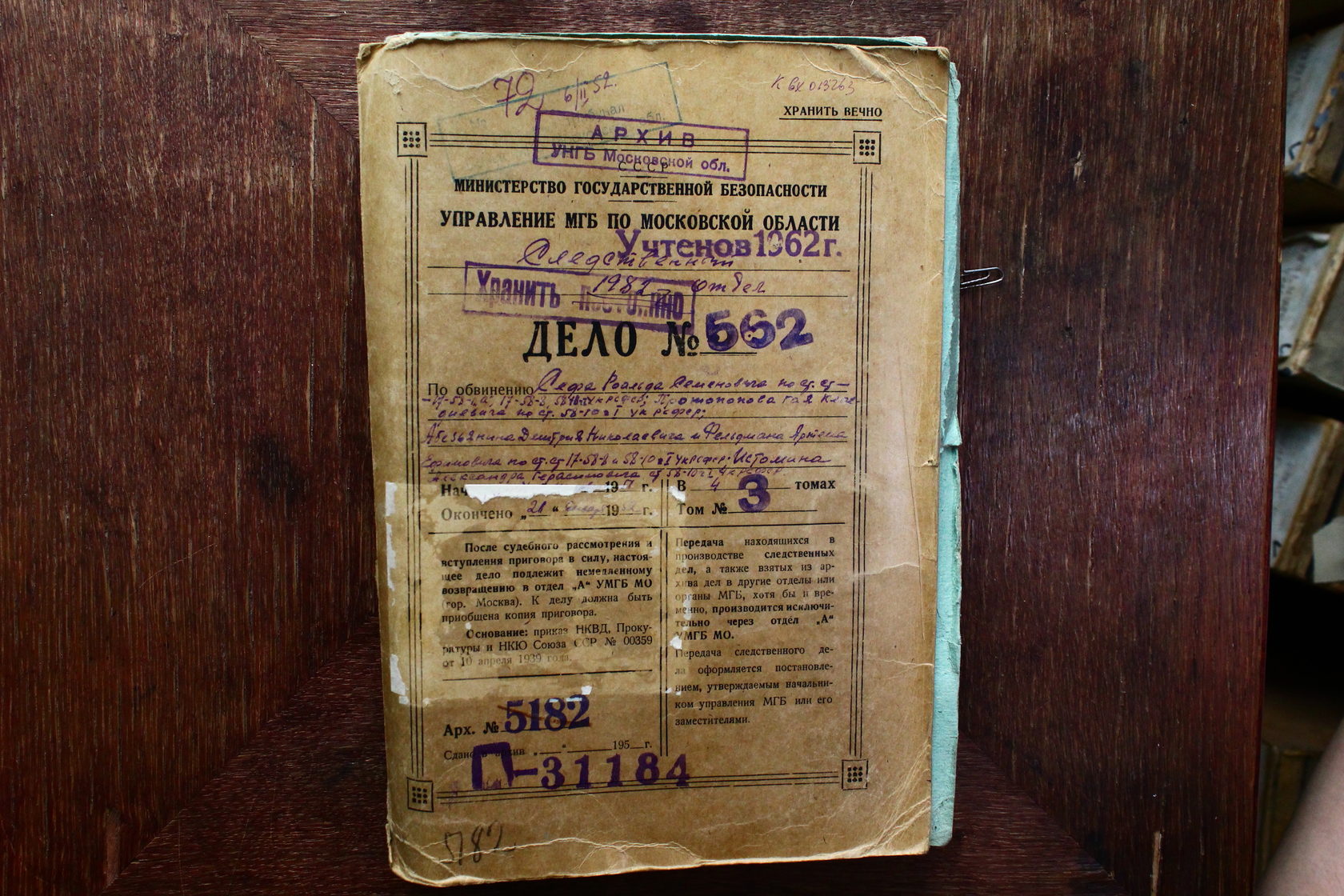
"I was crushed like a bug, instantly"
How a student of Moscow State University was condemned for jokes
for 25 years of hard labor
Author: Seraphim of Sverdlov
With the participation of Alexei Makarov ("Memorial")
The Memorial Society is included in the register of Foreign Agents. We are forced to leave this warning at the request of the state.
Publication: 25/01 /2020
Shortly before the arrest, one of the former neighbors came to Artem. Feldman writes in the memoirs: “Then it turned out that he was to everyone who was arrested in our business. Obviously, he was an agent of GB [state security bodies]. He came to me with a proposal to work in the Polytechnic Museum as a guide. It was a move to find out my further intentions - if I am going to leave Moscow. ”
However, Roalda Artem found about the arrest only in the fall when he returned to study after the summer holidays. At the university, he caught the strange gaze of unfamiliar students on himself and only then realized: apparently, there were already denunciations on him, and everyone knew that they were going to exclude him.
Once after the classes, Artem took aside the teacher and advised to be careful at the seminars. Artem writes: “Since I was, I can’t say different-, but still thinking, then in the classroom on the basics of Marxism-Leninism, out of ignorance, I got to the Trotskyist positions.”

How a student of Moscow State University was condemned for jokes
for 25 years of hard labor
Author: Seraphim of Sverdlov
With the participation of Alexei Makarov ("Memorial")
The Memorial Society is included in the register of Foreign Agents. We are forced to leave this warning at the request of the state.
Publication: 25/01 /2020
At the time of arrest, Artyom Feldman was 23 years old. He studied at the Faculty of Economics of Moscow State University, joked a lot and loved to tell jokes. It was for these jokes, which the investigation called the "anti -Soviet", in October 1951, and four comrades brought a case of anti -Soviet agitation on him and four comrades. Artem calls him “typical far -fetched”: “The group was created by the fantasy of my one -man, people were not interconnected. The indictment, mainly, was a set of individual phrases, jokes, everyday situations. ”
Shortly before the arrest, one of the former neighbors came to Artem. Feldman writes in the memoirs: “Then it turned out that he was to everyone who was arrested in our business. Obviously, he was an agent of GB [state security bodies]. He came to me with a proposal to work in the Polytechnic Museum as a guide. It was a move to find out my further intentions - if I am going to leave Moscow. ”
However, Roalda Artem found about the arrest only in the fall when he returned to study after the summer holidays. At the university, he caught the strange gaze of unfamiliar students on himself and only then realized: apparently, there were already denunciations on him, and everyone knew that they were going to exclude him.
Once after the classes, Artem took aside the teacher and advised to be careful at the seminars. Artem writes: “Since I was, I can’t say different-, but still thinking, then in the classroom on the basics of Marxism-Leninism, out of ignorance, I got to the Trotskyist positions.”
Photo of Artem attached to the materials of the investigation
Photo: Archive of the "International Memorial"
Artem was arrested at night, searching for a communal apartment room, in which he lived with his parents and younger sister. When Artyom was taken away, his father was not afraid of his arrest or conviction, saying that he believes in organs and will not say goodbye to his son.
The first interrogation was given to Artem. Before that, he stayed in boxing for a day, where it was only possible to stand, and there were much more investigators than they usually do such matters - a 20 man. “Such a cross interrogation so that a person was dizzy, I did not even have time to translate my eyes to the one who asked the question. The questions were the most stupid, the most unexpected - they had the only task - to confuse, completely demoralize the arrested. ”
The following interrogations were calmer. The young investigator “kept himself easily” and loved jokes. Investigators, apparently, immediately found an approach to him. If Artem felt pressure, he would have begun to resist, and in a calm conversation he was revealed much faster, as he recalls in his memoirs. When he realized that he was accused no more than in telling jokes, he felt the frivolity of his position. “I was crushed, like a bug, instantly, because the matter has already been created and all the roles were painted. I did not need to resist, and, in fact, I seriously did not think that some stupid jokes would serve as the reason for such a long term-25 years, and even in return for the death penalty, which was canceled by this time. ”
Decree on the seizure of the property of Artem
Photo: Archive of the "International Memorial"
Despite the constant jokes and a rather favorable atmosphere, Artem was completely exhausted by night interrogations and a single camera. “From some point, own fate has become [me] completely indifferent. The investigator needed something to write down-and I gave him the necessary testimonies quite obediently. " After several months, under arrest, he tried to recall what his fault was not by investigation, but in his life: "He selected the prosecution for himself, repented of something."
During interrogations, Artem pleaded guilty and confirmed that he did not quite agree with the politics of the Soviet state, compared in the form the system existing in the USSR with the dictatorship of Nazi Germany and stated that in the conditions of the Soviet regime, "he had to live in three deaths."
Artem did not feel any support what, for example, the guys who were going on the matter of youth organizations received for example. They had comrades who share their views. Artem felt his loneliness to the fullest: “When a person alone, against all this monstrous apparatus of violence, and his fate, indeed, becomes indifferent to him, he, of course, must choose the accusation for himself, because he was simply offending him completely in vain ...”
There were many confrontations, but one of the most memorable was with a witness who testified that Artem “slanderously claimed that Karl Marx was a Jew”:
“I turned to the investigator with a request to ask a question to the witness. The investigator allowed, and the following dialogue occurred:
- I really said this to emphasize that Karl Marx was a Jew, or was it just a statement of the fact of his nationality?
- No, without any emphasizing this fact.
Then the investigator from the witness asked:
- Why did you write it? What is slanderous?
The witness turned to the investigator and said with reproach and bewilderment:
- But you so wanted! .. "
From the very moment that Artyom was brought to the courtroom, he had a feeling of disgust and bewilderment: a long and tedious trial, a huge number of witnesses and accused, and judges seem to be solid people, and "picking in this shit, and most importantly, with pleasure."
All witnesses were launched into the hall and began to read the verdict. Artyom was sentenced to higher - 25 years in the third camp department of the steppe camp in the village of Kengir, located in the central part of Kazakhstan. He was charged with anti -Soviet, nationalist agitation, enemy and terrorist attacks against the leaders of the Soviet state, the composition, storage and distribution of documents of anti -Soviet content. He was stunned, because until the last moment he did not understand the seriousness of his situation.
Photo: Archive of the "International Memorial"
Artyom was taken to the station in the car with the inscription “Living Fish”, put separately from the criminals along with the Estonians, also with 25 years of terms. Further, a significant part of the memories is occupied by sketches of the surrounding people: political prisoners, criminals, overseers, and escorts.
“The prisoner-Tuvian, the old one, does not hear poorly, one eye is completely covered with underwear, the second is already touched. In Russian does not understand anything, knows only two words-twenty-five, and he answers all the security issues-twenty-five: an article, and a term, and how many years, and where you go. And only in the camp it turned out that his grandfather had article 58-6, i.e. espionage. And how he could physically spy, not seeing, not hearing or understanding in Russian, is still a riddle for me ... ”
Artyom was immediately determined in the construction team, where he worked his entire term. He adapted to masonry in 30-degree frosts in the wind. “In general, with regard to excavation: in the camps and in the wild it is still not clear to me how the globe was enough to perform all these works ...”
Photo: Archive of the "International Memorial"
He adapted to the domestic problems of camp life. At first, he used a piece of wood instead of a spoon that had to be cast from aluminum wire. Artyom also had to shave the beard moistened in a puddle with a pinch and eat with the help of transfers from other prisoners.
“When they killed the Livshits, who arrived with the stage of the Jew, whom no one even managed to see, Felix Berger and Fridman Fridmen were accused of murder, and at the same time they arrested me with them. They brought to prison, argued the buttons, removed the laces, but some senior lieutenant came and said: “And this one is extra!” And they returned me back.
And later I found out that the guys admitted the murder, although they never saw the murdered person. And after the death of Stalin, they began to convince them that they were not killed. And in the end, the prosecutor's office managed to prove that they did not kill ... "
Stalin's day Artem also remembers well. The prisoners were not taken out of the barracks, there was tense silence:
“A very cautious and law -abiding Motya Talalaevsky lay with me, he tells me a careful whisper; "Really died?" And suddenly from somewhere from above, with a nar voice to the whole hut: “Damn it, eat his mother!” ”
In 1956, the Moscow Commission for Revision of cases began in the camp. On July 17, Artem was released with the removal of a criminal record, at the end of the month he was in Moscow, and in November received a certificate of rehabilitation. He recovered at the university, issued a transfer to the All-Union Correspondence Institute of Civil Engineering and went to work as a designer in the mining work trust. In the late 1980s, Feldman played an important role in the creation of the Memorial and took an active part in the work of the Commission of the Moscow City Executive Committee for assistance to rehabilitated citizens.
| Discuss in VK |
| Discuss in the FB |
| Offer the material |