
Translated material
Reconciliation in Shiite
What is behind Iran’s “soft” answer to the murder of General Suleimani
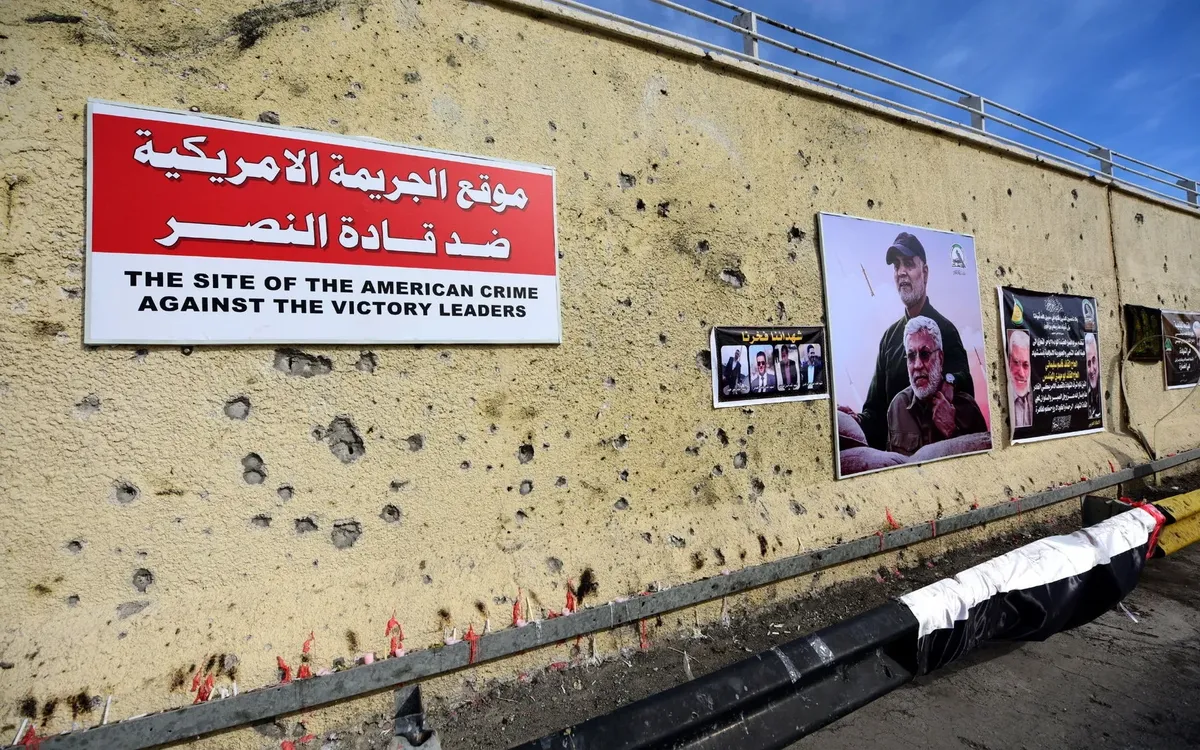
On January 3, the United States liquidated one of the highest officials of Iran, the head of the al-KudS special forces Corps of the Islamic Revolution of Kasem Suleimani. The general died as a result of a airstrike applied near the Baghdad airport.
The USA inflicted led to a small surge of oil prices (up to $ 69 per barrel. Brent), as well as to numerous fortune -telling relative to the beginning of the Third World War. For several days, the world “commentat” wondered what will be the answer of Iran to the actual Casus Belli.
On the night of January 8, Iran struck two US military bases in Iraqi Assade and Erbile. Tehran announced that he released 15 Earth-Earth classes in American objects. At the same time, Washington said that no one was injured as a result of a blow.
The market instantly appreciated the Iranian blow to the desert (or by void) as an action, on the one hand, which had the goal of maintaining a face within the country, on the other hand - as a sign of reconciliation with the United States. Oil prices instantly reacted to the fall to levels lower than before the murder of Suleimani (below $ 65/barrel. Brent).
Outside the general context of the situation in the Middle East, everything that happened looks like a faint Iranian answer to the unexpected aggression of America.
However, another interpretation is possible: the US actions are a veiled response to attacks on oil facilities of Saudi Arabia, carried out on September 14, 2019.
Recall that then several drones and possibly cruise missiles were attacked by two oil preparation plants, Akkayk and Khurais, in the east of Saudi Arabia. Responsibility for the attack was taken by the Husitian rebels from the neighboring Yemen, who are considered to be a proxy group of Iran.
The complex in ABAKACK accepts oil from the neighboring gigantic field of Gavar (the largest in the world), as well as from the deposits of Hurais and the Washing and cleans it from hydrogen sulfide. After this procedure, oil can be transported to ports on the shore of the Persian Gulf and exported. The operating capacity of the plant in ABAKAK-5-6 MBD.
This is a giant volume, given that all global oil production in the world is about 100 MBD. The industry insiders compared the attack on Akabka with a heart attack for the entire oil market.
As in the case of the murder of Suleimani, the world very quickly forgot about what happened. Oil prices jumped in mid -September to the local maximum $ 63 per barrel. Brent, but in just two weeks they entered the usual multi -month corridor $ 57 +/– $ 5 per barrel.
But it is quite possible that the memory of the Middle Eastern monarchs and their allies in the West is not as short as those for whom these events are only an informational noise. Attacks on Saudi oil facilities showed the critical vulnerability of the global hydrocarbon market. But at the same time, they were left without any obvious answer both from Saudi Arabia and from its Western allies. Strange, isn't it?
In this context, the murder of the Iranian general, who was just the same for the external military operations of Tehran, looks a little different. Moreover, the previous attempt on it was made in early October 2019, almost immediately after the attack on Saudi oil facilities.
The events of the beginning of 2020 in the Middle East, as always, is not an isolated act, but the next link in a very long chain. The issues of domestic policy, which largely forced Trump to show rigidity against Iran (presidential elections in 2020), are equally relevant for the clerical elite of Iran.
The production of oil and gas condensates in the country, which was 3.8 MBD and 3.6 MBD in 2017 and 2018, respectively, fell to 2.2 MBD at the end of 2019. The sanctions imposed by the Trump administration turned out to be much more tough than under President Obama. Given the high domestic consumption, the Iranian oil exports were actually abundant regarding the level of last year (below 1 MBD). And all this with the extremely painful consequences for the economy-according to the IMF, the Iranian GDP, in 2019, amounted to 9.5%. Not Venezuela (so far), but not enough.
Everyone heard about protests in Iran, but few pay attention to the fact that they are, including a social character. Society is waiting for changes not only in the economy, but also in politics, which is heated by the feminist movement.
In September, a girl named Sahara Khodayari died, having made an act of self -immolation in protest against a ban on women to visit football stadiums.
In the Middle East, such a desperate protest reaction is not the first case. The act of public self -immolation of the merchant Muhammad Buazizi in Tunisia in December 2010 provoked no less “jasmine revolution”. The incident in Iran forced local women to think about their rights and take to the streets, threatening the current regime. How to distract people from high inflation in such a situation, falling standard of living and protest moods? Remember around the top opposing world evil (USA).
Summary: Do not believe that it will end with a conciliatory (supposedly) gesture of Tehran. Iranian Shiism for centuries was in the status of an oppressed sect. At the same time, the latter developed a whole ethical complex of concealment of its true beliefs and actions - Takya, "the prudent hiding of his faith."
Since then, little has changed. Iran’s weak response to the murder of Suleimani with the blows “on the desert” means only unpreparedness to an instant response to the actions of the United States. But revenge, as you know, is a "dish that is served cold." And Iran will cook it as much as it takes. According to the analysts of Oxford Institute for Energy Studies, the answer options are enough - from cyber attacks to mining the Ormuzian Strait, which is critical for the transportation of oil of the Arab monarchies of the Persian Gulf. And, apparently, the real answer will be carried out by the strangers of the Iranian proxy, which always corresponded to the style of Tehran.