
Translated material
Gold attracts us
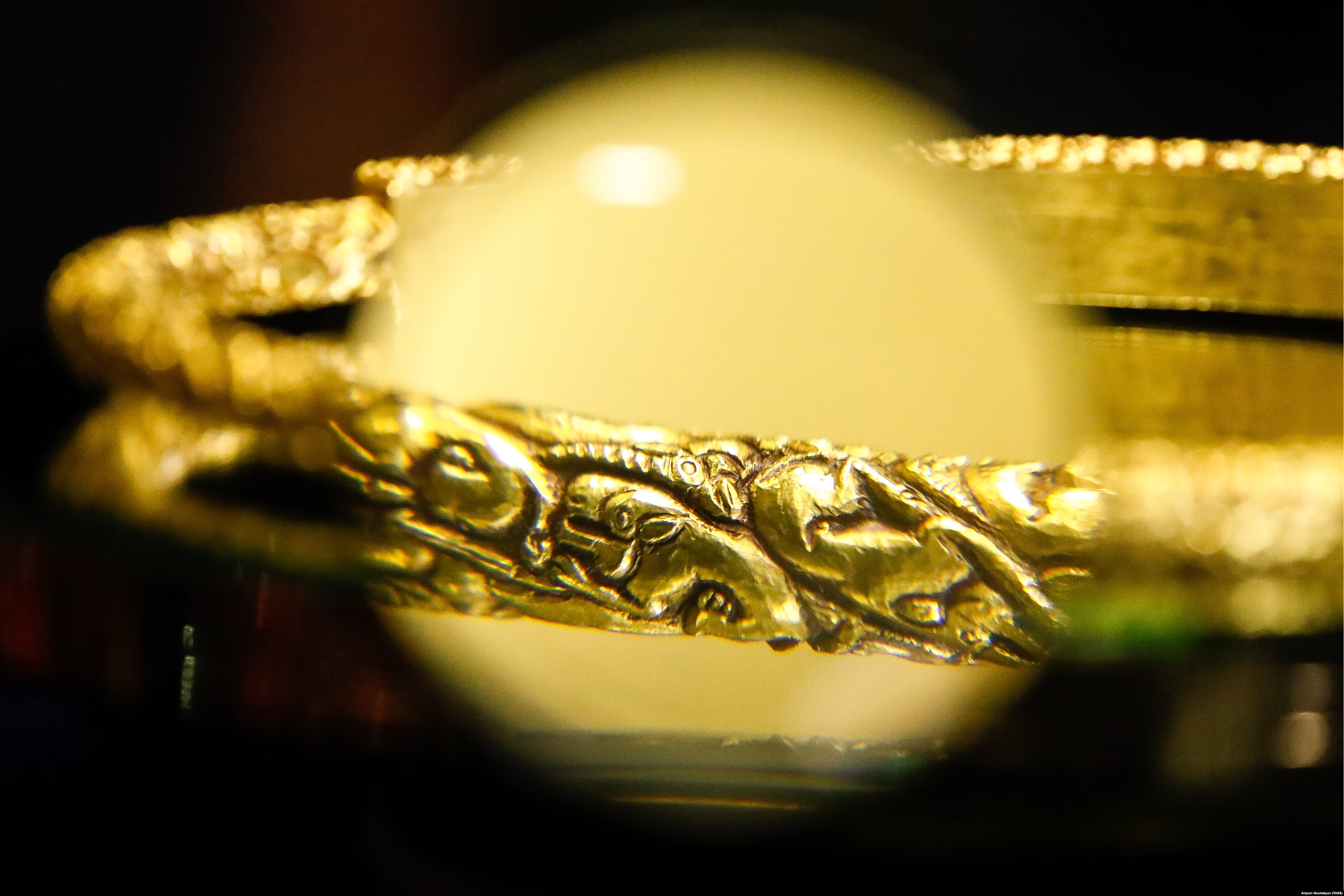
Vladimir Nikishin and Andrei Gilodo: Why is all the best in the world considered "golden"?
- The gold, coveted and contempt, played a special role in the history of mankind: it built and destroyed, generated and killed, inspired and drove crazy.
- Like no other metal, gold is surrounded by myths and secrets, wars started because of it, they worshiped him and served.
- Gold is a metal of the highest dignity, but at the same time it is somehow connected with the low and unclean: for nothing, the Russian people in the old days called cleaners of the restrooms "golden".
- The history of mankind is the history of gold treatment: gold is multifunctional due to its rarity and nobility.
Alexey Yudin: Today we will talk about the gold that built and destroyed, inspired and drove crazy.
Correspondent: Gold, like no other metal, is surrounded by various myths and secrets, wars started because of it, they worshiped him and served. It brought fame to someone, and someone deprived of all the most expensive.
From ancient times, gold was considered a symbol of wealth, power and success. It is often a measure of quality, beauty, nobility and uniqueness. Golden years, golden hands, golden words, golden age, golden people - all this is worth its weight in gold.
However, everything is not so unambiguous. From time to time, gold was called a despicable metal and even publicly refused it. The expression "golden youth" is also not about nobility and dignity. Among other things, until the beginning of the twentieth century, sewage was called night gold, and the Assenizers, therefore, the goldsmiths.
Gold was one of the first metals discovered by man. True, we are unlikely to find any accurate information about the beginning of its use. It is believed that gold was familiar to humanity already in the Neolithic era. One way or another, this metal is common on all continents, and it is believed that the main gold storage is in the earth's core.
Scientists believe that they began to systematically produce gold in Egypt: it was there that the first gold jewelry was found. In the 16th century BC, gold became a recognized standard in international trade, and in the 50s BC the first gold coin appeared. But as a monopoly money goods, gold coins were established only by the XIX century, however, it was not for long: after the First World War they were replaced by paper money.
To Russia, before Elizabethan times, gold was imported from abroad, and the first domestic deposits of this precious metal were opened in the Arkhangelsk province in 1732.
Today, Russia in gold reserves is in sixth place in the world, the first place is occupied by the United States, then Germany and the International Monetary Fund.
Today, gold is used in industry, dentistry, pharmacology and even in the food industry
Today, gold is used in industry, dentistry, pharmacology and even in the food industry. Despite the fact that gold is metal, it can be eaten. However, most often gold becomes the object of investment and the basis for jewelry. It seems that throughout the history of mankind, gold has been and remains an unchanged standard for a better life.
Alexey Yudin: I represent our guests: this is the adviser to the director of the All-Russian Museum of Decorative and Applied and Folk Art Andrei Gilodo and antiquity historian Vladimir Nikishin . Let's first sake praise and glory to gold. What did it give to humanity?
Andrei Gilodo: Gold, of course, appeared as a metal and as a value significant for his civilizational understanding, not earlier than during the period of bronze. The period of bronze is the mastery of metals, the ability to work with them in all types. Bronze has accompanied gold for almost millennia, like a certain imitator. Being not so valuable and not so rare metal, bronze, nevertheless, was valued very highly, in the same way it was an attribute of the highest classes of society. From bronze, both jewelry and weapons were made, that is, symbols of the social significance of a person. Polished, polished bronze in ancient monuments is always compared with gold - shines like gold.
Vladimir Nikishin: She was also often gilded.
Andrei Gilodo: Gold from the very beginning is a very interesting material. From the moment of its appearance in human civilization, it has been a sacred material, because initially it was a symbol of the sun, sunny. This is one of the highest deities of the Divine Pantheon in all religions, civilizations and ethnic groups.
Alexey Yudin: We recall Aztecs, Mayan, and the golden statues of the Buddha, and, of course, early Christian painting, icon painting, the total of the golden sky.
Andrei Gilodo: The plot said that gold appeared in Egypt, but this is not so. In Egypt, metals were not produced, all of them were imported, including from Nubia. They did certain things there, but gold as material, as raw materials in Egypt, was not produced, so it was so high and appreciated there. Scythian gold, what we know how the gold of Troy according to the Shliman collection is extremely thin, like paper petals. This speaks of a very high value. The famous pectorals and decorations of the Scythian kings are voluminous, they give the impression of very massive things, but in fact, it was in ancient times that they came up with the technology of the so -called blowing gold. These are the finest leaves from which the volume is made, and inside it was refueled either by a paste or special sand.
Gold was valued in the highest way. Only people of tsarist dignity, of the highest merits could use it: military leaders, nobles, temple representatives. It is no coincidence that in a number of civilizations in a number of civilizations: in China, and in India, and in the ancient East - it was not allowed to use gold to the ordinary estates, this was forbidden until the death penalty.
Gold is in circulation: this is evidenced by the famous archaeological finds associated with the gold heritage: gold returns, it does not disappear. And even being buried in the ground, it returns. There is a certain sacred mystical beginning. Divine material determines a lot of things in the civilization process, in human life.
Alexey Yudin: That is, gold is not only about metal, about matter, but also about something else.
Vladimir Nikishin: Copper is very close to gold, since 75% in the alloy is gold, and 25% of copper. In recent years, scientists have invented light gold. There is no more copper, in its place latex. Thus, it becomes possible to create the gold that does not sink in water, light or plastic gold.
The story of gold was brilliant. Real gold is no less magnificent. As for his future, it surpasses everything that can imagine the most bold imagination. Gold was, is and will be. This is a unique metal. The history of mankind is the history of gold, gold circulation, because gold is multifunctional due to its rarity and nobility of the metal itself. It is even known how much it has been mined over the past 7 thousand years - about 161 thousand tons: not so much. Almost all of this gold is in circulation. If we talk about the reserves of different countries, then today it is about 30 thousand tons. Gold continues to perform the most important function of exchange, circulation, accumulation, prestigious consumption, sacred function. Gold is the king of metals and the metal of the kings. Gold can be white and blue, and now also purple, and green, and black, and whatever.
Alexey Yudin: Did gold initially had any competitors?
Andrei Gilodo: There were no competitors and will not be. Even silver was no coincidence from the very beginning the second material. Silver is the material of the moon, this is all related to the lunar cycle and its sacred things.
Alexey Yudin: Did the diamonds stand nearby?
Andrey Gilodo: Never! Diamonds as a phenomenon in human life and as an object of art appeared quite late, in the XV - XVI centuries. This is the beginning of great geographical discoveries. In the ancient East and in the Middle Ages, and even in the new time, from where the impulse for jewelry things went, the diamond was never a number one stone. Colored stones were always valued there, and they were never processed. For an unprocessed, illiterate, unconnected, unnecessary diamond, this is nonsense, because it can be easily replaced by a natural crystal, and it will look the same. The appearance of diamonds is the result of a very large civilizational turn. When America was opened (Aztecs, Inca, etc.), a giant stream of gold, silver and precious stones went to Europe, why Spain at once became the first state for several centuries. Spain was not only able to use gold in the coin, but also a huge impetus was given to the development of jewelry art.

The Scythians, which spread in different cultures and versions from Altai to Syria and Egypt, remember two things: the first is that they are very belligerent, and the second - that they are very rich, all are hung with gold. Gold as part of weapons decoration is the second famous sacred thing. Jewel and weapons are two symbols of power.
Alexey Yudin: How did the person strive for gold, what interesting stories are there?
Vladimir Nikishin: Gold is a very powerful incentive, this has remained so for millennia. It stimulates the entire course of historical development, because it is the subject of prestigious consumption, the most valuable trophy that you can imagine, wars were often waged precisely for the sake of gold, the indemnities were paid in gold, the most valuable trophies were gold. If you recall the iconic events that turned the history of mankind, then first of all this is the story of Concista and in parallel - great geographical discoveries: here the most important motive was precisely gold. Columbus sailed west to swim to India: he needed gold. This was the main incentive for other navigators. Ultimately, even the pursuit of spices had in mind the accumulation of gold.
Alexey Yudin: Were there any spices competitors of gold?
Gold is a very powerful incentive, this has remained so for millennia
Vladimir Nikishin: In fact - yes. In this regard, a conquista arose. The conquistadors were shone with the ghostly light of gold. Hence the legends about Eldorado and so on. There were many interesting events and myths.
Alexey Yudin: This is also a grand incentive for the development of the world.
Vladimir Nikishin: Of course. For the local population, for the unfortunate Indians, who fell victim to this insatiable passion of Europeans to yellow metal, all this was disastrous.
Alexey Yudin: Autochthonous population did not have this passion?
Vladimir Nikishin: As I understand it, absolutely no. For Aztecs and Inca, gold was just a metal of the sun. It carried a sacred function, but there was never any golden fever, no golden fever among the great civilizations, Aztecs, Incas.
Andrei Gilodo: It was the cult, temple, sacred, but not material significance in these civilizations. Of course, gold is a certain marker in history. If you turn to antiquity, starting from the bronze age, then gold is one of the materials that equipped and outlined communication, trade routes, because along with copper and bronze it was the most important subject of trade. In the same Syria as the oldest civilizational center, there were never their metals of their gold, they came from the Caucasus, and a little later from the Urals. When creating large civilizations of the interfluve, tiger and Euphrates, the development of cities, the appearance of tsarist power and the entire hierarchy, gold was required for social situations.
Alexey Yudin: I am interested in the flip side, gold fever, this is an insatiable thirst.
Vladimir Nikishin: Here we can recall the most grandiose gold trophy in history, which Pisarro received as a ransom from the last emperor Inca Ataalpa. In order to redeem ataoelpu, the Indians paid almost 6 tons of gold and about 12 tons of silver. This is a record in history. These were mainly works of art that the Spaniards melted into ingots.
Andrei Gilodo: The development of piracy in the Caribbean was largely facilitated by the transportation of gold and silver from America to Spain. The “positive” moment of receiving gold to Europe gave rise to the destruction of interesting ancient civilizations in America and the creation of a whole section of a robber craft called “Piracy”.
Vladimir Nikishin: There was also a revolution of prices. True, not so much gold participated here as silver. Still, it played a major role in monetary circulation in Europe of that time: more silver coins were minted. Nevertheless, gold also played a role in the fact that the same Spain quickly ceased to be a great power precisely because of the excessive amount of precious metall, which poured from the New World to the Old.
Andrei Gilodo: That is, the gold raised Spain, and it also destroyed it. This is a dualistic value: it gives, and it takes. To take Jack London - there is a lot of great achievements of the human spirit, the great pioneering in the northern latitudes, and on the other hand, completely disgusting human greed, the willingness to sell anyone for the sake of gold, the murder of closest friends. Gold gives rise to both high in art and sacred things, and the most low. You can rephrase what was said about poisons: it all depends on the dose and context. The poison can kill, but can cure. So gold can kill, or can move to many very serious things.
Alexey Yudin: Can there be a measure for gold?
Vladimir Nikishin: Of course. This was engaged in economic thought. You said that gold comes, and the gold is leaving. I would change this formulation: when the gold remains, it gives the strength to that state, in the treasury of which it will peacefully rest in chests. Economists of the XVIII century knew this very well. The theory of mercantilism is born, which proceeds from the fact that the state is rich when the precious metals remain in it, and not flow out of it.

Spain claimed the role of the greatest power in Europe, and therefore spent gold: coming from the New World, it immediately left the country, did not invest in production. It was relied on coins and they were spent on the acquisition of regiments of hired soldiers, on the construction of ships, and so on. That is, the gold, leaving, as if revenge on the negligent short -sighted sovereigns, who were forced to declare state bankruptcy over and over again, and in the end it thus destroyed Spain.
Andrei Gilodo: I will allow myself to express a bold assumption that the abolition of gold as a guarantor of paper money in the financial system will lead to very sad consequences, and I will have to return to the same gold reserve system as a guarantor of all other turnover of money and finance. This is evidenced by a number of historical examples. In historical consciousness and subconscious, gold is a guaranteeing object. If at one stage or another humanity suddenly refuses this guarantor and marker, then the boomerang always returns.
Vladimir Nikishin: In my opinion, now we are observing the reverse process, because the price of gold is growing. In 1944, when the Bretton-Wood system arose, the price of Troika ounce was set at $ 35, and today it is 1600. The market price of gold is slowly but steadily growing. It may decrease or increase, the market is a market, but in the long run, gold has a brilliant future.
Andrei Gilodo: Golden stones, diamonds tried to make gold analogue. But the development of science, technology and technology made it possible to create artificial diamonds, and before that, emeralds, which almost even on very high equipment cannot be distinguished from natural ones, because conditions were created close in pressure to what are in nature where these stones are formed. Emeralds instantly depreciated, and now the same process is happening with diamonds. But gold, as it was gold, remains: it is not artificially reproduced.
Alexey Yudin: The dream of medieval alchemy remained a high dream.
Andrei Gilodo: Alchemy did not try to make gold with mass material, she tried to make it material for her own affirmation and raising her status. As soon as they try to transfer gold into a mass context, it immediately goes into the background, says: no, there are other materials and technologies here, I am not required here. Gold is a certain world, a certain habitat, a certain circle of users.
Vladimir Nikishin: Gold retreats to return, but in fact never leaves.
Alexey Yudin: There is an opinion of scientists that a person contains about ten milligrams of gold, and the female dose exceeds the men's five to six times.
Andrei Gilodo: It is not for nothing that they say "golden man": probably, the share of gold rises if it appears in an external manifestation.
Alexey Yudin: Metaphysics goes into physics and vice versa.
Andrei Gilodo: Jewelry art, which is always associated with gold and silver, with what we call precious materials is one of the oldest types of human creative activity. Сейчас очень часто путают два понятия – "мастер художественного ремесла" (то есть мастер-исполнитель) и "художник". Изначально эти два понятия были соединены в одном. Все мы знаем знаменитые скифские украшения, которые, как считалось, делались в греческих городах Причерноморья по заказу скифов. Выяснилось, что они делались не там, а в Афинах всего в двух мастерских по заказу скифских царей. Представитель царей сидел и показывал образцы, следил за тем, как они действуют, потому что в их изобразительных сюжетах все должно четко соответствовать культовым представлениям скифов. А греческие города при высоком уровне развития ремесла и ювелирного искусства не могли делать вещи определенного уровня. Дело в том, что в Афинах был художник, а не просто мастер-исполнитель, то есть человек, который не просто делал, а еще и моделировал, рисовал, делал эскизы.
Обручальное кольцо – это не предмет ювелирного искусства, а символ, выполненный из золота. В современном ювелирном искусстве обязательно должен присутствовать элемент основы на традиции. Традиции в первую очередь выражаются не только в тех или иных стилистических, формотворческих моментах, обязательно должна присутствовать рукотворность и многодельность, потому что многодельность у подавляющего большинства людей ассоциируется с художественностью. Это многотысячелетнее наследие, которое было накоплено и которым сейчас владеют и пользуются.
Алексей Юдин: Какие виды золота существуют? Есть привычное желтое золото, есть красное…
Поскольку появилось пластиковое золото, оно может быть зеленым, фиолетовым или розовым – возможны какие угодно оттенки
Владимир Никишин: Поскольку появилось пластиковое золото, оно может быть даже зеленым, фиолетовым или розовым – возможны какие угодно оттенки.
Андрей Гилодо: Классическое желтое и красное золото (это золото, в котором просто увеличено количество меди) существуют с древних времен, и существуют параллельно. Это еще вопрос технологии, умения, очистки или не очистки золота. Белое золото – с моей точки зрения, довольно спорная вещь, потому что оно имитирует платину. Платины добывалось мало, она до определенного момента была очень редким материалом и стоила очень дорого. В золоте технологически был найден способ, как имитировать платину.
Можно сделать фиолетовое золото или другие цвета, но зачем? Если это эксперимент: что можно сделать технологически, – наверное, да. Но с точки зрения образа, символа золота, его сакрального значения, по-моему, это совершенно бессмысленное занятие. Зачем использовать золото для создания того, что можно легко имитировать в других материалах? Это дешевле, и это можно запускать в массовый повтор.
Почему появилась бижутерия, почему она стала особенно расцветать где-то в 20-е годы ХХ века? Вся Европа после Первой мировой войны обнищала, и все, что делалось в драгметаллах, уже технологически можно было повторять в дешевых материалах. В то же время, здесь нет никакого опасения испортить вещь, потому что материал ничего не стоит. А это, в свою очередь, дает очень большой импульс для творческого развития. Если я не боюсь испортить и потерять материал, который дорого стоит, полет моей фантазии неограничен, и получаются очень интересные вещи.
Золото выступает как некая традиционная категория, постоянная величина, которая после любого эксперимента с другими материалами и в других контекстах может быть привлечена к удачному эксперименту, где золото сохраняет первоначальный статус и первоначальное значение. Поэтому золото в современном ювелирном искусстве всегда выступает как стабилизатор.
Алексей Юдин: Стало быть, золото не только манит, ведет, привлекает, разрушает и строит, оно еще и стабилизирует, и корректирует всю нашу историю. Мы помним пушкинское: "Все мое", – сказало злато. "Все мое", – сказал булат. "Все куплю", – сказало злато. "Все возьму", – сказал булат". А тут нам на помощь приходит Алексей Константинович Толстой и дополняет это замечательным образом: "Ну, так что ж?" – сказало злато. "Ничего", – сказал булат. "Так ступай", – сказало злато. "И пойду", – сказал булат". То есть сила уходит, а золото остается.
Андрей Гилодо: Здесь есть интересный нюанс: оружие высокого класса, клинки всегда украшались золотом. Мы привыкли к этому разделению: золото покупает, а сталь отнимает. Но они живут вместе.
Владимир Никишин: В гробнице Тутанхамона, по-моему, найден золотой кинжал, украшенный железом. Железа было слишком мало, и стоило оно тогда дороже золота.
Золото однозначно сильнее. Скорее булат искрошится в труху, чем это произойдет с золотом. Золото вечно.
Андрей Гилодо: И второй момент: булат адаптируется для массового воспроизведения, а золото формально может быть тиражировано, но по сакральному смыслу оно не терпит массового повтора.
Владимир Никишин: Вот в этом его сила – в элитарности. Золото является таковым, потому что оно редко.
Андрей Гилодо: Если мы посмотрим историю золота во всех его аспектах, то не человек зачастую выбирает золото, а золото выбирает человека.