
Translated material
Putin's amendments to the Constitution: the position of the "holder of power" was not created
Russian President Vladimir Putin introduced a bill on amendments to the Constitution. The promises of expanding the powers of the Federal Assembly were practically promises, but the possibilities of the head of state himself, on the contrary, are proposed to increase at the expense of the Constitutional Court.
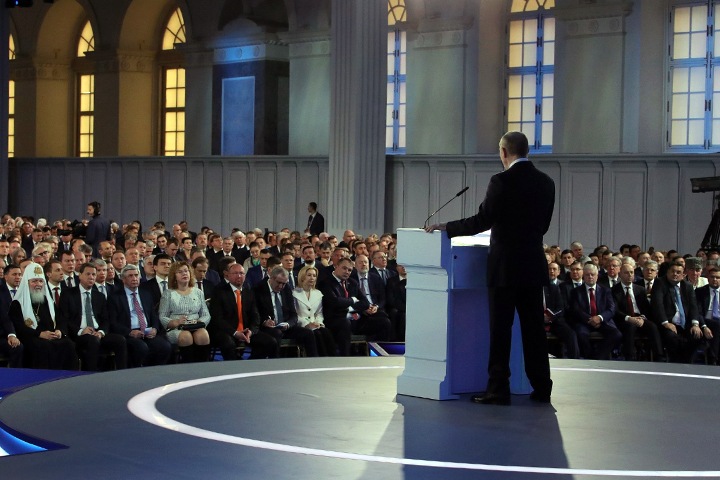
Putin amended the State Duma in the evening of January 20. The head of the analytical department of Taiga.info Alexei Mazur tells what they mean, and believes that the changes are not fatal, moreover, they are musk in nature.
Only four days were needed by the “ working group ” to prepare proposals for amendments to the Constitution of the Russian Federation to prepare these same amendments. Here is their short presentation.
The Constitution proposes to fix the situation that the minimum salary (minimum wage) cannot be lower than the subsistence minimum. As for the constant indexation of the minimum wage and the amount of pensions, the amendment is only cosmetic. Yes, the minimum wage should be indexed, but in the order defined by federal law - that is, as the government considers necessary.
The amendment on the priority of Russian legislation on the international was “stuck” in the article that Russia could participate in international associations. The current constitution says that the norms of these associations are not applicable in Russia if they contradict the "basics of the constitutional system." Now: "Decisions of interstate bodies adopted on the basis of international treaties of the Russian Federation in their interpretation, contradicting the Constitution of the Russian Federation, are not subject to execution in the Russian Federation." It is not very clear what exactly is meant, but soon we will see in practice. For example, on the execution of decisions of the European Court of Human Rights.
All chapters regarding the governors, deputies of the State Duma and the President of Russia have been amended, prohibiting these positions to those who have the right to constantly live in the territory of another country. And the president cannot be the one who has ever been a citizen of another state (except for the inhabitants of the attached territories, that is, Crimea).
True, there is an important postscript (small print) - additional restrictions can be established by federal law.
Change of power
Now about the main thing, that is, about the reconstruction of the power system. If earlier the president appointed the Prime Minister in agreement with the State Duma, now the Prime Minister will be appointed, whose candidacy was “approved” by the State Duma, again, again, the president. What is called, try to find the difference.
But now the president will not only approve the structure of the government, but also make changes to it.
The ministers, in addition to the power, will be approved by the State Duma. The president will appoint the power, after consultations with the Federation Council.
151498 GODDENT IS CONSTRUCTED A New Prime Minister
The President’s powers added the formation of the State Council “in order to ensure the coordinated functioning and interaction of state authorities, to determine the main directions of domestic and foreign policy”.
The only place to “stick” the mention of the State Council was a chapter about the powers of the president. Its status will be determined by federal laws.
It is important that the president receives additional opportunities to block laws adopted by the State Duma and the Federation Council. If the head of state does not sign the adopted law, then the State Duma must adopt it 2/3 of the vote. It was before. But now the president can send the law to the Constitutional Court, and if he “does not confirm the constitutionality of the law,” the president will return it to the State Duma without signing. What is curious - there are no restrictions on the time of consideration of the law in the Constitutional Court.
That is, the president, together with the Constitutional Court, can fully block the activities of the State Duma if they do not like it. The president and the Constitutional Court have similar rights in relation to regional legislative acts.
Therefore, it is not surprising that significant changes relate to the status of the Constitutional Court. Its number is reduced from 19 to 11 members. The Federation Council, on the proposal of the President, may hide the judges of the constitutional and supreme courts (and regional courts too).
That is, the president, together with the Federation Council, will fully control the constitutional and supreme courts (and courts in general).
In addition, the prosecutor's office was withdrawn from the influence of regional legislative authorities. Now prosecutors are appointed by the president in agreement with the Federation Council. Now prosecutors are approved by regional parliaments on the proposal of the prosecutor general of the Russian Federation.
Well, and a rather funny amendment to the section on local self -government. “Local self -government bodies are included in a single system of public power in the Russian Federation and interact for the most effective solution to problems in the interests of the population.”
It seems that the members of the working group did not understand what exactly was meant by the “unified system of public power”, therefore they simply decided to enter a quote from the President’s Epista into the Constitution, and then let it understand who wants it and understands.
The word "in a row" was removed from the restrictions on the deadlines of the presidency. That is, it is proposed to return to the formula “no more than two terms”, and this means that Putin will never be able to become president of Russia again.
Resume
The impression of the amendments is quite chaotic, the feeling that the clear concept never appeared, and the changes are momentary, responding to some threats, imaginary or real.
On the one hand, the powers of the State Duma and the Federation Council are expanding. On the other hand, the mechanism of “blocking” the laws adopted by the State Duma, the Federation Council and regional parliaments is introduced. Moreover, prosecutors are appointed without coordination with the regions.
151543
That is, among possible threats - the loss of control over the State Duma and the legislative bodies of a number of constituent entities of the Federation. Perhaps the case of the Moscow City Duma played a role, where control was almost lost, and the Moscow prosecutor, who became the object of investigation by Alexei Navalny and to which the opposition deputies of the capital of the capital had questions.
It is not clear why they are so hard to deal with the constitutional court. 11 members instead of 19 - almost half of the judges resigned. But transitional provisions are not spelled out - how will they be resigned? The President receives the right, together with the Federation Council, to set aside "in the case of a misconduct of a misconduct, discrediting the honor and dignity of a judge." Eight judges will not be removed on this basis.
Probably, they will leave themselves, exclusively voluntarily, as the governors do on the same day, without saying each other.
It is not clear why such a rush with the adoption of amendments. There was not even an attempt to depict a wide discussion with regions, public chambers and talk shows on central television channels. Something supports, some terms, the meaning of which is not yet clear.
Nevertheless, amendments are not a fatal nature, they do not change the system of power fundamentally. The elections are not canceled, the state council is not transferred to the entire fullness of power. Moreover, the word "in a row" is removed from the constitution. Now the president cannot be more than two terms, and the point.
That is, Vladimir Putin will not be president after 2024. But the new position of the “power holder” was not created. Just in case, “stoppers” are made if the opposition suddenly bursts into some legislative bodies (and besides the Moscow City Duma, there is still a precedent of the Khabarovsk Territory, where United Russia almost did not receive mandates at all).