
Translated material
Beautiful numbers
On Facebook , a message flashed that someone was selling a thousand-ruble banknote for 7 million 770 thousand rubles. Because her number is 7777770. Apparently, the author of the message rounded: it is clear that if you ask, then more: 7 million 777 thousand 770 rubles.
In fact, of course, so much to help the seller does not shine. But in general, banknotes with interesting numbers are really sold on Internet asuctions, sometimes with a noticeable bog to the face value (or to collectible value, if we are talking about banknotes that have left the circulation). The size of the allowance depends on the unusualness of the number, and here an interesting question arises. From a formal point of view, the probability of finding in your wallet some number does not depend on the sequence of its numbers-with two small clarifications: firstly, relatively smaller numbers are slightly more likely, because not all episodes reach the end of the numbering; Secondly, some numbers are removed from the circulation of collectors or simply lovers of souvenirs. Nevertheless, if you neglect this, then the probability of finding bill No. 7699742 (an example from my wallet) is no more than bill No. 7777770, but we will clearly perceive the latter as an unusual one.
The point, apparently, is that a person subconsciously notes the presence of some regularities in a particular number and, belonging to such a number to a whole class (for example, “almost all numbers are the same” or “starts with several zeros”), evaluates the probability of the entire class: the less numbers fall into this class, the less probable it is (this is trivial); Further, this feeling of low probability applies to individual numbers from this class (and this is already a cognitive substitution). In addition, apparently, some aesthetic preferences play a role.
From a mathematical point of view, all this seems close to the theory of the Kolmogor complexity - an approach that gives a formal meaning to an intuitive idea of what “the incliction of a single sequence” is (in the classical theory of probabilities, such a formulation of the question does not make sense: all sequences are equally equally). It seems that it would be very instructive to investigate what combinations of numbers in the room how many are worth it - and thereby evaluate how a person perceives incrovy, but this is a very laborious matter. Therefore, the further is, on the one hand, a retelling of discussions on several bonistic forums, and on the other, the result of a fluent viewing of the first pages of the search for the “beautiful number” at the “bag” auction and on the Fancy Serial Number and Low Serial Number on Ebay. So, what do some citizens seek to sue other citizens? (Numers with a sign No. Real, in the sense that such a bill is sold, and its photograph is given somewhere; without a sign No.-possible, but not registered; I, as a rule, will not mention prices, because the spread of large and requests of different sellers are not very comparable: they depend on temperament, cf. The very first paragraph.)
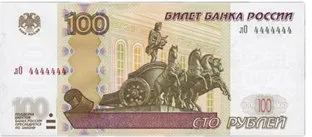
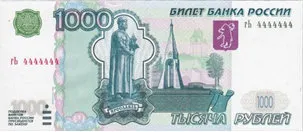
Let's start with the simplest (not in Kolmogorovsky, but in the ordinary sense): well, when one number is found in the room many times, preferably a group in a row, and the more, the better: for No. 0866666, they ask four times more than for neighboring No. 08666667. It is even better if there are only two, say, No. 14414444 or if there are five or six digits, and at the end, and at the end, and at the end, and at the end. Better than at the beginning. And even better, when frequent numbers are zeros, and even in a row, and even on the edge: No. 1500000 is better than 100,0005, but worse (by the way, this is an exception to the general rule, see below) than 0000015. Of course, the number with all the same numbers is ideal. By the way, only No. 4444444 can be relatively easy to buy (for several tens of thousands of rubles) at the moment (we are talking about Russia and about ruble banknotes). It is interesting whether this is due to the fact that the number 4 is considered unhappy in China (and therefore such bills may be in less demand)?
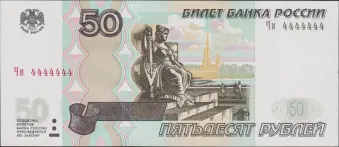
1. All four. (A) 50 rub, chi 4444444 ( nordklad.ru );
(B) 100 rubles., LO 4444444 ( Monetnik.ru );
(C) 1000 rub., GH 4444444 ( Monetnik.ru )
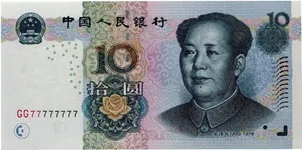
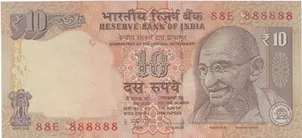
2. (A) all seven. China, 10 yuan, GC77777777; (B) all eights, India, 10 rupees, 88e888888 ( PMGNOTES.com )
An exception to zeros at the beginning is associated with a different trend - small numbers close to the beginning of the series are good. However, the comparison of the “bag” and eBay shows that this is more appreciated not in rubles, but in dollars that even have one or two zeros at the beginning are considered worthy of mention (for example, No. 00167125), however, for banknotes that have some kind of collective value besides the number. But, say, No. 0000001 is not a cool souvenir in any currency, but a very expensive copy for professionals; No. 0000002 will be much cheaper. In dollars, repetitions are also noted with a period of 2 or 3: No. 45454345 or No. 26112112; They try to sell such rubles less often, but it happens: No. 120247474.

But more complete repetitions or symmetry are good in any system. For example, the palindrms are valued: dollar No. 11366311 or ruble No. 7428247 (in rooms with an odd number of numbers, the central can be any: it can be expected that zero will be preferred, but there are no paired examples that differ only in this, and a large selection is needed for single observations). Both in Russia and in the USA, such numbers are called radar; Perhaps because this word itself is a palindrome. There are anti-radars-repetitions of 4–4 (for dollars) or (3-love-3) for rubles, for example, No. 04390439 and No. 3045304, respectively. Radar and anti -radar will be more expensive at the same time, such as No. 5253525.
However, there is another, more strict terminology [ 1 ]: a radar is not just a palindrome, but one in which the numbers increase from the middle: 8741478; Accordingly, the anti -radar will increase from the edge to the middle: 1478741. An even more stringent definition requires an arithmetic or geometric progression of numbers, for example, 7531357 or 1248421 - but there are no examples of such, because as much as it adds cost, it is difficult to evaluate.
Logs are interesting: numbers with numbers in a row, moreover, 1234567 more than 0123456, and this, in turn, is more expensive than, for example, 2345678. There are differences again: ruble paths (in Russia, in Belarus) are interesting only if the numbers go strictly in a row, while in dollars there are quite monotony, for example, 12346789. This confirms the importance of the factor of subjective rarity: monotonous numbers of seven digits (as in rubles) are relatively more than monotonous numbers of eight digits (a simple combinatorial task - to calculate the number of both). It can be expected that the prices for monotonous nine-digit (like 200-ruble and 2000-ruble banknotes) will be considerable, and to number 123456789-close to the maximum. Moreover, dollars are considered interesting even just that all numbers are different. Based on the “rarity theory” formulated above, it can be predicted that for nine -digit (but not seven -digit) ruble numbers this may matter, and bills with such numbers (apparently without zero) will sometimes be put up for sale.
Sometimes they sell pairs of bills of different series, but with the same number. It doesn't matter here what he is; It can even be assumed that the easier it is (Kolmogorov), that is, the more regular the number, the easier it is to collect such a couple (there would be enough monetary resources) - with an increase in “interestingness”, the concentration of such numbers at auctions and forums, and where to look for a banal number?
Another interesting direction is the numbers in which you can see the dates, for example, a birthday on a dollar bill: No. 06301986 (recall, this is an American style: June 30, 1986; however, the ambiguity is good: No. 10081984 can be presented on October 8 and on August 10). At the same time, zeros can be ignored: No. 19745500 is proposed to be considered as May 5, No. 19680170 - as January 7 (and we would have accepted as July 1) - but this is already a lot for an amateur, personally such options do not seem interesting to me. Tombstones (Tombstones) - numbers that are visible in which two years forming years of life look gloomy: No. 19181952. It is unclear who would accept such a bill as a gift - a ghost? A historian studying the life path of a character?
Finally, in banknote rooms you can look for postal indices. However, in Russian Bonistic (and the souvenir case), the date and indices are not considered representing interest, in any case, nothing of the kind is put up for sale - for now? In general, rich prospects are revealed here: how about bills with your phone number? By the way, there are lovers of beautiful numbers, but just there is a direct practical meaning: such numbers are easy to remember - here is another incarnation of Kolmogor complexity. But now we can now choose to order and give someone a banknote with the designation of a series that coincides with the initials of the gifted (well, or the donor).
M. G.
The ending follows