
Translated material
Such hot Arctic
In the Norwegian thromse, the annual Arctic Frontiers forum was held. All problems can be solved, except global warming
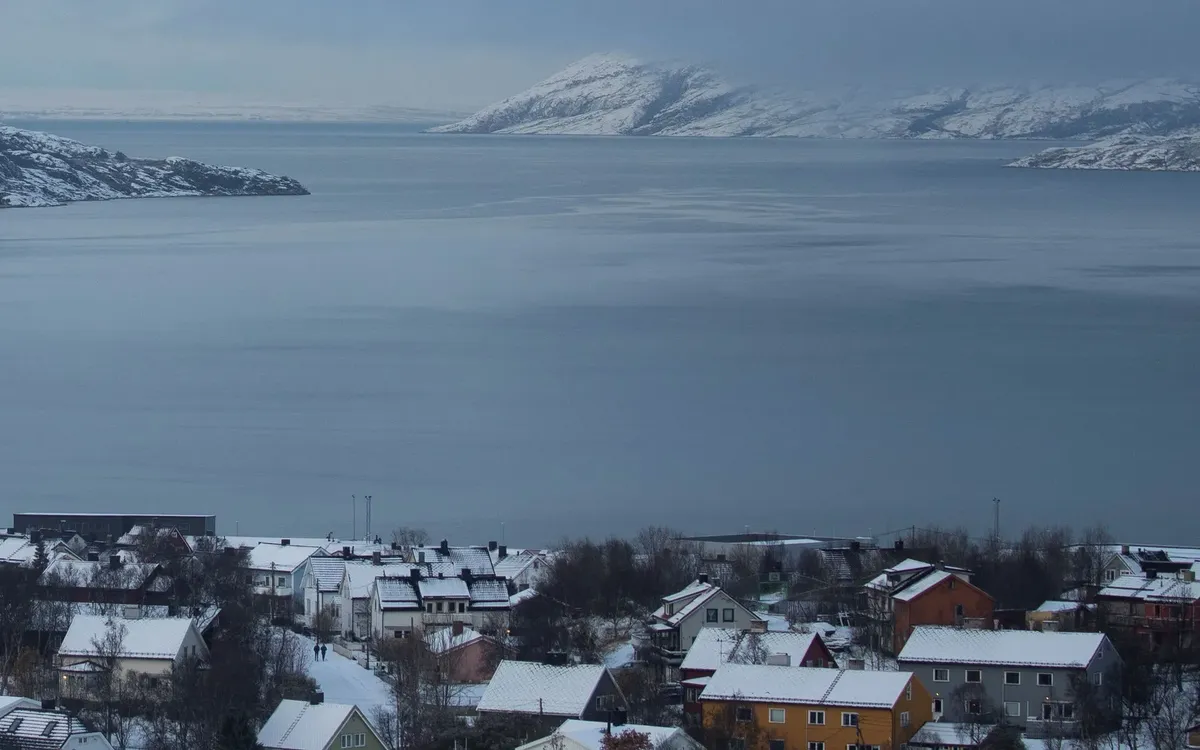
Traditionally, representatives of the eight Arctic powers take part in the Arctic Frontiers forum: Norway is the hostess of the event, Finland, Denmark, Iceland, Canada, Sweden, Russia and the USA. Plus numerous guests. This year these are almost three thousand people from 35 countries.
The forum itself is not a political event, according to its results, no joint declarations and pacts are accepted. Rather, this is a platform for expressing opinions and designating the problems that need to be solved in the Arctic from year to year. This year the conference was held under the slogan “Power of Knowlege” - “The Power of Knowledge”.
It is hardly a direct trolling addressed to the American president and the Paris Climate Agreement,
But some irony, of course, sounds.
The level, however, is quite representative. The Prime Minister of Norway waited for the opening, but at the last moment something broke up, the Minister of Foreign Affairs had to puff on the official part, and in the past to the Minister of Defense of Norway, INU Ericksen Sureide. From Finland was the Minister of Trade, Ville Skinnari, from Sweden - the Minister of Education Matilda Ernkens. Well, a variety of mayors of the Arctic cities, ambassadors, representatives of the Arctic Council and all kinds of unions.
It seems that there were rumors that even Greta Tunberg was waiting, but they were not confirmed. On the one hand, this Swedish Pigalita would drag all the attention of the press on herself. On the other hand, no one has no noticeable contradictions with her. Nobody in principle denies the threat of climate warming here, another question is that so far no one knows how to fight this threat. But the local Greenpeace worked out the protest agenda: before the conference at the entrance to the hotel, Ecologists stretched out the banner: “The power of knowledge? Listen to science! There is no oil production in the reserved Arctic. ”
Half an hour later they diverged - in Tromso minus ten.
There were no Russian ministers on the agenda, the Ambassador to UNESCO and the Deputy Minister of the Government of the Republic of Sakha on the topic of indigenous peoples participated in panel discussions. From the USA-a stately vice-admiral of a coast guard in the form of Scott Bushman and director of the Polar Institute Michael Streik. And from China - today the main Arctic villain - there was no one at all, although among the representatives of the press and spectators in the Chinese hall there was about half (and not a single mask that added nervousness a little, but everyone kept correctly).
The Conference was opened by the Minister of Foreign Affairs, INU Ericksen Sureide. Despite the problems, the minister began, we have restrained optimism and hopes for the future. And, of course, ambitions in the Arctic.
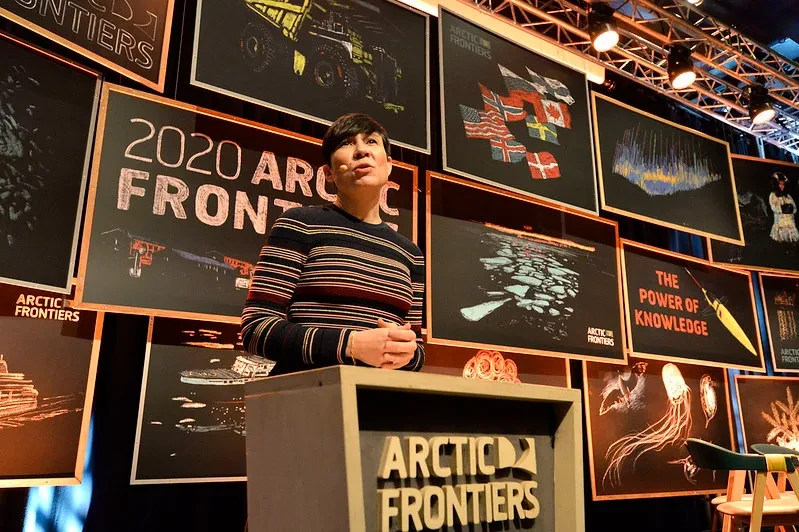
The Arctic movement is now in crisis. Last year, a meeting of the Arctic Council in Finland, just a political body of eight polar states, where all ministers were present, including Minister Lavrov and Secretary Pompeo, failed - for the first time since 1996 the joint declaration did not take place. The reason, of course, was the United States from climate agreements and the sudden denial of global warming - the participants could not agree on whether the need to comply with the Paris Convention should be prescribed in the final statement.
Since this year, Iceland presents in the Arctic Council. All the heads of the Arctic Eight countries have already been invited to a meeting in May, Vladimir Putin is also invited. And everyone hopes that this year a consensus will be found, although there are no special prospects on this topic,
And there are various alarming movements.
And the non -political seemingly forum in Tromso still rested on a climatic dispute and political statements one way or another. “Growth and development can undermine the Arctic,” says geopolitics, expert on international relations of Bobo Lo (Australia). - Today I see several main threats of the Arctic. The first is a global climate change. The second - the aggressive policy of Russia in the region, as a result, is the activation of the US forces and NATO. The third is China's growth. Here, the trade war between China and the USA, attempts by China to reach the Northern Sea Route. For China, the Arctic is not the main region, but the damage to this activity can be significant. Well, the fourth threat is a change in the entire world order. This concept is great discredited, and most likely
Soon there will be a new world mess.
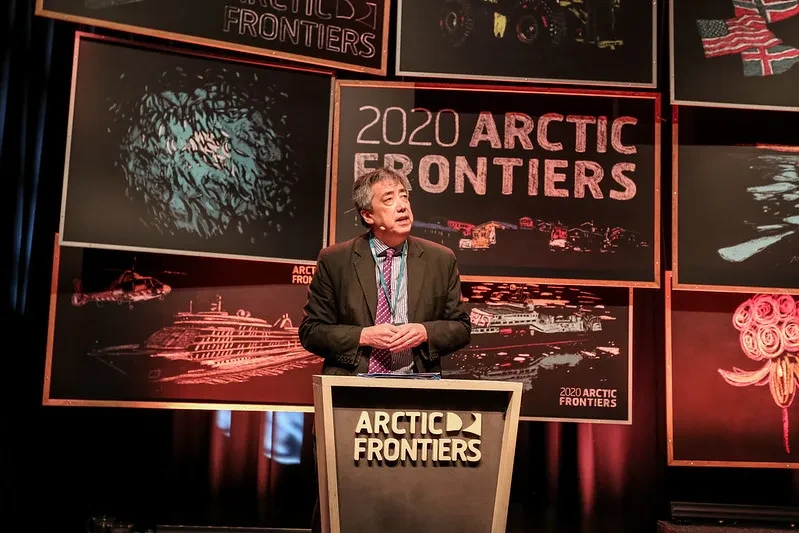
It is necessary to develop new mechanisms and rules. But the European Union, in particular France, refused to sign an agreement on global cooperation in the Arctic. And the United States left the Convention. It's Complicated".
The Minister Syreide, attached to the wall with a direct question, reluctantly admitted that there was a problem. “Both Moscow and Beijing with their activities affect stability in the Arctic. NATO has a new structure of naval forces - and this, of course, is associated with the actions of Russia. We do not regard this as a direct threat, but it can affect Norway and NATO. We do not agree with Russia on many issues, ”the former Minister of Defense admitted. -We support and will maintain sanctions over Crimea. But we have a general Arctic development strategy, and we will cooperate and discuss general issues. ” To a question from the audience, does the minister consider that the Arctic runs the risk of turning into the same controversial zone as the Middle East, he did not delicately answer Ericksen Sureide.
“Of course, I do not agree with such a question,” the official representative of the Russian Foreign Ministry on the Arctic Nikolai Korchunov told me during the break. - Those investments that the Russian Federation, together with foreign partners, makes the Arctic and the Arctic zone, are convincing evidence that we do not consider this region as a theater of military operations. Although while the Arctic is a territory of low tension, there is a feeling that this problem of "aggressive Russia" begins to warm up.
Here is the moderator of the discussion [Stephen Sakur, journalist] from the BBC. He talked about the actions of Russia and China for so long, but forgot to mention that the UK in October 2018 adopted a military strategy in the Arctic, not even being an Arctic country. Or France in August 2019 issued a report on the need to presence the French armed forces in high latitudes. That's what to do there? ”
And really.
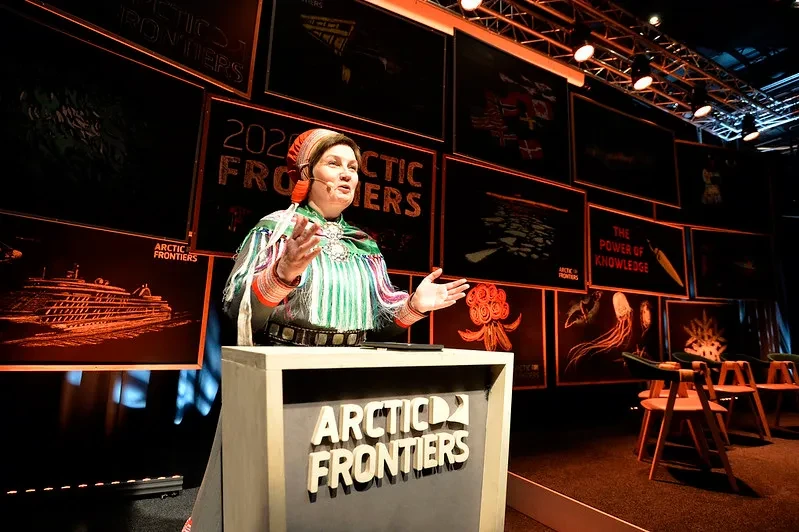
Having finished the difficult political situation, they further discussed the issues of ecology, education, business development and preservation of natural wealth and indigenous peoples.
Norway promised by 2030 to reduce the number of harmful emissions by 40% compared to 1990 (there was completely little left), Finland by 2035 promised to achieve carbon neutrality, and Faroe Islands - to completely switch to renewable energy sources and become a “green valley of Arctic”.
We also talked about the climate.
“The temperature is growing,” says Matt Collins, professor at the university of exteri. - This is the basic physics: the higher the temperature, the more ice melts. Now the temperature is increasing with double acceleration. Over the past ten years, the amount of snow in the Arctic has decreased by 30%. The eternal permafrost "warmed" for ten years by 0.3 degrees. Spitsbergen water is 3 degrees warmer than ten years ago. An increase in temperature is one and a half degrees - and we quite have a chance to see the Arctic without snow. Stop warming for one and a half degrees is a global and very difficult task. Because there are no technologies that are needed yet. ”
“And those who deny warming, they simply do not understand or pretend?”, The moderator, journalist of the BBC, Stephen Sakur, tried to provoke Haip.
“I don’t want to speculate, I'm a scientist,” Professor Collins held a blow. “But it would be nice to remember everyone that the Arctic is not only oil and tourism.” And development must be combined with science, and not to be divided. ”
A promising could be a discussion about business in the Arctic. But for some reason, for some reason, neither the word “shelf”, nor “Rosneft”, or even the word “oil”, never sounded.
We stopped on the fact that we must somehow develop, but also preserve. The chairman of the Arctic Economic Council, Icelander Haidar Gvyudyeonson, told how they began to build roads in Iceland, improved logistics and now, after 20 years, cod is not the only export product. And most of all they earn on tourism. Then they discussed education (it is necessary to invest so that young specialists do not leave), the problems of indigenous peoples (it is difficult to combine traditions and progress, but it is necessary), garbage (in the Arctic, the problem is not so acute, but plastic is full here). And although all these discussions did not imply any specific decisions, many dozen participants had a feeling of a harsh northern fraternity inherent in everyone who lives behind the polar circle. And, it seems, this was precisely the main meaning of the forum.
Tromso, Norway
Thank you for the help of the Embassy of the Kingdom of Norway