
Translated material
Petersburg destroy masters of culture?

This is not the Sorokov Stalingrad, this is Big Pushkarskaya today.
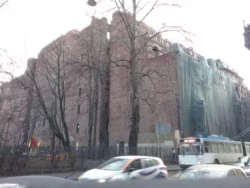
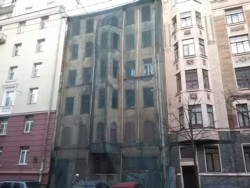
When I pass by this house, my heart is shrinking. He has long been resettled, but the wretched benches on the ground floor had recently been warming up - and the last windows went out, the vile green cobweb was closed - a sure sign of an imminent death. But Bolshaya Pushkarskaya, 7, isBasevich’s house , 1912, late modern.
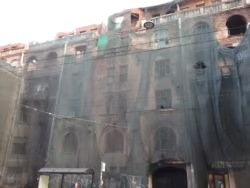
The house is huge - a whole quarter, they want to demolish it and build apartments. The scheme is worked out - the house is settled, turned off from heating, it stands under a green net for several years, allegedly waiting for restoration, it flows, burns, and then the owner orders the examination, and the next “specialist” helpfully writes that the house is not in emergency and recovery. Close -defenders emit a weak cry, officials shrug their hands - we would be happy, but emergency!
Each house is unique and valuable, this is the living flesh of the city, and biting off a piece from it, the city is killed. As far as we can, every day, every hour we must resist this, not give them a single old building
Of course, the image of the villain immediately arises in the brain - the next developer, the greedy bourgeois in conspiracy with corrupt officials fades a piece from the city. In general, the image is correct, but there are nuances. For many years, the city authorities powder our brains, promising to restore Basevich’s house in the framework of the program "Youth-Affordable Housing", but somehow it did not work out. And now this house, together with the site - attention - "Boris Eifman Dance Academy" , and there is already a sketch design of a sleeping building for students with halls for choreography and a complex of apartments for artists. That is, there is little Gergiev, who once dragged the project of a monstrous barn to create the second scene of the Mariinsky Theater, Sarai, who cost us the constructivist building of the 1st five-year period, part of the Lithuanian market of the 18th century, one of the best Petersburg species-to the hooks of the channel, in general, the most valuable quarter, forever the deceased. Now the second maestro is approaching the city, also from loyal, proxies, and also with exorbitant appetite.
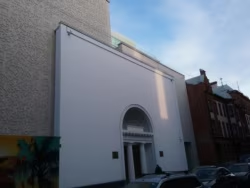
For Aifman, he is already being built nearby, on a cotton island, the dance palace, he has a new building on Lisa Tchaikina Street, for which one ancient house was already demolished, he has a children's dance theater in the former school building very close, on Vvedenskaya, all together this is a whole quarter, but he is not enough.
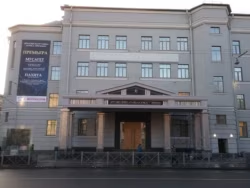
Like Gergiev, there is little expensive shed of a new scene - he methodically destroys Lermontov’s house on 61 Lermontov’s house, then the most where the poet lived before leaving for the Caucasus and where he wrote his famous verses “The Death of the Poet”: now this house is plundered, turns into a garbage bum. Because Gergiev, instead of the promised museum, wants to arrange a hotel there, and he does not give a damn about historical architecture and memory of the poet. So his colleague Eifman does not give a damn about Basevich’s house, without which Bolshoi Pushkarskaya will never be the same.
Basevich’s house is not the only hot point in the city, there are a lot of menacingly - it seems that a real new offensive is coming to the city. The identified monument "Building of the medical unit No. 1 of the plant named after M.I. Kalinin" on Odoevsky Street can be finally sentenced to demolition - and this will be the result of a long -term struggle for a beautiful building, the struggle of examinations, real, honest - and custom -made and corrupt, which (guess from three times, why), the officials responsible for the cultural heritage always give preference. At the threat of demolition and the house of Isotov on Kirillovskaya Street, it is already all gutted, the two upper floors are dismantled due to the threat of collapse, and the 8-story Forsyt residential complex with underground parking is still being built close to it, which can destroy several more neighboring houses. The same barbaric construction is carried out on a large ranger on the Petrograd side, and many more where. By the way, another house in the Art Nouveau style, narrow, elegant, but resettled, gutted and burned, is brought to accident right away, in a large multiple, 9, according to the same tested scheme as Basevich’s house.
The greed of developers and the unprincipled officials who answer not to the people, but to the bosses, are understandable. But the greed and unprinciplity of cultural figures who are not embarrassed to destroy the city for their ambitions is still a special kind of phenomenon. Perhaps they do not quite understand that destroying the city, they destroy their audience, which will no longer walk next to the beautiful facades that are swept away today, like old trash, but next to ugly boxes - monuments of corruption and ignorance. She will see how old houses are demolished, and draw conclusions - maybe this old culture really costs nothing? And then, perhaps, this audience will not go to watch the beautiful ballets of Eifman, but will fall with beer in front of the series. And Gergiev’s concerts will also not fall - by the way, in his shed with marvelous acoustics, I personally gave myself a vow for never to go, because I consider people who destroy my city with their personal enemies. I think that if not just citizens, but also citizens lived in the city, then a boycott would quickly organize the same Eifman, who decided to frolic in the heart of the city, on the Petrograd side.
Today, the city has new invaders with a cultural face. And the question breaks from the language: with whom are you, masters of culture?
Honestly, I could not help but rejoice when on January 19 in the Vienna opera Gergiev was replaced with another conductor, because he was late for the second time for 20 minutes. The audience was explained that 1,200 people in the hall and hundreds of musicians should not wait for one maestro. And I remembered the press conference at the Mariinsky Theater, where, together with other journalists, I waited for the same maestro for 40 minutes. Apparently, this is one, a boorish style of behavior - both in relation to people, and in relation to buildings built long before you and belonging to everything - and those who defended the city from the invaders, and then lifted it from the ruins, and to us and our descendants.
Today, the city has new invaders with a cultural face. And the question breaks from the language: with whom are you, the masters of culture - with developers who dream to demolish everything you get to, build their linear meters of housing and dump for a hill, where citizens cherish their cities, forests and rivers from people like them? Or with those who are trying to preserve in the city what else remains? I'm afraid the answer is clear.
But the life of those who do not care has not yet been confronted: look, something else will be removed from the protection, sell, build up, demolish, paint over. Togo and look, close the clinic, a sports school, a cinema, cut down the square, build a poisonous plant - just have time to turn and defend the resources that literally grab their hands. And the city defenders - at the front edge. Once, at the dawn of perestroika, it was from their movement that political activity began in the city-with candles lit by Delvig’s house, from angry crowds at Angletar. Today, the movement is exhausted - and this is understandable: in order to defend the city, you need effort and time, we need legal knowledge, willingness to write endless letters, go to the courts, stand in pickets. But we have no other way out. Under the lying mantra that "the city should develop," they develop it, demolishing everything they can reach. But we must know the price of this mantra: if you want to develop-develop sleeping areas, there are no things, the system there is new theaters, dance schools and apart-hotels for artists. Or think your head and build all this in the territory of the same abandoned factories in the same Petrogradka - why not? But either these places are already reserved for other large developers, or just too lazy to plan, resolve issues with the owners.
But still we must stop them. Each house is unique and valuable, this is the living flesh of the city, and biting off a piece from it, the city is killed. As far as we can, every day, every hour we must resist this, not give them a single old building. Is this our city?
Sofya Rogacheva - journalist
The "Opinion" expressed in the heading of the point of view may not coincide with the position of the editorial office